
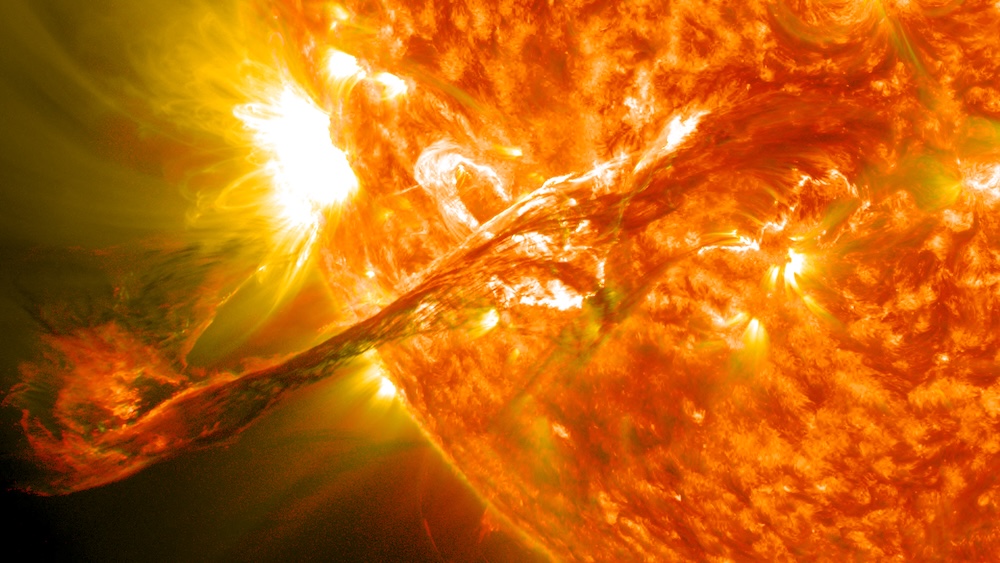
When multiple eruptions of solar plasma emerge from the Sun, these explosions can combine into a single mass as they travel through space. New simulations explore the physics behind merging coronal mass ejections.
Ejection Interactions
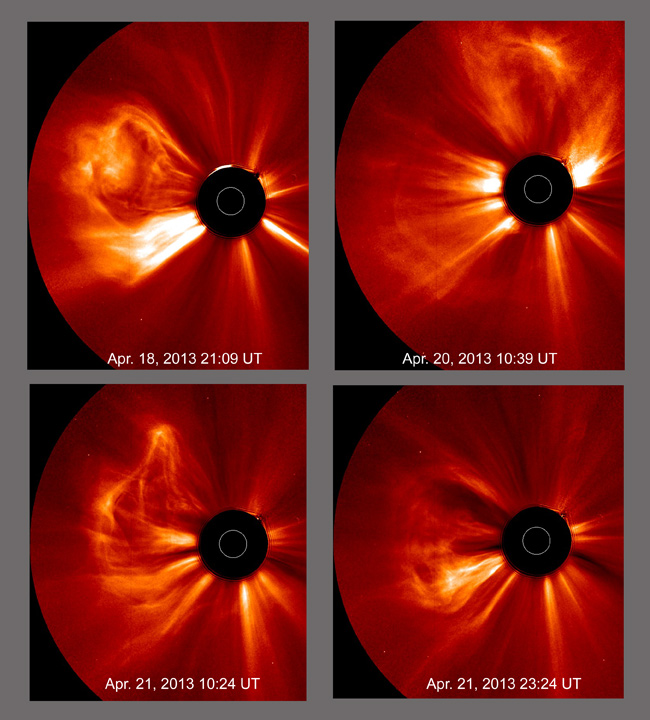
Multiple CMEs erupted within the span of a few days in 2013, as shown by this series of images. [NASA/STEREO]
Researchers have simulated different parts of this process separately. Some simulations have succeeded in launching multiple CMEs from the same area of the Sun, but these explorations paused before the eruptions overtook one another. Other simulations have examined the interactions between successive CMEs by placing multiple eruptions on a crash course, but they pressed play long after the CMEs were ejected. Now, Lijun Cai (Harbin Institute of Technology) and collaborators have stitched together these phases, exploring CME cannibalism in the first global 3D magnetohydrodynamic simulations that trace CME evolution from birth to merger.
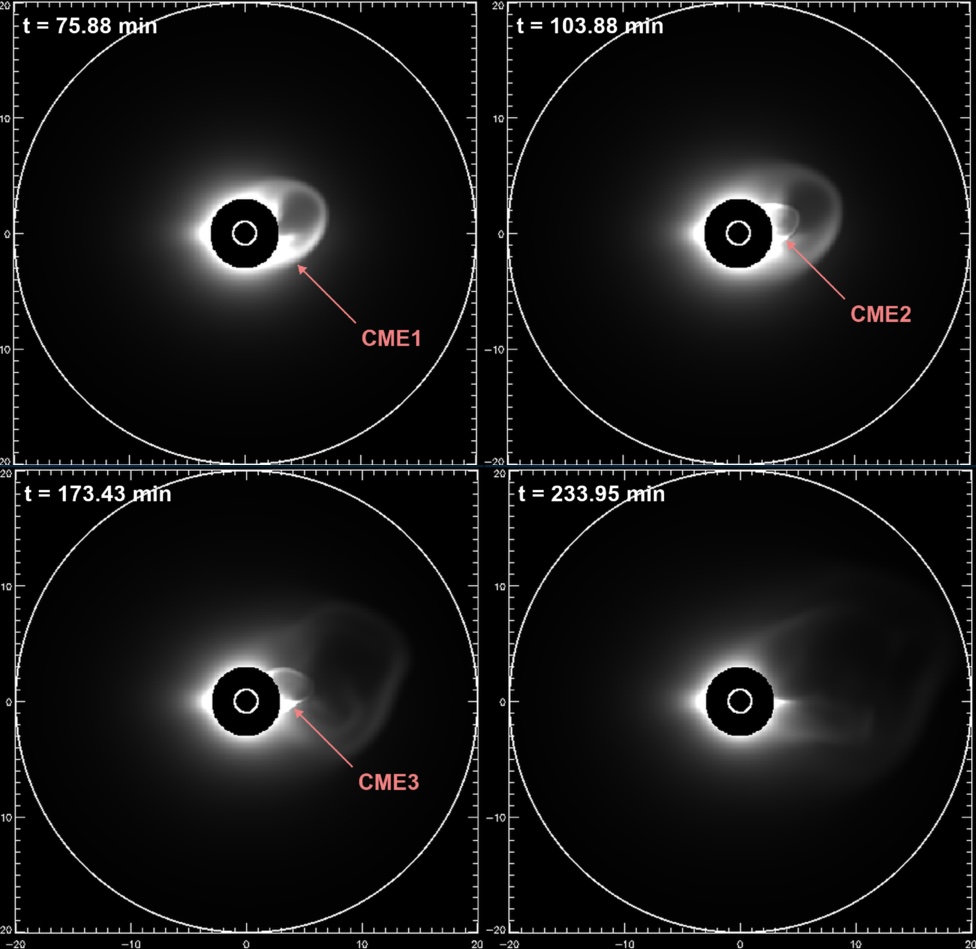
Synthetic white-light images of the simulated CMEs at four time steps. As each CME moves outward, it merges with the CME that preceded it. [Adapted from Cai et al. 2026]
Launching in 3, 2, 1…
Cai and coauthors initiated three CMEs in quick succession from a single region on the Sun’s visible “surface,” or photosphere. Each CME was launched by photospheric shearing, in which the motion of solar plasma shifts the “feet” of magnetic field lines that loop up into the Sun’s outer atmosphere, or corona, causing magnetic energy to build up until it spills over and releases a CME.
The team found that each successive CME traveled outward faster than the last, with the first, second, and third CME shocks clocked at 770, 2,480, and 3,230 kilometers per second, respectively. This increase in speed appears to be due to two factors. First, the passage of the first CME lowered the background plasma density by an order of magnitude, allowing subsequent eruptions to speed through the rarefied corona. Second, the second and third CMEs were powered by a greater release of magnetic energy than the first, attaining greater kinetic energy from the start.
Prepare to Merge
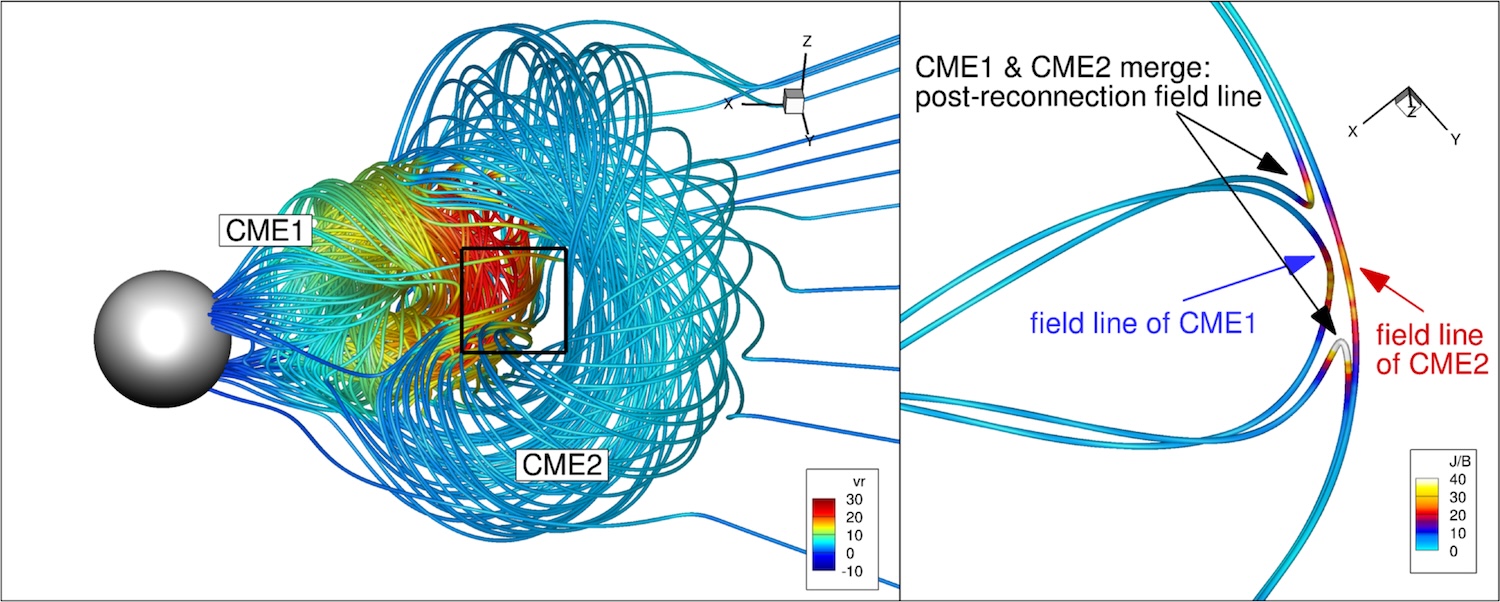
The magnetic fields of the first and second simulated CMEs, showing how magnetic reconnection occurs between the two eruptions at 103.9 minutes in simulation time. Click to enlarge. [Cai et al. 2026]
Overall, this work shows why successive CMEs from the same region on the Sun are able to overtake one another, and it shows how magnetic field interactions help the CMEs unite. Looking ahead, the team plans to extend their simulations to capture the behavior of cannibal CMEs from the Sun to Earth, working to understand how mergers impact the strength of a CME’s effects on Earth.
Citation
“A Global Magnetohydrodynamic Simulation of the Birth and Cannibalism of Homologous Coronal Mass Ejections,” Lijun Cai et al 2026 ApJL 1011 L46. doi:10.3847/2041-8213/aeb88d