
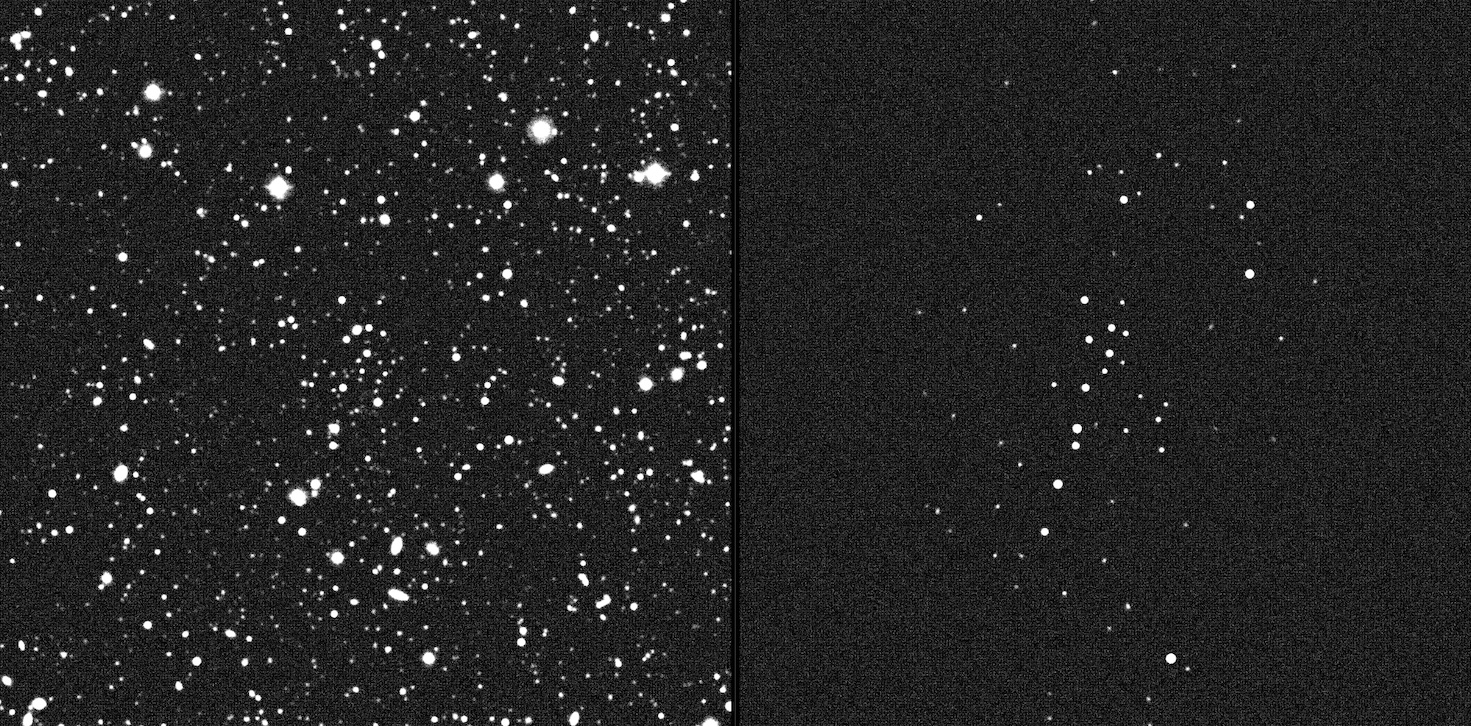
The smallest satellite of the Milky Way, Ursa Major III/UNIONS 1, has posed a mystery since its discovery. Is this smattering of stars a dwarf galaxy or a star cluster?
The Milky Way’s Mysterious Companion
In 2024, researchers discovered a small group of stars orbiting the Milky Way at a distance of about 33,000 light-years in data from the Ultraviolet Near Infrared Optical Northern Survey (UNIONS). This collection of stars amounts to just 16 solar masses and shines with only 11 times the Sun’s luminosity, making it 4–5 times less massive than the next faintest Milky Way satellite.
Considering its small stellar population and small size (its half-light radius is 10 light-years, which is typical for a globular cluster), this satellite appeared at first glance to be an ordinary star cluster. But early data also suggested that the stars had an unusually high velocity dispersion, which could mean that they are nestled within a dense and massive dark matter halo — making the satellite not a star cluster but a dwarf galaxy.
Reflecting this uncertainty, the satellite has two names: Ursa Major III (its dwarf galaxy designation) and UNIONS 1 (its star cluster classification). Can new data clear up the confusion?
New Dispersion Data
In a recent research article, William Cerny (Yale University) and collaborators described new observations of 16 stars in Ursa Major III/UNIONS 1 with the Keck II telescope.
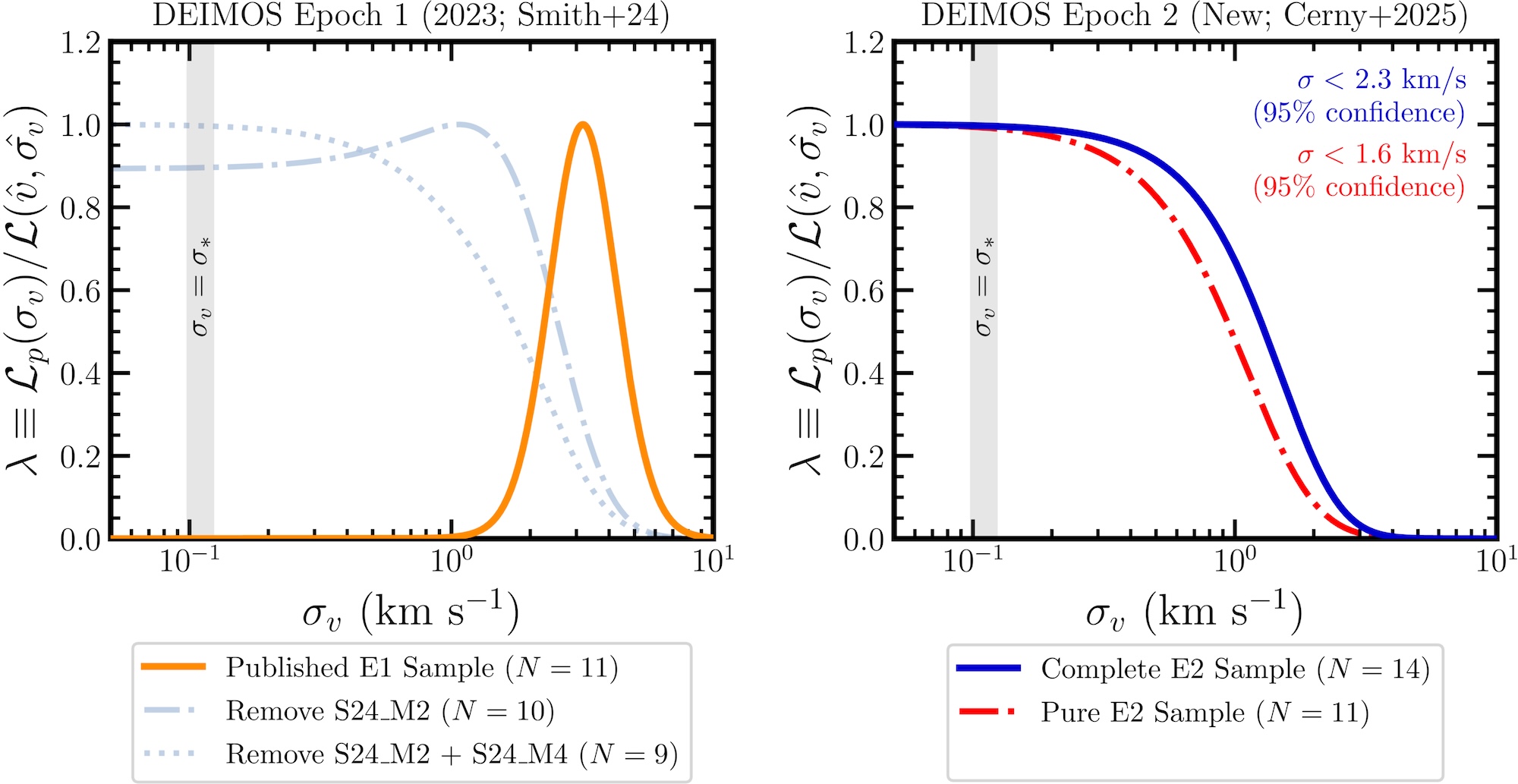
Normalized likelihoods for the velocity dispersion based on the initial data (left) and the new data (right). The initial velocity dispersion measurement of 3.7 km/s is ruled out by the new measurements. Click to enlarge. [Cerny et al. 2026]
These observations also helped to confirm one candidate binary pair and identify three new binary candidates. (This large binary fraction, though interesting, isn’t diagnostic, as both star clusters and dwarf galaxies are known to host high proportions of binary stars.)
Further Evidence
Cerny’s team conducted a further test of the Ursa Major III/UNIONS 1’s identity by measuring the metallicities of its 12 brightest stars. They found that the stars are metal poor and have little metallicity dispersion. This finding again points to a star cluster, in which stars form in a single epoch, rather than a dwarf galaxy, which may feature multiple generations of stars with different degrees of chemical enrichment.
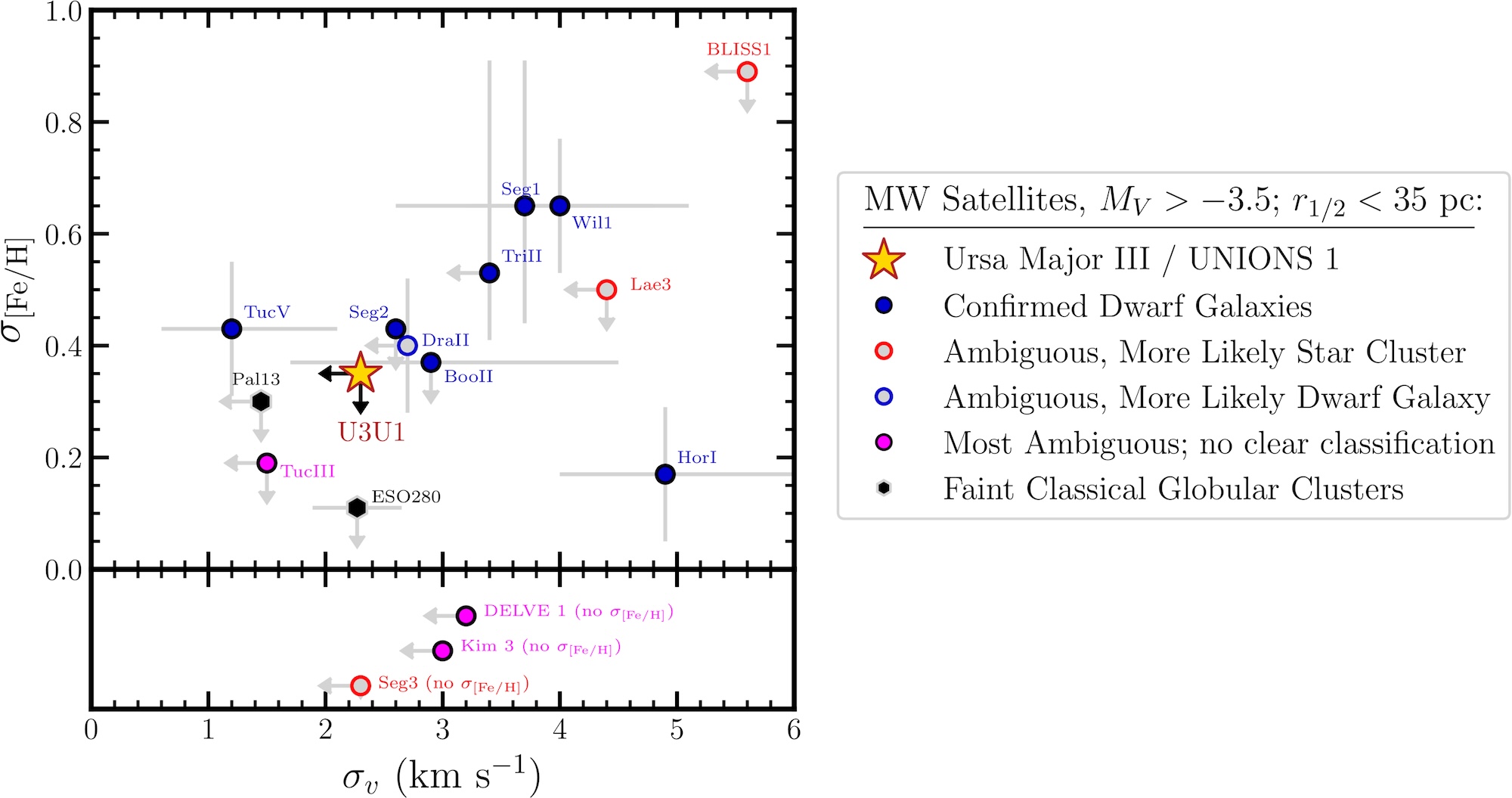
Upper limits on velocity dispersion and metallicity dispersion for Ursa Major III/UNIONS 1 compared to other faint Milky Way satellites. There are no confirmed dwarf galaxies for which the metallicity dispersion and velocity dispersion are both lower than for Ursa Major III/UNIONS 1. Click to enlarge. [Cerny et al. 2026]
Going forward, further chemical abundance measurements of Ursa Major III/UNIONS 1 may still sway the argument one way or another. And as facilities like the Vera C. Rubin Observatory and the Euclid space telescope continue to collect data, other extreme Milky Way satellites may come to light.
Citation
“No Observational Evidence for Dark Matter Nor a Large Metallicity Spread in the Extreme Milky Way Satellite Ursa Major III/UNIONS 1,” William Cerny et al 2026 ApJL 999 L8. doi:10.3847/2041-8213/ae29b8