
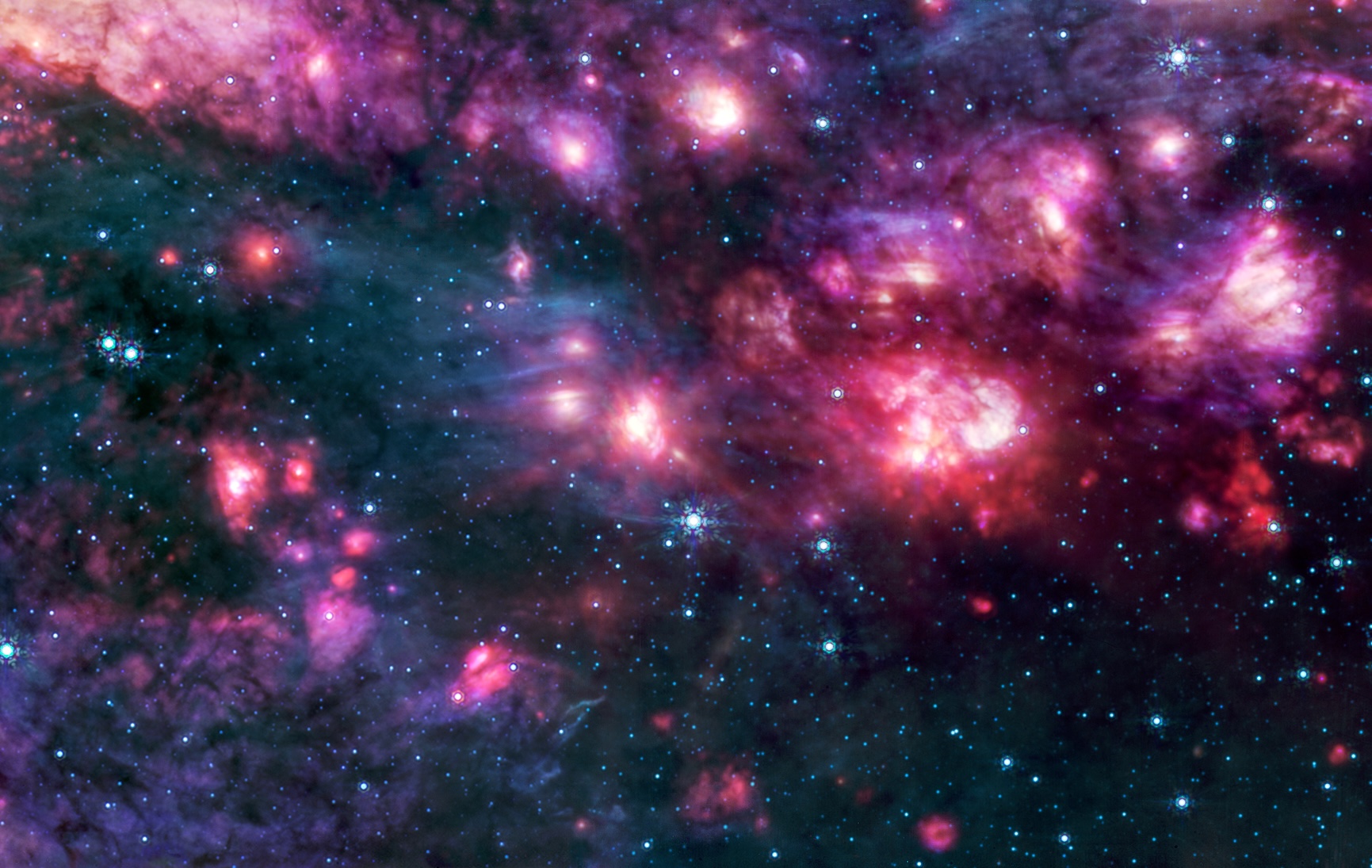
New research uses distant sources to investigate a question close to home: how the Milky Way replenishes its supply of star-forming gas.
Dynamic Galaxies

This Hubble Space Telescope image shows UGC 12158, a barred spiral galaxy that is likely very similar to the Milky Way. This image also features an asteroid streaking across the top of the galaxy. [NASA, ESA, Pablo García Martín (UAM)]
This interplay of inflowing and outflowing gas has important implications for a galaxy’s ability to form stars; without a way to resupply, galaxies would soon run out of star-forming gas. In a research article published this week, astronomers investigate one channel through which our own galaxy maintains its supply of star-formation fuel.
Quasars Lend a Hand
To learn more about how the Milky Way collects and incorporates new star-forming material, a team led by Hannah Bish (Space Telescope Science Institute; University of Washington) studied the low-velocity gas flowing into and out of our galaxy at the disk–halo interface. This interface is a transitional region in which gas from the Milky Way’s expansive, diffuse halo is incorporated into the disk, where it can condense into stars.

This Hubble image shows the quasar 3C 273. [ESA/Hubble & NASA; CC BY 4.0]
Complex Inflows and Outflows
The team used spectra of 132 quasars and ground-based measurements of neutral hydrogen to identify and disentangle the motions of gases with different temperatures and compositions. Along 67% of the lines of sight, Bish and collaborators found evidence for both inflowing and outflowing gas, suggesting that these processes occur simultaneously.

Infall velocities for the northern (top) and southern (bottom) hemispheres of the Milky Way. The infall velocities in the southern hemisphere are roughly equal regardless of direction, denoted by color, or the ionization energy of the ion being studied. By contrast, the northern hemisphere shows dramatically different behavior with direction and ionization energy. Click to enlarge. [Bish et al. 2026]
Bish’s team explored these results using a simple model of the Milky Way, which they found could largely reproduce the behavior in the southern hemisphere, but not the more complicated findings from the northern hemisphere. They suggested that the difference in behavior between the cooler and warmer gas could be evidence that accretion in the northern hemisphere occurs in patches, and that warm inflowing gas is piling up and cooling where it collides with denser gas at the disk–halo interface.
Looking forward, Bish’s team anticipates that high-resolution models — and more quasar observations to constrain those models — will be key to uncovering the causes of this curious behavior.
Citation
“Differential Accretion of Ionized Low-Velocity Gas at the Milky Way’s Disk–Halo Interface,” Hannah V. Bish et al 2026 ApJ 997 230. doi:10.3847/1538-4357/ae2741