
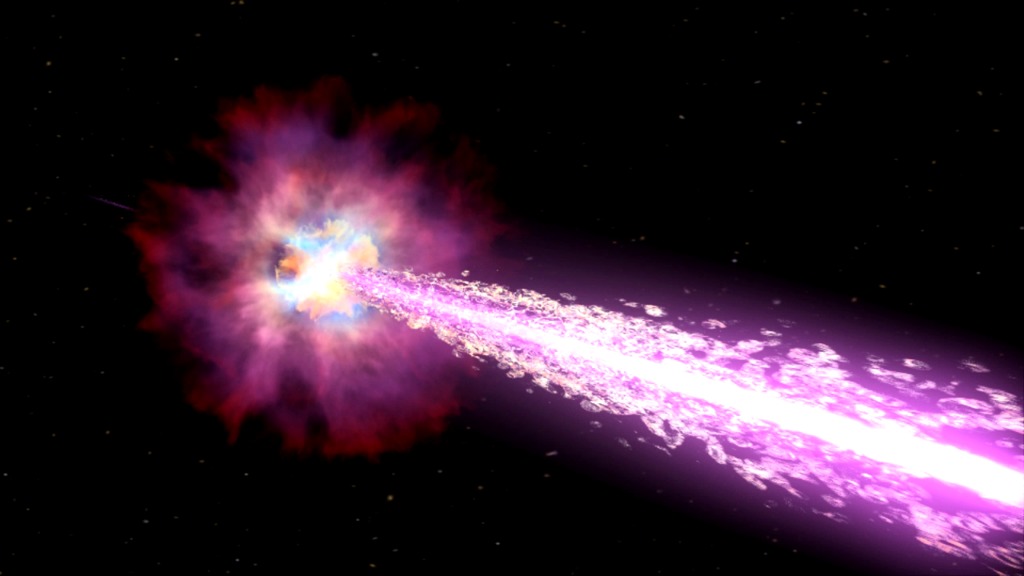
Discovered in July 2025, GRB 250702B is unlike any other gamma-ray burst astronomers have seen. New follow-up observations of the burst’s location have underscored the strangeness of this event.
Not Like Other GRBs
Gamma-ray bursts (GRBs) are intense flashes of gamma rays lasting anywhere from milliseconds to hours. The shortest of these bursts are thought to come from colliding neutron stars, while bursts lasting longer than a few seconds tend to come from collapsing massive stars, though notable exceptions have been discovered.
Even with known GRBs spanning such a broad range of timescales and arising from different sources, some bursts are truly exceptional. Such is the case for GRB 250702B, which was discovered on 2 July 2025 by the Fermi Gamma-Ray Burst Monitor. This event featured three separate bursts spread across several hours, as well as never-before-seen X-ray emission in the day leading up to the gamma-ray emission.
JWST on the Case
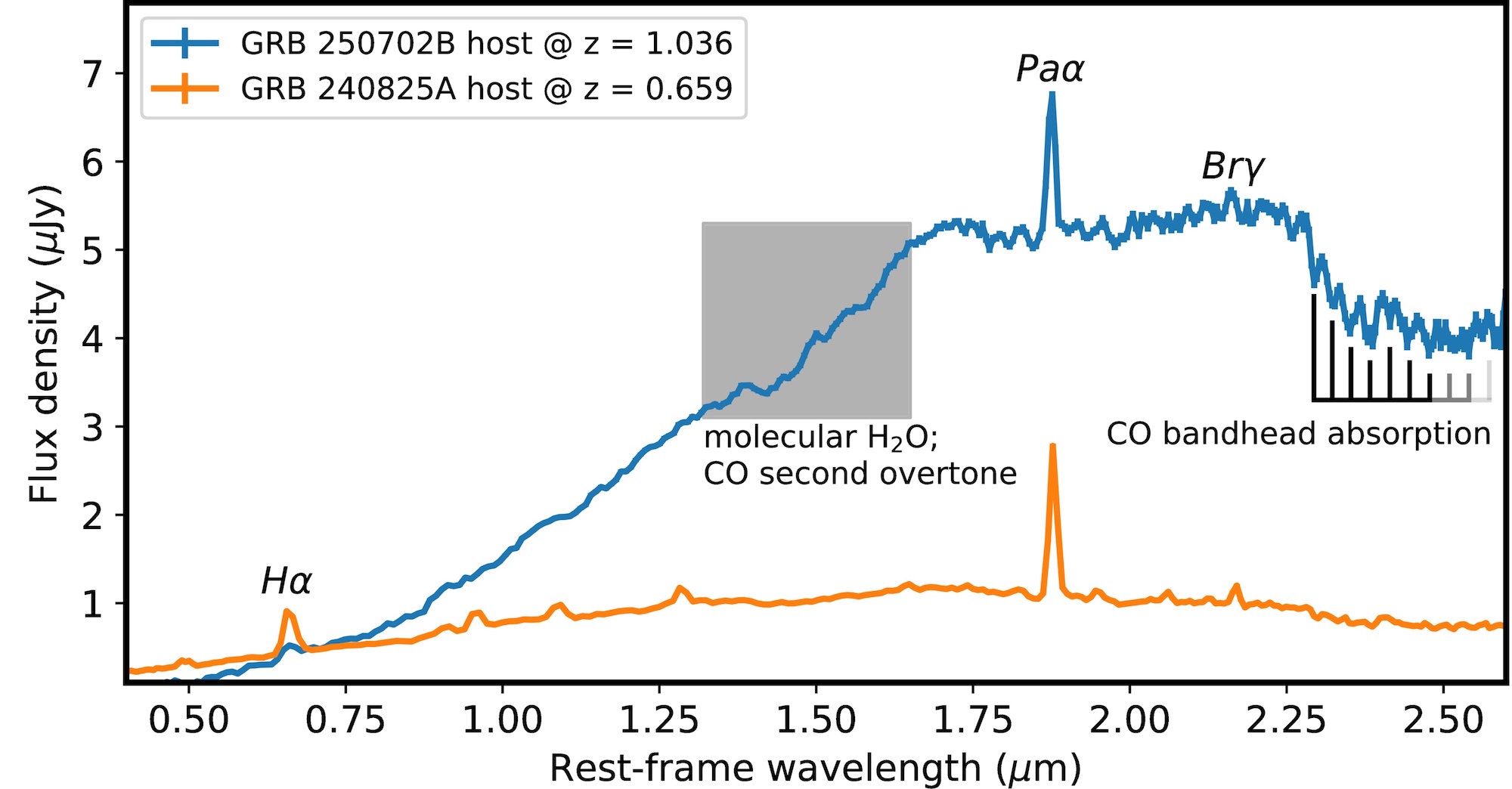
Rest-frame spectrum of GRB 250702B (blue) with the host galaxy spectrum of another burst, GRB 240825A, for comparison (orange). Click to enlarge. [Adapted from Gompertz et al. 2026]
This precisely measured redshift allowed the team to estimate the burst’s energy; in gamma rays alone, the event released at least 2.2 × 1054 ergs. This places GRB 250702B in the top 20 most energetic GRBs known, and the team estimates that events of this kind are 1,000 times less common than other long-duration GRBs and more than 100,000 times less common than typical core-collapse supernovae.
The burst’s host galaxy is also unusual. It’s larger, brighter, and dustier than other galaxies of similar redshift, and it’s unusually massive among GRB host galaxies. In the wavelength range studied here, it also appears to be the most luminous galaxy known to host a GRB.
What Caused GRB 250702B?
Now, to the cause of this unusual burst: is GRB 250702B just a very strange example of a long-duration burst arising from the collapse of a massive star into a black hole, or could it have an entirely different cause, like a star being ripped apart by a black hole?
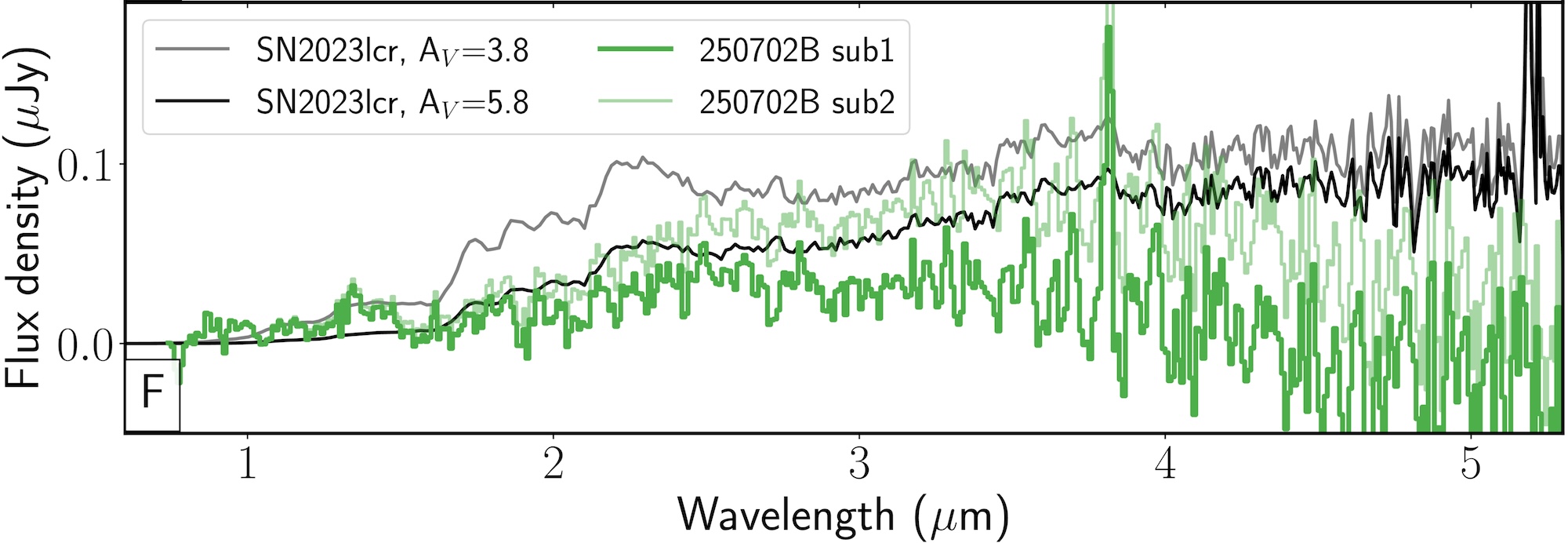
The team placed limits on the supernova emission by subtracting a spectrum of the host galaxy from the event. The green lines show this subtracted spectrum under two different normalization conditions. The black lines show for comparison the emission from the bright supernova SN 2023lcr using two possible extinction values. Click to enlarge. [Adapted from Gompertz et al. 2026]
The observations also place constraints on a tidal disruption event scenario, in which a star is ripped apart by a black hole. The data strongly favor a jetted, relativistic tidal disruption event, which makes it difficult to pin down the mass of the black hole involved. The timescales are consistent with a white dwarf spiraling around an intermediate-mass black hole, and other factors suggest that the black hole could be no more than a million solar masses, placing it firmly in the intermediate-mass regime, should this explanation prevail.
With GRB 250702B’s source still unsettled, astronomers will continue to study the burst and its unusual host galaxy. Gompertz and collaborators anticipate that follow-up spectroscopy will provide more clues in this case.
Citation
“JWST Spectroscopy of GRB 250702B: An Extremely Rare and Exceptionally Energetic Burst in a Dusty, Massive Galaxy at z = 1.036,” Benjamin P. Gompertz et al 2026 ApJL 997 L4. doi:10.3847/2041-8213/ae2ed9