
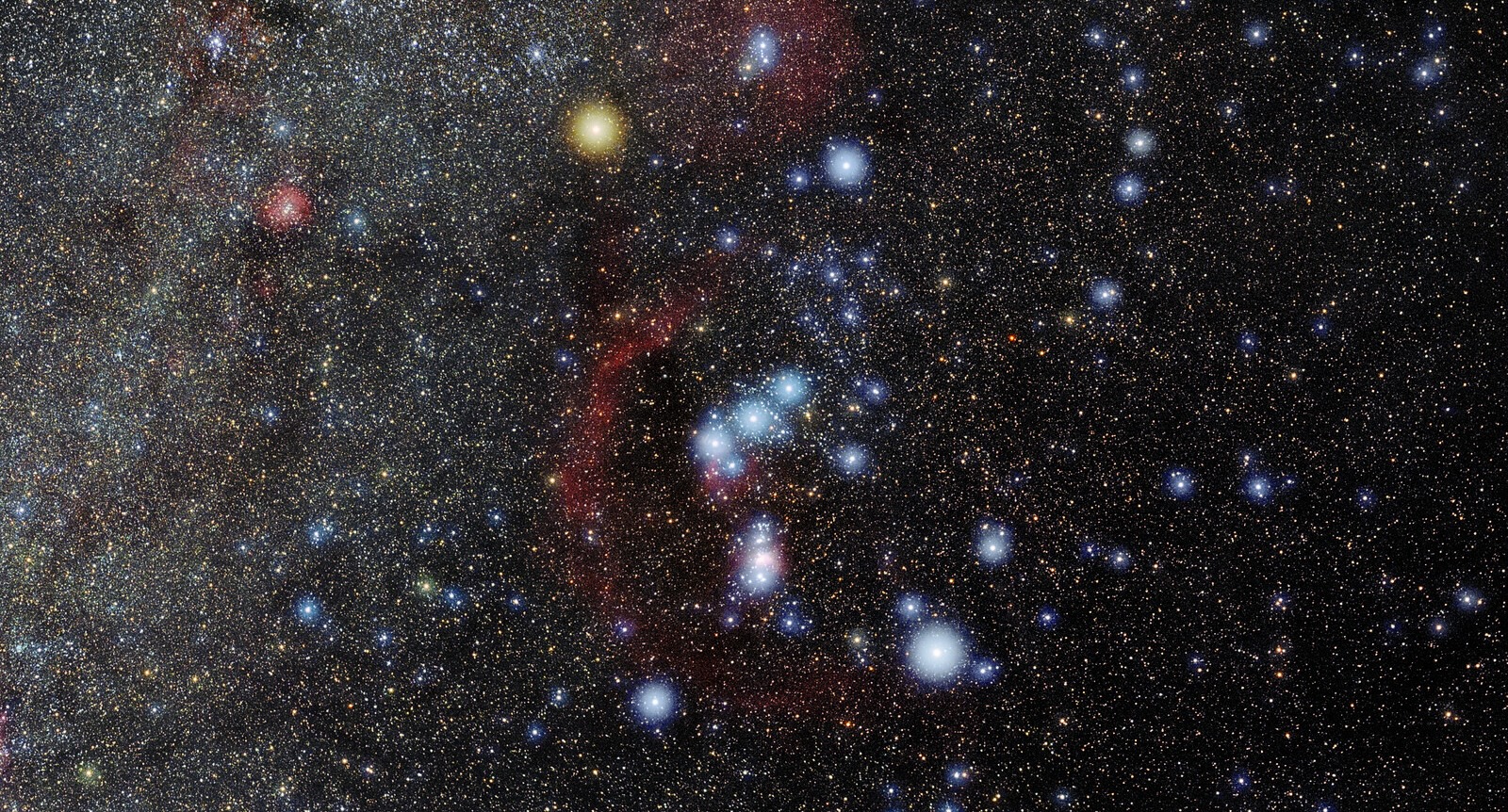
Multiple research teams have turned to the famous red supergiant Betelgeuse in search of a possible companion star hiding in its glare. A carefully designed spectroscopic search has placed new constraints on the identity of Betelgeuse’s stellar buddy.
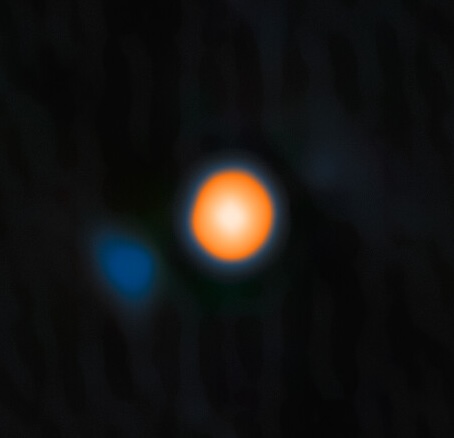
An image of Betelgeuse and its probable companion star from the ‘Alopeke instrument on the Gemini North telescope. [International Gemini Observatory/NOIRLab/NSF/AURA; Image Processing: M. Zamani (NSF NOIRLab); CC BY 4.0]
Betelgeuse and Its Buddy
Betelgeuse, a nearby red supergiant, is a variable star with a 400-day primary pulsation period and a 2,100-day secondary variation period. Recent studies have speculated that this secondary period is due to the presence of an 0.5–2.0-solar-mass companion star (often nicknamed “Betelbuddy”), and researchers using a speckle imaging technique likely spotted this companion earlier this year.
As is often the case when there’s an intriguing astronomical possibility, multiple research teams have sought out Betelgeuse’s purported stellar companion in different ways. One avenue recently described in a published paper was spectroscopic, searching for signs of ultraviolet emission lines from a growing young star.
Spectroscopic Search
In just 10 million years, Betelgeuse has sped through its main-sequence lifetime and taken on a new starring role as a red supergiant. In contrast, a 0.5–2.0-solar-mass companion star would not have even reached the main sequence in the same span of time. How is it possible to spot a tiny young stellar object next to a much brighter supergiant?
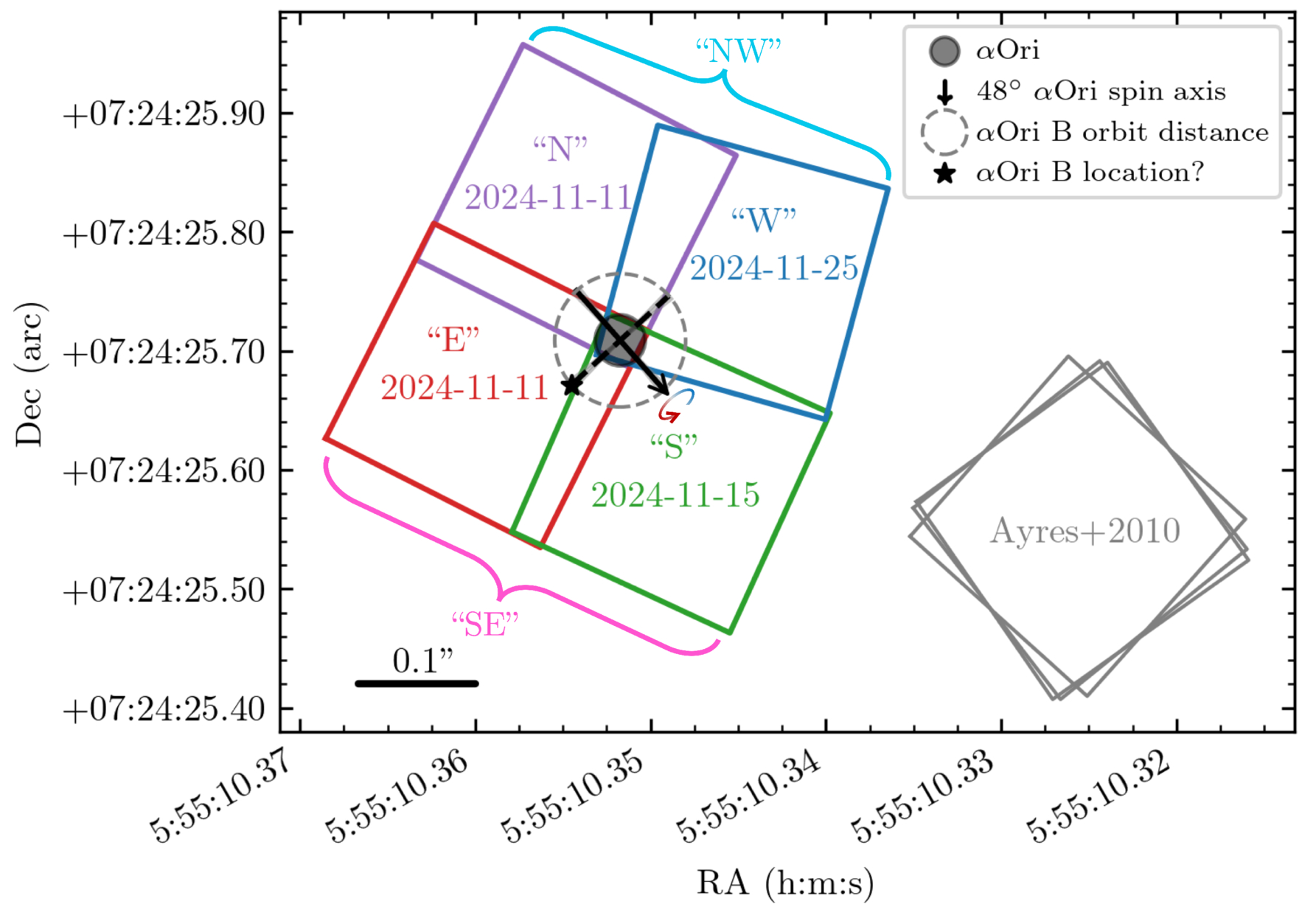
Hubble observing pattern, showing how the quadrants are arrayed around Betelgeuse. Click to enlarge. [Goldberg et al. 2025]
The search is on: Goldberg and collaborators observed Betelgeuse with the Hubble Space Telescope in November 2024, timed to when the companion star’s emission lines would be shifted relative to Betelgeuse. The observations split Betelgeuse’s disk into quadrants, only one or two of which should contain the companion, helping the team tease out the signal from the smaller star, if present. Ultimately, though, no statistically significant signals were found.
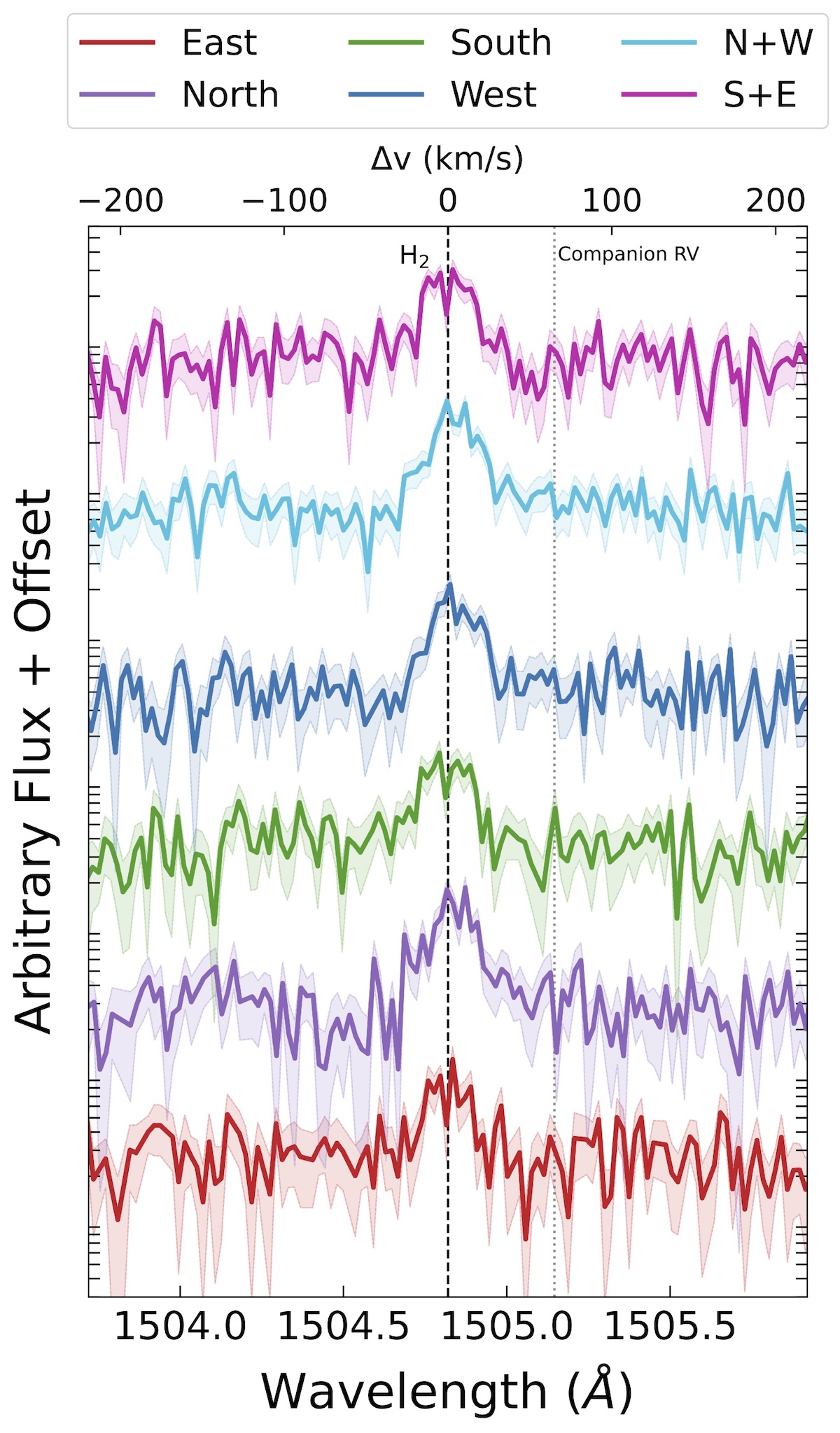
Emission around Betelgeuse’s 1504.82 Angstrom H2 line from each of the four observed quadrants as well as combinations of two quadrants. No significant signals were detected at the expected radial velocity of the companion star. [Goldberg et al. 2025]
When Finding Nothing Tells You Something
A lack of a significant detection doesn’t mean that the companion isn’t there, but it does place constraints on its identity. The data confidently rule out a companion star twice as massive as the Sun, marginally permit a star in the 1.1–1.5-solar-mass range, and favor a star lower than 1.1 solar masses.
Researchers assigned a likely mass of about 1.5 solar masses to the probable companion star imaged earlier this year. Though this is at the limit of what’s permitted by the ultraviolet observations, Goldberg and coauthors note that the companion star’s ultraviolet output could be suppressed due to tidal coupling with Betelgeuse or other processes. If the star’s ultraviolet emission is lower than expected, a 1.5-solar-mass companion remains consistent with Hubble’s non-detection of the star.
This is a fantastic example of how multiple lines of inquiry can converge on similar solutions. With the companion star expected to swing around to a favorable observing position again in 2027, this is certainly not the last chapter in the tale of Betelgeuse and Betelbuddy.
Citation
“Betelgeuse, Betelgeuse, Betelgeuse, Betel-buddy? Constraints on the Dynamical Companion to α Orionis from HST,” Jared A. Goldberg et al 2025 ApJ 994 101. doi:10.3847/1538-4357/ae0c0c