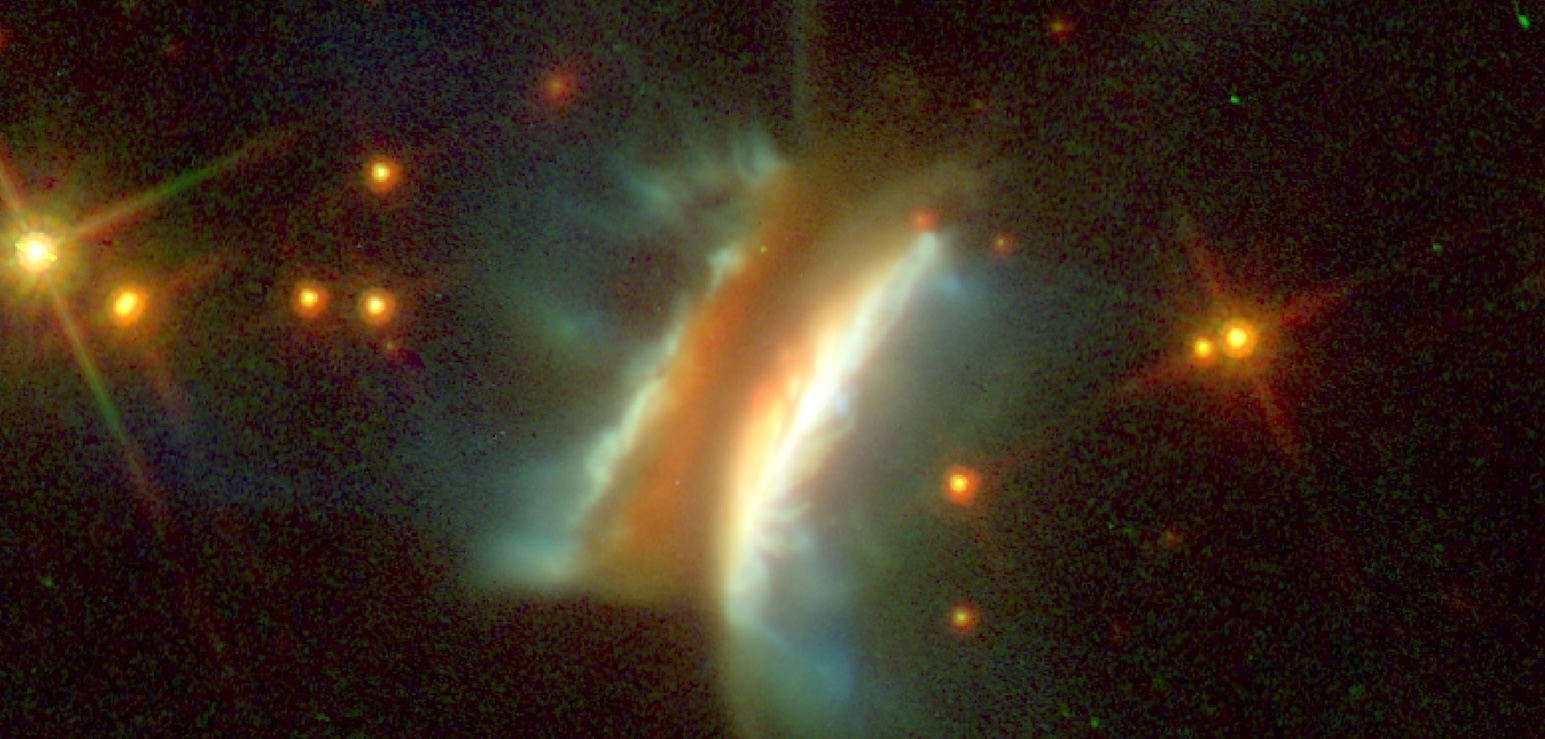
Hubble Space Telescope image of Dracula’s Chivito. [Monsch et al 2026]
The disks of gas and dust that collect around young stars — protoplanetary disks — hold the secrets to how planets form. When a protoplanetary disk is tilted edge-on from our perspective, the disk’s dense, dusty midplane blocks the light from the star at the center, revealing structures like winds and jets wafting off of the disk. Pictured above and to the right is the spectacular edge-on protoplanetary disk IRAS23077+6707, which is also known as Dracula’s Chivito. (Delightfully, the name combines references to the backgrounds of two of the astronomers who identified the object as a protoplanetary disk: one hailing from Transylvania and another from Uruguay, where a sandwich called a chivito is the national dish.) Though the distance to this disk is not known, estimates place it around 1,000 light-years away, which would make the disk about 4,200 au across — larger than any other known protoplanetary disk. Recently, a team led by Kristina Monsch (Center for Astrophysics ∣ Harvard & Smithsonian) published their Hubble Space Telescope observations of Dracula’s Chivito. These observations show in great detail the structure within the disk, including large-scale asymmetries, wispy tendrils, and potential signs of dust grains settling toward the midplane. To learn more about this exceptional protoplanetary disk, be sure to check out the full research article linked below.
Citation
“Hubble Reveals Complex Multiscale Structure in the Edge-On Protoplanetary Disk IRAS23077+6707,” Kristina Monsch et al 2026 ApJ 996 45. doi:10.3847/1538-4357/ae247f