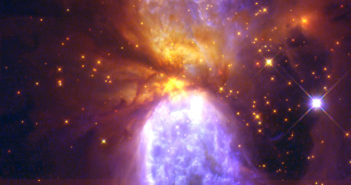
Featured Image: Explosive Star Formation
How does a massive star form and grow? Certainly not peacefully! A new study explores clues revealed by a powerful recent explosion.

How does a massive star form and grow? Certainly not peacefully! A new study explores clues revealed by a powerful recent explosion.
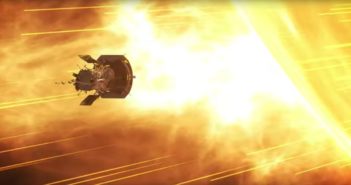
Now that it’s “touched” the Sun, will the Parker Solar Probe help solve the mysteries surrounding the cause of solar wind?
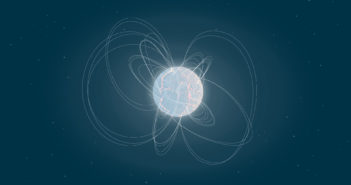
Highly magnetic neutron stars called magnetars might be responsible for many powerful radio bursts — but can these bursts really escape a magnetar’s intense magnetic fields?
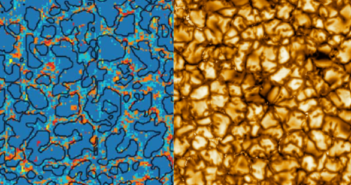
Astrobites reports on our Sun’s alternation between phases of tempest and tranquility, driven by its magnetic field roughly every 11 years. It has been difficult to measure the magnetic strength when the Sun goes silent — until now.
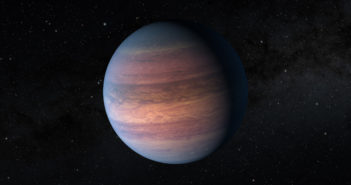
This week we’re reporting on the virtual programming associated with the canceled 239th AAS meeting. Here are the highlights from Days 4 and 5!
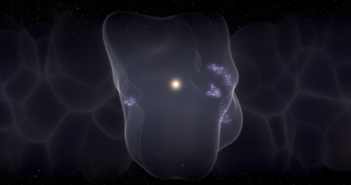
This week we’re reporting on the virtual programming associated with the canceled 239th AAS meeting. Here are the highlights from Day 3!
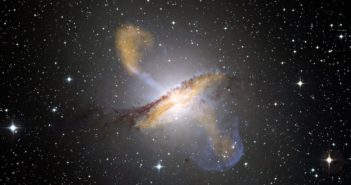
This week we’re reporting on the virtual programming associated with the canceled 239th AAS meeting. Here are the highlights from Day 2!
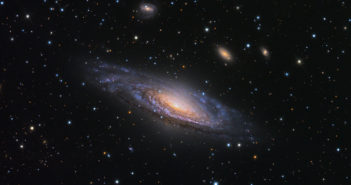
This week we’re reporting on the virtual programming associated with the canceled 239th AAS meeting. Here are the highlights from Day 1!
This week, we’re hosting eight virtual press conferences — tune in or follow along here for the latest newsworthy science results!

What’s caused the strange misalignment in 14 Herculis’s planets? An unstable origin, or a pesky passerby?
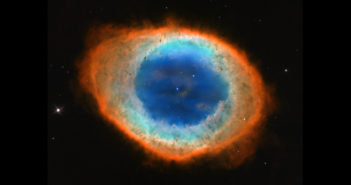
A new study of white dwarfs in binary systems raises questions about the connection between the mass of a star and the mass of the white dwarf it leaves behind.

Astrobites reports on a star that spoke its final words in the form of a long brightening before exploding as a supernova.