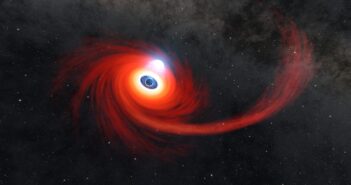
Double Disruption Dilemma: Exploring the Tidal Disruption Events of AT 2022dbl
A recently discovered tidal disruption event has astronomers investigating new ways in which stars may be ripped apart by supermassive black holes.

A recently discovered tidal disruption event has astronomers investigating new ways in which stars may be ripped apart by supermassive black holes.
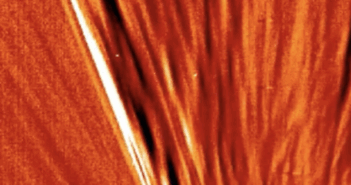
A new method for handling data with significant gaps can be applied to extremely sparse datasets, such as Voyager data from the outer heliosphere.
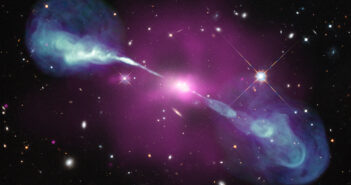
Astrobites reports on simulations that improve our understanding of how jets from active galactic nuclei interact with the interstellar medium.
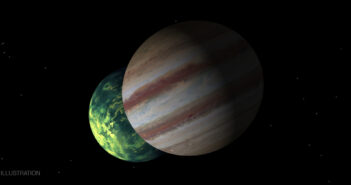
New research suggests that JWST is capable of directly imaging planets that resemble the gas giants in our solar system, provided they orbit nearby stars.
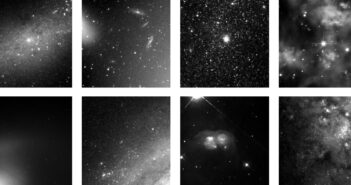
A team of citizen scientists compared 5.4 million pairs of astronomical images, helping researchers create a database of image similarity information that can be used to test image-search algorithms.
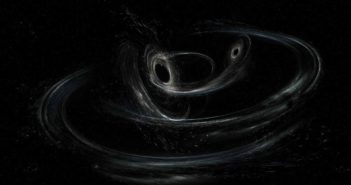
Astrobites reports on how researchers are preparing for future detections of merging supermassive and intermediate-mass black holes.

Two powerful telescopes examined the brightest gamma-ray burst ever observed by humans, hundreds of days after the burst was first detected. What did they see?

With their extremely low surface brightness, ultra-diffuse galaxies are very difficult to detect, but a recent study has spotted one by searching for its globular clusters.
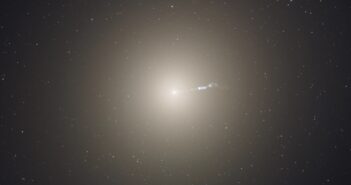
The massive nearby elliptical galaxy Messier 87 hosts one of the most-studied supermassive black holes in the universe. What have researchers recently learned about this black hole’s spin, jets, and flares?

Astrobites reports on JWST observations of a mysterious binary quasar system from cosmic noon.

The troubles continue for planets around the smallest and coolest stars: new research suggests that it’s even harder than previously suspected for these planets to hold on to their atmospheres.
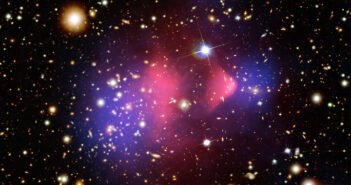
Astrobites reports on the famous Bullet Cluster — what JWST observations reveal about its complex merger history and the constraints these observations place on self-interacting dark matter.