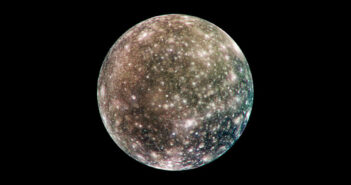
A Close Look at an Ancient Moon
Researchers present the first-ever millimeter-wavelength map of Callisto, the coldest and most weather-worn of Jupiter’s major moons.

Researchers present the first-ever millimeter-wavelength map of Callisto, the coldest and most weather-worn of Jupiter’s major moons.
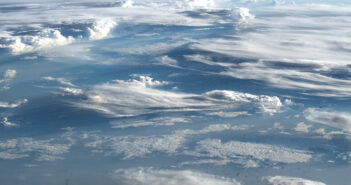
Astrobites reports on how clouds might actually be a good thing when it comes to detecting biosignatures with NASA’s proposed next-generation space telescope, the Habitable Worlds Observatory.
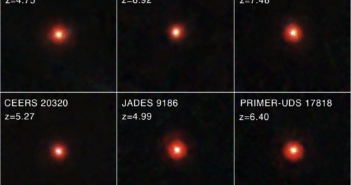
Small in size and glowing red, little red dots have been confusing astronomers since their discovery by JWST. What are the origins of these distant galaxies, and what have researchers learned so far?
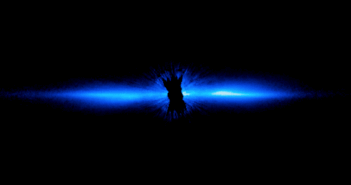
Rings and gaps in TWA 7’s debris disk suggested a planet might be lurking nearby. JWST observations may have revealed the hidden world.
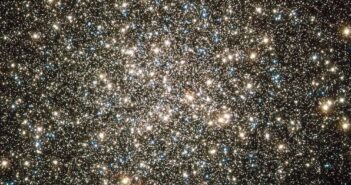
Astrobites reports on how we might be able to observe gravitational wave signals from intermediate-mass black holes in binary systems with stellar-mass black holes.
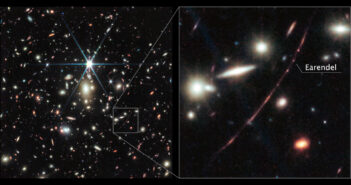
An incredible beacon from the first billion years of the universe, Earendel has been touted as the most distant single star ever seen — but it might not be a single star at all.
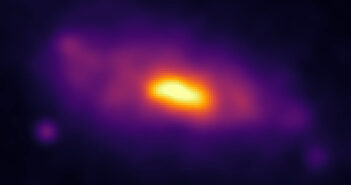
Astrobites reports on the three galactic suspects in the case of an ultra-high-energy neutrino.
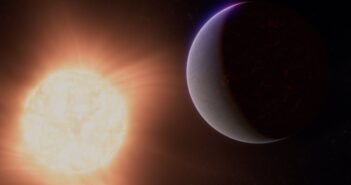
JWST provides new evidence that one of our nearest neighbor stars, Alpha Centauri A, might host a giant planet in its habitable zone.
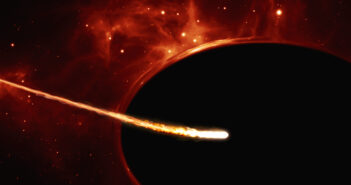
When a supermassive black hole captures a significantly smaller object, the interaction could produce gravitational waves that have not yet been detected. A new study explores such events and how future gravitational wave detectors may be able to feel them for years to come.
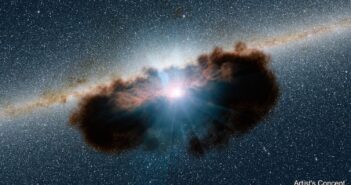
The “little red dot” CAPERS-LRD-z9 is the most distant object to show the characteristic broad emission lines of fast-moving gas around a black hole.
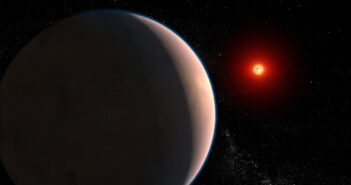
Astrobites reports on a warm, rocky exoplanet and what might be hidden beneath its atmosphere.
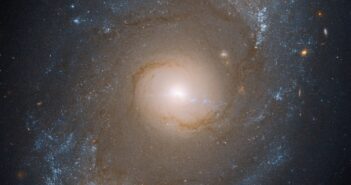
New observations from the X-Ray Imaging and Spectroscopy Mission (XRISM) show the multilayered winds of NGC 4151 in a whole new light.