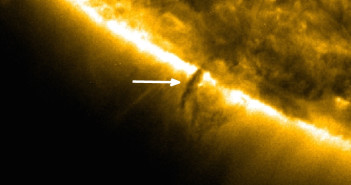
A Tornado on the Sun
A team of researchers has analyzed images of a giant tornado forming on the surface of the Sun in an effort to better understand the evolution of such events.

A team of researchers has analyzed images of a giant tornado forming on the surface of the Sun in an effort to better understand the evolution of such events.
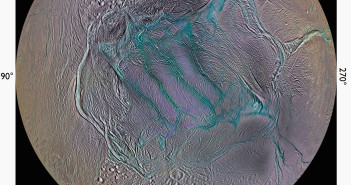
Does the extreme surface terrain of Saturn’s moon Enceladus affect the locations and behavior of the geysers spewing material into space from its south polar region?
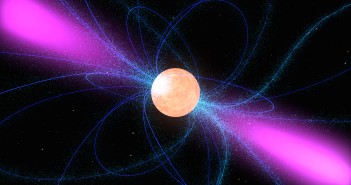
The sudden, unexpected outbursts exhibited by PSR 1846–0258 in 2006 may have permanently changed the behavior of this pulsar.
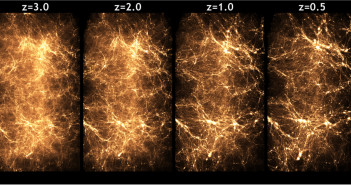
The Q Continuum simulation is currently the largest cosmological simulation available, evolving (1300 Mpc)^3 and over half a trillion particles.
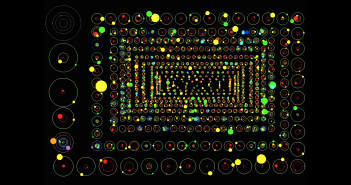
To date, we’ve discovered nearly 2000 confirmed exoplanets, as well as thousands of additional candidates. Amidst this vast sea of solar systems, how special is our own?
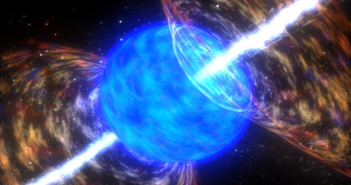
A recent study explores what we would see if supermassive stars in the early universe collapsed directly into black holes.
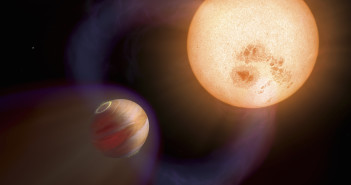
A bow shock has been detected ahead of transiting exoplanet HD 189733b, providing a potential indicator of the remarkably strong magnetic field of the planet.
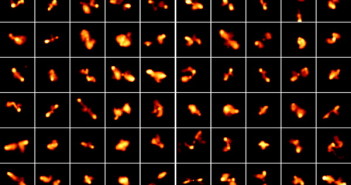
A new study suggests we may be over-predicting the rate of galaxy mergers — and the gravitational wave background — by counting X-shaped radio sources.
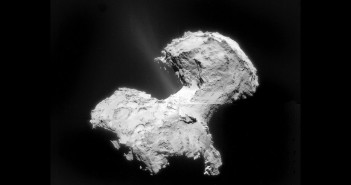
Recent models provide an explanation for the “early activity” unexpectedly emerging from the neck of comet 67P.
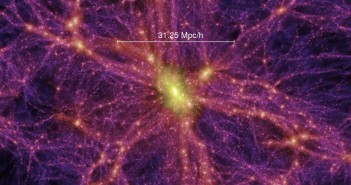
Observations of starbursts in low-metallicity galaxies have provided long-awaited evidence supporting predictions of how stars formed throughout cosmic history.
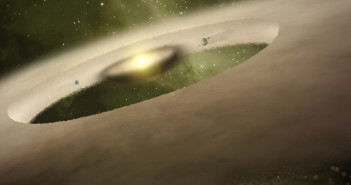
A recent study has found that the transitional disk DoAr 44 contains water vapor in its inner regions.
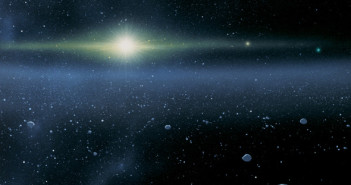
Neptune’s unusual migration in the early years of our solar system might have created features we now observe in the Kuiper Belt.