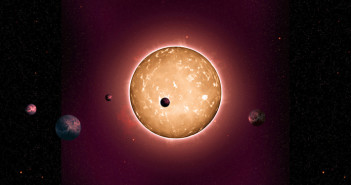
Selections from 2015: An Ancient System of Small Planets
Kepler-444 is a system of five sub-Earth-sized planets transiting a Sun-like star. This ancient system has been measured to be 11 billion years old.

Kepler-444 is a system of five sub-Earth-sized planets transiting a Sun-like star. This ancient system has been measured to be 11 billion years old.

The binary star system VFTS 352 is an “overcontact binary” — the two stars orbit each other so closely that they actually touch!

EGSY8p7 has a spectroscopic redshift of z=8.68, making it the most-distant known object in the universe.
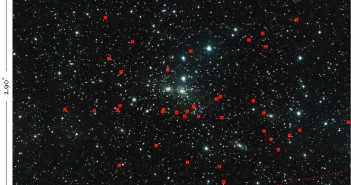
A survey of the Coma galaxy cluster unexpectedly revealed 47 diffuse, uncataloged galaxies roughly the size of the Milky Way.
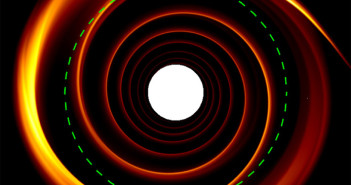
What can spiral structures in protoplanetary disks tell us about the planets that formed them?

New observations of a nearby dwarf galaxy may help to us understand how galaxies lose their metals.
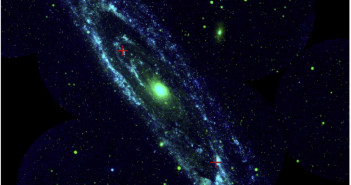
A recent study has used the reddening of several stars in nearby Andromeda to learn about the properties of the dust within this galaxy.

A recent study has determined how host stars can help their planets to lose initial, enormous gaseous envelopes and become more Earth-like.
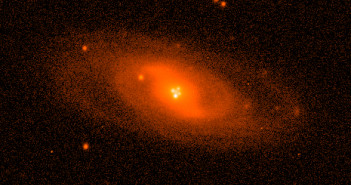
Gravitational microlensing of quasar Q2237+0305 has provided us with a close look at the structure within the innermost region surrounding its central black hole.
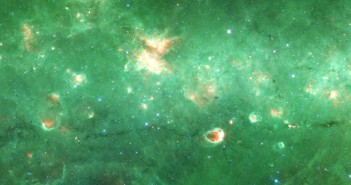
A recently discovered dark cloud nicknamed “Nessie” may have companions that make up a skeleton of the Milky Way, tracing out the densest parts of our galaxy’s spiral arms.
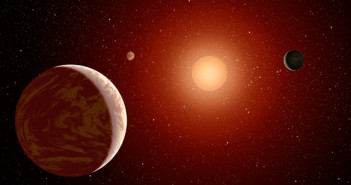
How did short-period Super-Earths come to exist so close to their host star? To address this question, a new study examines what the preferred hosts are for short-period exoplanets.

An isolated white dwarf was recently discovered to dim periodically, prompting a search for the cause of its variability.