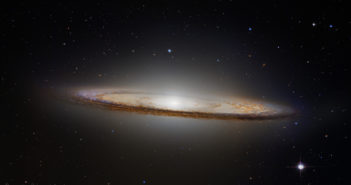
Good Luck Sorting This Hat
Astrobites reports on the challenge of sorting galaxies. New evidence suggests that, much like Harry Potter, the Sombrero galaxy may fit into more than one category.

Astrobites reports on the challenge of sorting galaxies. New evidence suggests that, much like Harry Potter, the Sombrero galaxy may fit into more than one category.
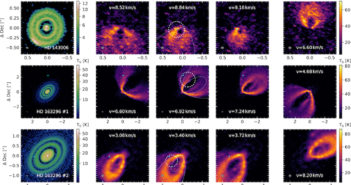
Observations of the gas in the disks around young stars may provide new evidence for the presence of hidden planets.
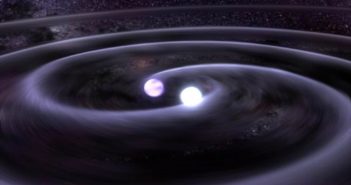
LIGO’s second observation of colliding neutron stars carries with it some interesting uncertainties and implications.
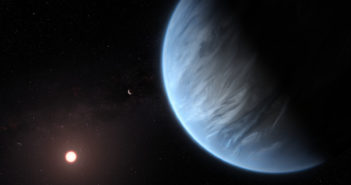
A new study explores how clouds might affect our ability to search for signs of water vapor in potentially habitable planet atmospheres.

We know the universe is filled with highly energetic particles. Astrobites reports on how a shot of caffeine could boost them to their extreme energies.
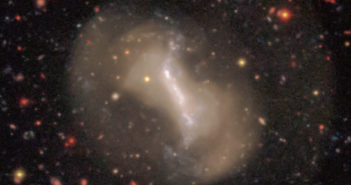
What happens when the large-scale drama of a violent galaxy merger plays out on small scales for a pair of dwarf galaxies?

The discovery of nine more repeating fast radio bursts brings us a little closer to understanding their origin.
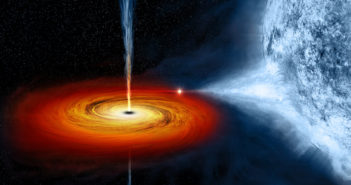
What can infrared emission from black hole X-ray binaries tell us about the speeds of their powerful jets?
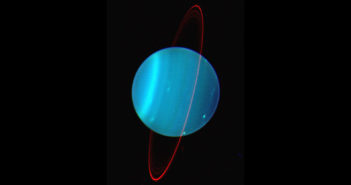
Astrobites reports on how Uranus may have gained its unusual 90-degree tilt.
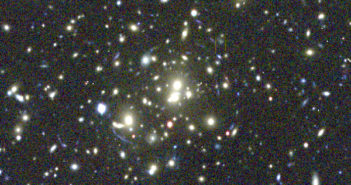
The South Pole Telescope has uncovered the signatures of hundreds of large clusters of galaxies.
Meet AAS Lead Editor Chris Lintott, a man of many hats.
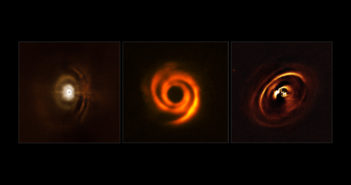
A new study proposes that the rings and spirals we see in protoplanetary disks may have a dramatic origin.