Features RSS

Large Magellanic Cloud

The Large Magellanic Cloud (LMC) — a dwarf galaxy that’s a satellite of the Milky Way — may have a newly discovered satellite of its own: a faint collection of stars dubbed SMASH 1. This tiny satellite has a tenuous future, however, as SMASH 1 may soon be torn apart by the LMC’s gravitational forces.

The Search for Faint Neighbors

The difficulty of detecting faint objects means that many low-luminosity satellites have been hiding, unseen, in the fringes of our galaxy. Studying these satellites can reveal information about our galaxy’s history, teaching us about the formation and evolution of galaxies like our own. But to study these faint satellites, we first have to find them!

SMASH 1

The position of SMASH 1 relative to other clusters that have been found around the LMC and the SMC. [Adapted from Martin et al. 2016]

A number of surveys have been developed in recent years with the goal of discovering faint nearby satellites. One such survey is the Survey of the Magellanic Stellar History, or SMASH, which uses the Dark Energy Camera mounted on the CTIO Blanco 4m telescope in Chile to hunt for very faint satellites in the vicinity of the Magellanic clouds.

In a recent study led by Nicolas Martin (University of Strasbourg and Max Planck Institute for Astronomy), a team of scientists present the discovery of a very faint stellar system, dubbed SMASH 1, that might be a satellite of the Large Magellanic Cloud.

Disrupting System

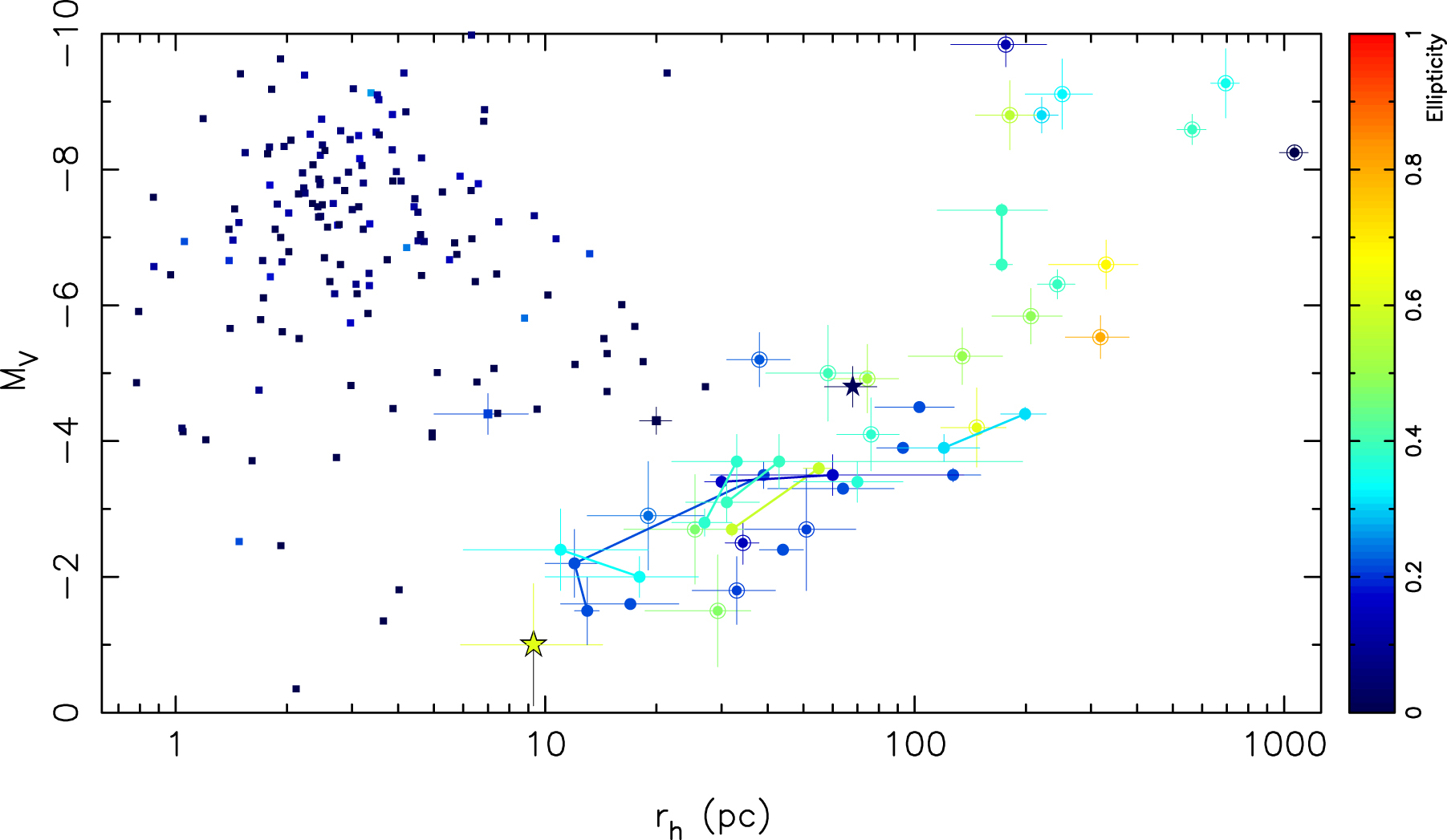
The team’s analysis of the observations show that SMASH 1 is compact, with a radius of just ~30 light-years (tiny compared to the Milky Way at 50,000 light-years or the LMC at 14,000 light-years in radius!). Its compact size — and the fact that it appears to be an old (13 Gyr) and metal-poor (Z=10-4) star system — cause the Martin and collaborators to argue that this is probably a globular cluster rather than a dwarf galaxy.
MW satellites

The distribution of Milky Way satellites in the size–luminosity plane. Globular clusters are shown as squares, Milky Way dwarf galaxies as circled dots, DECam-enabled discoveries as large dots, and SMASH 1 as a yellow star. [Martin et al. 2016]

SMASH 1 is located very near the LMC: it’s just 42,000 light-years away. The authors calculate that, given the satellite’s mass and size and its distance from the LMC, it must currently be in the process of being torn apart by the LMC’s tidal forces. This idea is supported by the fact that SMASH 1 appears slightly elongated, with the major axis pointed at the LMC — as would be expected if the Cloud were tugging on it in the process of disrupting it.

The discovery of SMASH 1 raises some interesting questions, such as how it has presumably survived many orbits without disrupting before now. To better understand this satellite, the next step is to obtain follow-up velocity measurements. These will allow us to determine whether its orbit truly is bound to the LMC, or if SMASH 1 is a satellite of the Milky Way instead.

Citation

Nicolas F. Martin et al 2016 ApJ 830 L10. doi:10.3847/2041-8205/830/1/L10
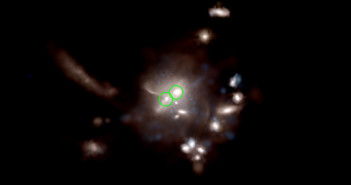
When galaxies merge, the supermassive black holes (SMBHs) at the galaxies’ centers are thought to coalesce, forming a new, larger black hole. But can this merger process take place on timescales short enough that we could actually observe it? Results from a new simulation suggest that it can!

When Galaxies Collide

Time evolution of galaxy merger

These stills demonstrate the time evolution of the galaxy merger after the beginning of the authors’ simulation (starting from z=3.6). The red and blue dots mark the positions of the SMBHs. [Adapted from Khan et al. 2016]

At present, it’s not well understood how the merger of two SMBHs proceeds from the merger of their host galaxies. What’s more, there are concerns about whether the SMBHs can coalesce on reasonable timescales; in many simulations and models, the inspiral of these behemoths stalls out when they are about a parsec apart, in what’s known as “the final parsec problem”.

Why are these mergers poorly understood? Modeling them — from the initial interactions of the host galaxies all the way down to the final coalescence of their SMBHs in a burst of gravitational waves — is notoriously complicated, due to the enormous range of scales and different processes that must be accounted for.

But in a recent study, a team of scientists led by Fazeel Khan (Institute of Space Technology in Pakistan) has presented a simulation that successfully manages to track the entire merger — making it the first multi-scale simulation to model the complete evolution of an SMBH binary that forms within a cosmological galaxy merger.

Stages of a Simulation

Khan and collaborators tackled the challenges of this simulation by using a multi-tiered approach.

  1. Beginning with the output of a cosmological hydrodynamical simulation, the authors select a merger of two typical massive galaxies at z=3.6 and use this as the starting point for their simulation. They increase the resolution and add in two supermassive black holes, one at the center of each galaxy.
  2. They then continue to evolve the galaxies hydrodynamically, simulating the final stages of the galaxy merger.
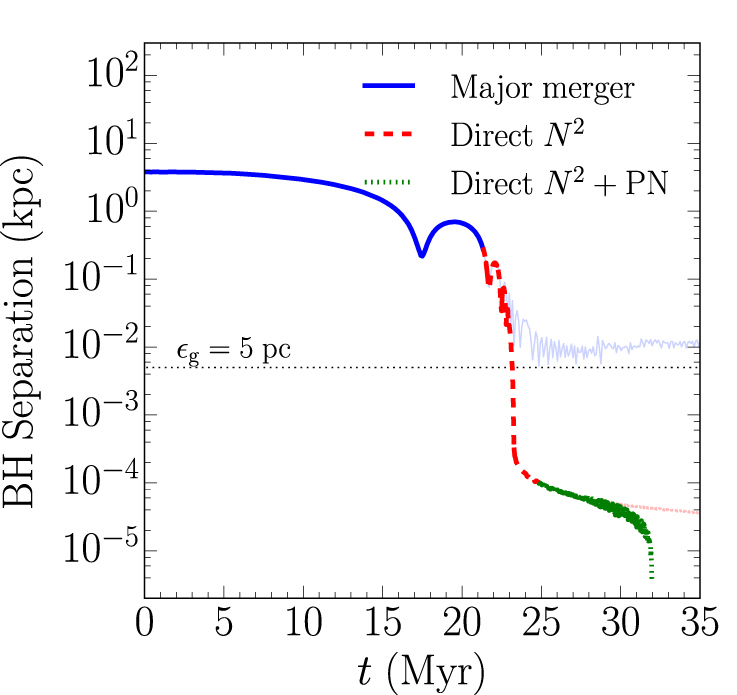
  3. When the separation of the two SMBHs is small enough, the authors extract a spherical region of 5 kpc from around the pair and evolve this as an N-body simulation.
  4. Finally, the separation of the SMBHs becomes so small (<0.01 pc) that gravitational-wave emission is the dominant loss of energy driving the inspiral. The authors add post-Newtonian terms into the N-body simulation to account for this.
Different simulation stages

Time evolution of the separation between the SMBHs, beginning with the hydrodynamical simulation (blue), then transitioning to the direct N-body calculation (red), and ending with the introduction of post-Newtonian terms (green) to account for gravitational-wave emission. [Adapted from Khan et al. 2016]

Successful Coalescence

Khan and collaborators’ complex approach allows them to simulate the entire process of the merger and SMBH coalescence, resulting in several key determinations.

First, they demonstrate that the SMBHs can coalesce on timescales of only tens of Myr, which is roughly two orders of magnitude smaller than what was typically estimated before. They find that gas dissipation before the merger is instrumental in creating the conditions that allow for this rapid orbital decay.

The authors also demonstrate that the gravitational potential of the galaxy merger remnant is triaxial throughout the merger. Khan and collaborators’ simulations confirm that this non-spherical potential solves the final parsec problem by sending stars on plunging orbits around the SMBHs. These more distant stars cause the SMBHs to lose angular momentum through dynamical friction and continue their inspiral, even when the stars immediately surrounding the SMBHs have been depleted.

This simulation is an important step toward a better understanding of SMBH mergers. Its outcomes are especially promising for future gravitational-wave campaigns, as the short SMBH coalescence timescales indicate that these mergers could indeed be observable!

Citation

Fazeel Mahmood Khan et al 2016 ApJ 828 73. doi:10.3847/0004-637X/828/2/73

dark matter clumps

It’s a tricky business to reconcile simulations of our galaxy’s formation with our current observations of the Milky Way and its satellites. In a recent study, scientists have addressed one discrepancy between simulations and observations: the so-called “to big to fail” problem.

From “Missing Satellites” to “Too Big to Fail”

The favored model of the universe is the lambda-cold-dark-matter (ΛCDM) cosmological model. This model does a great job of correctly predicting the large-scale structure of the universe, but there are still a few problems with it on smaller scales.

dwarf galaxy

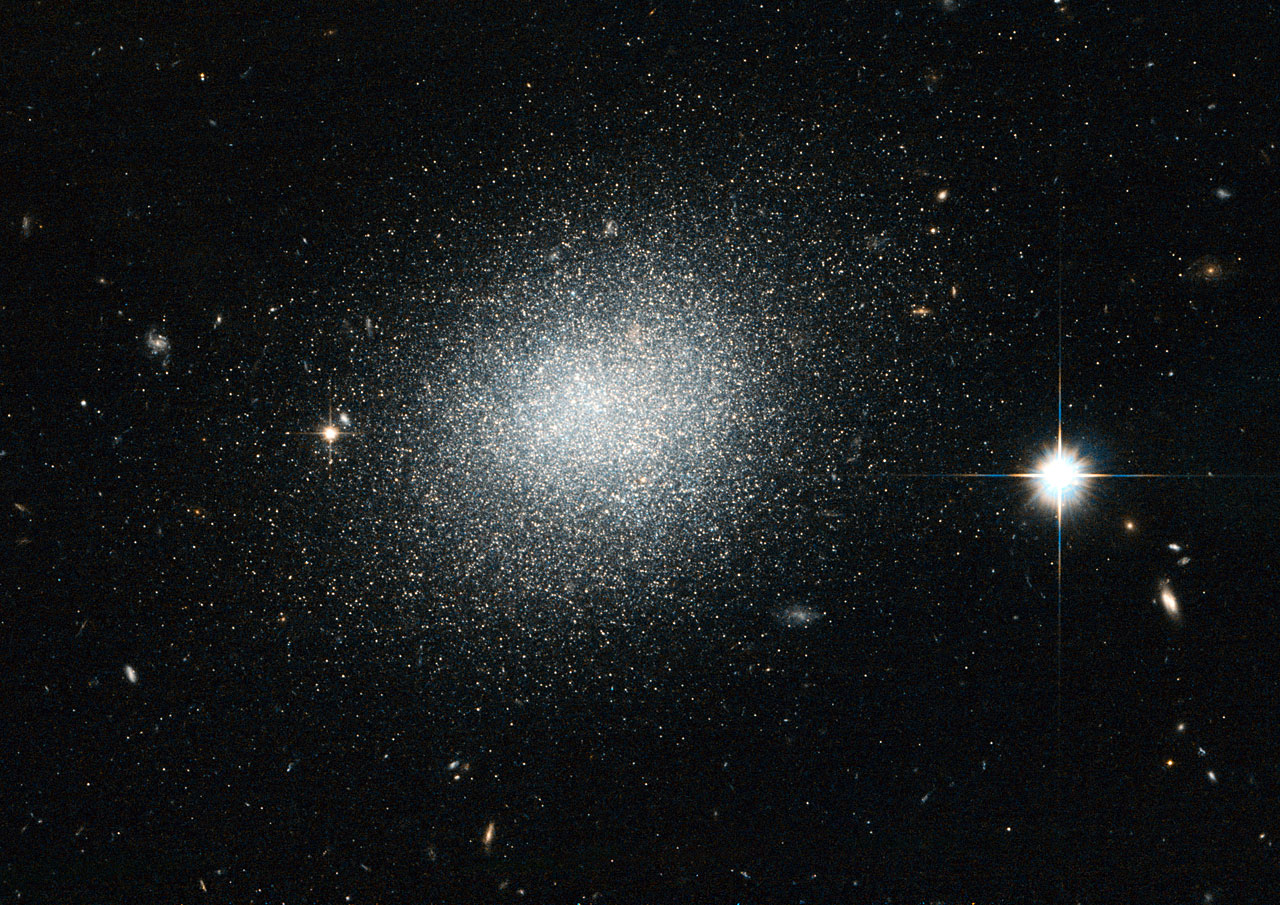
Hubble image of UGC 5497, a dwarf galaxy associated with Messier 81. In the “missing satellite” problem, simulations of galaxy formation predict that there should be more such satellite galaxies than we observe. [ESA/NASA]

The first is the “missing satellites” problem: ΛCDM cosmology predicts that galaxies like the Milky Way should have significantly more satellite galaxies than we observe. A proposed solution to this problem is the argument that there may exist many more satellites than we’ve observed, but these dwarf galaxies have had their stars stripped from them during tidal interactions — which prevents us from being able to see them.

This solution creates a new problem, though: the “too big to fail” problem. This problem states that many of the satellites predicted by ΛCDM cosmology are simply so massive that there’s no way they couldn’t have visible stars. Another way of looking at it: the observed satellites of the Milky Way are not massive enough to be consistent with predictions from ΛCDM.

supernova

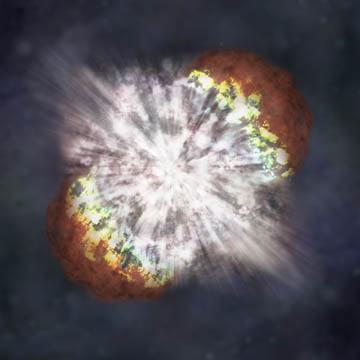
Artist’s illustration of a supernova, a type of stellar feedback that can modify the dark-matter distribution of a satellite galaxy. [NASA/CXC/M. Weiss]

Density Profiles and Tidal Stirring

Led by Mihai Tomozeiu (University of Zurich), a team of scientists has published a study in which they propose a solution to the “too big to fail” problem. By running detailed cosmological zoom simulations of our galaxy’s formation, Tomozeiu and collaborators modeled the dark matter and the stellar content of the galaxy, tracking the formation and evolution of dark-matter subhalos.

Based on the results of their simulations, the team argues that the “too big to fail” problem can be resolved by combining two effects:

  1. Stellar feedback in a satellite galaxy can modify its dark-matter distribution, lowering the dark-matter density in the galaxy’s center and creating a shallower density profile. Satellites with such shallow density profiles evolve differently than those typically modeled, which have a high concentration of dark matter in their centers.
  2. After these satellites fall into the Milky Way’s potential, tidal effects such as shocks and stripping modify the mass distribution of both the dark matter and the baryons even further.
simulated dwarf galaxies

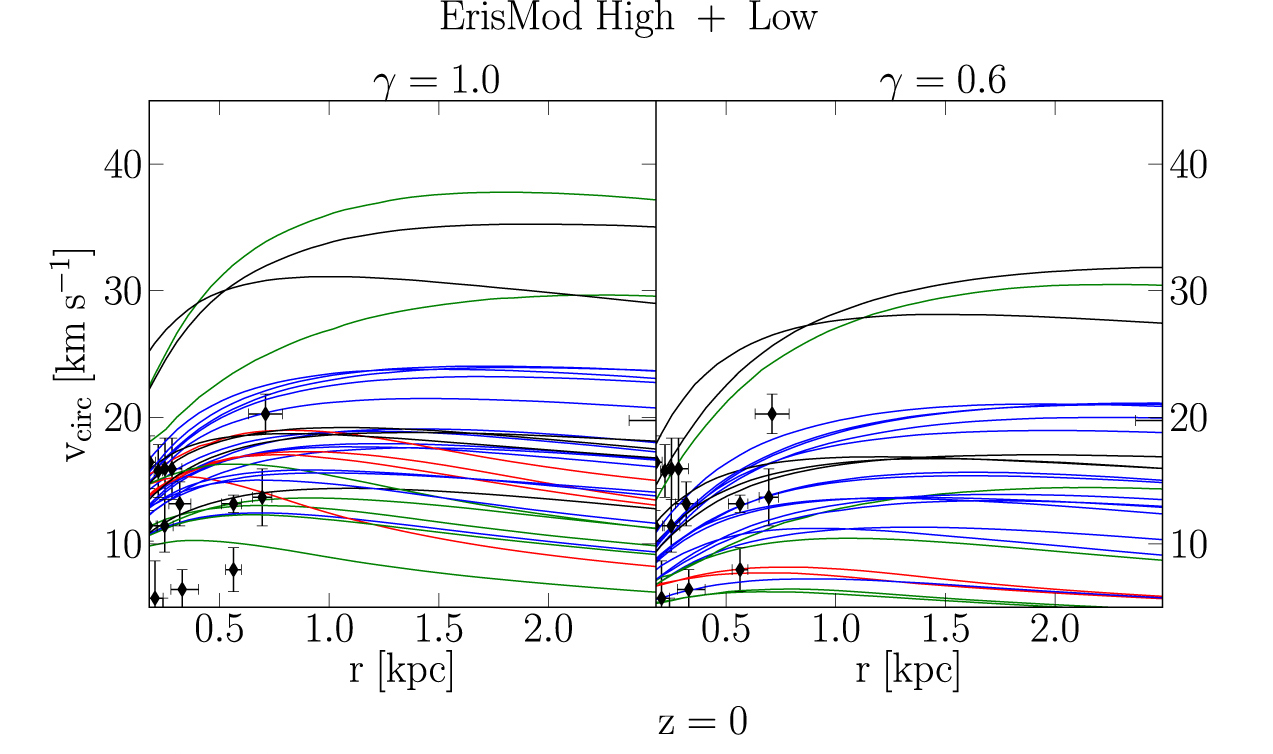
Each curve represents a simulated satellite’s circular velocity (which corresponds to its total mass) at z=0. Left: results using typical dark-matter density profiles. Right: results using the shallower profiles expected when stellar feedback is included. Results from the shallower profiles are consistent with observed Milky-Way satellites (black crosses). [Adapted from Tomozeiu et al. 2016]

A Match to Observations

Tomozeiu and collaborators found that when they used traditional density profiles to model the satellites, the satellites at z=0 in the simulation were much larger than those we observe around the Milky Way — consistent with the “too big to fail” problem.

When the team used shallower density profiles and took into account tidal effects, however, the simulations produced a distribution of satellites at z=0 that is consistent with what we observe.

This study provides a tidy potential solution to the “too big to fail” problem, further strengthening the support for ΛCDM cosmology.

Citation

Mihai Tomozeiu et al 2016 ApJ 827 L15. doi:10.3847/2041-8205/827/1/L15

exoplanet around hot star

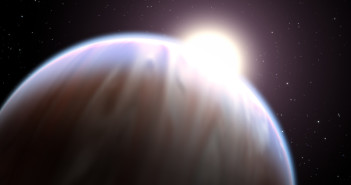
Searching for planets around very hot stars is much more challenging than looking around cool stars. For this reason, the recent discovery of a planet around a main-sequence A star is an important find — both because of its unique position near the star’s habitable zone, and because of the way in which the planet was discovered.

Challenges in Variability

In the past three decades, we’ve discovered thousands of exoplanets — yet most of them have been found around cool stars (like M dwarfs) or moderate stars (like G stars like our Sun). Very few of the planets that we’ve found orbit hot stars; in fact, we’ve only discovered ~20 planets orbiting the very hot, main-sequence A stars.

Instability strip

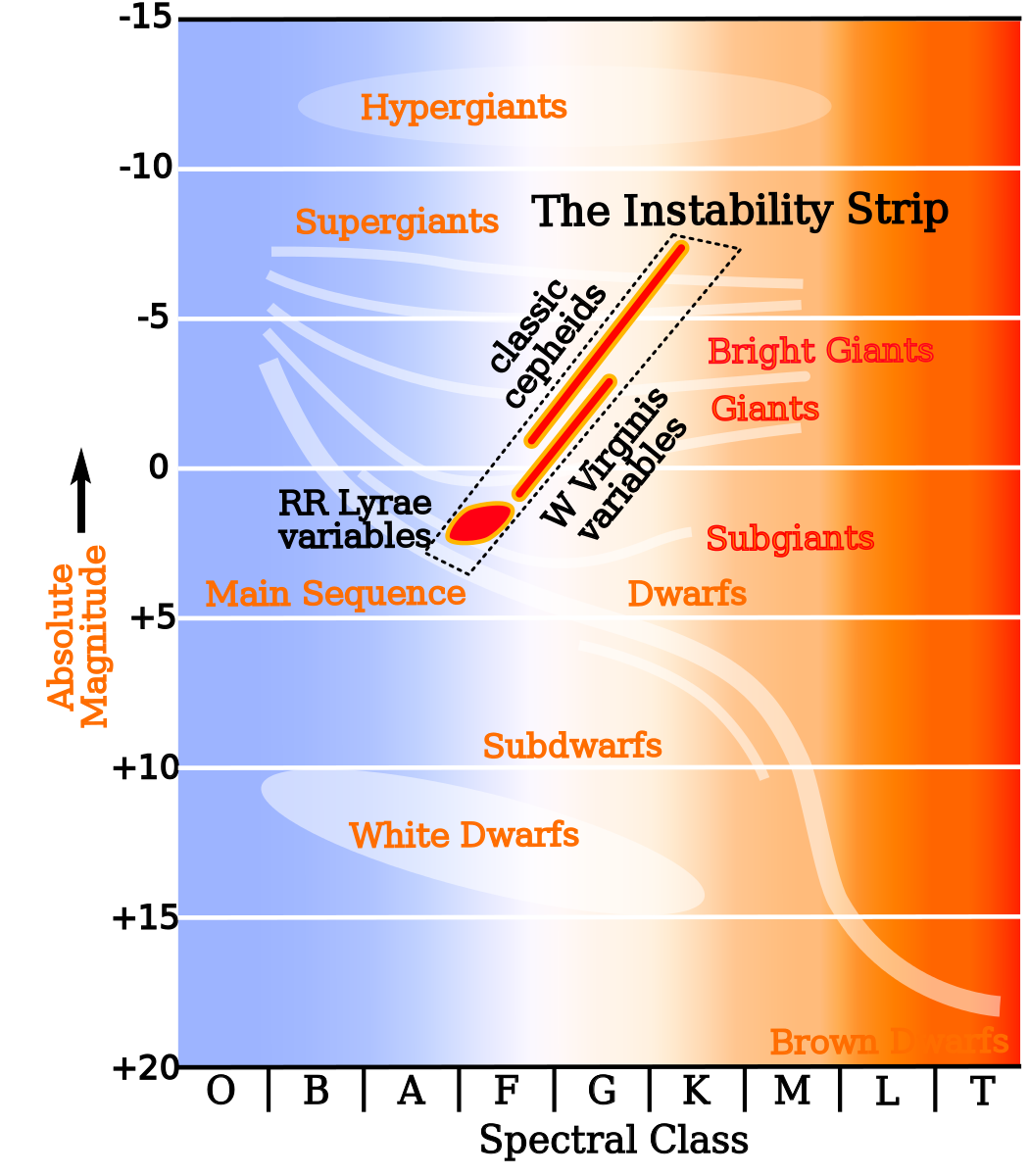
The instability strip, indicated on an H-R diagram. Stellar classification types are listed across the bottom of the diagram. Many main-sequence A stars reside in the instability strip. [Rursus]

Why is this? We don’t expect that main-sequence A stars host fewer planets than cooler stars. Instead, it’s primarily because the two main techniques that we use to find planets — namely, transits and radial velocity — can’t be used as effectively on the main-sequence A stars that are most likely to host planets, because the luminosities of these stars are often variable.

These stars can lie on what’s known as the “classical instability strip” in the Herzsprung-Russell diagram. Such variable stars pulsate due to changes in the ionization state of atoms deep in their interiors, which causes the stars to puff up and then collapse back inward. For variable main-sequence A stars, the periods for these pulsations can be several to several tens of times per day.

These very pulsations that make transits and radial-velocity measurements so difficult, however, can potentially be used to detect planets in a different way. Led by Simon Murphy (University of Sydney, Australia and Aarhus University, Denmark), a team of scientists has recently detected the first planet ever to be discovered around a main-sequence A star from the timing of the star’s pulses.

Delayed Pulses

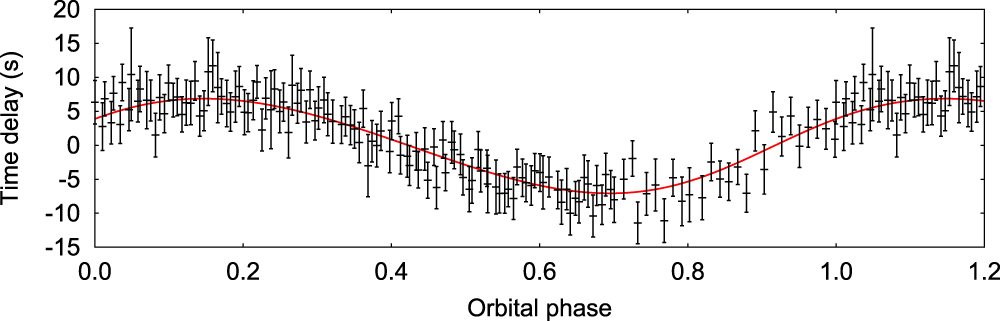
Murphy and collaborators examined the pulsation period of the star KIC 7917485 over four years of Kepler data. They found that the star’s pulsations, which have a predictable periodic timing, are delayed slightly in their arrival time. But the delays themselves show periodicity — indicating that these delays are caused by the orbit of another body whose small gravitational tug modulates the star’s pulses.

Pulsation delays

The time delays of KIC 7917485’s pulsations show a periodic oscillation, indicating the presence of an orbiting companion. [Murphy et al. 2016]

By modeling the star’s light curve, the authors were able to determine that its companion is roughly 12 Jupiter masses, has an orbital eccentricity of ~0.15, and orbits once every ~840 days. This period suggests the planet’s location is consistent with its host’s habitable zone, making this the first planet that has been found near the habitable zone for a main-sequence A star.

This successful discovery — despite the planet not having been detected via transits, direct imaging, or other techniques — suggests that looking for modulation in the pulses of hot, variable stars may be an excellent new way to find planets orbiting them.

Citation

Simon J. Murphy et al 2016 ApJ 827 L17. doi:10.3847/2041-8205/827/1/L17

SMBH

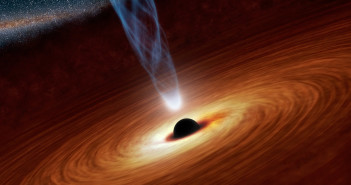
Supermassive black holes (SMBHs) lurk in the centers of galaxies, and we’ve measured their masses to range from hundreds of thousands to ten billion solar masses. But is there a maximum mass that these monsters are limited to?

Observed Maximum

Since the era when the first SMBHs formed, enough time has passed for them to potentially grow to monstrous size, assuming a sufficient supply of fuel.

Instead, however, we observe that SMBHs in the centers of the largest local-universe galaxies max out at a top mass of a few times 1010 solar masses. Even more intriguingly, this limit appears to be redshift-independent: we see the same maximum mass of a few 1010 solar masses for SMBHs fueling the brightest of quasars at redshifts up to z~7.

accretion rates

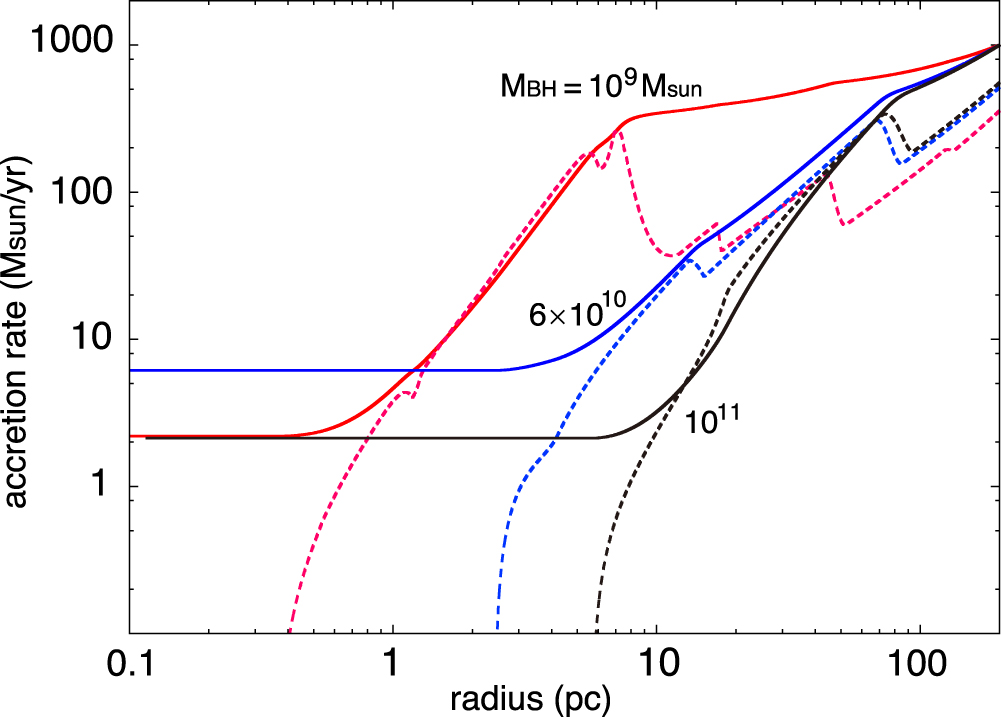
Accretion rate (solid) and star formation rate (dashed) vs. radius in a star-forming accretion disk, for several different values of black-hole mass. Though accretion rates start out very high at large radius, they drop to just a few solar masses per year at small radii, because much of the gas is lost to star formation in the disk. [Inayoshi & Haiman 2016]

So why don’t we see any giants larger than around 10 billion solar masses, regardless of where we look? Two astronomers from Columbia University, Kohei Inayoshi (Simons Fellow) and Zoltán Haiman, suggest that there is a limiting mass for SMBHs that’s set by small-scale physical processes, rather than large processes like galaxy evolution, star formation history, or background cosmology.

Challenges for Accretion

Growing an SMBH that’s more massive than 1010 solar masses requires gas to be quickly funneled from the outer regions of the galaxy (hundreds of light-years out), through the large accretion disk that surrounds the black hole, and into the nuclear region (light-year scales): the gas must be brought in at rates as high as 1,000 solar masses per year.

Modeling this process, Inayoshi and Haiman demonstrate that at such high rates, the majority of the gas instead gets stuck in the disk, causing star formation at radii of tens to hundreds of light-years and never getting close enough to fuel the SMBH. The remaining trickle of gas that does accrete onto the SMBH is not enough to allow it to grow to more than 1011 solar masses in the age of the universe.

Cygnus A

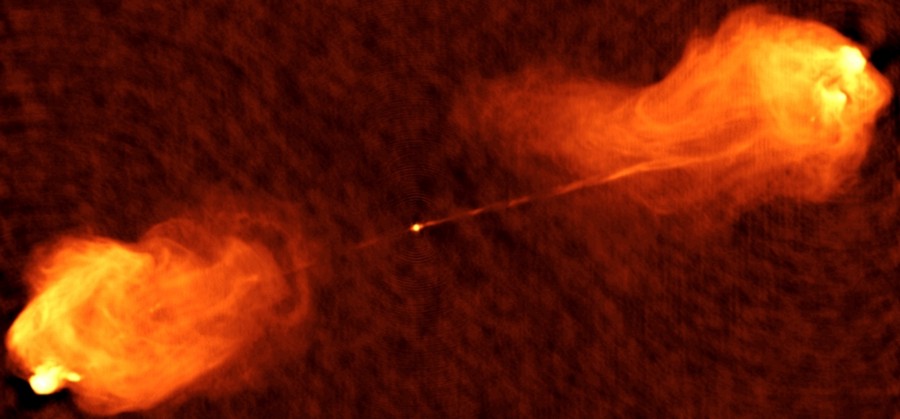
Cygnus A provides a stunning example of the tremendous jets that can be launched from SMBHs at the center of galaxies. [NRAO]

What’s more, for a large enough SMBH, this trickle of gas can become so small relative to the black hole mass that the physics of the accretion itself changes, causing the inner disk to puff up and launching strong outflows and jets. Once this transition occurs, the black-hole feeding is suppressed, preventing the SMBH from growing any larger.

The authors show that the critical mass for this transition is 1–6 x 10¹⁰ solar masses — consistent with the maximum masses that we’ve observed for SMBHs in the wild. This consistency supports the idea that the small-scale physics around the SMBH may be setting its size limit, rather than the large-scale environment around the galaxy.

Citation

Kohei Inayoshi and Zoltán Haiman 2016 ApJ 828 110. doi:10.3847/0004-637X/828/2/110

Phobos and Deimos

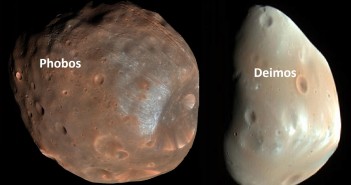
A new study examines the possibility that Mars’s two moons formed after a large body slammed into Mars, creating a disk of debris. This scenario might be the key to reconciling the moons’ orbital properties with their compositions.

Conflicting Evidence

Formation scenarios

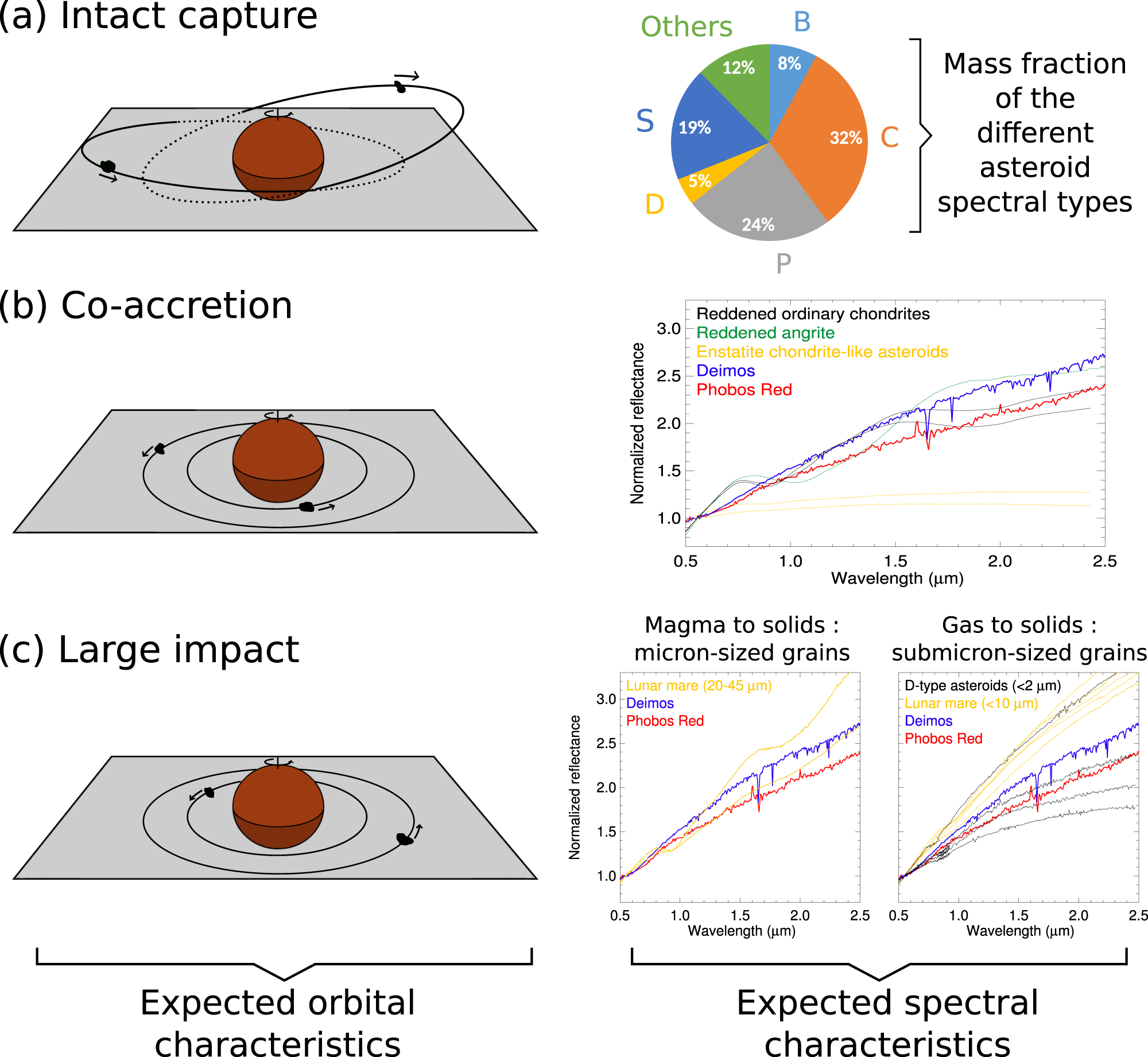
The different orbital (left) and spectral (right) characteristics of the Martian moons in the three different formation scenarios. Click for a better look! Phobos and Deimos’s orbital characteristics are best matched by formation around Mars (b and c), and their physical characteristics are best matched by formation in the outer region of an impact-generated accretion disk (rightmost panel of c). [Ronnet et al. 2016]

How were Mars’s two moons, Phobos and Deimos, formed? There are three standing theories:

  1. Two already-formed, small bodies from the outer main asteroid belt were captured by Mars, intact.
  2. The bodies formed simultaneously with Mars, by accretion from the same materials.
  3. A large impact on Mars created an accretion disk of material from which the two bodies formed.

Our observations of the Martian moons, unfortunately, provide conflicting evidence about which of these scenarios is correct. The physical properties of the moons — low albedos, low densities — are consistent with those of asteroids in our solar system, and are not consistent with Mars’s properties, suggesting that the co-accretion scenario is unlikely. On the other hand, the moons’ orbital properties — low inclination, low eccentricity, prograde orbits — are consistent with bodies that formed around Mars rather than being captured.

In a recent study, a team of scientists led by Thomas Ronnet and Pierre Vernazza (Aix-Marseille University, Laboratory of Astrophysics of Marseille) has attempted to reconcile these conflicting observations by focusing on the third option.

Moons After a Large Impact

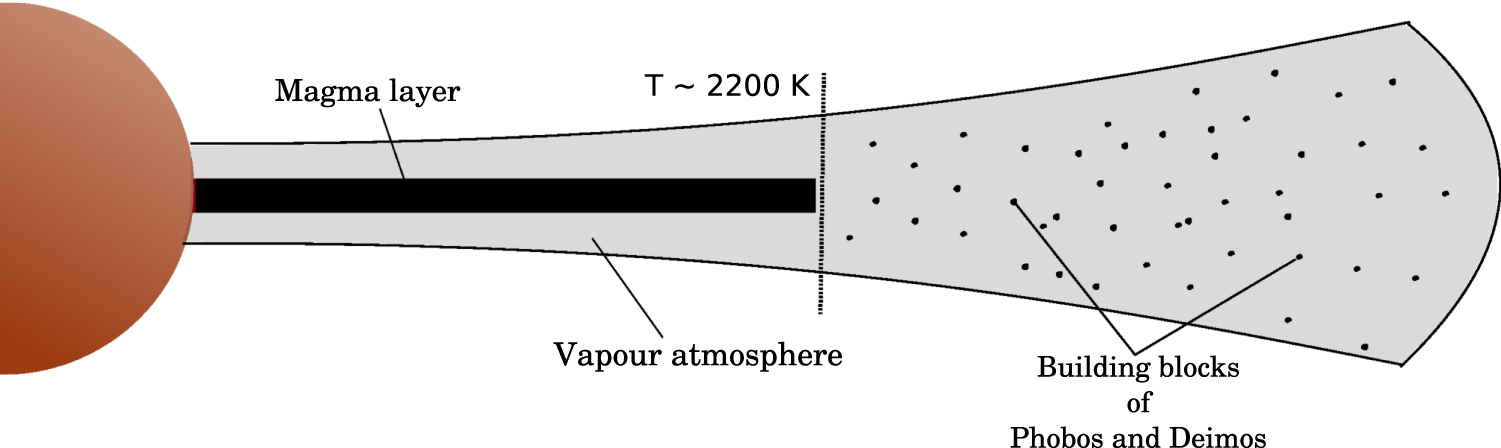
In the third scenario, an impactor of perhaps a few percent of Mars’s mass smashed into Mars, forming a debris disk of hot material that encircled Mars. Perturbations in the disk then led to the formation of large clumps, which eventually agglomerated to form Phobos and Deimos.

Circum-Mars accretion disk

The authors find that Phobos and Deimos most likely formed in the outer regions of the accretion disk that was created by a large impact with Mars. [Adapted from Ronnet et al. 2016]

In the study conducted by Ronnet, Vernazza, and collaborators, the authors investigated the composition and texture of the dust that would have crystallized in an impact-generated accretion disk making up Mars’s moons. They find that Phobos and Deimos could not have formed out of the extremely hot, magma-filled inner regions of such a disk, because this would have resulted in different compositions than we observe.

Phobos and Deimos could have formed, however, in the very outer part of an impact-generated accretion disk, where the hot gas condensed directly into small solid grains instead of passing through the magma phase. Accretion of such tiny grains would naturally explain the similarity in physical properties we observe between Mars’s moons and some main-belt asteroids — and yet this picture is also consistent with the moons’ current orbital parameters.

The authors argue that the formation of the Martian moons from the outer regions of an impact-generated accretion disk is therefore a plausible scenario, neatly reconciling the observed physical properties of Phobos and Diemos with their orbital properties.

Citation

T. Ronnet et al 2016 ApJ 828 109. doi:10.3847/0004-637X/828/2/109

NS merger

Where do the heavy elements — the chemical elements beyond iron — in our universe come from? One of the primary candidate sources is the merger of two neutron stars, but recent observations have cast doubt on this model. Can neutron-star mergers really be responsible?

Elements from Collisions?

element origins

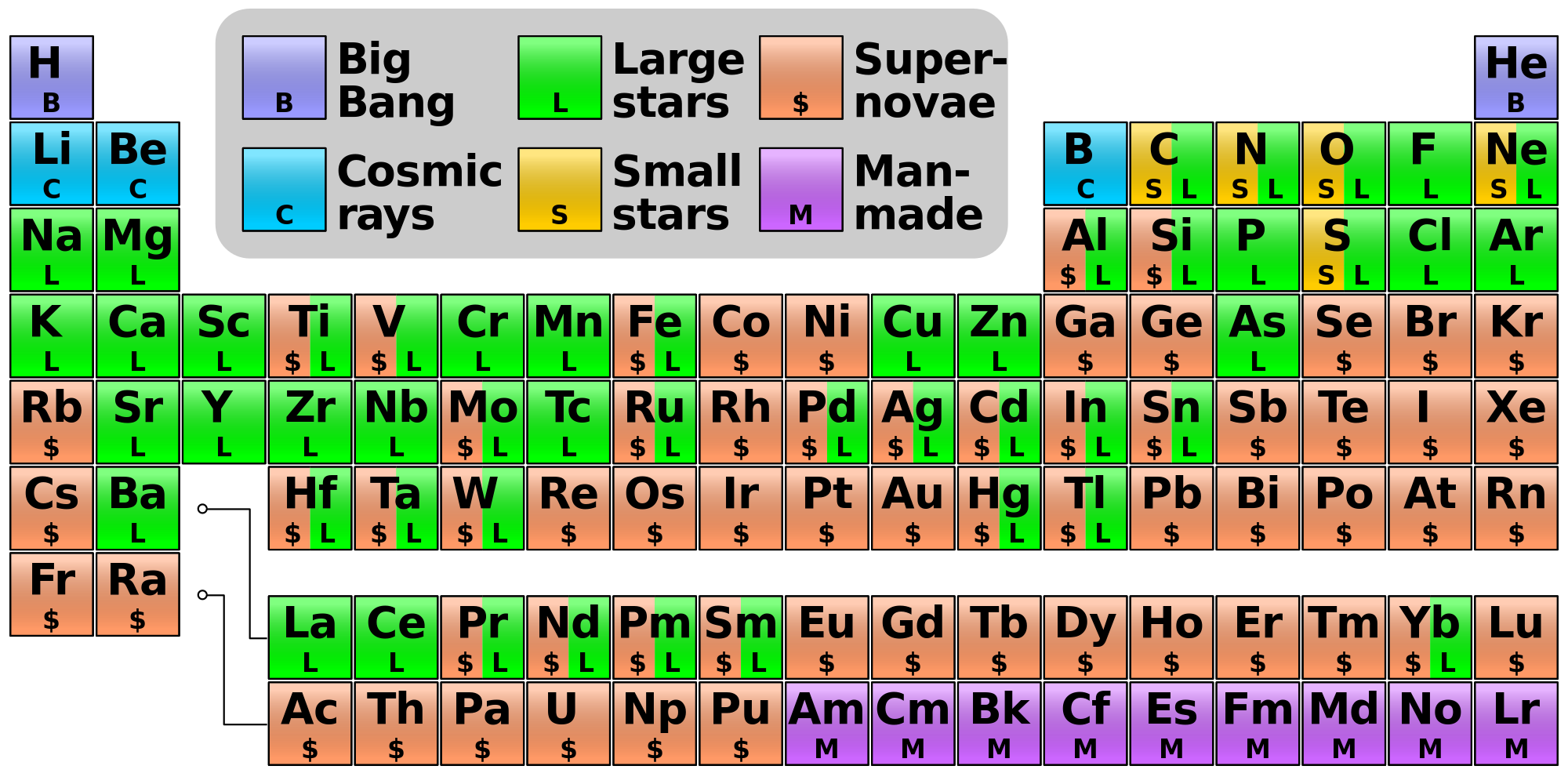
Periodic table showing the origin of each chemical element. Those produced by the r-process are shaded orange and attributed to supernovae in this image; though supernovae are one proposed source of r-process elements, an alternative source is the merger of two neutron stars. [Cmglee]

When a binary-neutron-star system inspirals and the two neutron stars smash into each other, a shower of neutrons are released. These neutrons are thought to bombard the surrounding atoms, rapidly producing heavy elements in what is known as r-process nucleosynthesis.

So could these mergers be responsible for producing the majority of the universe’s heavy r-process elements? Proponents of this model argue that it’s supported by observations. The overall amount of heavy r-process material in the Milky Way, for instance, is consistent with the expected ejection amounts from mergers, based both on predicted merger rates for neutron stars in the galaxy, and on the observed rates of soft gamma-ray bursts (which are thought to accompany double-neutron-star mergers).

Challenges from Ultra-Faint Dwarfs

Recently, however, r-process elements have been observed in ultra-faint dwarf satellite galaxies. This discovery raises two major challenges to the merger model for heavy-element production:

  1. When neutron stars are born during a core-collapse supernova, mass is ejected, providing the stars with asymmetric natal kicks. During the second collapse in a double-neutron-star binary, wouldn’t the kick exceed the low escape velocity of an ultra-faint dwarf, ejecting the binary before it could merge and enrich the galaxy?
  2. Ultra-faint dwarfs have very old stellar populations — and the observation of r-process elements in these stars requires mergers to have occurred very early in the galaxy’s history. Can double-neutron-star systems merge quickly enough to account for the observed chemical enrichment?

Small Kicks and Fast Mergers

kick velocities

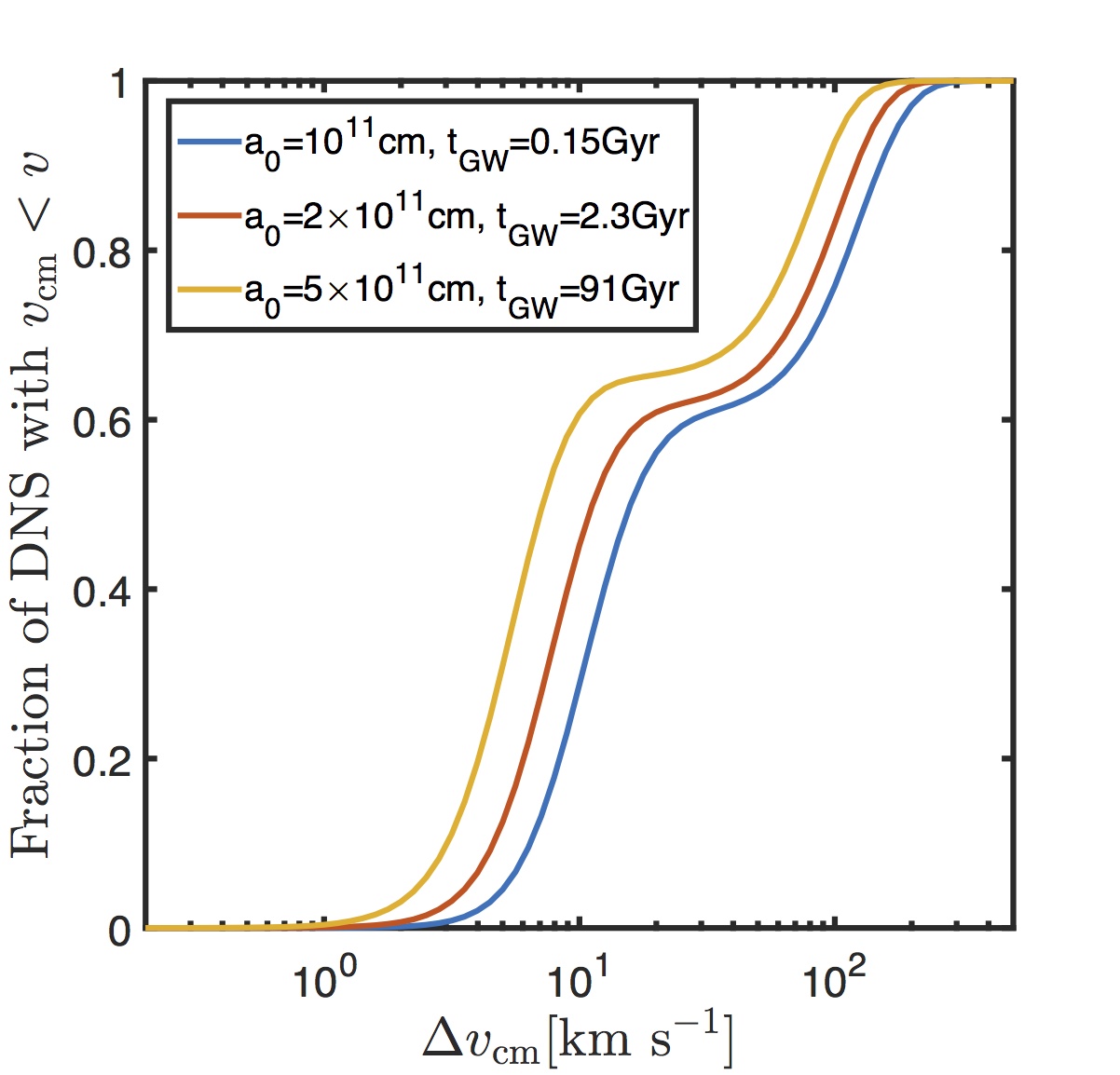
Fraction of double-neutron-star systems that remain bound, vs. the magnitude of the kick they receive. A typical escape velocity for an ultra-faint dwarf is ~15 km/s; roughly 55-65% of binaries receive smaller kicks than that and wouldn’t be ejected from an ultra-faint dwarf. [Beniamini et al. 2016]

Led by Paz Beniamini, a team of scientists from the Racah Institute of Physics at the Hebrew University of Jerusalem has set out to answer these questions. Using the statistics of our galaxy’s double-neutron-star population, the team performed Monte Carlo simulations to estimate the distributions of mass ejection and kick velocities for the systems.

Beniamini and collaborators find that, for typical initial separations, more than half of neutron star binaries are born with small enough kicks that they remain bound and aren’t ejected — even from small, ultra-faint dwarf galaxies.

The team also used their statistics to calculate the time until merger for the population of binaries, finding that ~90% of the double-neutron-star systems merge within 300 Myr, and around 15% merge within 100 Myr — quick enough to enrich even the old population of stars.

This population of systems that remain confined to the galaxy and merge rapidly can therefore explain the observations of r-process material in ultra-faint dwarf galaxies. Beniamini and collaborators’ work suggests that the merger of neutron stars is indeed a viable model for the production of heavy elements in our universe.

Citation

Paz Beniamini et al 2016 ApJ 829 L13. doi:10.3847/2041-8205/829/1/L13

blue straggler/white dwarf

A new study has examined how the puzzling wide binary system HS 2220+2146 — which consists of two white dwarfs orbiting each other — might have formed. This system may be an example of a new evolutionary pathway for wide white-dwarf binaries.

Evolution of a Binary

More than 100 stellar systems have been discovered consisting of two white dwarfs in a wide orbit around each other. How do these binaries form? In the traditional picture, the system begins as a binary consisting of two main-sequence stars. Due to the large separation between the stars, the stars evolve independently, each passing through the main-sequence and giant branches and ending their lives as white dwarfs.

hierarchical triple

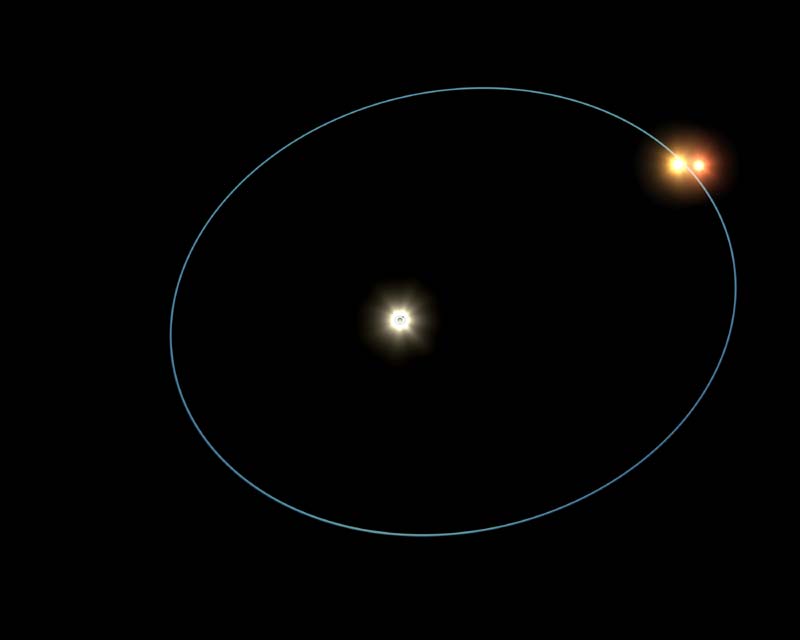
An illustration of a hierarchical triple star system, in which two stars orbit each other, and a third star orbits the pair. [NASA/JPL-Caltech]

Because more massive stars evolve more quickly, the most massive of the two stars in a binary pair should be the first to evolve into a white dwarf. Consequently, when we observe a double-white-dwarf binary, it’s usually a safe bet that the more massive of the two white dwarfs will also be the older and cooler of the pair, since it should have formed first.

But in the case of the double-white-dwarf binary HS 2220+2146, the opposite is true: the more massive of the two white dwarfs appears to be the younger and hotter of the pair. If it wasn’t created in the traditional way, then how did this system form?

Two From Three?

Led by Jeff Andrews (Foundation for Research and Technology-Hellas, Greece and Columbia University), a team of scientists recently examined this system more carefully, analyzing its spectra to confirm our understanding of the white dwarfs’ temperatures and masses.

Based on their observations, Andrews and collaborators determined that there are no hidden additional companions that could have caused the unusual evolution of this system. Instead, the team proposed that this unusual binary might be an example of an evolutionary channel that involves three stars.

formation model

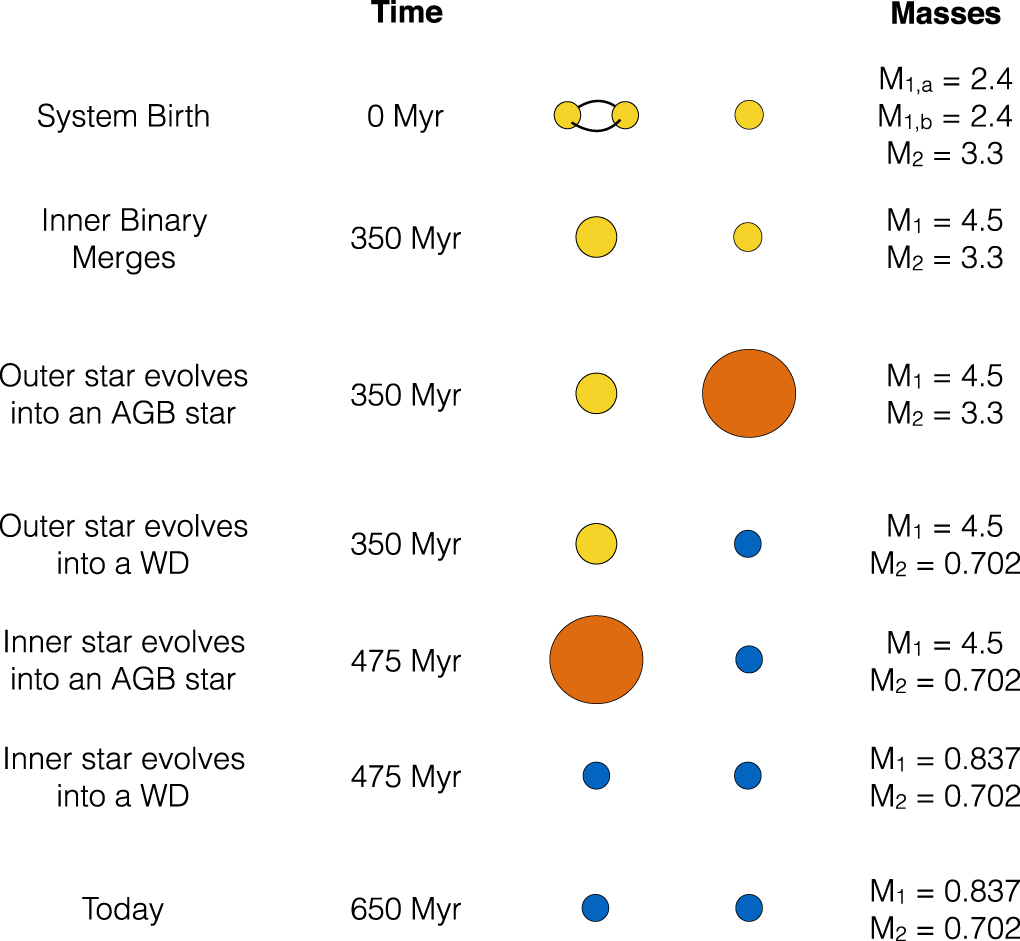
The authors’ proposed formation scenario for H220+2146. In this picture, the inner binary merges to form a blue straggler. This star and the remaining main-sequence star then evolve independently into white dwarfs, forming the system observed today. [Andrews et al. 2016]

An Early Merger

In the model the authors propose for HS 2220+2146, the binary system began as a hierarchical triple system of main-sequence stars. The innermost binary then merged to form a large star known as a “blue straggler” — a star that, due to the merger, will evolve more slowly than its larger mass implies it should.

The blue straggler and the remaining main-sequence star, still in a wide orbit, then continued to evolve independently of each other. The smaller star ended its main-sequence lifetime and became a white dwarf first, followed by the more massive but slowly evolving blue straggler — thus forming the system we observe today.

If the authors’ model is correct, then HS 2220+2146 would be the first binary double white dwarf known to have formed through this channel. ESA’s Gaia mission, currently underway, is expected to discover up to a million new white dwarfs, many of which will likely be in wide binary systems. Among these, we may well find many other systems like HS 2220+2146 that formed in the same way.

Citation

Jeff J. Andrews et al 2016 ApJ 828 38. doi:10.3847/0004-637X/828/1/38

comet swarm

KIC 8462860

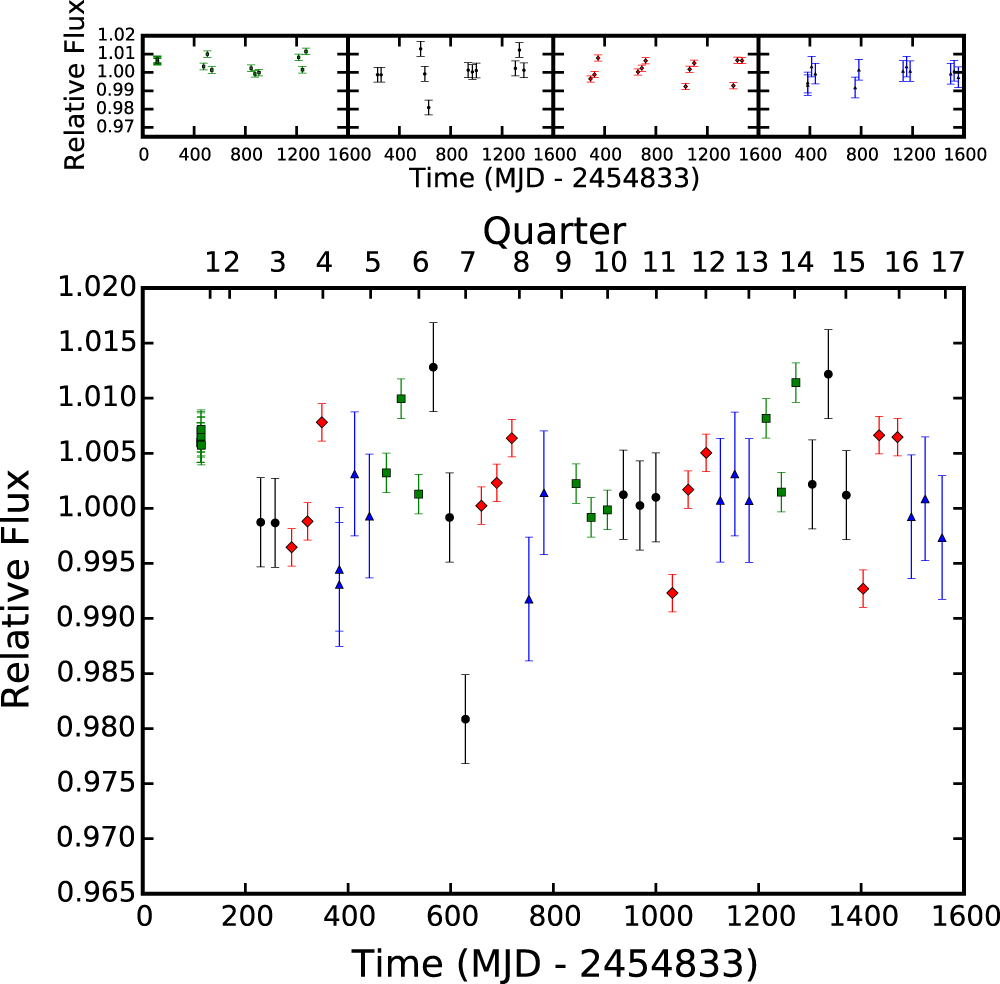
Photometric time series for a neighboring star that’s 25” NNW of Boyajian’s Star. No significant long-term dimming is seen — which constrains the size of potential material obscuring Boyajian’s Star. [Wright et al. 2016/Benjamin Montet]

What’s causing the mysterious light-curve dips of the so-called “alien megastructure” star, Boyajian’s Star? A recent study analyzes a variety of possible explanations to determine which ones are the most plausible.

An Unusual Light Curve

Earlier this year, astronomer Tabetha Boyajian reported on the unusual light curve of the star KIC 8462852. This star, now nicknamed “Tabby’s Star” or “Boyajian’s Star”, shows unusual dips on day-long timescales that are too large to be explained by planet transits or similar phenomena.

In addition to these short dips in luminosity, recent observations have also indicated that the star has faded by roughly 20% over the past hundred years. What could be causing both the short-term dips in the star’s light and the long-term dimming over a century?

Alien megastructures

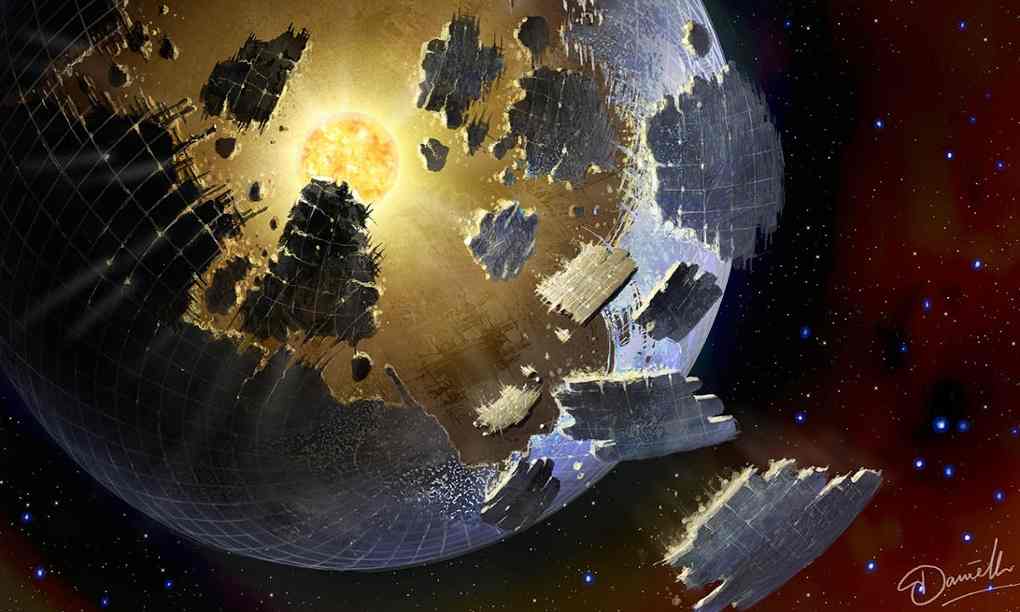
Could the dimming be caused by an ‘alien megastructure’ built by an extraterrestrial civilization? The authors find that a spherical structure is very unlikely. [Danielle Futselaar/SETI International]

Alien Megastructures? Or Another Explanation?

Boyajian’s Star was vaulted into the media spotlight when astronomer Jason Wright (Pennsylvania State University and University of California, Berkeley) proposed that its unusual light curve could potentially be explained by a surrounding megastructure built by an extraterrestrial civilization.

Now Wright is back with co-author Steinn Sigurd̵sson (Pennsylvania State University). In a new study, Wright and Sigurd̵sson analyze an extensive list of explanations for the puzzling apparent behavior of Boyajian’s Star, based on our latest knowledge about this strange object.

The Realm of Possibilities

Here are just a few possible causes of Boyajian’s Star’s dimming, as well as the authors’ assessment of their plausibility. For the full list, see the authors’ original article, or check out Wright’s own summary of the article here!

  1. Pulsations, polar spots, and other stellar variability: unlikely
    The authors show that the variety of timescales observed for dimming events make scenarios involving stellar variations unlikely.
  2. Circumstellar material: unlikely
    Material orbiting the star (like comets) would explain some of the light-curve dips, but it can’t explain the long-term dimming observed.
  3. Post-merger return to normal: unclear
    Perhaps Boyajian’s Star recently merged with a brown dwarf or other star? Now it could be gradually dimming as it returns to its normal brightness, and restructuring of the star’s material could cause the short-term dips. Though this scenario is possible, the timescales for the brightness changes are shorter than we would expect.
  4. Artificial structures: unclear
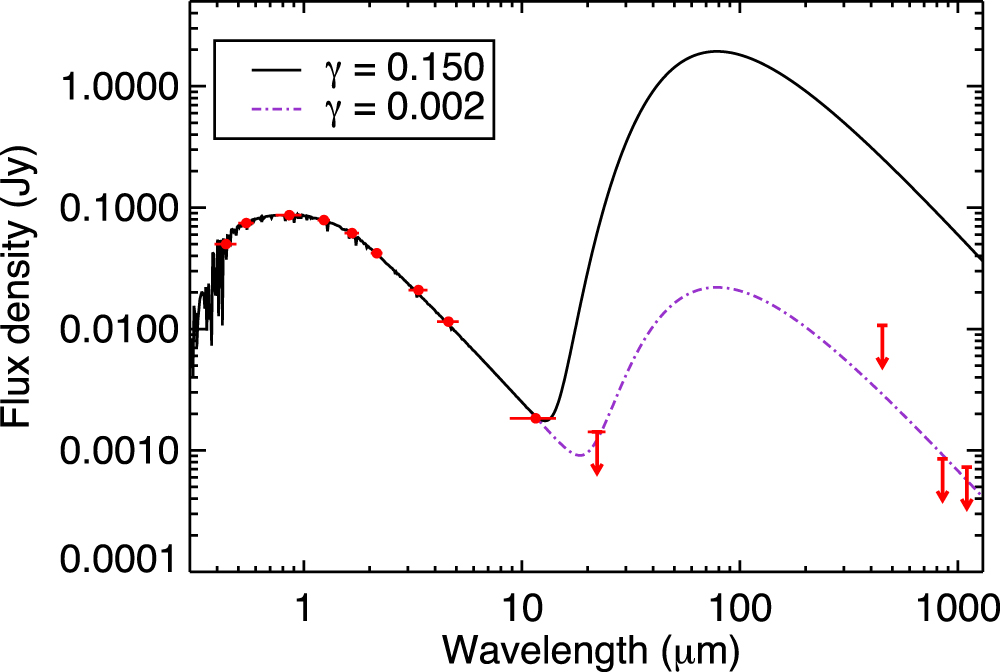
    Spherical swarms of structures would intercept the star’s light and re-radiate it in infrared. Since long-wavelength observations have found no evidence of such radiation, the authors declare spherical geometries to be unlikely. Other structure geometries can’t yet be ruled out, though.
  5. Small-scale interstellar medium (ISM) structure: plausible
    Small-scale density variations in the ISM between us and Boyajian’s Star could cause the dimming we observe, but the fact that nearby stars don’t show similar dimming sets tight limits on the size of such ISM clumps.
SED

Spectral energy distribution of Boyajian’s Star. The upper-limit arrows on the right-hand side indicate that big clouds of megastructures are unlikely, because we would detect their heat as they re-radiate the star’s light in infrared. [Wright et al. 2016]

Looking to the Future

Of the possible locations for the source of the dimming, Wright and Sigurd̵sson deem the interstellar space between us and Boyajian’s Star to be the most likely culprit. They identify several future lines of research that could help us further eliminate possibilities, however, including a study of the ISM toward Boyajian’s Star, a hunt for similar variations in stars near in the sky to Boyajian’s Star, and infrared observation of the star with JWST to search for heat signatures.

Citation

Jason T. Wright and Steinn Sigurd̵sson 2016 ApJ 829 L3. doi:10.3847/2041-8205/829/1/L3

CME at Earth

Coronal mass ejections (CMEs), enormous releases of energy from the Sun, can have significant space-weather implications for Earth. Do similar storms from smaller stars — M dwarfs like V374 Peg, or the nearby Proxima Centauri — mean bad news for the planets that these stars host?

Volatile Stars

Habitable zones

Difference in habitable-zone sizes for different stellar types. [NASA]

When plasma is released from the Sun in the form of a CME traveling toward Earth, these storms can be powerful enough to disrupt communications and navigational equipment, damage satellites, and cause blackouts — even with our planetary magnetic field to protect us! How might planets in the habitable zone of M-dwarf stars fare against similar storms?

The first danger for an M dwarf’s planets is that the habitable zone lies much closer to the star: it can range from 0.03 to 0.4 AU (i.e., within Mercury’s orbit). Being so close to the star definitely makes a planet in an M dwarf’s habitable zone vulnerable to storms.

Probability of impact

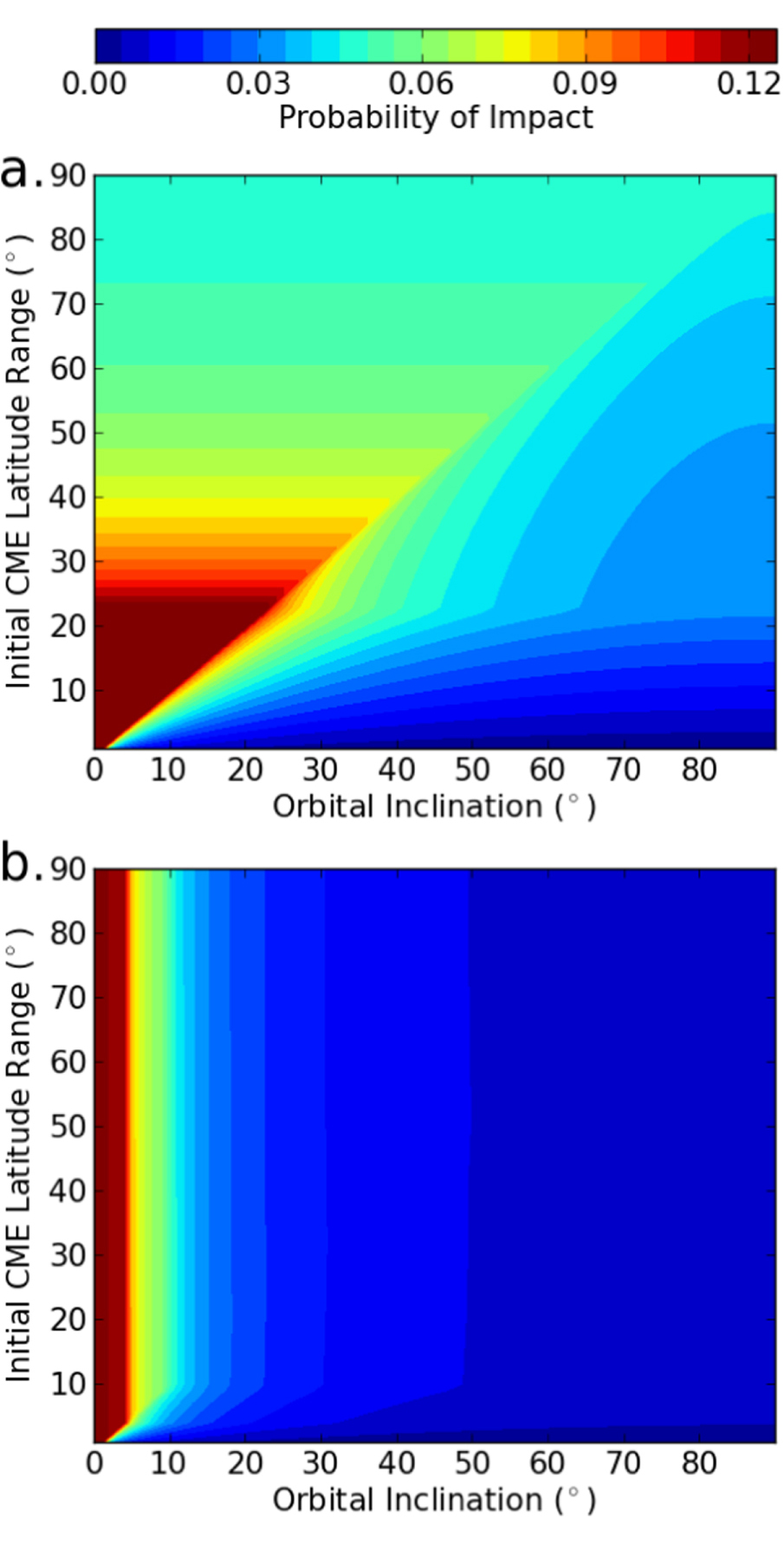
Colors indicate the probability of CME impact, for different different stellar latitudes where the CME originated vs. orbital inclination of the planet, (a) without any deflection, and (b) taking into account the CME deflection by the star’s magnetic field. Hanging out in an orbit aligned with the current sheet turns out to be a bad idea. [Adapted from Kay et al. 2016]

What about the storms themselves? You might think that because M dwarfs are cooler stars, they would be quieter, releasing fewer CMEs with less energy. Surprisingly, the opposite is true: M dwarfs are significantly more active than solar-type stars, and the CMEs are typically ten times more massive than those released from the Sun. Impacts from these powerful outbursts could easily strip any existing planet atmosphere, making a planet much less likely to be habitable. To make matters worse, M dwarfs can remain magnetically active for billions of years: even a star like Proxima Centauri, which is nearly 5 billion years old, is still relatively active.

Dodging Deflected Storms

Interestingly, an important factor in the survival of an M dwarf’s habitable-zone planet is the plane in which the planet’s orbit lies. A team of scientists led by Christina Kay (NASA Goddard’s Solar Physics Laboratory and Boston University) recently modeled CMEs from V374 Peg, a mid-type M dwarf of roughly a third of the Sun’s mass and radius, to determine how the CMEs propagate and the probability that they’ll impact a hypothetical planet in the star’s habitable zone.

The team shows that traveling CMEs tend to be deflected by the star’s magnetic field. Instead of propagating purely radially outward, the CMEs are pushed toward the astrospheric current sheet — the minimum point of the background magnetic field — which moves around, but is generally located toward the stellar equatorial plane.

Kay and collaborators find that planet orbits roughly aligned with the current sheet therefore have a higher probability of getting hit by a CME: around 10%. In contrast, planets with higher-inclination orbits have CME impact probabilities around 1%. These probabilities translate to an impact rate of about 0.5–5 times per day for a habitable-zone planet around a mid-type M dwarf — which is 2–20 times the average at Earth during solar maximum!

Magnetic field strength needed

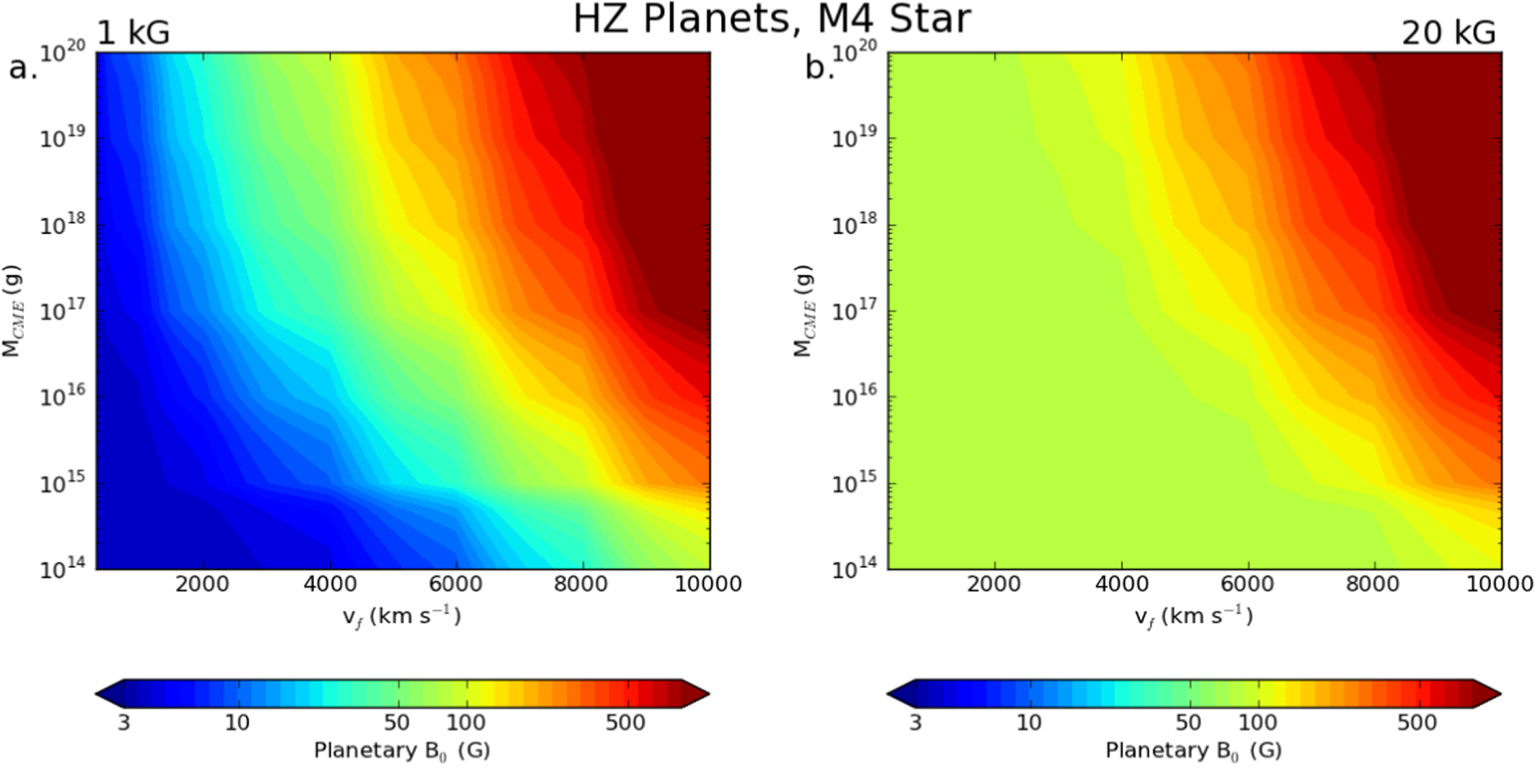
Minimum planetary magnetic field strength required to sustain a magnetosphere twice the size of the planetary radius for different CME masses and speeds, for a 1 kG (left) and 20 kG (right) initial CME magnetic field strength. A typical CME requires a field strength of 10–100 G. [Adapted from Kay et al. 2016]

Is There Hope for Planet Habitability?

With this many CME impacts even outside of the current-sheet plane, how can a planet hope to survive? The key lies in having a strong magnetic field to protect the planet. Such a field would deflect the charged particles from the CME, preventing the CME from stripping the planet’s atmosphere.

Kay and collaborators calculate that a habitable-zone mid-type M-dwarf exoplanet would need a planetary magnetic field between tens and hundreds of Gauss — 1 to 2 orders of magnitude more than that of Earth — to protect itself from these CMEs: difficult to muster, but not impossible!

These results provide some interesting food for thought as we continue to discover new exoplanets orbiting M-dwarf stars.

Citation

C. Kay et al 2016 ApJ 826 195. doi:10.3847/0004-637X/826/2/195

1 96 97 98 99 100 113