Features RSS

Milky Way bulge

In our efforts to map our galaxy’s structure, one region has remained very difficult to probe: the galactic center. A new survey, however, uses infrared light to peer through the gas and dust in the galactic plane, searching for variable stars in the bulge of the galaxy. This study has discovered a population of very young stars in a thin disk in the galactic center, providing clues to the star formation history of the Milky Way over the last 100 million years.

Obscured Center

The center of the Milky Way is dominated by a region known as the galactic bulge. Efforts to better understand this region — in particular, its star formation history — have been hindered by the stars, gas, and dust of the galactic disk, which prevent us from viewing the galactic bulge at low latitudes in visible light.

The positions of the 35 classical Cepheids discovered in VVV data are projected onto an image of the galactic plane. The survey area is outlined by the blue lines. The galactic bar is marked with a red curve, and the bottom panel shows the position of the Cepheids overlaid on the VVV bulge extinction map. Click for a better look! [Dékány et al. 2015]

The positions of the 35 classical Cepheids discovered in VVV data, projected onto an image of the galactic plane. Click for a better look! The survey area is bounded by the blue lines, and the galactic bar is marked with a red curve. The bottom panel shows the position of the Cepheids overlaid on the VVV bulge extinction map. [Dékány et al. 2015]

Infrared light, however, can be used to probe deeper through the dust than visible-light searches. A new survey called VISTA Variables in the Via Lactea (VVV) uses the VISTA telescope in Chile to search, in infrared, for variable stars in the inner part of the galaxy. The VVV survey area spans the Milky Way bulge and an adjacent section of the mid-plane where star formation activity is high.

Led by István Dékány, a researcher at the Millennium Institute of Astrophysics and the Pontifical Catholic University of Chile, a team has now used VVV data to specifically identify classical Cepheid variable stars in the bulge. Why? Cepheids are pulsating stars with a very useful relation between their periods and luminosities that allows them to be used as distance indicators. Moreover, classical Cepheids are indicators of young stellar populations — which can provide information about the star formation history of the region.

New Population

Dékány and collaborators found a total of 35 objects that they believe to be young classical Cepheids. These stars, which were found to have a spread in ages below 100 Myr, span the center of the galaxy, bridging the innermost nuclear region and the larger bulge extent. Despite their distribution across the bulge, however, they make up a very thin disk, all lying close to the mid-plane of the galaxy.

This newly discovered component of the inner galaxy demonstrates that stars have been continuously forming in or near the central region of the galaxy over the last hundred million years. Future investigations of these stars will help determine if the star formation actually occurred in the central bulge, or if the stars originated further out and migrated inwards.

Citation

I. Dékány et al 2015 ApJ 812 L29. doi:10.1088/2041-8205/812/2/L29
Mrk 739

Dual active galactic nuclei (AGN), an intermediary product of galaxy mergers, can give us a better understanding of what happens when two galaxies collide. But because the angular separation of the two galactic nuclei is so small at this stage, identifying these systems is very difficult. In a recent study, a team of authors proposes a new technique for confirming dual AGN candidates.

Signatures in Spectra

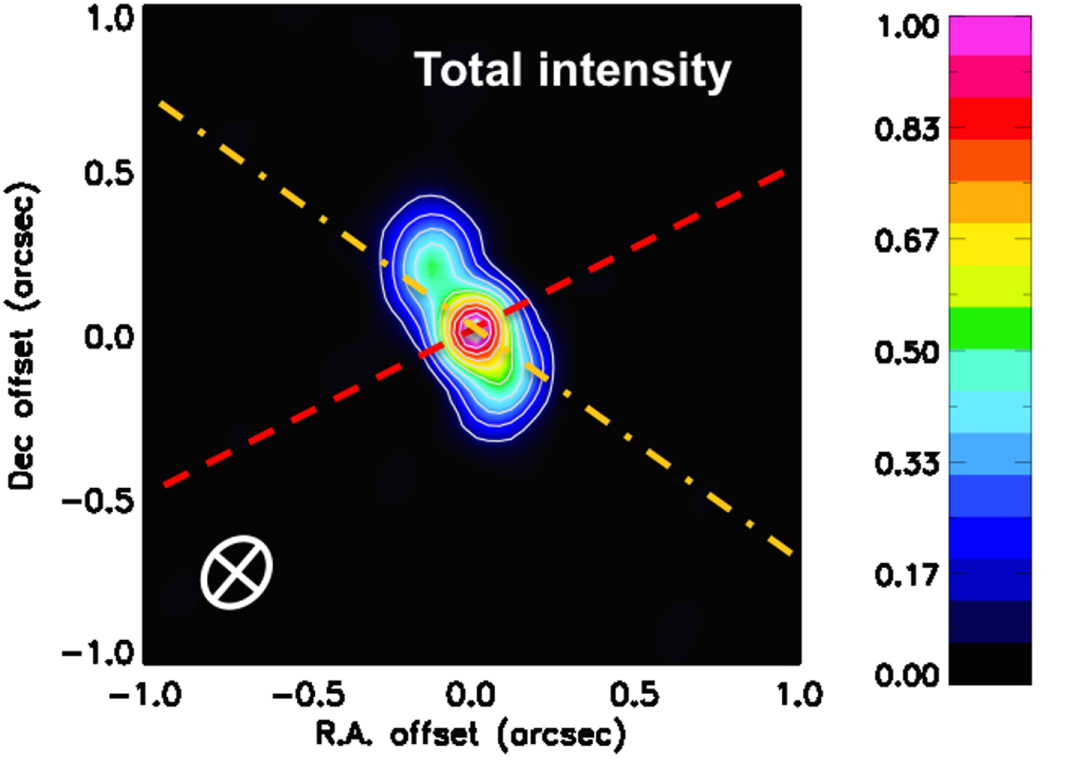
Total-intensity VLA image for J1023+3243. This system is confirmed as a dual AGN; the two compact radio cores are separately identifiable here. [Müller-Sánchez et al. 2015]

Total-intensity VLA image for J1023+3243. This system is confirmed as a dual AGN; the two compact radio cores are separately identifiable here. [Müller-Sánchez et al. 2015]

One approach commonly used to identify dual AGN candidates is to look for signatures in the spectra of these galaxies. Light is emitted by ionized gas in the narrow-line region (NLR), the region that extends from a few hundreds of parsecs to ~30kpc from the nuclei. The spatially-averaged spectrum of this region for dual AGN, however, appears double-peaked due to the motion of the two nuclei rotating around each other.

But there’s a problem with using this technique to identify dual AGN: other processes also produce double-peaked narrow-line emission, mimicking the behavior of dual AGN. These processes include the rotation of ionized gas in the galactic disk, and the motion of radio jets emitted from the AGN.

A team of scientists led by Francisco Müller-Sánchez (University of Colorado Boulder) have proposed that the use of a combination of high-resolution radio observations and spatially-resolved spectroscopy could be used to discern between these possible cases.

Dual AGN or Moving Gas?

To test this method, the group examined a sample of 18 active galactic nuclei from the Sloan Digital Sky Survey. These AGN had previously been identified as candidate dual AGN with double-peaked narrow emission lines. The team obtained both optical long-slit spectroscopy and high-resolution Very Large Array observations of these AGN. They then combined this information to identify the cause of the double-peaked lines in each case.

radio jet

Total-intensity VLA image for J0009–0036. This system contains a two-sided radio jet, causing the extended radio emission seen here. [Müller-Sánchez et al. 2015]

Müller-Sánchez and collaborators found the following:

Roughly 15% are confirmed to be dual AGN. In these cases, distinctly separated radio cores are visible in the Very Large Array data, but their spectra are similar to those of single AGN.

Roughly 75% have double-peaked lines due to gas kinematics, instead. These kinematics include jets, rotating NLR regions, and wind-driven outflows. The jets are identifiable by their extended radio emission and steeper spectra, whereas the rotating NLR regions and wind-driven outflows are identifiable by their lack of additional radio cores or extended emission, and the morphology of their spectra.

Only two cases of the 18 were ambiguous and couldn’t be identified. The authors conclude that their method of confirming dual AGN is therefore a powerful means of identifying dual AGN that have very small angular separations.

Citation

F. Müller-Sánchez et al 2015 ApJ 813 103. doi:10.1088/0004-637X/813/2/103

T Tauri star

T Tauri stars are a young class of variable stars. The T Tauri star PTFO 8-8695, which lies around 1,100 light-years away in Orion, has been suspected of harboring a close-in giant planet. A recent study, however, casts doubt on this theory.

Fading Star

Finding a close-in giant planet around a very young (i.e., less than a few million years old) star would be a major discovery. Such a system could tell us about when planets form, how they behave as newly-born planets, and the mechanism that causes planets to migrate inwards to create hot Jupiters. Thus far, the only candidate system of a very young star with a close-in giant planet is PTFO 8-8695.

On top of its normal variability, PTFO 8-8695 was found to exhibit periodic fading events, during which it dims by a few percent for an interval of ~1.8 hours. The leading interpretation of these events was that they are caused by the transit of a planet with a precessing orbit.

Normally we would test this hypothesis by looking for radial-velocity variation of the host star, but stellar activity prevents us from being able to pick out a signal here. So a collaboration of scientists led by Liang Yu (Massachusetts Institute of Technology) set out to systematically test this theory using less conventional approaches.

Failed Tests

Yu and collaborators used three different tests:

  1. They looked for slow changes in the light curve morphology.
    A planet with a precessing orbit would leave a distinctive signature in the appearance of the light curve. The team, however, didn’t find this predicted morphology. Even more importantly, they discovered that the fading events aren’t even strictly periodic — in recent observations, the period has decreased.
  2. They tried to detect the planet’s radiation in infrared.
    Planets emit in infrared, so by observing the system during times when the planet is supposedly passing behind the star, there should be a visible dip in the measured infrared radiation. No dip of the predicted size was found.
  3. They looked for the Rossiter-McLaughlin effect.
    The RM effect is an anomaly that appears in spectroscopic data of a planet’s transit due to stellar rotation. To check for this, the team obtained high-resolution spectroscopy during a fading event. No effect was seen at the predicted level in their data.

Given these three failed tests, and the new evidence that the fading events aren’t strictly periodic, the authors argue that these events aren’t caused by a planet transiting PTFO 8-8695. Instead, the team put forward a few new hypotheses, including starspots, eclipses by circumstellar dust, or occultations of an accretion hotspot. Further observations should help to narrow down the possibilities.

Citation

Liang Yu et al 2015 ApJ 812 48. doi:10.1088/0004-637X/812/1/48

star formation

Extremely high star formation rates have been observed in galaxies at high redshifts, posing somewhat of a mystery: how are these enormous rates achieved? A team of scientists has proposed that these high rates of star formation could be explained by feedback from active nuclei at the centers of the galaxies.

Pressurized Bubble

We believe that star formation occurs in galaxies as a result of gas clumps that collapse under their own gravity, eventually becoming dense enough to launch nuclear fusion. Recently, there’s been mounting evidence that the star formation rate is significantly higher in high-redshift galaxies, particularly those with active galactic nuclei (AGN). Could this simply be caused by a higher gas fraction at higher redshifts? Or is it possible that a different mechanism is at work in these galaxies, producing more efficient star formation?

A team of authors led by Rebekka Bieri (Paris Institute of Astrophysics) has proposed that this enhanced star formation may be caused by positive feedback from the active nucleus of the galaxy. The team suggests that an outflow from the AGN could create an over-pressurized bubble around the galactic disk that pushes back on the disk, leading to a higher rate of star formation.

Simulating a Boost

The authors test this toy model by simulating the scenario. They model a disk galaxy with roughly a tenth of the mass of the Milky Way, which starts in a relaxed state. The galaxy is then evolved either with or without an applied external pressure, representing the isotropic pressure from the bubble created by the AGN outflow. These models are tested in two different scenarios: one where the initial gas fraction is 10%, and one where the initial gas fraction is 50%.

Star formation rates for the low-gas-fraction (left) and high-gas-fraction (right) simulated galaxies. The blue lines show the rates without external pressure; the red lines show the rates with external pressure applied. Click for a better look! [Bieri et al. 2015]

Star formation rates for the low-gas-fraction (left) and high-gas-fraction (right) simulated galaxies. The blue lines show the rates without external pressure; the red lines show the rates with external pressure applied. [Bieri et al. 2015]

The simulations show that in all cases, the presence of external pressure causes the star formation rates to be significantly higher than in the cases with no feedback. For galaxies that contain a high gas fraction, this difference is especially pronounced at early times; the external pressure causes gas to fragment into clumps that are dense enough to form stars much sooner than in the absence of pressure.

Bieri and collaborators also track the mass entering and leaving the galactic disk during the simulation. When external pressure is present, it drives a large net mass inflow at the beginning of the simulation, carrying in material from the halo and outer disk. This early source of mass helps to feed cloud and clump growth in the inner parts of the galaxy — contributing to the increased star formation rate in the pressurized cases.

Thus, this simple model has demonstrated that enhanced pressure due to AGN feedback is an effective means of explaining the large star formation rates we observe in high-redshift galaxies.

Citation

Rebekka Bieri et al 2015 ApJ 812 L36. doi:10.1088/2041-8205/812/2/L36

compact object merger

The merger of two neutron stars (a NS–NS merger) is suspected to be the most likely source of short-duration gamma-ray bursts (GRBs) — powerful explosions that can be seen from billions of light-years away. But whether a GRB is launched is dependent on what remnant is created by the merging NSs. Do they form another NS? Or a black hole (BH)?

Uncertain Remnant

If the NS–NS merger forms a BH remnant, a GRB can be launched during the ensuing accretion. But if it instead forms a NS, a GRB may only be launched if the remnant collapses to a BH within 100 milliseconds; any longer, and theory says that the GRB jet will become loaded with baryons and choke.

Unfortunately, determining whether the merger will produce a NS or a BH is difficult. A major limitation is that we don’t know what equation of state describes the interior of a NS — which means we also don’t know what maximum mass a NS can have before it collapses into a BH.

Led by Chris Fryer of the University of Arizona and the Los Alamos National Laboratory, a group of researchers undertook a highly collaborative study to better understand the fates of NS–NS mergers.

Maximum Mass

fractional outcomes

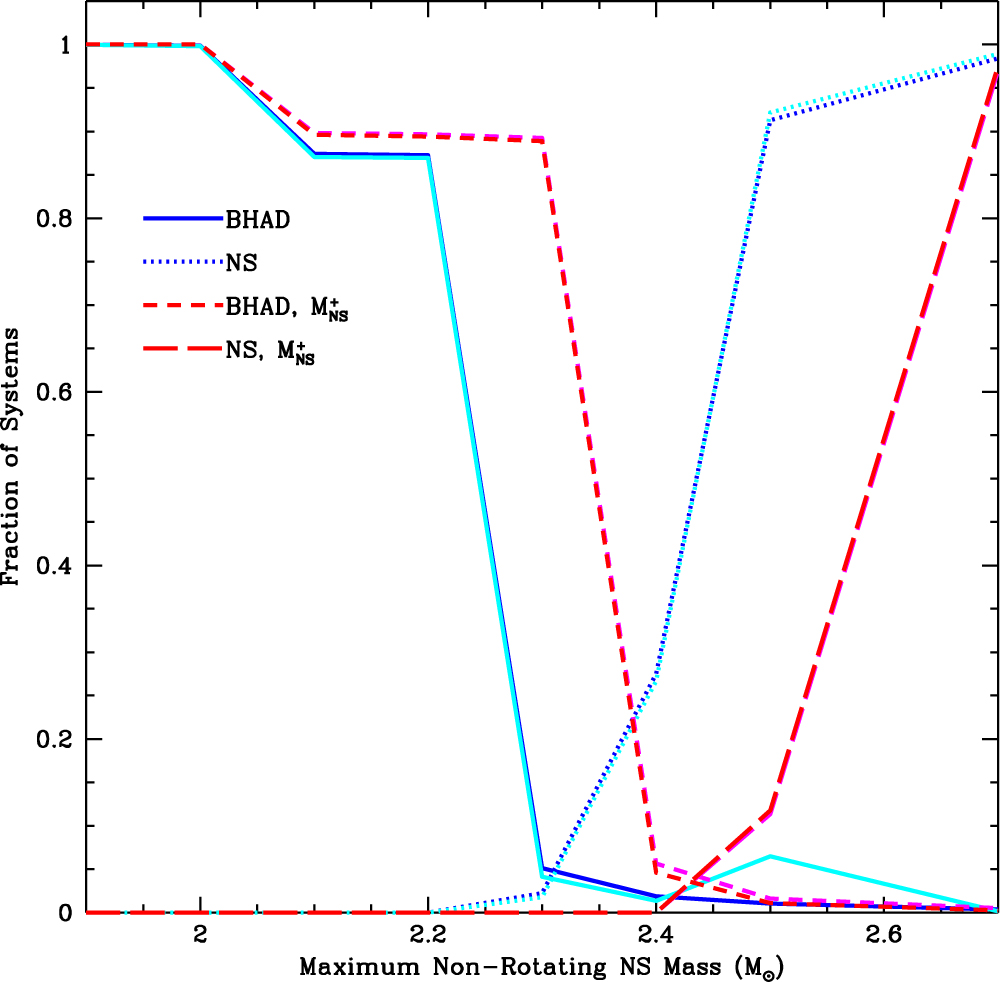
The fraction of mergers that produce BHs (and, consequently, GRBs) and NSs, as a function of the maximum NS mass allowed by the equation of state. Lines labeled BHAD are mergers that produce BHs (under two different initial conditions); lines labeled NS are those that produce NSs. [Fryer et al. 2015]

The authors used a combination of merger calculations, neutron star equation of state studies, and population synthesis simulations to model the outcome of the merger of two NSs. With this information, they determined the statistical likelihood that the remnant that forms in the merger collapses directly to a BH, collapses to a BH after a delay, or remains a NS.

Fryer and collaborators find that the outcome is highly dependent upon the maximum mass allowed by the uncertain NS equation of state. If this maximum NS mass is below 2.3–2.4 solar masses, most NS mergers will result in a BH within 100 milliseconds of the merger. In this case, most mergers would be capable of producing GRBs. If, on the other hand, the maximum NS mass is above this cutoff, then the majority of NS mergers will form a NS remnant — only rarely launching a GRB.

Since, to match observed GRB rates, the second scenario requires a rate of mergers significantly higher than what theory predicts, it seems more likely that NS masses are limited to 2.3–2.4 solar masses. Upcoming observational projects like advanced LIGO will help to test this theory and place further constraints on our models of NSs.

Citation

Chris L. Fryer et al 2015 ApJ 812 24. doi:10.1088/0004-637X/812/1/24

M31

Usually stars that are born together tend to move together — but sometimes stars can go rogue and “run away” from their original birthplace. A pair of astronomers have now discovered the first runaway red supergiant (RSG) ever identified in another galaxy. With a radial velocity discrepancy of 300 km/s, it’s also the fastest runaway massive star known.

Discrepant Speeds

When massive stars form in giant molecular clouds, they create what are known as OB associations: groups of hot, massive, short-lived stars that have similar velocities because they’re moving through space together. But sometimes stars that appear to be part of an OB association don’t have the same velocity as the rest of the group. These stars are called “runaways.”

What causes an OB star to run away is still debated, but we know that a fairly significant fraction of OB stars are runaways. In spite of this, surprisingly few runaways have been found that are evolved massive stars — i.e., the post-main-sequence state of OB stars. This is presumably because these evolved stars have had more time to move away from their birthplace, and it’s more difficult to identify a runaway without the context of its original group.

An Evolved Runaway

velocity difference

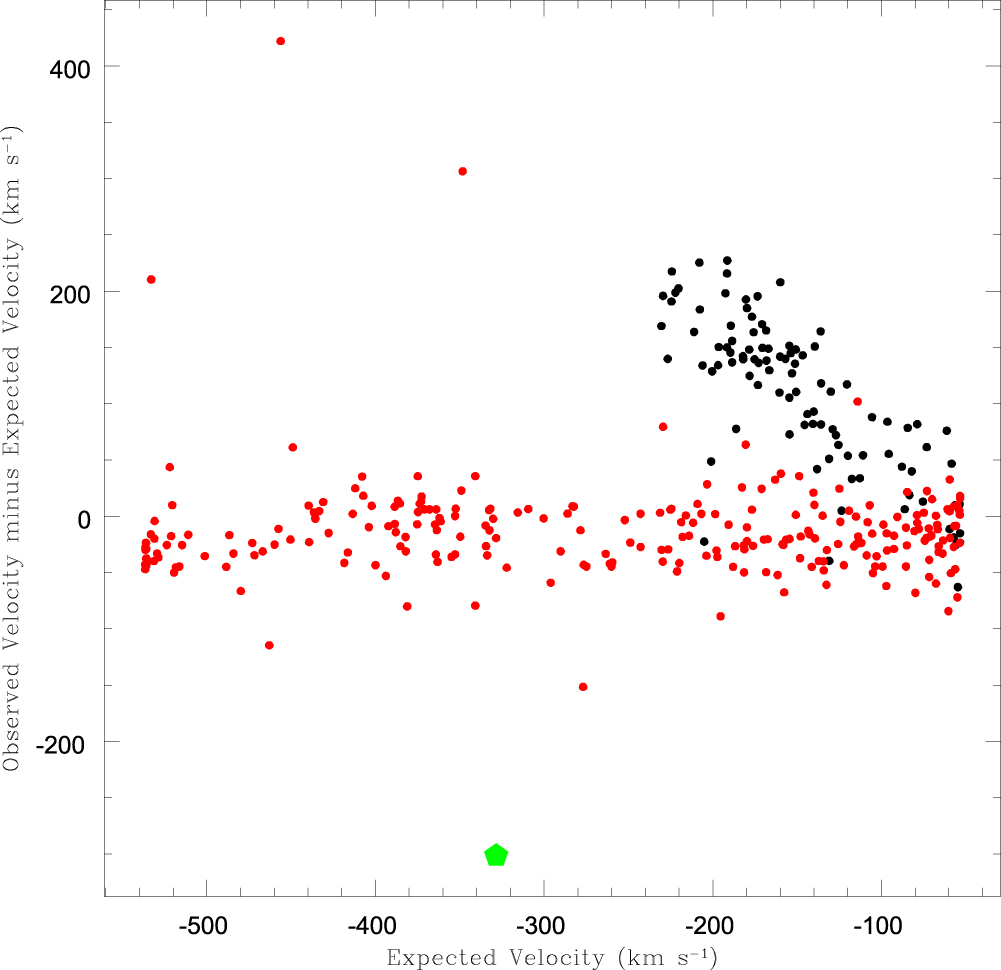
Difference between observed velocity and expected velocity, plotted as a function of expected velocity. The black points are foreground stars. The red points are expected RSGs, clustered around a velocity difference of zero. The green pentagon is the runaway RSG J004330.06+405258.4. [Evans & Massey 2015]

Despite this challenge, a recent survey of RSGs in the galaxy M31 has led to the detection of a massive star on the run! Kate Evans (Lowell Observatory and California Institute of Technology) and Philip Massey (Lowell Observatory and Northern Arizona University) discovered that RSG J004330.06+405258.4 is moving through the Andromeda Galaxy with a radial velocity that’s off by about 300 km/s from the radial velocity expected for its location.

Evans and Massey discovered this rogue star via a photometric survey of RSGs in M31, followed up by spectroscopy with the Multiple Mirror Telescope. They determined that the star is also separated from other massive stars in the disk of the galaxy by about 4.6 kpc — which is roughly the distance it would be expected to travel, given its discrepant motion, in an assumed age of about 10 Myr.

The authors suggest that this star may be a high-mass analog of “hypervelocity stars” — stars within the Milky Way that are moving fast enough to escape the galaxy. The authors demonstrate that the total discrepant speed of RSG J004330.06+405258.4 is probably comparable to the escape velocity of M31’s disk.

But whether or not this star is moving fast enough to escape turns out to be moot: it will only live another million years, which means it won’t have enough time to leave the galaxy before ending its life in a spectacular supernova.

Citation

Kate Anne Evans and Philip Massey 2015 AJ 150 149. doi:10.1088/0004-6256/150/5/149

M dwarf

Despite having lost two of its reaction wheels, the Kepler mission has proven itself still capable of making discoveries. Now in a mission extension called K2, in which radiation pressure from the Sun stabilizes the spacecraft, Kepler has continued to detect planets in distant solar systems. And one of its latest discoveries is an especially intriguing pair of Earth-sized planets transiting a small, cool star only ~200 light-years away!

Transiting Discoveries

Earth-sized planets that orbit close to their host stars are thought to be remarkably  common. They’re predicted to exist around more than a quarter of Sun-like stars, and to be nearly ubiquitous around the smaller, cooler M dwarfs. Unfortunately, systems with M-dwarf hosts are hard to find, since they’re often very faint; a large survey is needed to spot the few M dwarfs near enough to be easily detectable. Luckily, Kepler has risen to the occasion!

light curves

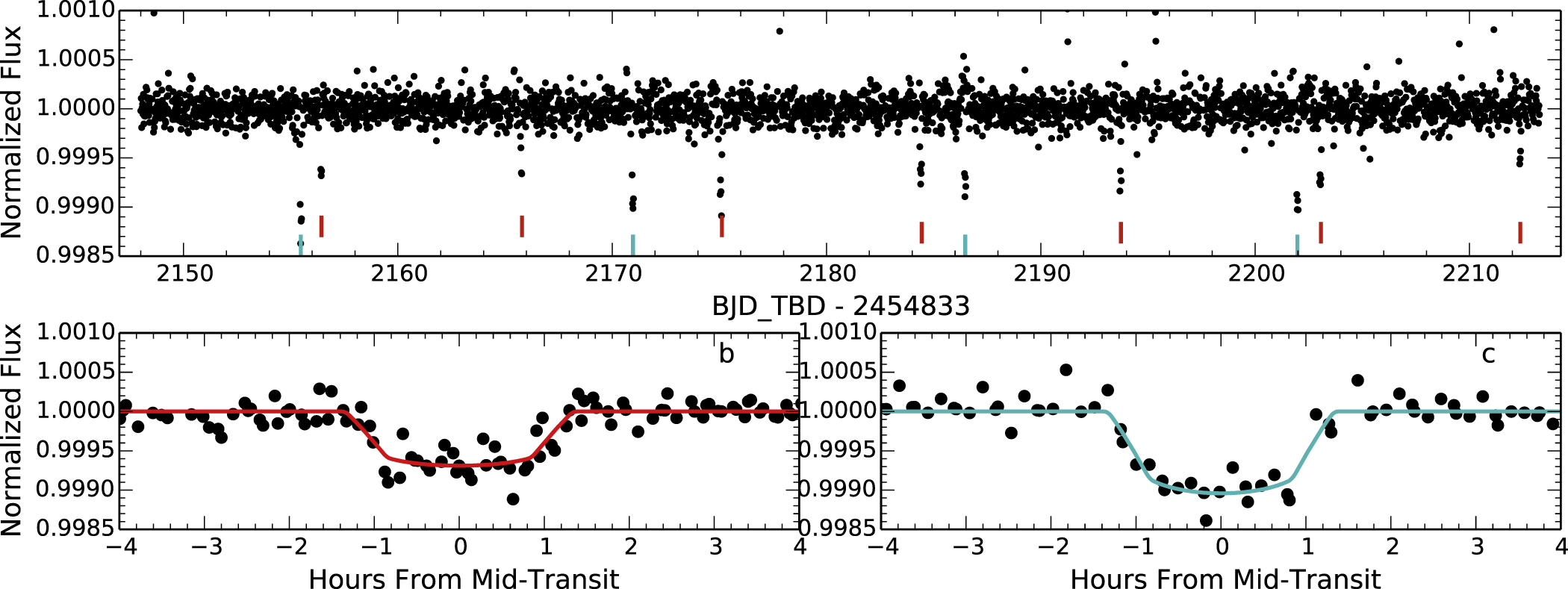
Calibrated photometry for the K2-21 system, with the planet transits marked by red and teal ticks. Best-fit light curves for the transits are shown in the lower panels. Click for a closer look! [Petigura et al. 2015]

In a recent paper, a team of scientists led by Erik Petigura (Hubble Fellow at the California Institute of Technology) reports the discovery of two new transiting, Earth-sized planets around nearby M dwarf K2-21. The team followed up with spectroscopy of the host star, which allowed them to estimate that the two planets, K2-21b and K2-21c, have radii roughly 1.6 and 1.9 times the radius of Earth. These sizes mean that they straddle the boundary between high-density, rocky planets and low-density planets with thick gaseous envelopes.

Unique Planets

One unanswered question about close-in, small planets common around dwarfs is whether they form in situ, or form far from their host and migrate inward. K2-21b and c have orbital periods of approximately 9.3 and 15.5 days, which means they are very nearly in a 5:3 resonance. This may be evidence that they formed further out and migrated inward, as planets evolving according to this model often get trapped in resonance during their migration.

Another interesting feature of the K2-21 system is that the planets receive fairly low levels of radiation from their host star. This is unusual: more than 80% of the planets we’ve found with radii of R<2 Earth radii receive more than 100 times the stellar flux we get on Earth — which irradiates their atmospheres and drives mass loss. This system’s levels of incident radiation are much closer to those of Earth, and it’s nearby enough that we can follow up with studies that look at transit timing, radial velocity, and even atmospheric transmission once James Webb is operational!

Citation

Erik A. Petigura et al 2015 ApJ 811 102. doi:10.1088/0004-637X/811/2/102

The objective of the Interstellar Boundary Explorer, or IBEX, is to study the interaction between the solar wind and the interstellar medium (ISM) at the outer boundary of our solar system. In a special issue of the Astrophysical Journal Supplement Series, a set of 14 papers presents some of the most recent scientific results to come from the first six years of IBEX data.

The Heliosphere and IBEX

IBEX

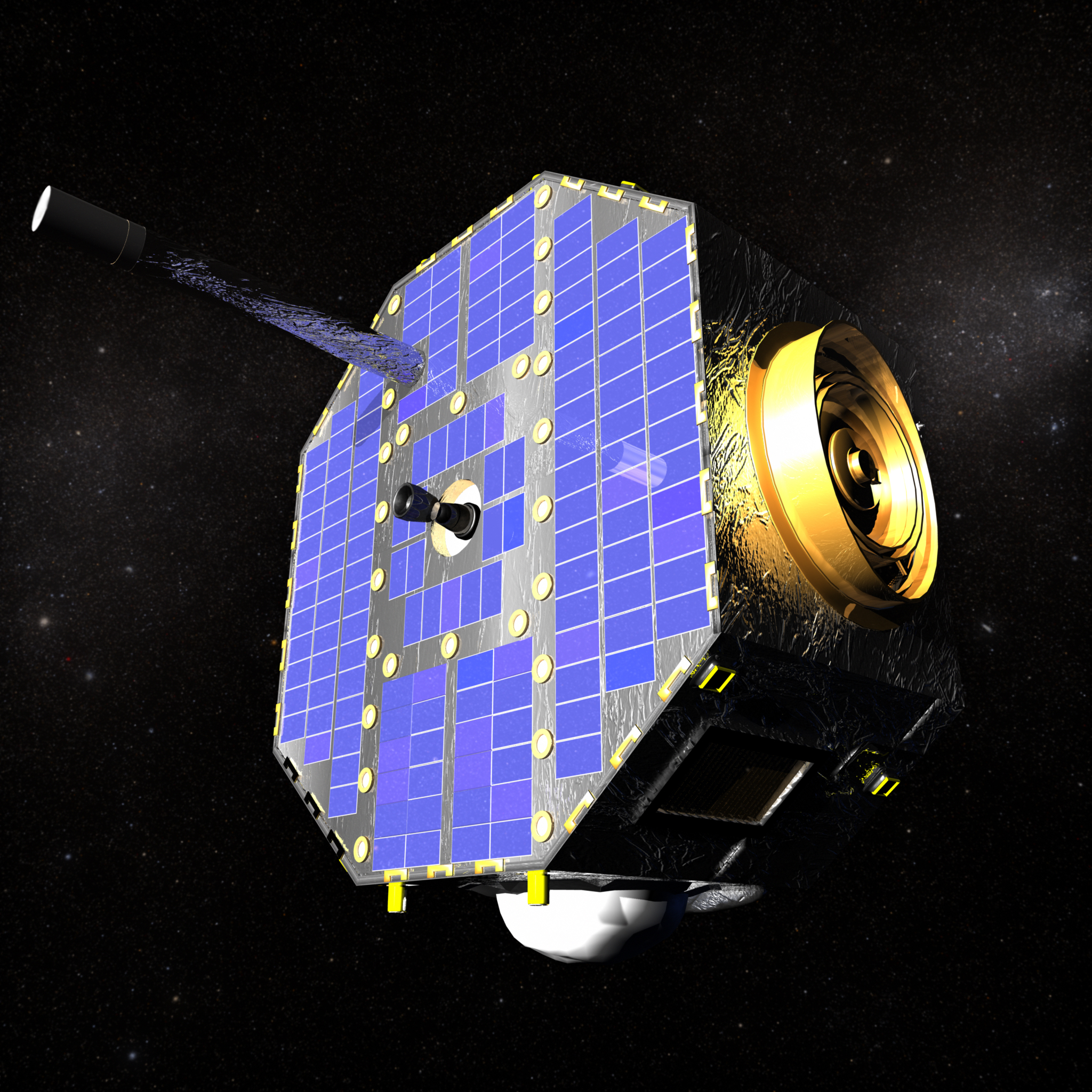
The IBEX spacecraft, launched in October 2008. [NASA]

As the solar wind streams outward, it blows a bubble into the ISM known as the “heliosphere.” The outer boundary of the heliosphere, where the solar wind is no longer able to push the ISM out of the way, marks the edge of our solar system. We’d like to understand the composition and properties of both the heliosphere and the local interstellar environment, as well as the processes at work in the interstellar space around our Sun.

How do we learn about these things? One approach is to send spacecraft to the edge of the heliosphere to make measurements, such as Voyagers 1 and 2. But these spacecraft are only able to measure properties at their specific locations — and since the heliosphere doesn’t appear to be symmetric, this is a major limitation. This is where IBEX comes in.

IBEX orbit

IBEX’s orbit around the Earth, at various stages in the Earth’s orbit around the Sun. IBEX makes its observations while outside of the Earth’s magnetosphere (purple shaded region). [SwRI/IBEX Team]

IBEX is a spacecraft on a highly elliptical orbit around Earth. Its orbit takes it outside of the Earth’s magnetosphere, where it’s able to detect neutral atoms of varying energies that have traveled from the outer edges of our solar system. IBEX’s observations are therefore of particles rather than light; the spacecraft detects the directions and energies of roughly 600 particles per day. This data has provided us with a full 3D view of the outer boundary of the heliosphere.

IBEX’s detections rely on two types of particles: 1) energetic neutral atoms, which are produced by charge exchange at the solar system boundary when the solar wind ions and the neutral ISM gas interact, and 2) various species of interstellar neutral atoms themselves that pass through the heliosphere and stream toward Earth. Detections of the latter type are the focus of the papers in this special issue of ApJS.

Latest Results

In the overview paper of this ApJS issue, PI David McComas (Southwest Research Institute) and coauthors outline the recent science results of IBEX. The major outcomes include:

  1. Resolution of the differences between IBEX’s and Ulysses’s measurements of helium atoms in the ISM
    The space mission Ulysses, which gathered data while orbiting the Sun until 2009, measured a different temperature and direction for the interstellar flow of helium atoms than IBEX did. These two studies have now been reconciled and confirm that the local interstellar wind is significantly hotter than originally measured by Ulysses.
  2. Determination of where the “pristine” ISM starts
    Understanding the properties of the ISM outside of our solar system requires knowing how far out we need to look to observe ISM that hasn’t been mixed with atoms from our solar system. The studies presented here find that the distance to the “pristine” ISM is 1000 AU (that’s more than 30 times the distance to Neptune!). The temperature, speed, and direction of the ISM flow at that location are also presented.
  3. Measurement of other interstellar neutral atoms
    IBEX has gathered neutral hydrogen, oxygen, and neon particles, helping to identify the flows of these interstellar neutral atoms and the composition of the local region surrounding the heliosphere.

These results are the latest in a long stream of important scientific findings from IBEX — and as the mission has been extended through at least 2017, it seems likely that there will be many more!

Citation

D. J. McComas et al 2015 ApJS 220 22. doi:10.1088/0067-0049/220/2/22

The entire ApJS issue can be found here: http://iopscience.iop.org/0067-0049/220/2

The Λ-cold dark matter cosmological model predicts that galaxies are assembled through the disruption and absorption of small satellite dwarf galaxies by their larger hosts. A recent study argues that NGC 4631, otherwise known as the “Whale” galaxy, shows evidence of such a recent merger — in the form of an enormous stellar stream extending from it.

Stream Signatures

According to the Λ-CDM model, stellar tidal streams should be a ubiquitous feature among galaxies. When satellite dwarf galaxies are torn apart, they spread out into such streams before ultimately feeding the host galaxy. Unfortunately, these streams are very faint, so we’re only recently starting to detect these features.

Stellar tidal streams have been discovered around the Milky Way and Andromeda, providing evidence of these galaxies’ growth via recent (within the last 8 Gyr) mergers. But discovering stellar streams around other Milky Way-like galaxies would help us to determine if the model of hierarchical galaxy assembly applies generally.

To this end, the Stellar Tidal Stream Survey, led by PI David Martínez-Delgado (Center for Astronomy of Heidelberg University), is carrying out the first systematic survey of stellar tidal streams. In a recent study, Martínez-Delgado and collaborators present their detection of a giant (85 kpc long!) stellar tidal stream extending into the halo of NGC 4631, the Whale galaxy.

Modeling a Satellite

stream simulation

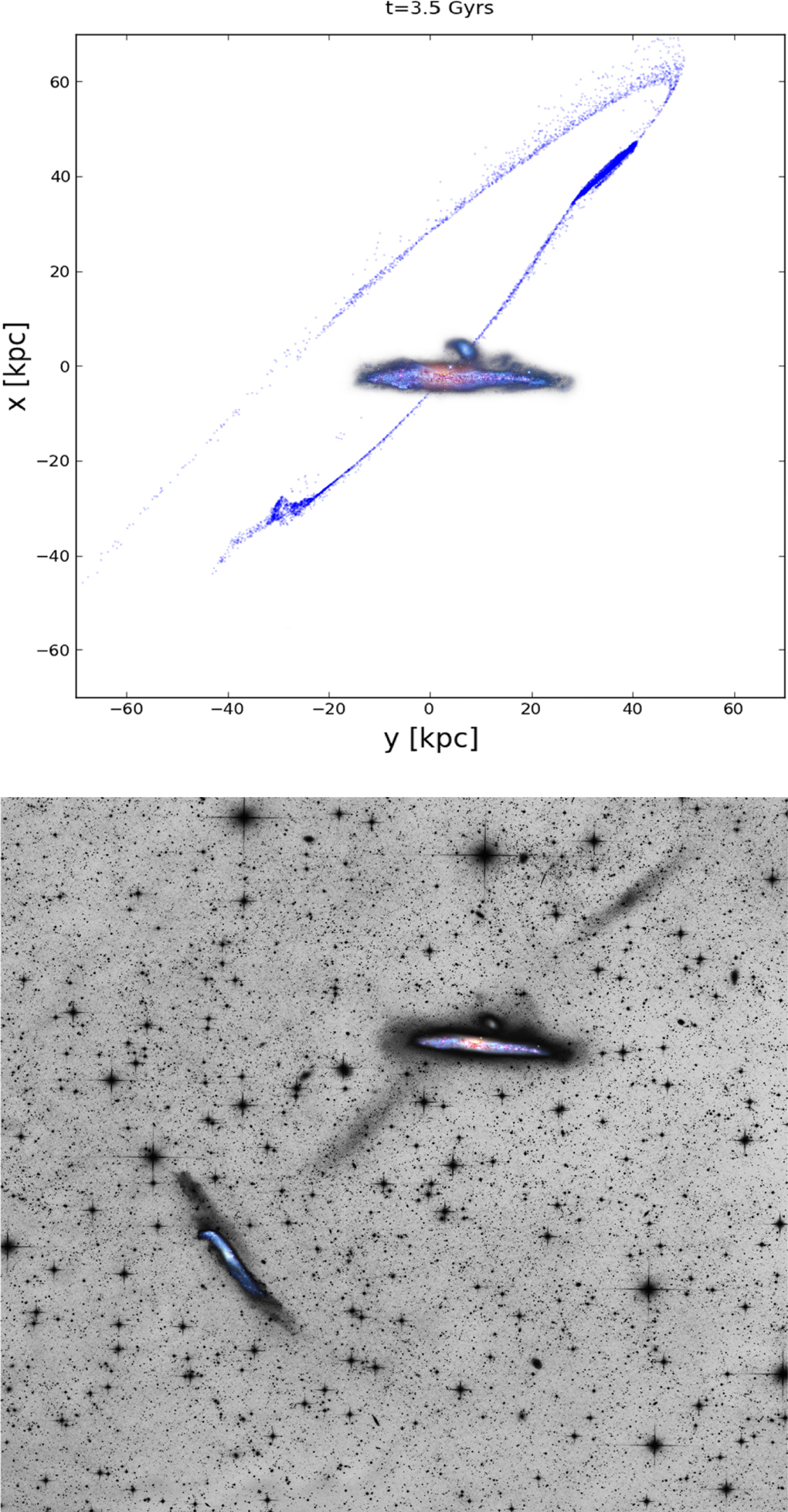
The top image is a snapshot from an N-body simulation of a single dwarf satellite, 3.5 Gyr after it started interacting with the Whale galaxy. The satellite has been torn apart and spread into a stream that reproduces observations, which are shown in the lower image (scale is not the same). [Martínez-Delgado et al. 2015]

The Whale galaxy is a nearby edge-on spiral galaxy interacting with a second spiral, NGC 4656. But the authors don’t believe that the Whale galaxy’s giant tidal stellar stream is caused by its interactions with NGC 4656. Instead, based on their observations, they believe that a dwarf satellite galaxy was disrupted to make that stream.

To support their observations, the authors modeled the system using an N-body simulation. They were able to reproduce the appearance of the stream by sending a single, massive dwarf satellite onto a moderately eccentric orbit around the Whale galaxy. The team showed that, over the span of about 3.5 Gyr, the satellite became disrupted and spread into a structure very similar to the stellar tidal stream we now observe. In this simulation, the last remains of the dwarf satellite are contained within the northwest arm of the stream.

The authors point out that the Whale galaxy has additional gaseous tidal features that likely originated from a more recent, gas-rich accretion event. There are also two bright regions that may be more dwarf satellites around the galaxy (labeled DW1 and DW2 in the header image). If the authors’ interpretation of the observed stellar stream is correct, then the Whale galaxy shows evidence for multiple recent mergers. This would support the idea that hierarchical formation models apply to other galaxies similar to the Milky Way.

Citation

David Martínez-Delgado et al 2015 AJ 150 116. doi:10.1088/0004-6256/150/4/116

quadruple system

An important part of exoplanet studies is the attempt to understand how planets and solar systems form. New measurements of the lowest-mass quadruple star system ever discovered are now confirming an intriguing theory: in addition to other channels, large gas planets may form in the same way that stars do.

Formation Channels

Exoplanets have been found in an enormous variety of configurations, from hot Jupiters only 0.01 AU away from their host star, to planetary-mass companions that orbit at a whopping distance of 1,000 AU.

Formation of these gas giants could occur via a number of different theorized pathways, such as growth from rocky cores close to host star, or fragmentation from instabilities far out in the protoplanetary disk. But given that the line between giant planets and brown dwarfs is somewhat fuzzy, another theory has come under consideration as well: could gas giants form out of the collapse and fragmentation of a molecular cloud, in the same way that stars form?

In a recent study, Brendan Bowler and Lynne Hillenbrand (California Institute of Technology) argue that one star system, 2M0441+2301 AabBab, might actually be evidence that this channel works. 2M0441+2301 AabBab is a young (less than 3 million years old) quadruple system in the Taurus star-forming region, previously identified through imaging. Since photometry alone isn’t enough to be sure of the masses of the components, Bowler and Hillenbrand used the OSIRIS instrument on the Keck I telescope to obtain the first resolved spectra of each component of this system, verifying the system’s intriguing properties.

Pair of Pairs

Near-IR spectra of 2M0441+2301 Aa, Ab, Ba, and Bb. The insets shows the unresolved 2MASS image of the system and the Keck/NIRC2 images of each binary subsystem. Click for a better look! [Bowler&Hillenbrand 2015]

Near-IR spectra of 2M0441+2301 Aa, Ab, Ba, and Bb. The insets shows the unresolved 2MASS image of the system and the Keck/NIRC2 images of each binary subsystem. Click for a better look! [Bowler&Hillenbrand 2015]

2M0441+2301 AabBab is what’s known as a hierarchical quadruple system: it consists of a pair of close-binary star systems that orbit each other at an enormous distance of at least 1,800 AU — which means that, if the system is only a few million years old, the binary pairs have orbited each other no more than ~20 times.

The authors’ measurements show that the first binary pair (labeled Aab, where Aa and Ab are the two stars) consists of a 200 MJup low-mass star and a 35 MJup brown dwarf. The second binary pair (Bab) consists of a 19 MJup brown dwarf and a ~10 MJup companion. This gives 2M0441+2301 AabBab a total mass of only ~0.26 solar masses, making it the lowest-mass quadruple system yet discovered.

The hierarchical structure of this system strongly suggests that it formed from the collapse and fragmentation of a molecular cloud core. What makes this system especially interesting is the span of masses involved. The low mass of the companion in Bab indicates that it’s possible to form planetary-mass companions from a cloud-fragmentation pathway — which suggests that this may also be legitimate channel to consider for the formation of massive exoplanets.

Note: article edited to more accurately reflect the specific contributions of this study.

Citation

Brendan P. Bowler and Lynne A. Hillenbrand 2015 ApJ 811 L30. doi:10.1088/2041-8205/811/2/L30

1 110 111 112 113 114 116