Astrobites RSS

simulations of Pop III star groups

Editor’s note: Astrobites is a graduate-student-run organization that digests astrophysical literature for undergraduate students. As part of the new partnership between the AAS and astrobites, we will be reposting astrobites content here at AAS Nova once a week. We hope you enjoy this post from astrobites; the original can be viewed at astrobites.org!

Title: A Common Origin for Globular Clusters and Ultra-Faint Dwarfs in Simulations of the First Galaxies
Authors: Massimo Ricotti, Owen H. Parry, Nickolay Y. Gnedin
First Author’s Institution: University of Maryland
Status: Submitted to ApJ

Over the past century we have rapidly closed many gaps in our knowledge of the history of the universe. We can see all the way back to the epoch of recombination, just 380,000 years after the Big Bang, thanks to the Cosmic Microwave Background (CMB). Some of the first galaxies, existing just a billion years after the Big Bang, are beginning to be revealed by the largest space- and ground-based telescopes. The time between these two epochs, however, is still out of reach. This is the epoch when the first stars formed, and gradually began to light up the universe.

The first stars, confusingly named Population III, form out of gas containing no metals (astronomy parlance for elements heavier than Hydrogen and Helium). This makes them different from stars that form subsequently (known as Population I and II. I know, it’s backwards. Blame Walter Baade), as these later stars form from gas containing the metals expelled by the trailblazing Pop III stars. Because Pop III stars form from metal free gas, they have unique properties compared to stars in the universe today. One of the most striking features is their extreme mass, a hundred times the mass of the Sun in some theories. Such large stars subsequently have very short lifetimes, as they burn through their nuclear fuel rapidly. This in turn makes them difficult to detect; in the grand timeline of the universe, they blink in and out of existence. Until we get better observations one of the only ways to explore these objects, and test theories of their formation and evolution, is through simulations.

Gas Density

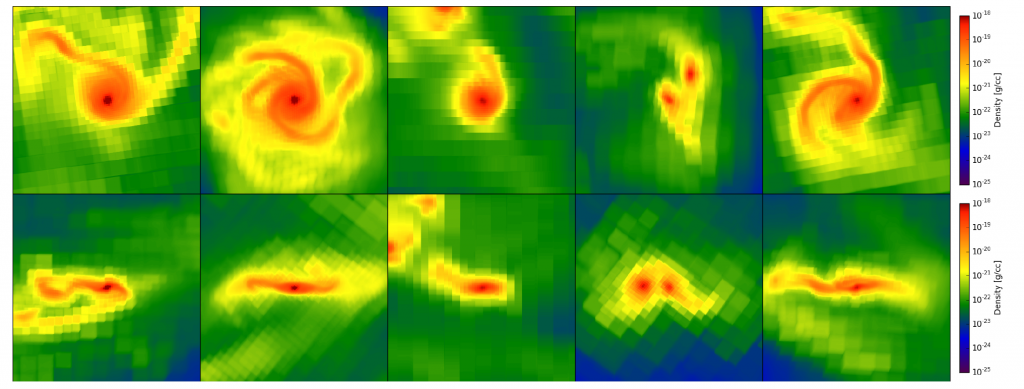
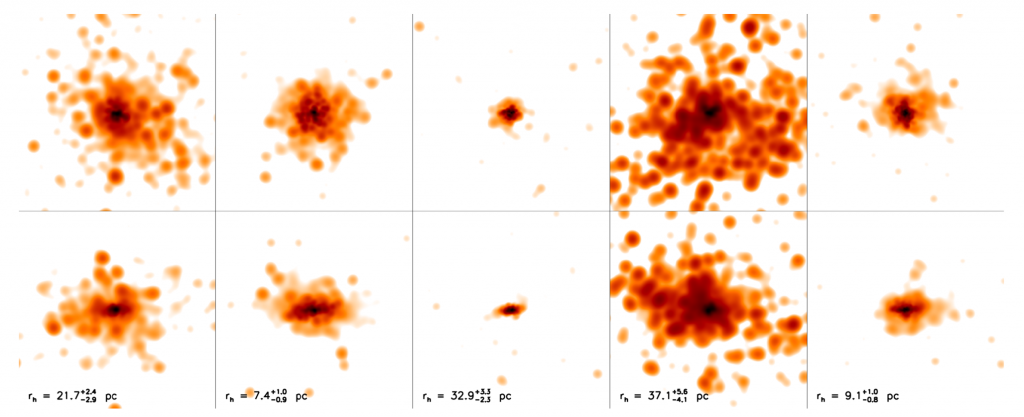
Figure 1: The projected density of gas for the biggest galaxies at z = 9 (roughly 500-600 Myr since the Big Bang). Where there is a disc, the top row shows a top down view of it and the bottom row shows a side view. Each image is 100 parsecs on a side.

Today’s paper is about one such simulation. The authors explored the kinds of environments that the first stars are born into, and what objects they evolve into. Unfortunately, simulating galaxies is difficult. They are large, and interact closely with their nearby environment, so you need to simulate a big volume. But ideally you would want to simulate each individual star too. Simulating this huge range of scales, from individual stars to clusters of galaxies, is currently impossible — no astrophysicist has access to a computer powerful enough — but the authors begin to push this limit by ramping up the resolution of their simulation so that each simulation particle represents a collection of stellar objects that are approximately 40 times the mass of the Sun. Previous simulations of small galaxy clusters could only resolve collections of tens of thousands of stars, so this is a big improvement.

Stellar Density

Figure 2: Each panel displays an identical view to Figure 1, but showing the projected density of stars. The disc is nowhere to be seen, and the stars extend to much greater distance than the gas.

The authors look at the morphology of their simulated objects and distinguish a few trends. The gas tends to form a disc inside a dark matter halo, and star formation is confined to the disc (see figure 1). The stars themselves though are often spread out in a wider, spherical arrangement (see figure 2). They attribute this to the fact that the stars, after eating up most of their surrounding gas in the disc, become unbound — in other words, they are no longer held together by their mutual gravity, and they begin to separate out. They then become bound within the larger dark matter halo, and the expansion stops. These objects look suspiciously like ultra faint dwarf galaxies in the local universe. The size of the spheroid can also be extended through mergers, which dynamically heat the object, adding some kinetic energy to all the constituent stars.

Certain objects tend to be smaller and more compact, containing only Pop II stars. They are triggered by nearby Pop III stars which, when they die, spread the metals they contain into the cosmos through powerful winds or supernovae. Gas polluted by these metals can cool efficiently, and therefore form Pop II stars easier. The authors suggest that these objects could be the first compact, bound stellar objects in the universe, but hesitate on what to call them — are they globular clusters, ultra compact dwarfs, or something in between? And how many of these objects will actually survive to the present day, perhaps visible in our local galaxy as “fossil” galaxies, relics directly from the first stellar objects? These simulations are only run up to a billion years after the Big Bang, so such questions will have to wait for bigger simulations in the future that follow these objects to redshift zero.

Another peculiar object the authors identify contains only Pop III stars. Since these stars are so short lived, they will rapidly die, leaving behind a dark, apparently empty halo, though it will in fact be full of the remnants of these monster stars. Hints of such objects were found last year (here’s a summary of the results, and here’s the original paper).

One of the most pertinent and urgent reasons why we need to understand these objects is for the upcoming James Webb Space Telescope, which will begin to probe this era of first star formation. We need to understand the transition from Pop III to Pop II star formation in order to know how many Pop III stars JWST could expect to see.

Many of the questions raised above could be solved by simulations with higher resolution. But the results are an exciting step towards a full understanding of the environment in which the first stars formed. The intriguing common origin of compact star clusters and ultra-faint dwarfs is worthy of further investigation, which the authors plan to publish shortly. It remains to be seen whether any relics of these first collections of baby stars have survived to the present day, and are kicking around our galactic backyard, waiting to be discovered.

About the author, Christopher Lovell:

I’m a first year PhD student at the University of Sussex, studying high redshift galaxies using hydrodynamical simulations. When I’m not reading about physics I like to read science fiction and history, and when I’m not reading I enjoy dodging London traffic on my bike.

solar system orbits

Editor’s note: Astrobites is a graduate-student-run organization that digests astrophysical literature for undergraduate students. As part of the new partnership between the AAS and astrobites, we will be reposting astrobites content here at AAS Nova once a week. We hope you enjoy this post from astrobites; the original can be viewed at astrobites.org!

Title: The Influence of Magnetic Field Geometry on the Formation of Close-In Exoplanets
Author: Jake Simon
First Author’s Institution: Southwest Research Institute
Status: Published in ApJL

Our solar system is different from many others. While Mercury never gets closer than 0.3 AU from the Sun, many of the exoplanets we have discovered make our closest planet look distant. About 50% of all systems have multiple planets tightly packed within that distance, leaving astronomers to wonder why our solar system and the other half of planetary systems do not have any close-in planets.

It is a common quip in planet formation and protoplanetary disks that if you have any type of problem whatsoever that you do not understand, you should try to solve it with magnetic fields! The author of this paper — Jake Simon —  puts this problem-solving technique to good use. Simon specifically asks: Does a disk’s magnetic field alignment affect whether planetesimals can form at less than 0.3 AU?

Starting Small

Planets typically form from much smaller planetesimals (10 to 100 km-sized) that slowly aggregate over time. Likewise, planetesimals also need to form from much smaller solid dust particles (cm-sized or smaller). However, solid dust faces a barrier to grow into larger particles: the meter-size barrier. When meter-size particles collide with each other, they break up instead of combine, preventing them from growing in the usual way. The only way solid dust can cross the meter-size barrier is to circumvent it by becoming dense enough to gravitationally collapse into planetesimals. This can happen directly or through the streaming instability. After this occurs, the planetesimals that form are much larger than meter-sized and thus, free to grow to planet-size as usual through collisions.

Gravitational collapse requires a high concentration of solid material to gas — a ratio known in the field of planet formation as a disk’s metallicity (denoted by Z). If the inner region of a disk at less than 0.3 AU has a low metallicity, the disk cannot create planetesimals this close to the star. Without planetesimals, planets cannot form.

When Magnetic Fields Align

Instead of investigating a mechanism for increasing the concentration of solids, Simon looks into whether the orientation of a disk’s magnetic field can decrease the concentration of gas. Since Z is a ratio, lower gas densities also create higher metallicities that help planetesimal formation.

Magnetic fields in protoplanetary disks are vital to their evolution. They make the disk unstable to the magneto-rotational instability (MRI), which is one of the key sources of turbulence that gives the disk its viscous, fluid nature. (This is very different from most liquids and gases, which do not need magnetic fields or turbulence to behave like fluids!) Although the gas in the disk tries to act like a fluid, it struggles with the fact that the gas at larger radii moves at slower velocities due to Kepler’s 3rd Law. This creates the following situation:

  1. The gas is forced to balance itself out by exchanging momentum with the adjacent rings, causing it to slow down over time and ultimately feed all of the disk’s momentum to the outer part.
  2. As the gas loses angular momentum to the outer disk, it spirals inward.
  3. Eventually, the gas in the inner disk will spiral inward enough to accrete onto the star.

This process by which the disk accretes is known as shear flow. Disks that are more viscous will flow more easily, causing them to deplete faster than disks with lower viscosities.

metallicity

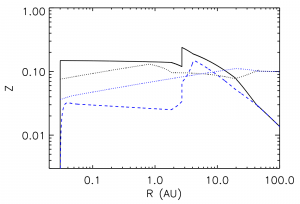
Figure 1. Radial metallicity profiles for the aligned case (solid black; top) and the anti-aligned case (dashed blue; bottom). For each case, the dotted lines (middle) of the same color show the required metallicity to form planetesimals over a range of radii. At less than 1.0 AU, the aligned case has a high enough metallicity to form planetesimals (the solid line is above dotted black line), but the anti-aligned case never has a high enough metallicity (the dashed line is below the dotted blue line).

Simon knew from previous work that the orientation of a magnetic field can greatly affect the level of viscosity in the inner disk. If a disk’s magnetic field aligns with its angular momentum (such that the two vectors are pointing in the same hemisphere), it will induce stronger magnetic winds and non-turbulent laminar flow due to the Hall effect. These additional flows create a much higher viscosity than in a disk where the two vectors are anti-aligned and the Hall effect does not manifest this way.

In the case where the field aligns, the gas in the disk is more viscous, causing it to deplete faster. This creates metallicities that are high enough to allow planetesimals — and subsequently, planets — to form at less than 0.3 AU. In the case where the field is anti-aligned, the gas in the disk is less viscous, keeping the gas density high and the metallicities at less than 0.3 AU too low to form planetesimals or planets (see Figure 1). If magnetic field orientations are distributed randomly, about half of them should be aligned and half should be anti-aligned. As a result, one would expect to find that roughly 50% of all planetary systems have planets at less than 0.3 AU, which is consistent with what we see in the population of known planetary systems.

Radial surface density distributions for aligned (black) and anti-aligned (blue) magnetic fields. The MMSN (red) matches up with the latter, suggesting our solar system may have had anti-aligned magnetic field, which would explain why we do not have any planets within Mercury's distance.

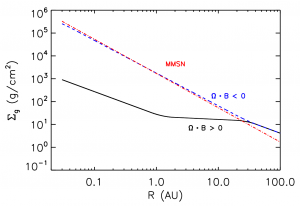
Figure 2. Radial surface density distributions for aligned (black) and anti-aligned (blue) magnetic fields. The MMSN (red) matches up better with the latter, suggesting our solar system may have had an anti-aligned magnetic field, which would explain why we do not have any planets within Mercury’s distance.

How was our Solar System’s magnetic field aligned?

When Simon calculates the disk’s metallicity distribution as a function of radius for both the aligned and anti-aligned magnetic fields, he notices that the anti-aligned case closely resembles the metallicity of the Minimum Mass Solar Nebula (MMSN), which is intended to model our solar system’s disk structure before any planets formed. If this resemblance has any bearing, our solar system may have had an anti-aligned magnetic field that prevented any planets from forming closer in than 0.3 AU, thereby offering a possible explanation as to why Mercury is so far from the Sun compared to the closest planets in roughly half of other planetary systems.

About the author, Michael Hammer:

I am a 1st-year graduate student at the University of Arizona, where I am working with Kaitlin Kratter on studying planetary dynamics and planet-disk interactions through numerical simulations. I am from Queens, NYC.

Abell 2744

Editor’s note: Astrobites is a graduate-student-run organization that digests astrophysical literature for undergraduate students. As part of the new partnership between the AAS and astrobites, we will be reposting astrobites content here at AAS Nova once a week. We hope you enjoy this post from astrobites; the original can be viewed at astrobites.org!

Title: Local Analogs for High-Redshift Galaxies: Resembling the Physical Conditions of the Insterstellar Medium in High-Redshift Galaxies
Authors: Fuyan Bian, Lisa Kewley, Michael Dopita, Stephanie Juneau
First Author’s Institution: Research School of Astronomy & Astrophysics, Mt Stromlo Observatory, Australian National University
Status: Published in ApJ

Very distant galaxies can teach us a lot about the formation and evolution of some of the earliest systems in the Universe. However, they are also notoriously difficult to study as, due to their distance, they appear both dim and small. Due to the expansion of the cosmos, their spectra have been stretched and shifted redwards — giving those distant galaxies the name “high-redshift” galaxies. Studies of such objects indicate they have different properties compared to more nearby local galaxies: they are 10 times better at forming stars than local galaxies, while also being significantly smaller than those galaxies found near us. Additionally, there are indications that the interstellar medium (ISM), the matter (gas, dust, and cosmic rays) between stars, in high-redshift galaxies differs from that in nearby ones.

select

Fig. 1: Selecting the local analogues sample on the BPT diagram which plots oxygen, hydrogen and nitrogen ratios against each other. The blue dots are the selected local sample, while the black contour lines show where “normal” local galaxies live. As can clearly be seen, there is a distinct offset between the selection and the space on the plot which normal galaxies occupy. In order to mimic the ISM conditions found in high-redshift galaxies, the authors selected their local sample so as to recreate their high ionization ratios. It isn’t currently clear what causes the observed offset between the distant and local galaxy populations.

The BPT Diagram

To learn about the conditions of the ISM, the authors study some of its elements: the ISM contains hot, ionized hydrogen, oxygen, and nitrogen gases which, when ionized by radiation from e.g. stars or active galactic nuclei, give off monochromatic light at well-defined wavelenghts. By measuring the ratios and strengths of these so-called spectral lines it is possible to determine how much ionizing flux is present. The authors plot the ratios of hydrogen, oxygen, and nitrogen lines on the Baldwin-Phillips-Terlevich, or BPT, diagram (see Fig. 1). Where a galaxy falls on this diagram can give us clues about both how ionizing the radiation within it is, and whether the galaxy is powered by star formation or contains an active galactic nucleus. While this works quite well for nearby galaxies, it has been suggested that the position of both star-forming and AGN-containing galaxies in the distant universe is different to those of local galaxies on the BPT diagram. This raises the intriguing question: what causes this change in the conditions of the ISM?

Selecting Local Analogues for High-Redshift Galaxies

Given the difficulty in studying very distant galaxies, how can we study their ISM? The authors of today’s paper attempt to answer this question by selecting nearby galaxies that are located at the same place as high-redshift galaxies on the BPT diagram (see Fig. 1), and which are hence thought to share the same physical conditions of the ISM as star-forming galaxies at redshifts 2-3 (when the universe about 2-3 billion years old). If these local galaxies are indeed true analogues, they can then be used as local laboratories to study the very distant star-forming galaxies — making it easier to study them in greater detail, as they appear brighter and more extended than their high-redshift cousins. The authors of today’s paper select 252 low-redshift, i.e. local, galaxies from the Sloan Digital Sky Survey whose hydrogen, oxygen, and nitrogen spectral line ratios put them into a similar place on the BPT diagram as those found in very distant galaxies.

Physical properties

Fig. 2: The physical properties found in the local analogues sample (blue) and normal local galaxies (red). All panels show histograms of the derived properties scaled to the same height. The top panel compares the star formation rates (in log-space): the local analogues to the distant galaxies can be seen to have slightly higher star formation rates than normal nearby galaxies. The second panel shows the distribution of masses, with a clear offset between the two populations: the local analogues are almost a factor of 10 less massive than normal nearby galaxies. Finally, the ratio of star formation rate and mass, the specific star formation rate sSFR, is shown. It indicates how efficiently a galaxy is converting mass into stars. The blue population is forming stars significantly more effectively than normal local galaxies, but very similarly to the high-redshift galaxy population whose median value is indicated by a purple line.

Establishing the Properties of Local Analogues

Having selected their local sample, the authors measure various physical properties of these galaxies, and then compare them to those found in normal local galaxies and very distant star-forming ones. This allows the authors to determine whether the selected sample can indeed be used as a local laboratory to learn about very distant galaxies. They find that their selected galaxies form on average 3.6 solar masses per year (in comparison, the Milky Way forms 1 solar mass per year) and are about a factor of 10 less massive than normal nearby galaxies (see Fig. 2). Using these two measures, the authors calculate that the galaxies in their sample are very effectively transforming gas into stars (also see Fig. 2), building faster than even the distant galaxies! Previous studies have found that high-redshift galaxies have smaller sizes compared to nearby galaxies with similar masses. Determining the sizes of their local galaxy sample, the authors find that the local analogues are more compact than normal star-forming, but much like the high-redshift galaxies. Additionally, the authors compare the ratio of ionizing flux and gas density, a property known as the ionization parameter, as well as the relationship between the stellar mass and amount of metals. They find good agreement in both cases, making their analogues reliable local laboratories for studying distant galaxy populations with comparable ionization and interstellar medium conditions to the high-redshift sources.

What the Future Might Hold

Having established that their selected sample reproduces the ISM conditions found in very distant galaxies, the authors indicate that future studies of their local analogues could provide much information on the environment inside distant galaxies. Since the local analogues are relatively nearby, it might be possible to resolve individual star-forming regions in them, and hence study in detail the physical properties within them and make direct comparisons with those found in the high-redshift universe.

About the author, Steph Greis:

I’m a third (out of four) year PhD student at the University of Warwick, UK, where I study local analogues to redshift z~5 Lyman break galaxies (LBGs) which are some of the earliest galaxies in the Universe.
When I’m not thinking about galaxies far, far away, I enjoy reading, cooking, and geocaching.

white dwarf star

Editor’s note: Astrobites is a graduate-student-run organization that digests astrophysical literature for undergraduate students. As part of the new partnership between the AAS and astrobites, we will be reposting astrobites content here at AAS Nova once a week. We hope you enjoy this post from astrobites; the original can be viewed at astrobites.org!

Title: Outbursts in two new cool pulsating DA white dwarfs
Authors: Keaton J. Bell, J. J. Hermes, M. H. Montgomery et al.
First Author’s Institution: Department of Astronomy, University of Texas at Austin
Status: Accepted for publication in the Astrophysical Journal

The Kepler spacecraft, launched in 2009, is best known for its monumental contributions to the science of exoplanets. But the unique observing technique of the space telescope, staring at thousands of stars all day, every day for months at a time, has led to surprising new discoveries in many fields beyond exoplanets.
Nearly a year ago, Astrobites reported on one example of Kepler’s unexpected findings: A pair of white dwarfs that were “outbursting”, becoming as much as 20 percent brighter every few days before quieting down again. Although variable white dwarfs have been studied for decades, only the continuous data obtained by Kepler provided the coverage to spot these short, unpredictable events. Today’s paper adds another two outbursting white dwarfs, and begins to explore the reason for this hitherto unobserved behaviour.

White dwarfs are the leftover cores of stars that have run out of hydrogen fuel. More than 90 percent of stars, including the Sun, will end their lives this way, a glowing ember roughly the size of the Earth. White dwarfs start off incredibly hot, millions of Kelvin, but with no more nuclear reactions taking place, they slowly cool down over many centuries.

As they cool past the (roughly) 12,500 K mark, something odd happens: The white dwarfs begin to pulse, changing in brightness by about one percent every few minutes. This carries on until, millions of years later, they cool to below around 10,600 K, and the pulsations stop.

The intriguing aspect is that those temperatures were not predicted by theoretical models of how the interiors of white dwarfs change as they cool, but come from observations. Although those models can reproduce the temperature at which pulsations start, they also predict that the pulsations should last much longer, enduring until the white dwarf reaches just 6,000 K. So why do the pulsations suddenly stop? Bell et al. suggest that the new class of outbursting white dwarfs may hold the answer.

ktwo211629697_LC

Figure 1: Kepler observations of the white dwarf EPIC 211629697. Each point is a measurement of how much light is reaching the telescope from the white dwarf, with the black data being taken every 30 seconds and the red every thirty minutes. The grey regions show the outbursts, where the brightness of the white dwarf increased by up to 14 percent. The right-hand-side figure shows an enlarged version of one outburst.

The two new outbursting white dwarfs were observed by Kepler in mid-2015. Over the roughly eighty days that each white dwarf was observed, the amount of light coming from them made sudden jumps (Figure 1), 15 times in the case of the first white dwarf observed and 33 times for the second. The outbursts were spaced seemingly randomly apart, and implied increases in brightness of up to 14 percent.

loggteff

Figure 2: A collection of white dwarfs, comparing their surface temperatures (x-axis) and gravities (a proxy for the mass, y-axis). The blue and red lines show the hot and cold boundaries between which white dwarfs have been found to pulsate. The grey crosses show white dwarfs observed with Kepler that do not pulsate, yellow dots are Kepler white dwarfs that do pulsate, and blue dots are other pulsating white dwarfs. The four red squares are the outbursting white dwarfs, with a fifth candidate shown by the orange triangle.

Although these white dwarfs are interesting in themselves, being only the third and fourth examples of what was, just a few years ago, an unknown phenomenon, the authors find that they become even more revealing when compared with other white dwarfs. Figure 2 compares the surface temperatures and gravities of the four outbursting white dwarfs (red squares), with those of other white dwarfs, both pulsating and not.

All four of the white dwarfs are found near the cool end of the temperature range where white dwarfs pulsate—exactly the place that theoretical models find difficult to predict. The authors suspect that the two behaviours are linked, with the emergence of outbursts at low temperatures leading to the cessation of pulsation soon afterwards. However, more of the outbursting white dwarfs are needed to confirm this link, as the similar temperatures of the four discovered so far could just be coincidence. With Kepler’s mission recently extended into 2018, new discoveries should not be too long in coming.

About the author, David Wilson:

PhD student at the University of Warwick working with Professor Boris Gaensicke. I study the remnants of planetary systems at white dwarfs, looking at what they reveal about planet compositions and searching for variability. When not doing that I mostly spend my time reading, writing, playing board games and building various little plastic people.

AGB star

Editor’s note: Astrobites is a graduate-student-run organization that digests astrophysical literature for undergraduate students. As part of the new partnership between the AAS and astrobites, we will be reposting astrobites content here at AAS Nova once a week. We hope you enjoy this post from astrobites; the original can be viewed at astrobites.org!

Title: Pulsation-Triggered Mass Loss From AGB Stars: The 60-Day Critical Period
Authors: Iain McDonald and Albert Zijlstra
First Author’s Institution: Jodrell Bank Centre for Astrophysics
Status: Published in ApJ Letters

Background

Perhaps you’ve heard that four billion years from now, the Sun will grow into a red giant with a radius the size of Earth’s orbit before eventually shrinking into a white dwarf about the size of Earth itself. Besides being very small, the resulting white dwarf will probably only have half of the original mass of the Sun. Where does that lost mass go?

Figure 1: An HR Diagram showing the main sequence, red giant branch, horizontal branch, and asymptotic giant branch. The horizontal axis indicates the temperature, while the vertical axis indicates the luminosity. [http://www.astronomy.ohio-state.edu/~pogge/]

Figure 1: An HR Diagram showing the main sequence, red giant branch, horizontal branch, and asymptotic giant branch. The horizontal axis indicates the temperature, while the vertical axis indicates the luminosity. [http://www.astronomy.ohio-state.edu/~pogge/]

During a star’s post-main-sequence (MS) evolution, it will lose much of its starting mass through stellar winds. Currently, the Sun is constantly losing mass through solar winds—material that is being ejected from its surface—but when the Sun leaves MS and reaches the red giant branch (RGB), these solar winds will become even stronger. After the end of the RGB phase, the Sun will continue to evolve until it reaches the asymptotic giant branch (AGB)—so named because it will then asymptotically approach the same location on the Hertzsprung-Russell diagram that it does as an RGB star (see Figure 1 for an example). AGB stars have even stronger stellar winds, meaning they are losing mass at an even more rapid rate than RGB stars. It is thought that much of a star’s mass loss happens when it is on the RGB and AGB. In addition, all of this excess material being blown off of the star means that AGB stars are often surrounded by a lot of dust

Exactly what really drives this process, however, is not something that we understand very well. Today’s astrobite discusses some of the possible mechanisms for stellar mass loss in AGB stars, particularly the role that pulsation plays in mass loss.

Stars can pulsate in a variety of different pulsational modes. The fundamental mode is probably what you imagine when you think of stellar pulsation—all of the star is moving radially in the same direction. However, if the star has radial nodes, different parts of the star move in different directions at the same time (sort of like the nodes of an pipe). We call these pulsational modes overtone modes, and the type of overtone mode (first, second, third, etc.) tells you the number of nodes that exist in the star.

Mass Loss Above the 60-Day Critical Pulsational Period

Figure 2: The dust excess (given by K-[22] color) on the vertical axis plotted against period in days on the horizontal axis. The dotted horizontal line marks the authors' criterion for 'substantial dust excess'. The red circles show period data taken from Tabur (2009), the green squares from the International Variable Star Index, and the blue triangles from the General Catalogue of Variable Stars. Smaller light blue triangles indicate the stars for which they had GCVS data, but could not detect with Hipparcos. Starting at a period of 60 days, there is an increased number of stars with greater dust excess than their criterion. There is another increase at about 300 days. [McDonald & Zijlstra 2016]

Figure 2: The dust excess (given by K-[22] color) on the vertical axis plotted against period in days on the horizontal axis. The dotted horizontal line marks the authors’ criterion for ‘substantial dust excess’. The red circles show period data taken from Tabur (2009), the green squares from the International Variable Star Index, and the blue triangles from the General Catalogue of Variable Stars. Smaller light blue triangles indicate the stars for which they had GCVS data, but could not detect with Hipparcos. Starting at a period of 60 days, there is an increased number of stars with greater dust excess than their criterion. There is another increase at about 300 days. [McDonald & Zijlstra 2016]

Most previous studies of the effects of pulsation on mass loss have focused on stars with pulsational periods greater than 300 days, because both observation and theory have shown that to be when stars have the greatest dust production and highest mass-loss rate. However, a less-studied 60-day ‘critical period’ in the increase of dust production has also been noted as well.

Mass-loss in RGB and AGB stars seems to increase at a period of 60 days. Both RGB stars and AGB stars can pulsate (in fact, there is evidence that all stars pulsate…if only we could study them well enough to see it), but the authors find that despite inhabiting roughly the same area on the HR diagram, the 60-day period stars with strong mass loss appear to only be AGB stars and not RGB stars. This 60-day period also happens to correspond with roughly the point when AGB stars transition from second and third overtone pulsation to the first overtone pulsation mode.  Additional nodes will also result in lower pulsational amplitude (smaller change in brightness and radius over one period) for the star, leading AGB stars to have bigger amplitudes at this point. RGB stars seem to pulse only in the second and third overtone modes. This is most likely responsible for why they produce so much less dust and experience less mass-loss at the same period as their AGB star counterparts.

The relationship between dust production and infrared excess, which the authors use as a proxy for the amount of dust the star is producing, is shown in Figure 2. From this figure, we can see that at periods longer than 60 days, there appear to be more stars that are producing dust above their criterion for substantial dust excess. Figure 3 shows period-amplitude diagrams, where the pulsational amplitude is plotted against the pulsational period (where the amplitude suggests of the mode of pulsation). From this diagram, we can see that the stars with less dust production appear to also have lower amplitudes of pulsation. Together, these support the hypothesis that the pulsational mode plays a critical role in producing dust and driving mass loss. These results also confirm the increase in mass-loss at 300 days, which roughly corresponds with stars transitioning from the first overtone pulsation to the fundamental mode.

Figure 3: Amplitude in the V-band plotted against period. In both subplots, the darker colored circles are stars with substantial dust excess, and the lighter colored circles are stars without substantial dust excess. This seems to suggest that greater dust excess corresponds with greater amplitude. Greater amplitude also usually indicates fewer radial nodes. The 60 and 300-day increase in dust productions are also visible in both plots. [Adapted from McDonald & Zijlstra 2016]

Figure 3: Amplitude in the V-band plotted against period. In both subplots, the darker colored circles are stars with substantial dust excess, and the lighter colored circles are stars without substantial dust excess. This seems to suggest that greater dust excess corresponds with greater amplitude. Greater amplitude also usually indicates fewer radial nodes. The 60 and 300-day increase in dust productions are also visible in both plots. [Adapted from McDonald & Zijlstra 2016]

Conclusion

So what’s next? Well, as you might expect, the follow up to science is usually…more science! The authors point out that further study will be necessary in order to get conclusive evidence for exactly what role this critical period serves and how pulsational mode can affect it. Is it really a change in the stellar-mass loss rate, or is the stellar wind pre-existing, and the 60-day period just coincides with an increase in dust condensation? Similar studies focusing on stars with different metallicities will also be a good check to see whether these critical periods are universal.

About the author, Caroline Huang:

I’m a 2nd year graduate student in astronomy at Johns Hopkins. My main research interests lie in extragalactic astronomy, large dataset analysis, and cosmology. At the moment, I’m using galactic Cepheids to calibrate the Cepheid period-luminosity relationship.

I did my undergrad at Harvard, where I was a joint physics and astrophysics concentrator. I love traveling, cool weather, food, books, and Oxford commas.

1 44 45 46