AAS News RSS

NuSTAR

Editor’s Note: This week we’re at the 227th AAS Meeting in Kissimmee, FL. Along with several fellow authors from astrobites.com, I will be writing updates on selected events at the meeting and posting at the end of each day. Follow along here or at astrobites.com, or catch our live-tweeted updates from the @astrobites Twitter account. The usual posting schedule for AAS Nova will resume next week.


Welcome to Day 2 of the winter American Astronomical Society (AAS) meeting in Kissimmee! Several of us are attending the conference this year, and we will report highlights from each day here on astrobites. If you’d like to see more timely updates during the day, we encourage you to follow @astrobites on twitter or search the #aas227 hashtag.


Plenary Session: Black Hole Physics with the Event Horizon Telescope (by Susanna Kohler)

If anyone needed motivation to wake up early this morning, they got it — in the form of Feryal Ozel (University of Arizona) enthralling us all with exciting pictures, videos, and words about black holes and the Event Horizon Telescope. Ozel spoke to a packed room (at 8:30am!) about where the project currently stands, and where it’s heading in the future.

The EHT has pretty much the coolest goal ever: actually image the event horizons of black holes in our universe. The problem is that the largest black hole we can look at (Sgr A*, in the center of our galaxy) has an event horizon size of 50 µas. For this kind of resolution — roughly equivalent to trying to image a DVD on the Moon! — we’d need an Earth-sized telescope. EHT has solved this problem by linking telescopes around the world, creating one giant, mm-wavelength effective telescope with a baseline the size of Earth.

Besides producing awesome images, the EHT will be able to test properties of black-hole spacetime, the no-hair theorem, and general relativity (GR) in new regimes.

Ozel walked us through some of the theory prep work we need to do now in order to get the most science out of the EHT, including devising new tests of GR, and performing predictive GRMHD simulations — hydrodynamics simulations that include magnetic fields and full GR treatment. Ozel pointed out that one of the recent theoretical advancements in GRMHD simulations is harnessing the power of GPUs to render images in simulations; check out the tweet below for the awesome video she showed us!

Deployment of the full EHT array is planned for early 2017, and they’ve already got 10 targets selected — black holes that are near enough and large enough that the EHT should be able to image their shadows. I, for one, can’t wait to see the first results!


Grad School and Postdocs as a Means to a Job (by Meredith Rawls)

This morning session was presented by Karen Kelsky of The Professor Is In. She presented a very practical overview of the advice in her book (which this job-searching Astrobiter highly recommends). Her target audience is postdocs and graduate students who are finishing their PhDs and applying for tenure-track jobs. Karen’s background is in the social sciences, but she has worked with many scientists and her expertise easily transferred. Much of her writing advice also applies for undergraduates who are writing research statements and proposals to apply to graduate school. For example:

One of Karen’s main takeaways is that academia is not automatically good preparation for a job search. Writing documents like cover letters, resumes, and research statements will be harder and take more time than you think, and it is important to make them top-notch. Karen was also surprised that the majority of professional astronomers at the AAS meeting carry backpacks, because she typically advises against bringing a backpack to a job interview or campus visit. She conceded that astronomy is an exception to this rule!


Brown Dwarfs and Exoplanets (by Caroline Morley)

I started my morning in a session near and dear to my heart on brown dwarfs. The session had four dissertation talks, showcasing each student’s (impressive!) work over the last 4+ years.

Astrobites alumnus Ben Montet kicked off the session to talk about his recent work to study the eclipsing brown dwarf LHS 6343, discovered in Kepler data. This brown dwarf is one of the best so-called benchmark brown dwarfs that we have discovered. Unlike almost every other object, we can measure LHS 6343’s mass, radius, luminosity, and metallicity. Ben’s Spitzer observations reveal that it’s a ~1100 K T dwarf.

Joe Filippazzo spoke next about his work to put together a large and impressive database of 300 brown dwarfs ranging in spectral type from M to Y, stitching together literature photometry, parallaxes, and both low and high resolution spectra. He studies the effect of age on the fundamental properties of these objects, empirically without needing models! You can download the database at BDNYC.org and use Joe’s open-source Python package astrokit which includes the SQL management tools to use the database.

Jonathan Gagné presented results from his survey to find young free-floating objects in young moving groups. These objects are really interesting because they have the masses of planets but are easier to observe since they don’t have nearby stars. He is currently extending his survey from his PhD thesis to be able to find even cooler objects (literally and figuratively) in these groups.

Sebastian Pineda gave a very interesting talk about his thesis work to understand auroral emission from brown dwarfs. Brown dwarfs with a range of temperatures have been observed to have both radio activity and H-alpha emission, despite their neutral atmospheres. These properties are believed to be generated by auroral emission — just like aurorae on Jupiter! One of many interesting results is that cooler objects have rare and weak aurorae. Sebastian postulates that these brown dwarfs may have aurorae that are modulated by the presence of satellites (brown dwarf moons?!). Very cool idea that needs more study!

The last speaker of the session was the only non-dissertation talk of the session. Nolan Grieves presented results from his statistical survey of brown dwarf companions using the MARVELS radial velocity survey and finds a brown dwarf companion occurrence rate around 0.7%.


Science to Action: Thoughts on Convincing a Skeptical Public (by Meredith Rawls)

This year’s Public Policy plenary talk was delivered by William Press from UT Austin. Many scientific stories follow a familiar narrative, and too often, scientific consensus about a hazard has been accepted by the public only after some catalyzing event like a catastrophic fire or a spike in deaths linked to smoking. Press suggested that climate change may be at the tipping point of mainstream acceptance. He also discussed how a definition of “science” can encompass two distinct ideas: a series of fact-based conclusions and a value judgment based on rational thinking. To illustrate this dichotomy, he posed a question to the audience:

Press stated that he strongly supports the top view, but it was eye-opening to see a nearly even split of raised hands. His point was that GMO labeling ultimately boils down to a value judgement, not a scientific one, and we should be careful to understand the difference. Science communicators certainly have our work cut out for us! In the broadest sense, Press’ takeaway for effective science communication is a two-step approach: (1) communicate the value of a rationalist approach to decision making, and (2) communicate well-established scientific results.


AAS Journals Workshop for Authors & Referees

First half (by Susanna Kohler)

Disclaimer: I’m an employee of the AAS, as editor of AAS Nova.

This 2-hour-long author & referee workshop was intended partially as an overview of what it means to be an author or a referee (in any journal), and partly as a reveal of some of the new features that are now being implemented within the AAS publishing program. Many of the presentations have been uploaded here. A few highlights from the first half:

  • Talks about authoring articles by Ethan Vishniac, and refereeing articles by Butler Burton
  • Intro to AAS Nova — the AAS’s means of sharing its authors’ results with the broader community — by me!
  • Discussion of the AAS’s new policy for software citation by Chris Lintott

Second half (by Becky Nevin)

In between hopping between all the amazing science sessions today I made it to the last half of a very interesting Author & Referee Workshop run by AAS journals. Even with missing the first half, I can still tell that there’s a lot of changes coming to AAS journals (which include ApJ, AJ, ApJS, ApJL), in particular in the way that your research will be published. All good from what I saw — in particular they’ve addressed the long-standing problem of how to cite astronomical software (usually produced for free by a keen member of the community). Now they give guidelines for how to do this and have even appointed a new lead editor for instrumentation & software.

What got me most excited though was the demonstration by Greg Schwarz of AASTex v6.0 — a markup package to assist authors in preparing manuscripts intended for submission to AAS-affiliated journals — i.e. super cool amazing new LaTeX commands to satisfy even the most obsessive LaTeX-er! Check it out, because it will definitely ease the pain of writing and responding to referees. In the final talk (before free lunch, score!) Gus Muench showcased the new ways that authors will be able to include interactive JavaScript figures into articles in AAS journals. You can check out some of the amazing integrations in this nifty tutorial.


A Report on the Inclusive Astronomy 2015 Meeting: Community Recommendations for Diversity and Inclusion in Astronomy
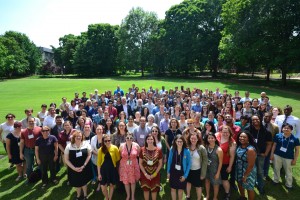
IA2015

This very well-attended session recapped the Inclusive Astronomy 2015 meeting (see this link for a summary!)

The IA2015 meeting results can be found here.

A draft of the recommendations from IA2015 is here. Note that this document, termed the “Nashville Recommendations,” is a living document that isn’t yet finalized, and feedback is welcome.


Dannie Heineman Prize: From “~” to Precision Science: Cosmology from 1995 to 2025 (by Erika Nesvold)

Marc Kamionkowski of Johns Hopkins University and David Spergel of Princeton University shared this year’s Heineman Prize for outstanding work in astronomy, and gave an impressive tag-team overview of the progress in the field of cosmology over the past 20 years.

Spergel pointed out that in 1995, cosmologists were still debating over the value of the Hubble constant, and whether or not the universe is flat. Kamionkowski pointed out that back then, cosmology was an “order of magnitude game” where observations lagged far behind theory. He noted that in general, theorists tend to “sit around predicting things,” and not much progress is made in testing those predictions, at least not within the lifetime of an individual theorist. In cosmology, however, the measurements and observations made since 1995 have been more successful and precise than anyone could have anticipated.

This is thanks in part to the WMAP mission and later the Planck satellite, which measured the cosmic microwave background and collected an amazing set of data. There is excellent agreement between the data from WMAP and Planck, a triumph for observational cosmologists. Much to the surprise of Spergel and other cosmologists, a simple model of only five fundamental parameters fits these data extremely well. Twenty years later, thanks to the hard work of cosmologists, we now know that the age of the universe is 13.8 billion years, and that it is composed of roughly 4% atoms, 23% dark matter, and 73% dark energy.

Spergel and Kamionkowski then pointed towards the future, predicting even more spectacular results to come over the next decade or so. Our current model of the universe predicts gravitational waves, which we haven’t observed so far, but the search is heating up. Kamionkowski called this potentially the most important new physics result of this century! He also explained that we can now do neutrino physics using the cosmic microwave background, which already provides the strongest constraint on the sum of neutrinon masses. In the next decade, we should be able to further determine the neutrino mass hierarchy. The coming years in cosmology could be even more exciting than the past twenty!


HEAD Rossi Prize talk: A New View of the High Energy Universe with NuSTAR (by Susanna Kohler)

This year’s Rossi Prize winner Fiona Harrison capped off the main part of the day with a plenary talk about some of the highlights from the first two years of the NuSTAR mission, NASA’s space-based, high-energy X-ray telescope.
NuSTAR

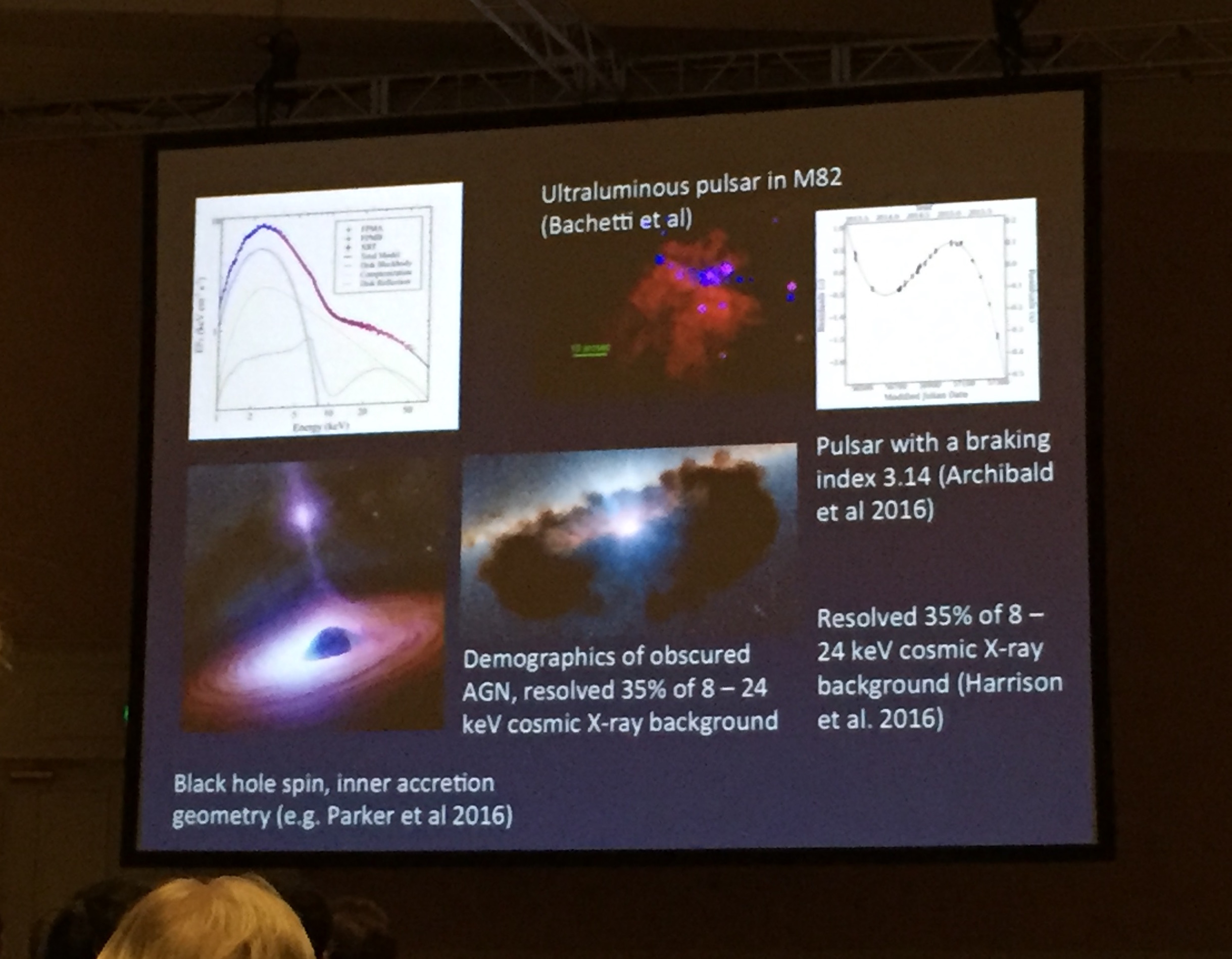
Additional science results from the past two years with NuSTAR.

Harrison began by telling us about NuSTAR’s launch in 2012, in which a Pegasus rocket — with NuSTAR as its payload — was launched from a L-1011 ‘Stargazer’ aircraft. She claims to have been unconcerned about this part: “The payload would go up or it would go down, there wasn’t anything I could do about it.” The real terror for the NuSTAR team came 9 days later when the telescope slowly unfolded itself over the span of 24 minutes, snapping components into place. All went well, however, and NuSTAR has since been forging exciting new territory in the high-energy X-ray regime!

Harrison discussed science highlights from the last two years of NuSTAR, like the discovery of a population of dead stars in the inner parsecs of the galaxy, the identification of the mechanism that most likely re-energizes stalled shocks in supernovae and launches the explosion (in case you’re keeping track, it’s because the star sloshes around. Seriously.), or the evidence that supernova 1987A exploded asymmetrically.

NuSTAR is funded through the end of 2016 and is now in its extended mission, so we can expect to see more exciting science coming from it in the future!
 

Editor’s Note: This week we’re at the 227th AAS Meeting in Kissimmee, FL. Along with several fellow authors from astrobites.com, I will be writing updates on selected events at the meeting and posting at the end of each day. Follow along here or at astrobites.com, or catch our live-tweeted updates from the @astrobites Twitter account. The usual posting schedule for AAS Nova will resume next week.


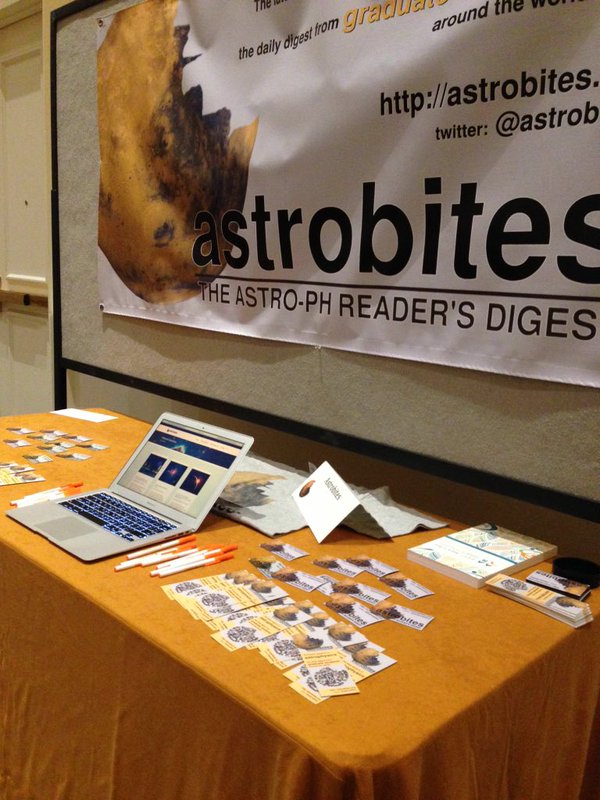
aas 227 astrobites booth

Things kicked off last night at our undergraduate reception booth. Thanks to all of you who stopped by — we were delighted to have so many people tell us that they already know about and use astrobites, and we were excited to introduce a new cohort of students at AAS to astrobites for the first time.

Tuesday morning was the official start of the meeting. Here are just a few of the talks and workshops astrobiters attended today.


Opening Address (by Becky Smethurst)

The President of the AAS, aka our fearless leader Meg Urry kicked off the meeting this morning at the purely coffee powered hour of 8am this morning. She spoke about the importance of young astronomers at the meeting (here’s looking at you reader!) and also the importance of the new Working Group for Accessibility and Disabilities (aka WGAD pronounced like wicked) at the AAS. The Society has made extra effort this year to make the conference accessible to all, a message which was very well received by everyone in attendance.


Kavli Lecture: New Horizons – Alan Stern (by Becky Smethurst)

We were definitely spoilt with the first Plenary lecture at this year’s conference – Alan Stern gave us a a review of the New Horizons mission of the Pluto Fly By (astrobites covered the mission back in July with this post). We were treated to beautiful images, wonderful results and a foray into geology. 

Some awesome facts from the lecture that blew my mind:

  • New Horizons is now 2AU (!) beyond Pluto
  • The mission was featured on the front pages of 450 newspapers worldwide on every single continent (including Antartica!)
  • New Horizons reached the Moon in 9 HOURS after launch (compared to the ~3 days it took the Apollo missions)
  • The mission controllers were aiming for a 100km window of space all the way from Earth
  • There was a window of ~400seconds which the probe had to arrive within – the probe arrived 90 seconds early! Putting tardy astronomers everywhere to shame.
  • Charon was the only satellite of Pluto known at the time of the mission proposal
  • The canyon found on Charon is not only bigger than the Grand Canyon but bigger than Mariner Valley on Mars which is already 4000 km (2500 mi) long and reaches depths of up to 7 km (4 mi)!

  • The mountains ringing the Sputnik Planum (aka the heart of Pluto) are over 4km high and are snow capped with methane ice

  • Pluto’s atmosphere has a dozen distinct haze layers – but how they are created is a mystery

Alan also spoke about the future of New Horizons – there is a new mission proposal for a fly by of a Kuiper Belt object 2014MU69  in Jan 2019 which should give us a better understanding of this icy frontier at the edge of the Solar System. As a parting gift Alan played the most gorgeously detailed fly over video of Pluto’s surface that had all in the room melting into their flip flops. It’s safe to say that the whole room is now Pluto-curious and wondering whether a change of discipline is in order!


Press Conference: Black Holes and Exoplanets (by Susanna Kohler)

This morning marked the first press conference of the meeting, covering some hot topics in black holes and exoplanets.

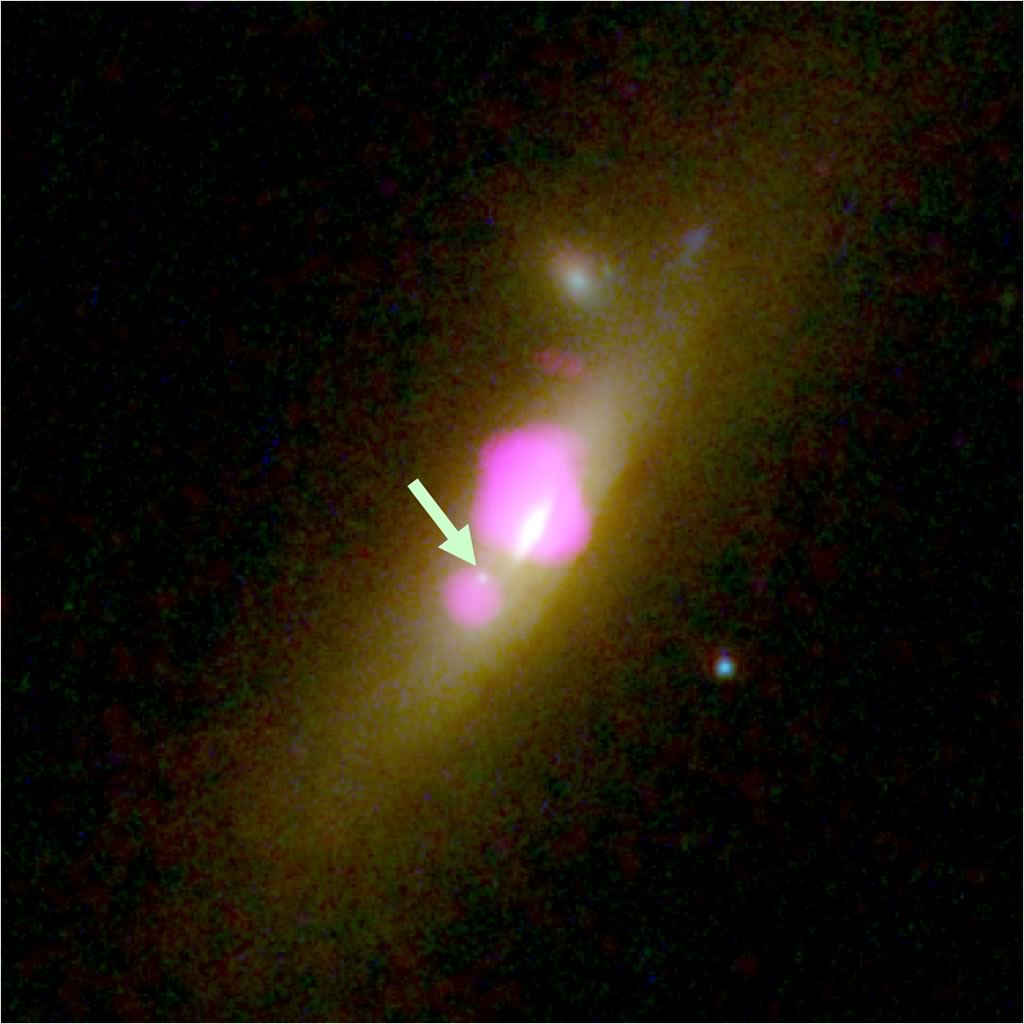
Hubble (background) and Chandra (purple) image of SDSS J1126+2944. The arrow marks the second black hole. (From http://casa.colorado.edu/~comerford/press)

Hubble (background) and Chandra (purple) image of SDSS J1126+2944. The arrow marks the second black hole. (From http://casa.colorado.edu/~comerford/press)

The first speaker was Julie Comerford (University of Colorado Boulder), who told us about SDSS J1126+2944, a galaxy that was shown by Chandra X-ray detections to contain not just one, but two supermassive black holes. This is a sign of a recent merger between two galaxies, which can result in one new, larger galaxy with two nuclei for a while. The second black hole is surrounded by only a small sphere of stars. This may be because the rest have been stripped away in the process of the merger — but it’s also possible that the second black hole is an elusive “intermediate mass black hole” of only 100-1,000,000 solar masses! Here’s the press release.

The second speaker was Eric Schlegel (University of Texas, San Antonio), who spoke about the galaxy NGC 5195. Eric discussed an interesting problem: we know that star formation ends in galaxies after a time, but the gas must be cleared out of the galaxy for the star formation to halt. What process does this? Schlegel’s collaboration found evidence in NGC 5195 for a “burping” supermassive black hole — the shock from the black hole’s outflow sweeps up the hydrogen gas and blows it out of the galactic center. Here’s the press release.

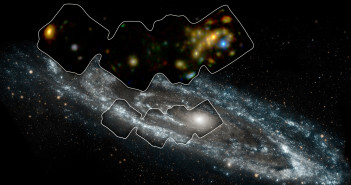
NuSTAR image of Andromeda, inset on a UV image by NASA's Galaxy Evolution Explorer. Click for a better look! [NASA/JPL-Caltech/GSFC]

NuSTAR image of Andromeda, inset on a UV image by NASA’s Galaxy Evolution Explorer. Click for a better look! [NASA/JPL-Caltech/GSFC]

Next up was Daniel Wik (NASA/Goddard SFC), who discussed recent high-energy X-ray observations of Andromeda galaxy with NASA’s NuSTAR. As Wik described it, NuSTAR is like a CSI detective, working to identify what fraction of the compact remnants in X-ray binaries of Andromeda are neutron stars, and what fraction are black holes. Since X-ray binaries play a crucial role in heating gas in protogalaxies, shaping galaxy formation, it’s important that we learn more about this population and how it evolves over time. Here’s the press release.

The final speaker was grad student Samuel Grunblatt (University of Hawaii Institute for Astronomy), who spoke about measuring the mass of exoplanets around active stars. In radial velocity studies of exoplanets, a planet orbiting its star causes the star to “wobble”. This signal for an Earth-like planet is as tiny as 9 cm/s! Unfortunately, activity of the star can cause radial velocity noise of 1-10 m/s — so to detect Earth-like planets, we need to find a way of subtracting off the noise. Grunblatt talked about an intriguing new method for determining planet masses that controls for the signature of their host’s activity. Here’s his paper.


Annie Jump Cannon Award Lecture: On the Dynamics of Planets, Stars and Black Holes (by Erika Nesvold)

This year, the Annie Jump Cannon Award was given to Smadar Naoz, an assistant professor at UCLA. The Cannon Award is given every year to a young (less than 5 years since PhD), female astronomer for outstanding work in her field. Traditionally, the Cannon Award recipient delivers a lecture on her research, so this year we were lucky to see a dynamic and engaging talk by Smadar Naoz about her research in dynamical theory.

You may have heard the common career advice that you should focus on becoming “the” expert on one particular facet of astronomy: a particular type of object, an observational technique, a type of instrument, etc. Naoz has managed to follow that advice while still managing to study a huge range of astronomical topics, from exoplanets to cosmology. She studies hierarchical triples, systems of three gravitational bodies in which two of the bodies orbit one another very closely, while the third orbits the other two from a much greater distance. For example, a planet in a tight orbit around a star, with a brown dwarf orbiting hundreds of AU away, make up a hierarchical triple system. So does a system in which two black holes orbit each other closely, with a third black hole orbiting farther away. The physics of these systems are all the same, so by studying the equations that govern a hierarchical triple system, Naoz can study a huge variety of astronomical objects.

In particular, Naoz studies a mechanism called the Kozai-Lidov mechanism, named after the two researchers who discovered it independently. If the outer body in a hierarchical triple orbits at a high enough inclination to the inner body (> 40 degrees), the Kozai-Lidov mechanism will excite the inclination and eccentricity of the inner body. In fact, the inclination and eccentricity will oscillate opposite one another: as the inclination increases, the eccentricity will decrease, and vice versa. In the course of her research, Naoz discovered a flaw in Kozai’s original derivations of this mechanism, and derived a more accurate, general set of equations describing the Kozai-Lidov mechanism. These new equations indicate that the eccentricity of the inner object can become extremely high, and that the inclination can become so high that the object’s orbit can flip from prograde to retrograde! In other words, the object can start orbiting in the opposite direction around the central body.

This work has applications in many different types of systems. For example, over the past decade, observers have discovered a large number of retrograde hot Jupiters, gas giant planets orbiting very close to their star, in the opposite direction from the star’s spin. Naoz showed that the new, correct Kozai-Lidov mechanism can explain the orbits of these exoplanets, because it increases the planet’s eccentricity until its orbit approaches very close to the star, and it flips the inclination into a retrograde orbit.

Naoz also showed applications of the Kozai-Lidov mechanisms to dark matter halos around black holes, triple black hole systems, and so-called “blue stragglers”: main-sequence stars in clusters that are brighter and bluer than they should be. Her body of work is an excellent example of how theorists can adapt general physics theories to a wonderful variety of astronomical problems.


Harassment in the Astronomical Sciences Town Hall (by Caroline Morley)

The Town Hall on Harassment in the Astronomical Sciences involved a sobering panel discussion on the current state on workplace climate in astronomy and the current steps that the AAS and federal agencies are taking to improve it. Christina Richey kicked it off by presenting preliminary results from the CSWA Survey on workplace climate. This survey involved 426 participants, and reveals that many people, especially junior members of the field, experience harassment including both verbal and physical harassment. These results will be published this year. Next up, Dara Norman, a Councilor of the AAS and a member of the AAS Ethics Task Force, spoke about the proposed changes to the current AAS Ethics Statement. These changes will focus on corrective policies to improve the state of the field; they will solicit community feedback this Spring and vote on the changes at the Summer AAS meeting. Last, Jim Ulvestad, representing the federal agencies including NSF, NASA, and the DOE, spoke about the current policies for reporting to federal funding agencies. He reminds us that if an institution accepts money from the federal government, they are required by law to follow laws such as Title VI (covering racial harassment) and Title IX (covering sexual harassment), and that breaches can be reported to the funding agency.


Tools and Tips for Better Software (aka Pain Reduction for Code Authors) (by Caroline Morley)

This afternoon breakout session included a drinking-from-the-firehose set of short talks that covered everything from source-code management and software testing to building communities that create sustainable code. First, Kenza Arraki discussed software such as Git to do version control to keep track of code changes. (Version Control is my (science) New Years Resolution, so I was happy to learn that there is a CodeAcademy tutorial for Git!). Next up, Adrian Price-Whelan described the merits of software testing and suggests that we actually do “Test-driven development” where we write tests for the code first, then write code, run tests and debug until tests all pass. Erik Tollerud spoke on “Why Document code and how you might convince yourself to do so” (documenting code is another good science New Years Resolution!) The most important rule is to always document as you code because you won’t ever go back! Bruce Berriman described the best practices for code release, including, importantly, licensing it and describing it well (with tutorials, examples). Matthew Turk reminded us the importance of building community around code development. Robert Nemiroff ended the talks with a discussion of what to do with “dead” codes. The lowest bar? Put it in your Dropbox and share it with your collaborators and students!

For more info on all of these topics and more, consider attending a Software Carpentry workshop.


AAS 227

Greetings from the 227th American Astronomical Society meeting in Kissimmee, Florida! This week, along with several fellow authors from astrobites, I will be writing updates on selected events at the meeting and posting at the end of each day. You can follow along here or at astrobites.com, or catch our live-tweeted updates from the @astrobites Twitter account. The usual posting schedule for AAS Nova will resume next week.

AAS Journals

If you’re an author or referee (or plan to be!) and you’re here at the meeting, consider joining us at our Author and Referee Workshop on Wednesday in the Tallahassee room, where we’ll be sharing some of the exciting new features of the AAS journals. You can drop into either of the two-hour sessions (10 AM – 12 PM or 1 PM – 3 PM), and there will be a free buffet lunch at noon. Here’s the agenda:

Morning Session Topic & Speaker
10:00 am – 10:05 am Introductions
Julie Steffen
10:05 am – 10:35 am Changes at AAS Journals; How to Be a Successful AAS Author
Ethan Vishniac
10:35 am – 11:00 am The Peer Review Process
Butler Burton
11:00 am – 11:15 am AAS Nova: Sharing AAS Authors’ Research with the Broader Community
Susanna Kohler
11:15 am – 11:30 am Fixing Software and Instrumentation Publishing: New Paper Styles in AAS Journals
Chris Lintott
11:30 am – 11:45 am Making Article Writing Easier with the New AASTeX v6.0
Greg Schwarz
11:45 am – 12:00 pm Bringing JavaScript and Interactivity to Your AAS Journal Figures
Gus Muench
Lunch Session Topic & Speaker
12:00 pm – 12:15 pm Unified Astronomy Thesaurus
Katie Frey
12:15 pm – 12:30 pm AAS/ADS ORCID Integration Tool
Alberto Accomazzi
12:30 pm – 12:45 pm WorldWide Telescope and Video Abstracts
Josh Peek
12:45 pm – 01:00 pm Arizona Astronomical Data Hub (AADH)
Bryan Heidorn
Afternoon Session Topic & Speaker
01:00 pm – 01:05 pm Introductions
Julie Steffen
01:05 pm – 01:35 pm Changes at AAS Journals; How to Be a Successful AAS Author
Ethan Vishniac
01:35 pm – 02:00 pm The Peer Review Process
Butler Burton
02:00 pm – 02:15 pm AAS Nova: Sharing AAS Authors’ Research with the Broader Community
Susanna Kohler
02:15 pm – 02:30 pm Fixing Software and Instrumentation Publishing: New Paper Styles in AAS Journals
Chris Lintott
02:30 pm – 02:45 pm Making Article Writing Easier with the New AASTeX v6.0
Greg Schwarz
02:45 pm – 03:00 pm Bringing JavaScript and Interactivity to Your AAS Journal Figures
Gus Muench


If you’re at the meeting but can’t make the workshop, stop by the IOP booth in the Exhibit Hall (Booth #223) to learn more about the new corridors for AAS Journals and to pick up a badge pin to represent your corridor!

corridors


AAS Publishing News

Do you write code for your research? Use astronomical software? Do you wish there were a better way of citing, sharing, archiving, or discovering software for astronomy research?

You’re not alone! In April 2015, AAS’s publishing team joined other leaders in the astronomical software community in a meeting funded by the Sloan Foundation, with the purpose of discussing these issues and potential solutions. In attendance were representatives from academic astronomy, publishing, libraries, for-profit software sharing platforms, telescope facilities, and grantmaking institutions.

The goal of the group was to establish “protocols, policies, and platforms for astronomical software citation, sharing, and archiving,” in the hopes of encouraging a set of normalized standards across the field.

The AAS is now collaborating with leaders at GitHub to write grant proposals for a project to develop strategies for software discoverability and citation, in astronomy and beyond.

If this topic interests you, you can find more details in this document released by the group after the meeting: http://astronomy-software-index.github.io/2015-workshop/

The group hopes to move this project forward with input and support from the broader community. Please share the above document, comment on it, discuss it on social media using the hashtag #astroware (so that your conversations can be found!), or send private comments to julie.steffen@aas.org.

1 21 22 23