AAS News RSS

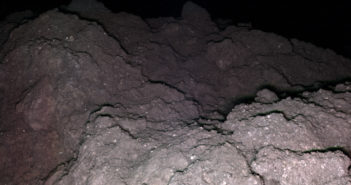
Ryugu surface

Editor’s note: We’re wrapping up a busy summer with one last conference: the EPSC-DPS joint meeting in Geneva, Switzerland. To celebrate the announcement of AAS Publishing’s new Planetary Science Journal, we’ll be bringing you some highlights from this planetary science conference all week!

Press Conference: Asteroid Sample Return Mission: Hayabusa2

It’s pretty exciting that, in recent years, we’ve been able to send spacecraft to directly explore a number of the small bodies in our solar system, learning more about these objects’ composition, formation, evolution — and even their role in the formation of life on Earth. Two of these recent missions, Hayabusa2 and OSIRIS-REx, are visiting nearby asteroids — and they have the added goal of returning samples of these asteroids to Earth. In today’s press conference, we got to hear more about one of these endeavors.

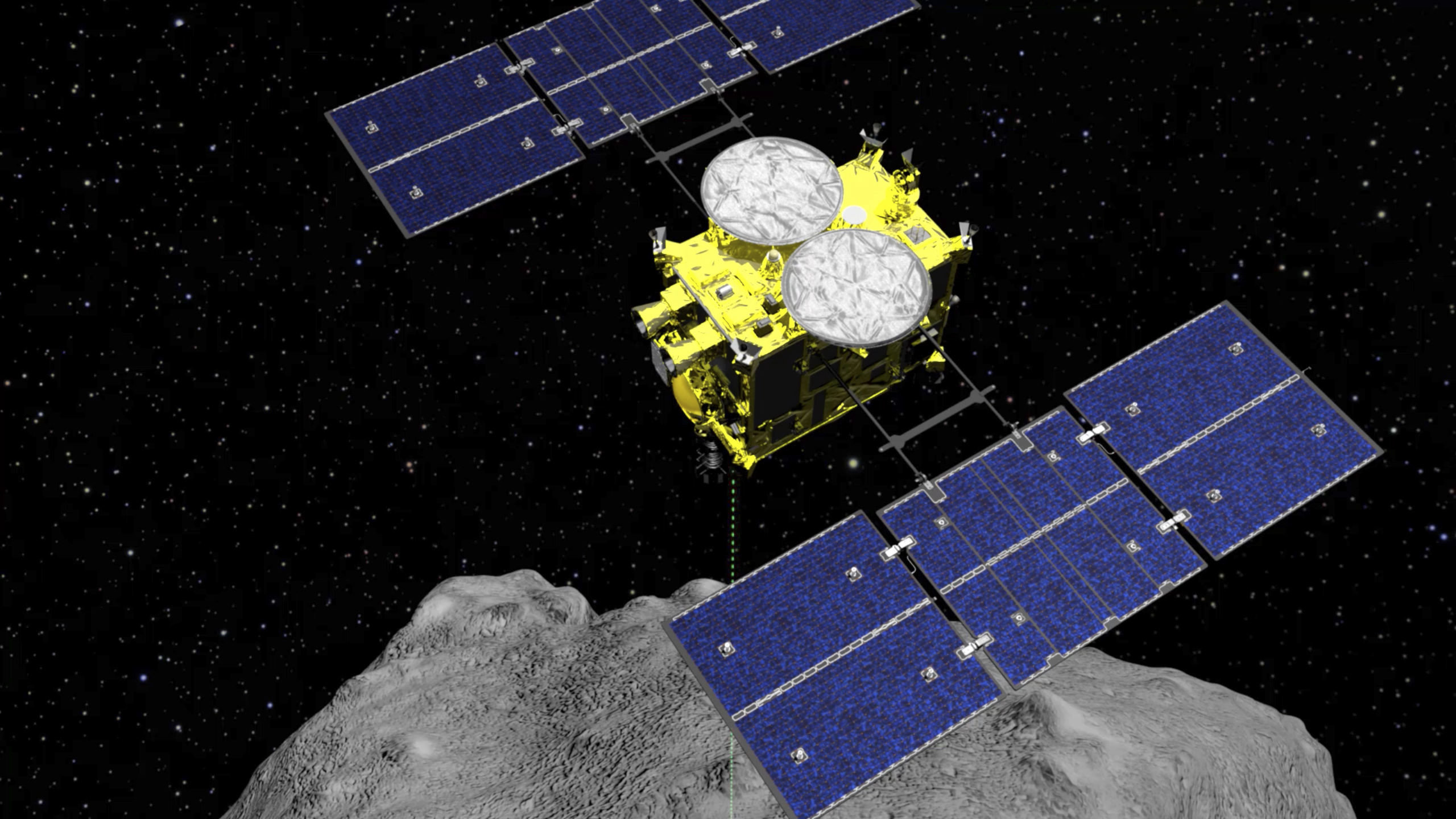
Hayabusa2

Artist’s illustration of the Hayabusa2 spacecraft. [JAXA]

The Hayabusa2 mission follows on the heels of Hayabusa, a spacecraft developed by the Japan Aerospace Exploration Agency (JAXA) that, in 2003, traveled to small near-Earth asteroid 25143 Itokawa and returned a sample to Earth in 2010. Hayabusa2 hopes to build on that success, providing additional clues to the origin and evolution of the inner, terrestrial planets in our solar system, as well as to the origin of water and organic compounds — precursors to life — on Earth.

Like all missions that include actual contact with a solar-system body, Hayabusa2’s operations are incredibly complex. After launching in 2014 and arriving at its target — the asteroid 162173 Ryugu — in 2018, Hayabusa2 began a multi-step process to gather information about this primitive near-Earth asteroid. Several rovers were deployed to the asteroid, an impactor was fired at Ryugu’s surface, and the spacecraft completed two touchdowns, briefly tapping the asteroid’s surface before lifting off again.

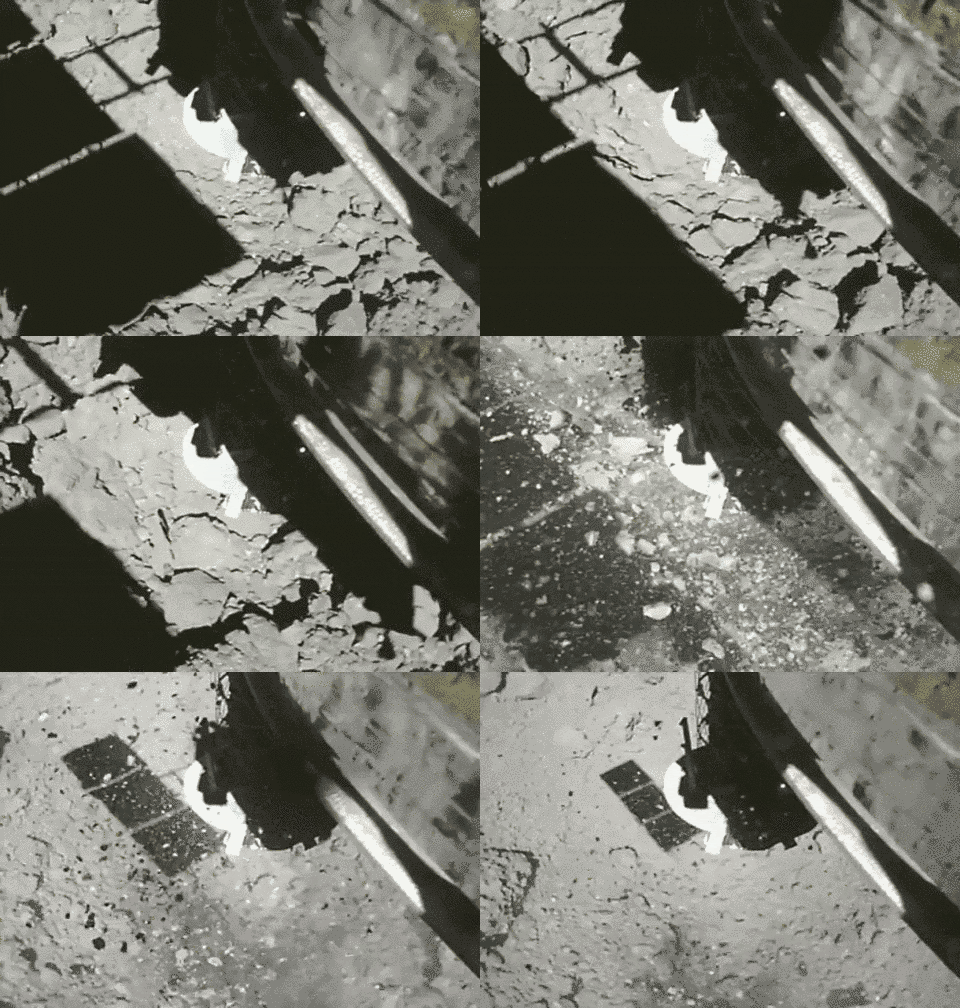
Hayabusa2 touchdown

Short clip of Hayabusa2 touching down on the surface of asteroid Ryugu. The clip plays at roughly ten times the actual speed. [JAXA]

So how’s the mission going so far? Makoto Yoshikawa (ISAS/JAXA) shared more about the impact experiment and Hayabusa2’s second touchdown.

In April 2019, Hayabusa2 deployed what is basically a space gun: a system that could fire a single 2.5-kg copper projectile into Ryugu’s surface at a speed of ~2 km/s (about 4,500 mph). After deploying a camera to watch, Hayabusa2 hid out of reach of debris and waited for the results. We expected the formation of a crater of perhaps 2 or 3 meters — but the actual crater that formed is larger than 10 meters! This suggests that Ryugu’s material is of lower density and higher porosity than we thought.

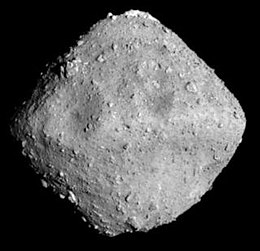
Ryugu

Asteroid Ryugu, as imaged by Hayabusa2. [JAXA]

The next step was to sample Ryugu’s subsurface material, kicked up by the impact and deposited around the crater region. Hayabusa2’s second touchdown occurred roughly 20 meters from the crater site, giving the spacecraft an opportunity to gather a quick sample of the ejected material before returning to orbit. We don’t yet know how much material was gathered — and, in fact, we won’t know until we open the sample container once it’s returned to Earth at the end of next year! — but we don’t need much: all the sample analysis can be completed if we’ve gathered as little as 0.1 grams.

Even before we consider the upcoming sample return, we’ve already learned a lot about Ryugu from Hayabusa2’s imaging observations! Antonella Barucci (Observatoire de Paris) detailed how advanced statistics have allowed us to explore the reflected light from Ryugu, mapping out the asteroid’s surface and gathering detailed information from its spectrum. The spectral variation on Ryugu’s surface reveals information about space weathering and the grains of its surface material (its regolith). It also provides constraints on how this rubble-pile asteroid formed, reaccumulating from the wreckage of its parent asteroid.


Changing gears, Franck Marchis (SETI Institute) discussed recent work that will advance another asteroid mission: Lucy. NASA’s Lucy space probe will launch in 2021 and journey to Jupiter’s trojan asteroids, likely flying by six of them on its tour. Before the spacecraft undertakes this voyage, however, it would be helpful for us to learn everything we can about its targets. This, according to Marchis, is where eVscope can be useful.

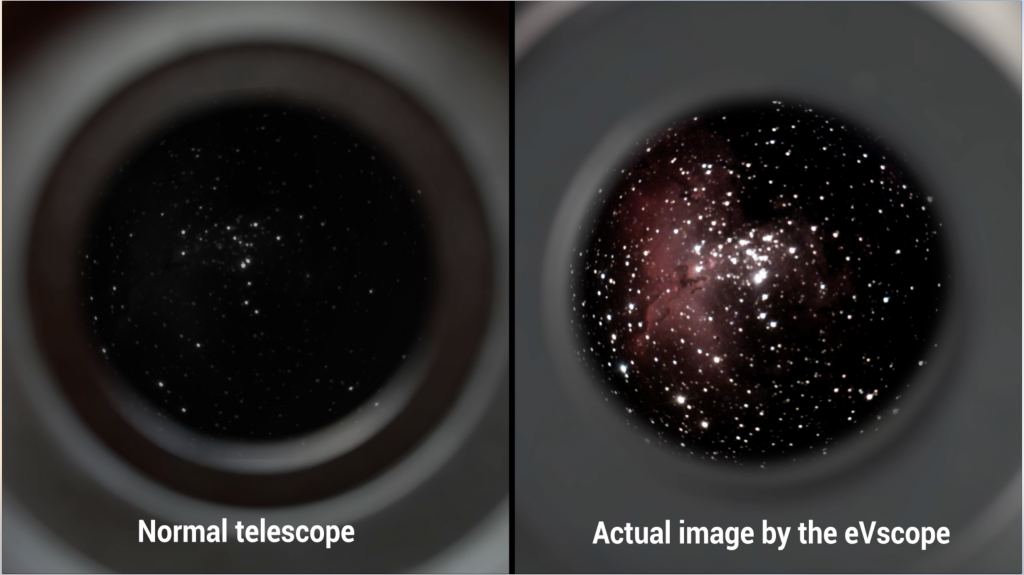
unistellar eVscope

eVscope accumulates light over short periods of time, providing deeper observations. [eVscope]

Unistellar’s enhanced vision telescope (eVscope) is a backyard telescope that began as a kickstarter project and has now gone into production. This unique telescope is designed to reduce the entry barrier to amateur astronomical observation, making it easy for anyone to observe the night sky. The telescope is highly portable, easily and quickly set up and initiated, and accumulates light over short periods rather than passing it directly through to an eyepiece, providing an immediate deeper view.

Perhaps most intriguing of eVscope’s features is the fact that it comes with an app that allows the user to connect to world-wide observing campaigns. The app is able to send out alerts about upcoming transient events (perhaps an asteroid flyby, a supernova, or a comet) and, if the user accepts the observation request, it can transmit instructions to automatically point the user’s eVscope to observe the event. The observations from all users are then combined and shared, allowing scientists to build a much more complete picture of the event than could be obtained through a single observation. The added benefit of this eVscope brand of citizen science is that the network of amateur astronomers making observations are all doing so with the exact same equipment, vastly simplifying the process of combining the data.

asteroid occultation

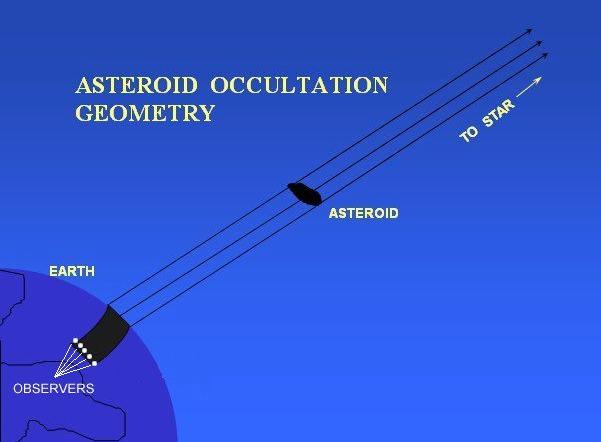
Diagram of an asteroid occultation. An asteroid passes in front of a distant star, casting a brief shadow on Earth than can be seen by observers spread out in the predicted path. [IOTA

One of the ways in which we can take advantage of this benefit is with occultations — events where a nearby, solar-system body passes in front of a distant star, briefly blocking the star’s light and allowing us to learn more about the properties of the occulting object. More than 40 occultations will be observable per day with the eVscope network, according to Marchis, and if as many people participate as they hope, eVscopes could provide an ideal world-wide network for hunting down occultations.

As a proof of concept, the eVscope team has tested this in Oman by using these telescopes to make the first occultation observation of asteroid 21900 Orus, one of the Lucy mission’s upcoming targets. To catch a glimpse of Orus’s shadow as it passed in front of a star, teams were stationed at different locations near the predicted path the shadow would take. The successful observation of the occultation by one team (and the non-observation by the other!) confirmed Orus’s orbit and provided an independent measurement of its size.

The eVscope team plans to do this again the next time Orus passes in front of a background star, on 4 November — this time with more people and more telescopes involved. From this, Marchis hopes that we’ll be able to learn even more about the asteroid — from its size and shape to whether it has any moons — thereby improving science planning for Lucy’s flyby.

New Horizons Pluto

Editor’s note: We’re wrapping up a busy summer with one last conference: the EPSC-DPS joint meeting in Geneva, Switzerland. To celebrate the announcement of AAS Publishing’s new Planetary Science Journal, we’ll be bringing you some highlights from this planetary science conference all week!

DPS Kuiper Prize Lecture: Inside the Moon Fifty Years After Apollo

The DPS’s 2019 Gerard P. Kuiper Prize for outstanding contributions to the field of planetary science has been awarded to Maria Zuber (MIT) “for her contributions to advancements in geophysics, planetary gravity mapping, and laser altimetry.”

Buzz Aldrin Moon

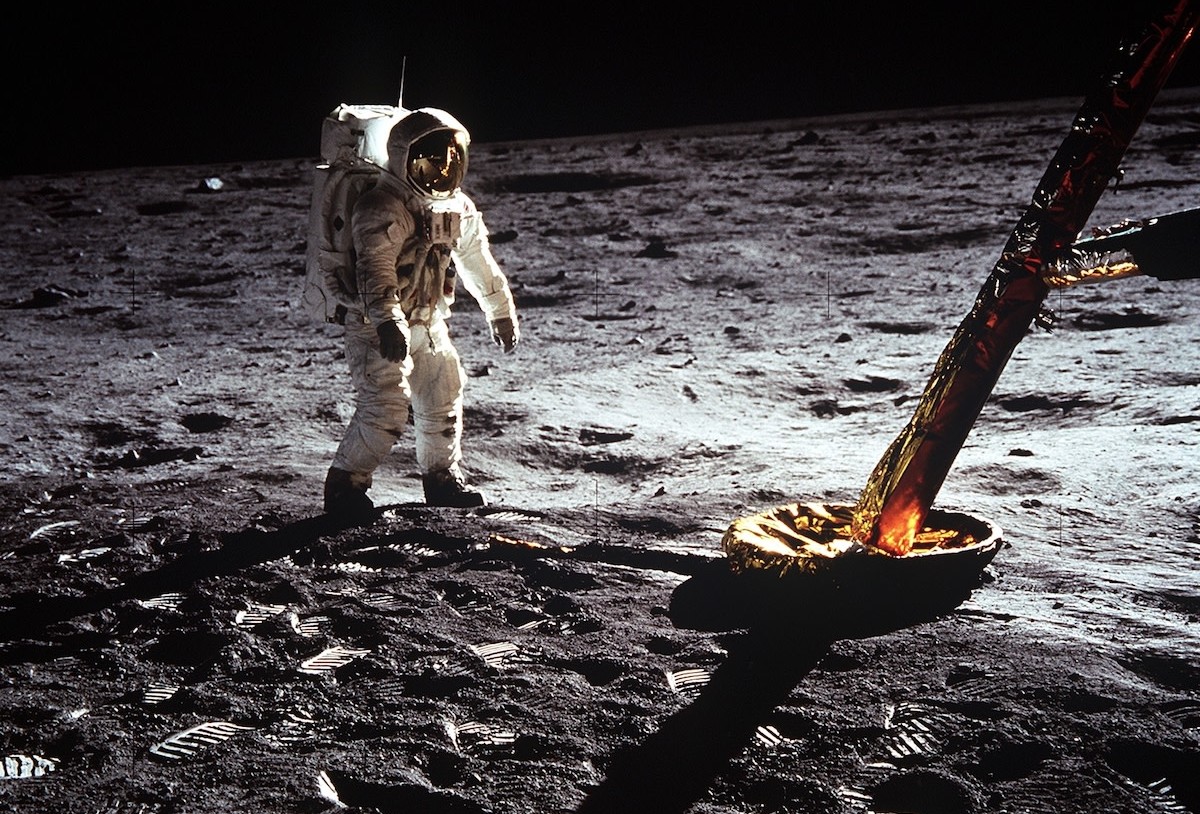
Apollo 11 astronaut Buzz Aldrin stands on (and doesn’t sink into!) the surface of the Moon. [NASA]

Zuber opened her prize lecture by pointing out how much we didn’t know about the Moon before the first lunar landing fifty years ago. We weren’t sure what to expect regarding the Moon’s structure and composition, nor how that could influence the landing — was the lunar dust so soft and thick that it would swallow the lander like quicksand? Fortunately, none of our uncertainties about the Moon derailed the landing — and with research since then, we now much better understand the lunar crust and interior.

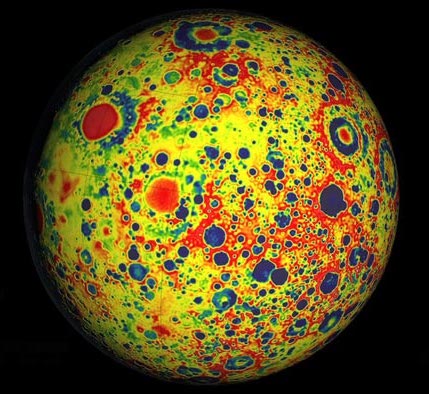
An important means by which we’ve learned about the Moon’s structure is the Gravity Recovery and Interior Laboratory (GRAIL) mission, led by Zuber, which lasted from 2011 to 2012. By flying two spacecraft close over the Moon’s surface and measuring minute changes in the distance between them, the GRAIL team was able to construct an extremely detailed map of the Moon’s gravitational field, thereby revealing its internal geological structure.

GRAIL view of Moon

Variations in the Moon’s gravitational field, as measured by GRAIL. [NASA/JPL-Caltech/MIT/GSFC]

GRAIL’s data produced many important results, including detailed maps of the lunar crust and lithosphere, insight into the subsurface structure of the Moon’s 74 impact basins with diameters greater than 200 km, and constraints on the presence of a core at the Moon’s center. One of the biggest surprises from the mission, says Zuber, was the discovery of the Moon’s fractured crust: even beneath the lunar surface, the Moon’s crust is broken up. GRAIL’s insights provide a record of massive impacts in the inner solar system early in its history, as well as a look at some of the formation processes that were at work during the Moon’s birth.

Could a mission like GRAIL be applied to other solar-system bodies in the future? In order to build its detailed maps, GRAIL dropped to within a handful of kilometers of the lunar surface — a feat that wouldn’t be possible around any of our solar system’s planets. If we tried that with a spacecraft around Mercury, for instance, the thermal radiation would destroy the spacecraft.

But perhaps a mission like GRAIL could be used to map other satellites in our solar system, such as Jupiter’s Galilean moons? Fifty years after we first landed on the Moon, it’s exciting to see how much we’ve learned since then — as well as how much we still stand to learn, both about Earth’s only natural satellite and about other, similar bodies in our solar system.


DPS Urey Prize Lecture: New Horizons: Exploration of Distant Worlds in the Kuiper Belt

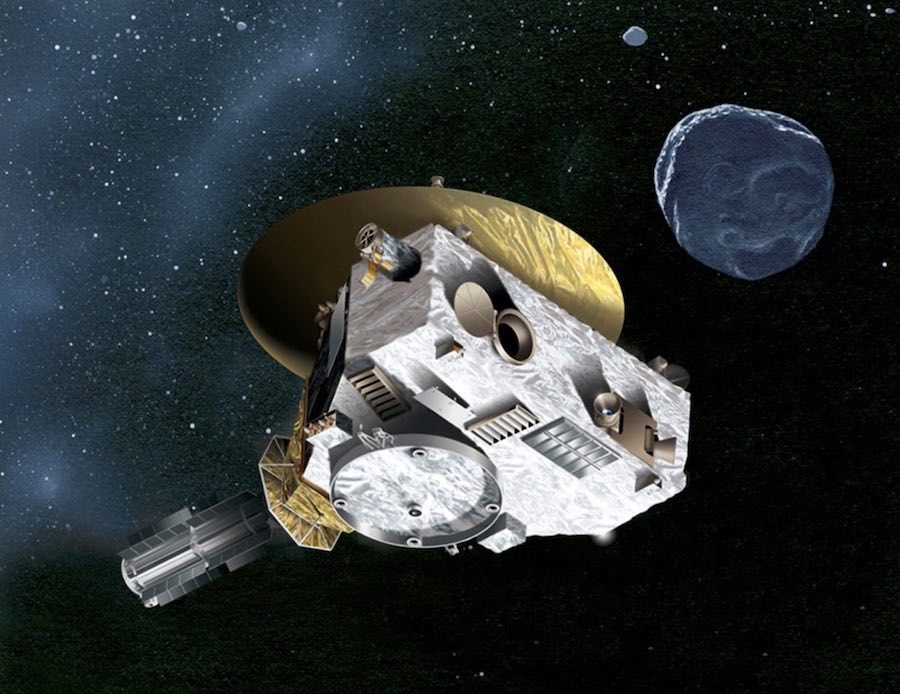
New Horizons

Artist’s illustration of the New Horizons spacecraft flying by a Kuiper-belt object. [NASA/JHUAPL/SWRI]

In a transition from nearby bodies, our next speaker took us to the outer reaches of the solar system with the New Horizons mission. Kelsi Singer (Southwest Research Institute), this year’s DPS Urey Prize winner for outstanding achievement in planetary research by a young scientist, gave us an update on this intrepid little explorer’s latest adventures.

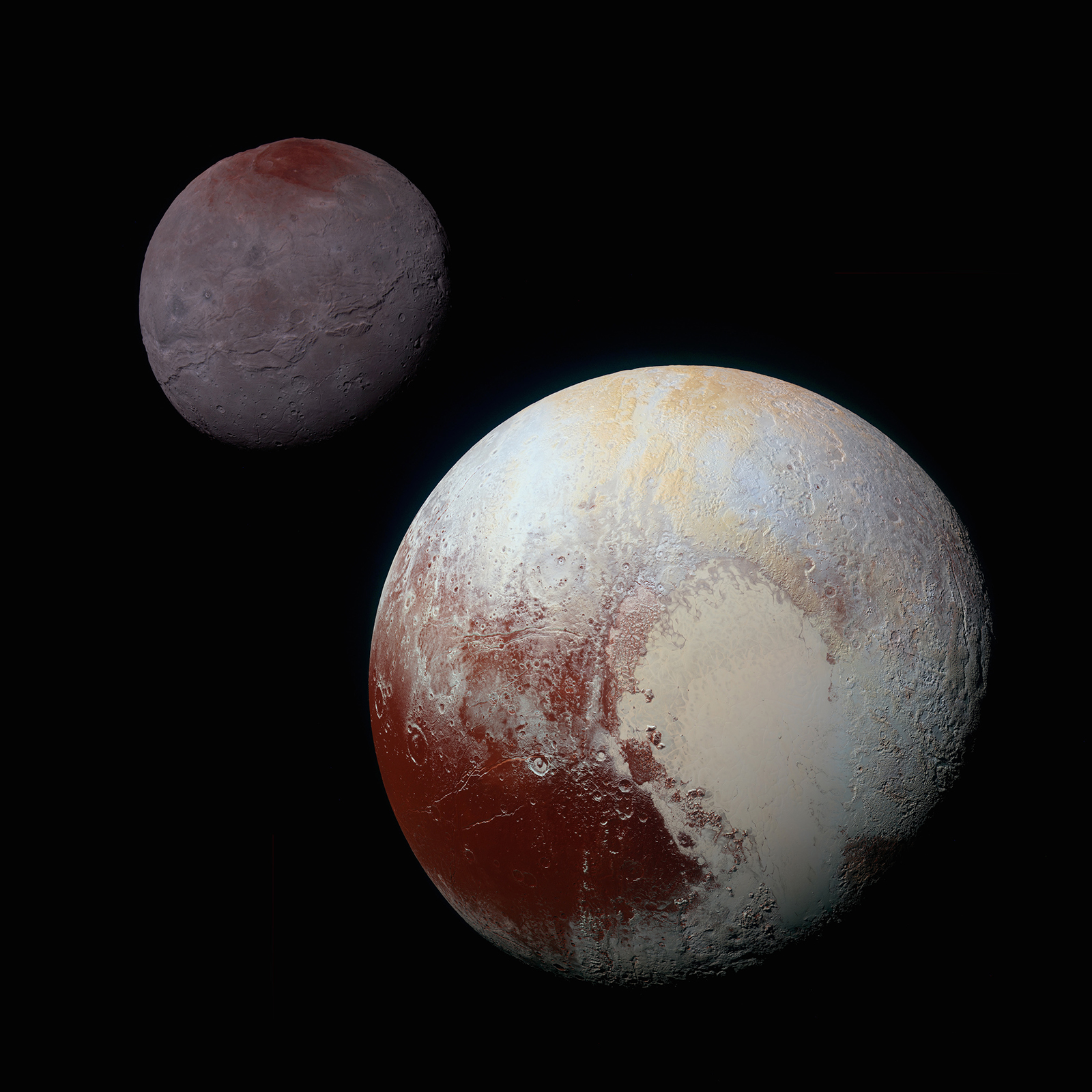
New Horizons launched in January 2006, and after a gravity assist from Jupiter, it arrived at the Pluto system in July of 2015. After flying by Pluto and taking detailed images of the former planet and its moon Charon, New Horizons then continued onward, later buzzing the Kuiper belt object 2014 MU69 in January of this year.

Pluto and Charon

This composite image with enhanced colors shows New Horizons observations of Pluto (foreground) and Charon (background). These Kuiper belt bodies, as well as MU69, appear to have very few craters. [NASA/JHUAPL/SwRI]

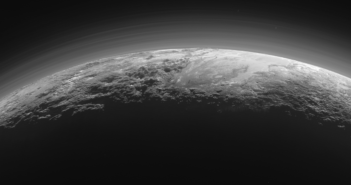
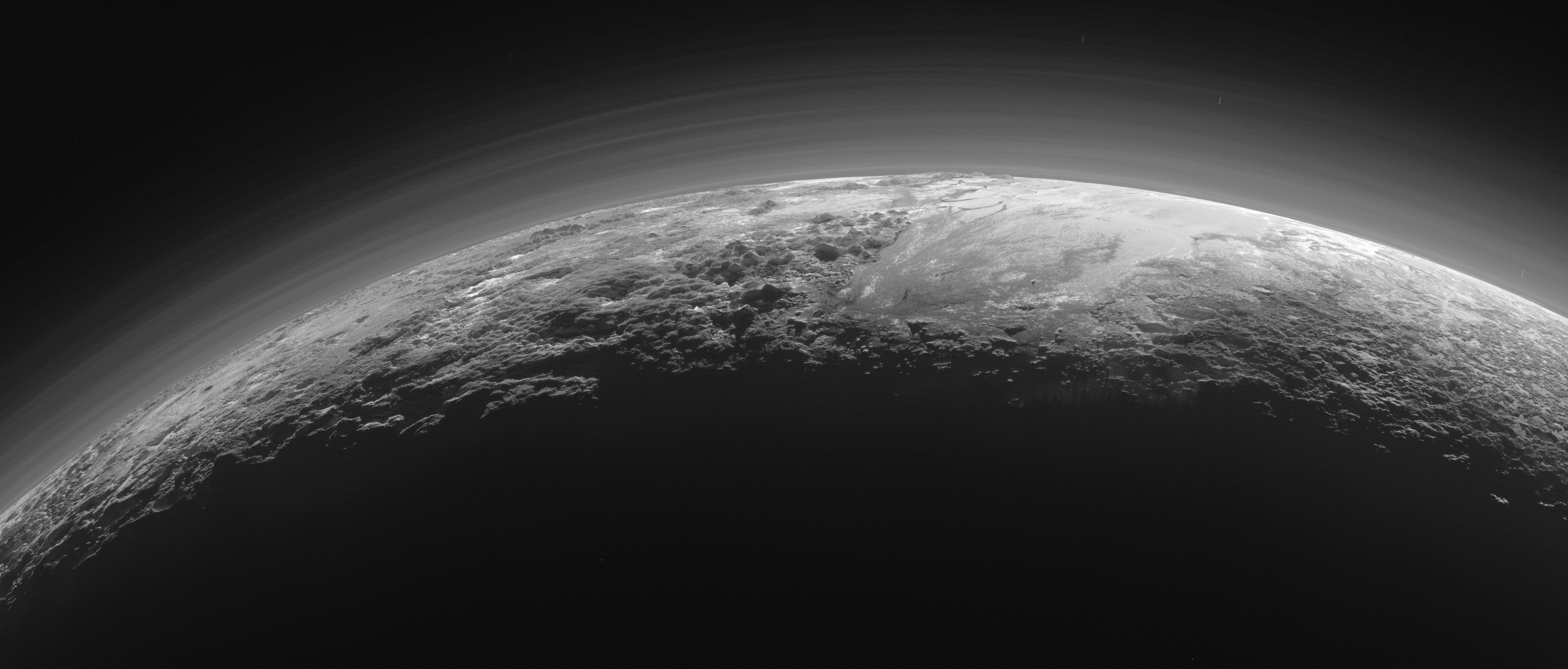
New Horizons’s images have been nothing short of spectacular (see, for instance, the incredible detail in the image of Pluto that’s on The Planetary Science Journal‘s cover and shown at the top of the page. No seriously, check out the high-res version. Zoom in. It’s unreal!). Singer showed us some of the images of Charon that reveal a whole host of features: a mountain surrounded by a moat, ropey structures from icy volcanic eruptions, wide flat plains. All of these features are clues that can be used to piece together Charon’s past — in this case indicating that the moon was resurfaced long ago, and it has been sitting gathering crater impacts since.

The craters, however, raise another new puzzle. Singer highlighted the lack of small (< 10 km in diameter) craters relative to what we expected to see, and showed the same missing-crater trend in New Horizons’s images of MU69. As these craters should have been caused by Kuiper belt objects of < 1 km in size, their dearth suggests there may be far fewer small Kuiper belt objects than we thought. This suggests one of the following:

  1. Fewer small objects tend to form in the Kuiper belt than we initially thought, or
  2. Small objects do form, but they somehow get preferentially removed.

Either explanation would have important implications for how our solar system formed and evolved, and more observations like those of New Horizons will prove invaluable in puzzling out this mystery!


EPSC Farinella Prize Lectures: Completing the Inventory of the Solar System

The 2019 Farinella prize was awarded for the first time to a team of people rather than to a single individual. Scott Sheppard (Carnegie Institution for Science) and Chad Trujillo (Northern Arizona University) jointly received the award for their collaborative work observationally characterizing the Kuiper belt and Neptune-trojan population.

Neptune Trojans
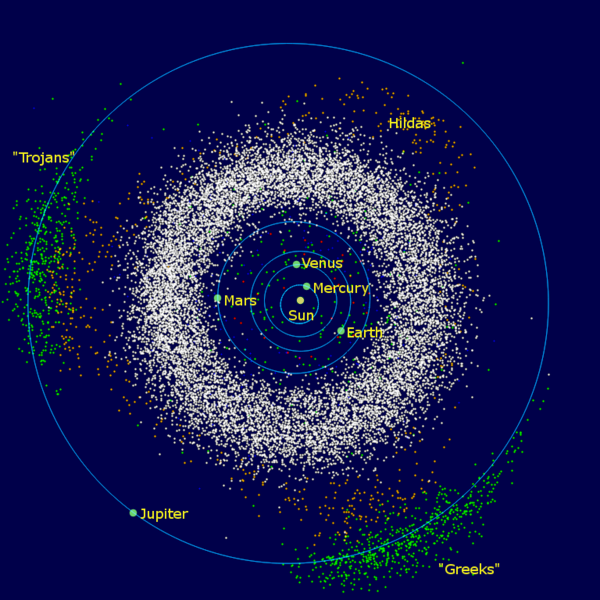
Jupiter trojans

Diagram showing the locations of the two groups of Jupiter trojans (seen in green; the ones that trail Jupiter’s orbit are called “Trojans” and the ones that lead Jupiter’s orbit are called “Greeks”). [Mdf]

What are trojans? These small celestial bodies (mostly asteroids) orbit the Sun along the same path as the planet with which they’re associated, but they either lead 60° ahead or trail 60° behind the planet at so-called stable Lagrange points. The Jovian trojans are perhaps the most well known — there are more than 7,000 known asteroids that move in these two clumps ahead of and behind Jupiter. But other planets have trojans as well: we’ve spotted four around Mars, a pair around Uranus, and even one around Earth.

Neptune, at current count, has 23 known — and Sheppard and Trujillo have discovered a number of them. When the duo first started looking for Neptune trojans, it was unclear whether the majority of these bodies would be on high- or low-inclination orbits. Sheppard and Trujillo’s work, however, suggests that the vast majority of Neptune trojans are high-inclination (high-inclination orbits dominate by a ratio of 4 to 1!). This puffed-up population points to an interesting origin: they were likely captured by Neptune from elsewhere in the solar system during a period of migration for the giant planets.

As Neptune trojans share a lot of similar properties with Jupiter trojans, we can guess that these two populations may have similar histories. With any luck, we’ll be able to test this theory soon: in 2021, NASA plans to launch a space probe called Lucy to visit six different Jupiter trojans. This mission is sure to reveal more about these intriguing bodies.

Extreme TNOs

What other unexpected objects lurk deep in the outer reaches of our solar system? The minor planet Sedna, which lies at a distance of about 86 AU (three times the distance to Neptune), poses an interesting riddle with its extremely eccentric orbit. With a number of plausible formation scenarios proposed — each with different implications for the solar system’s formation environment and subsequent evolution — Sheppard and Trujillo determined that the best way to understand Sedna was to find more bodies like it!

Thus began an extensive deep solar system survey, using the CTIO 4-m telescope with the Dark Energy Camera in the southern hemisphere and the Subaru 8-m telescope with HyperSuprimeCam in the northern hemisphere. This large uniform survey has covered 3,000 square degrees, or about 20% of the sky, to 24th magnitude — and through this search, Sheppard and Trujillo have discovered roughly 80% of the known objects beyond 60 AU.

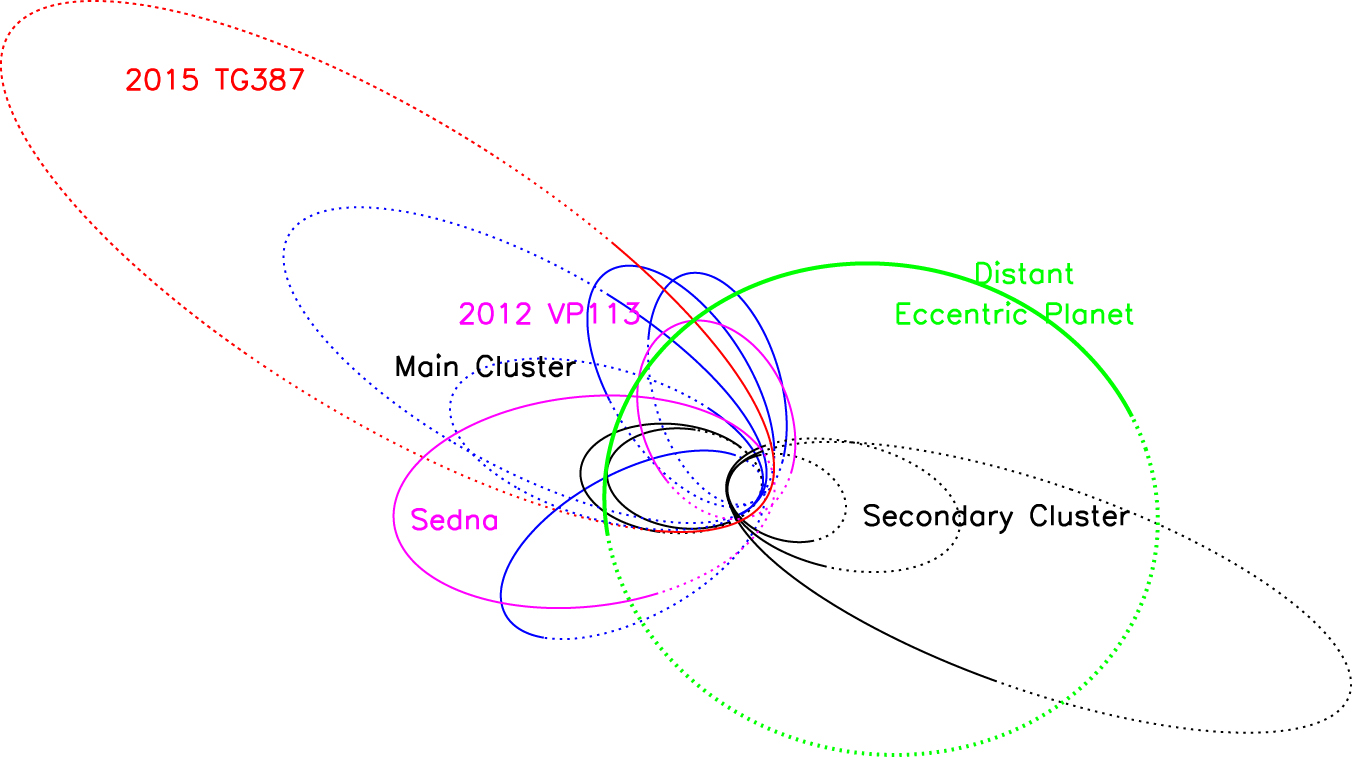
eTNO orbit clustering

Schematic showing the alignment of the orbits of detached eTNOs and the proposed orbit of a hypothetical super-Earth-mass planet (in green). A secondary cluster of aligned bodies is also predicted in this model, and is observed. [Sheppard et al. 2019]

The survey revealed two Sedna-like objects — 2012 VP113, a distant minor planet with a whopping perihelion of ~80 AU; and “The Goblin”, 2015 TG387, which has an orbital period of more than 11,000 years — as well as a number of additional extreme trans-Neptunian objects (eTNOs), bodies with perihelions of >40 AU and semimajor axes of >150 AU. Intriguingly, a pattern appeared in the data: all of the orbits of the eTNOs appeared to cluster in approximate alignment, rather than being randomly distributed around the Sun.

Could a distant, massive, as-yet undiscovered planet in our solar system be influencing these bodies’ orbits, shepherding them into a cluster? That’s what Sheppard and Trujillo proposed, and this theory has been supported by additional eTNOs that have been found since.

The distant-object discoveries continue to pour in — two of the latest are FarOut (2018 VG18), which currently lies at ~120 AU and FarFarOut (no designation yet), which is estimated to be at a whopping near-140-AU distance! These continued discoveries bring us ever closer to understanding our outer solar system — and possibly finding any hidden planets that may lurk there.


Splinter Session: Status Report on Planning for the Next Planetary Science Decadal Survey

What’s planned for the next decade of planetary science? That’s exactly what needs to be decided via the next Planetary Science Decadal Survey, a review process in which the community comes together to define and prioritize the key scientific questions that could potentially be addressed in the next decade, as well as prioritize the possible missions that might address these questions.

Planetary Science Decadal Survey

Cover for the last planetary science decadal survey. [National Research Council for the National Academies]

You may have thought we just went through this whole process recently — but it turns out planetary science has its own overview, which occurs completely independently of the astronomy decadal survey (Astro 2020 is currently underway). The planetary science decadal is offset by a few years, so the field is only just starting to gear up for this review.

In this session, David Smith (Space Studies Board, NAS Engineering and Medicine), Lori Glaze (director of NASA’s Science Mission Directorate’s Planetary Science Division), and Linda French (program director at NSF) were on hand to discuss plans and processes for the upcoming planetary science decadal. The estimated timeline, as it currently stands:

  • 2/2020: Opening of the website through which scientists can submit white papers, short papers that describe important science questions, missions, or the state of the field
  • 5/2020: White paper submission deadline
  • 6/2020: The decadal survey committee and panels, made up of members of the planetary science community, begin meetings to consider the white papers and mission studies
  • 10/2021: The survey committee compiles their recommendations into the first draft of a report with recommendations for the coming decade
  • 3/2022: The final survey report is released

Keep an eye out next year for the start of this important process!

EPSC-DPS Joint Meeting 2019

Greetings from the EPSC-DPS meeting in Geneva, Switzerland! We’re wrapping up a busy summer of conferences with this meeting, jointly hosted by the European Planetary Science Congress and the American Astronomical Society’s Division for Planetary Sciences. The normal posting schedule for AAS Nova will resume next week.

The Planetary Science Journal

A new journal is coming soon: AAS Publishing’s The Planetary Science Journal. [AAS Publishing]

Why are we here? AAS publishing recently announced a brand new journal, the Planetary Science Journal. In honor of this exciting news, we’re here at EPSC-DPS 2019 to celebrate the latest research from the field of planetary science (and to bring you some of the highlights)!

This year marks the third joint meeting between EPSC and DPS — and with more than 1,500 participants from around the world registered, this promises to be the largest gathering of planetary scientists held in Europe to date! More than 1,000 oral presentations and nearly as many posters are scheduled over the course of this week, with presentations broken into parallel sessions spanning six broad topics:

  • Terrestrial planets

We’re looking forward to hearing about some of the latest news from this community!

tilted disk

Editor’s note: This is the final installment from last week, when we were in Reykjavik, Iceland at the Extreme Solar Systems (ExSS) IV meeting. Check out the previous four posts as well, to read more on the latest news from the field of exoplanet research!

Session 15: Atmospheres III

And we’re back for the last day of the conference and our third session on atmospheres!

Andy Skemer (UC Santa Cruz) opened the session by presenting the work of his graduate student, Brittany Miles, who was unfortunately unable to be here. Miles’s research has probed the atmospheres of some of the coldest brown dwarfs (the coldest, WISE 0855, is “250 K … so, colder than Iceland,” quips Skemer). Their spectra showed carbon-monoxide features that indicate the atmospheres of these cold bodies undergo strong mixing; this trend may continue down to even lower temperatures (e.g., planets).

The next several speakers took us to the opposite end of the temperature scale, discussing scalding ultra-hot Jupiters (with temperatures of >2,000 K).

  • KELT-9b

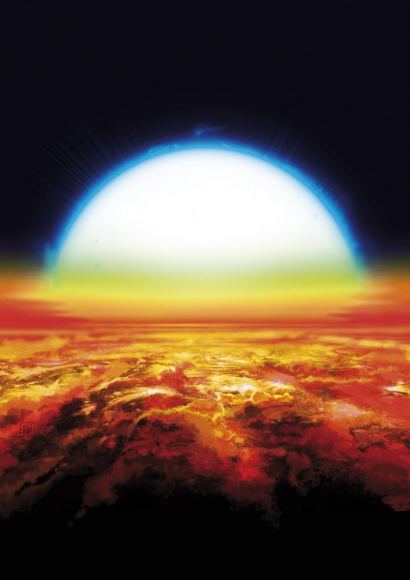
    Artist’s impression of a sunset on ultra-hot Jupiter KELT-9b. [Denis Bajram]

    Lorenzo Pino (U Amsterdam; presenting on behalf of Jean-Michel Désert) showed how spectra from these planets have enabled a variety of measurements of the atmospheric composition and metallicities of ultra-hot Jupiters, paving a way forward to study these extreme bodies in the context of planet formation.
  • Jens Hoeijmakers (U Bern) discussed the atmospheric composition of the especially extreme KELT-9b, which reaches more than 4,000 K on its dayside. Transmission spectra indicate its atmosphere contains heavy and rare-Earth metals (anybody need some yttrium?) — and new work suggests KELT-9b isn’t unique in this.
  • David Ehrenreich (Geneva) showed how he and collaborators used the ESPRESSO instrument at the VLT — nominally designed to search for Earth-like planets — to explore the atmosphere of an ultra-hot gas giant. They find evidence for iron in the atmosphere on the dayside and evening of the planet, but it’s absent on the nightside and morning — which indicates that it may literally rain iron on this planet at night.
  • Thomas Beatty (Arizona) dug deeper into ultra-hot-Jupiter clouds, describing observations that track the formation of clouds at the planet’s dusk and their destruction at dawn. He also presented observations that resolve a hot Jupiter’s atmospheric wind speeds as a function of longitude. These results show that we’re actually able to observe the weather on exoplanets — which is pretty awesome!

Melodie Kao (Arizona State) closed the session by zooming out and looking at the environment of atmospheres: their magnetospheres. One of the most direct ways to measure a planet’s magnetic field would be to observe exoplanet aurorae at radio wavelengths. So far, we haven’t yet achieved this — but Kao presented the next best thing: the first detection of an exo-aurora from a brown dwarf. This object is just 11–12 Jupiter masses; with any luck, exoplanet aurorae will be next!

Session 16: Disks

Next up, we got a closer look at the birthplaces of exoplanets: protoplanetary disks.

protoplanetary disk

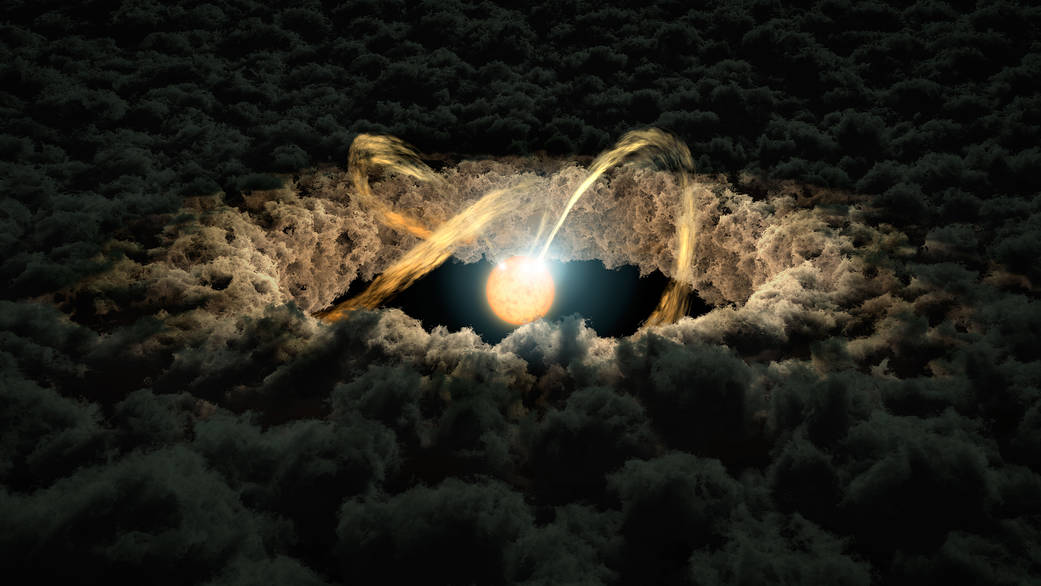
Artist’s illustration of a star surrounded by a protoplanetary disk. [NASA/JPL-Caltech]

Catherine Espaillat (Boston U) provided a broad, multi-wavelength and multi-epoch view of a protoplanetary disk surrounding a young, dynamic host star. Her work shows the first observational evidence for a connection between these bright young stars, the accreting disk, and powerful jets ejecting mass from the system.

The total mass of a protoplanetary disk and its ratio of solids to gas can influence how quickly planets form and what their compositions will be. Diana Powell (UC Santa Cruz) explored these properties by modeling a sample of disks, showing that disks are more massive than we’d previously appreciated (typically 9–27% the mass of the host star), and that ice formation in the outer, colder regions of the disk can alter its radial composition.

HL Tau

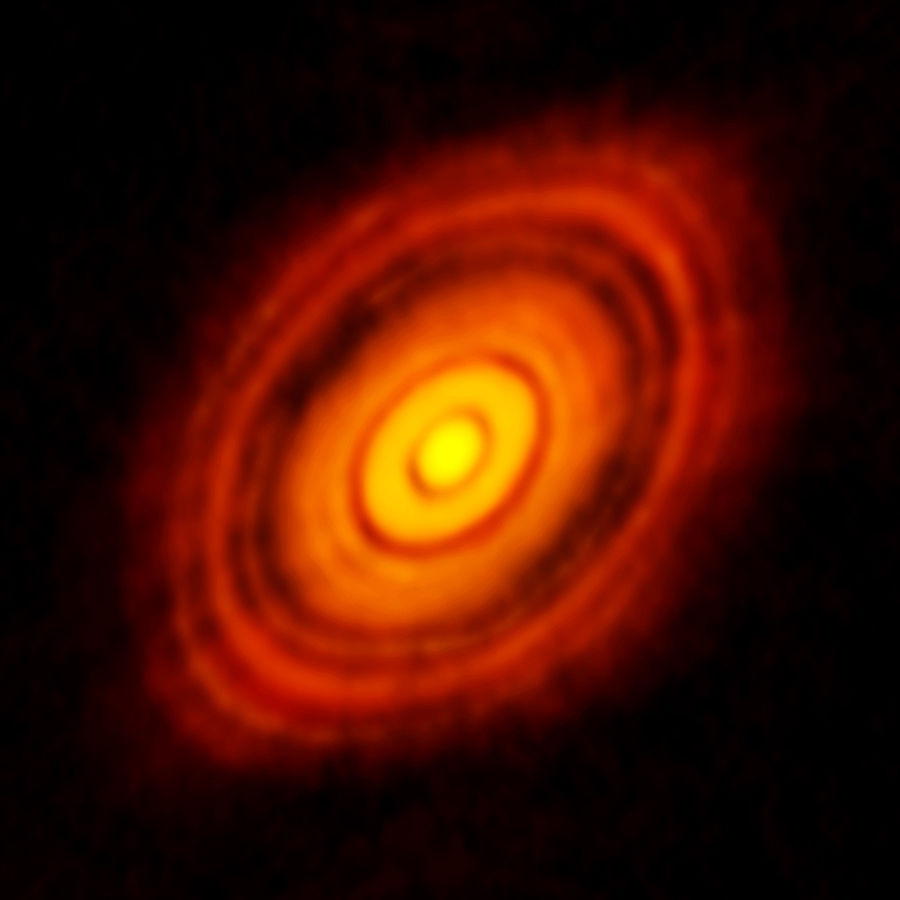
This ALMA image of the protoplanetary disk surrounding the star HL Tau reveals the detailed substructure of the disk, including gaps that may have been cleared by planets. [ALMA (ESO/NAOJ/NRAO)]

Are the gaps in HL Tau and similar disks carved by planets? Christophe Pinte (Monash U) argues that at least some of them are — and he’s got the data to back up his claim. In 2018, he found that velocity measurements of the gas in the disk reveal a kink indicating the presence of an embedded planet orbiting at 230 AU. Since this discovery, he’s made similar detections of kinematic signatures of planets in the gaps of other ALMA-imaged disks.

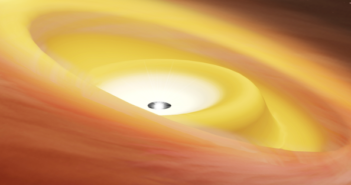
Disks aren’t always neat and well-behaved. Satoshi Mayama (SOKENDAI) showed us observations of a disk marred by symmetric shadows — shadows that we’ve guessed are cast by a tilted inner disk lying inside the outer disk’s cavity. Now, Mayama showed, we’ve made the first-ever direct detection of this inner gas disk with ALMA; modeling these observations confirms the inner disk is highly misaligned.

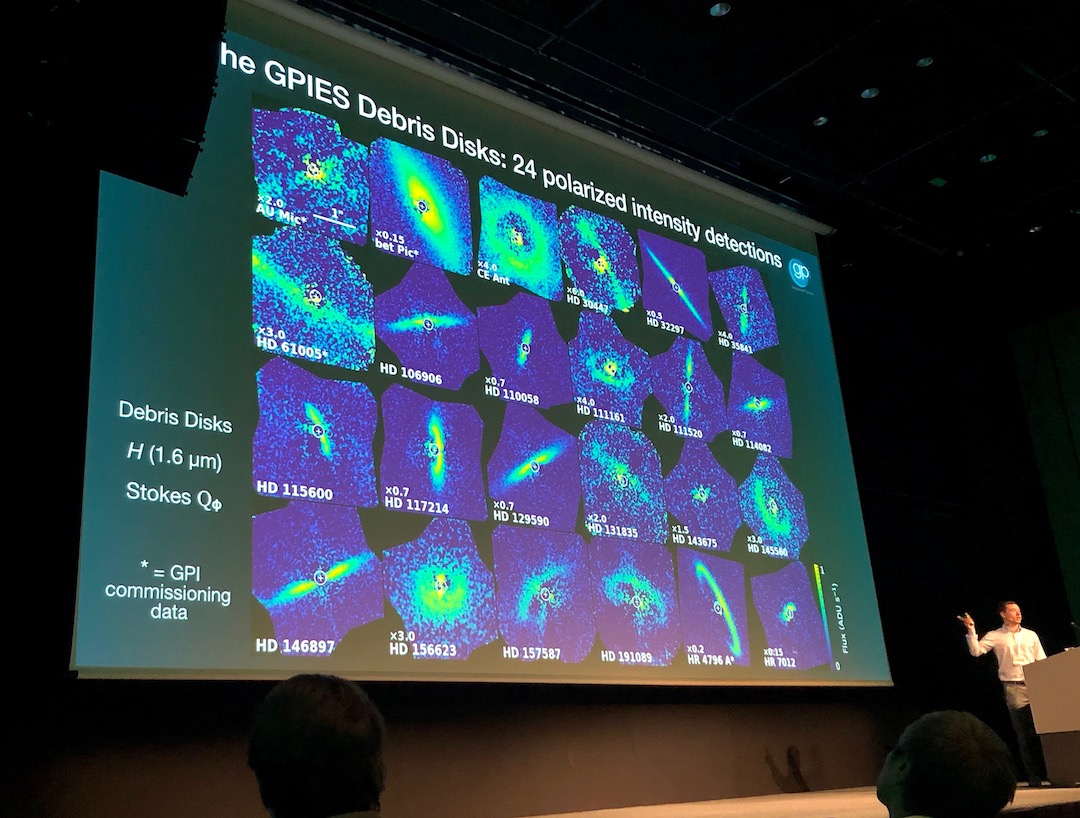
Esposito presents the GPIES debris disk observations. Click to enlarge. [AAS Nova/Thomas Esposito]

“This is beautiful, I’m having this painted on my living-room wall,” Thomas Esposito (UC Berkeley) joked as he presented a spectacular set of 24 high-resolution polarized intensity detections of debris disks made with GPIES. Debris disks are circumstellar disks of dust and debris thought to be left behind after a protoplanetary disk has cleared out the majority of its gas. Esposito outlined some of what the team has learned from these observations — which track the small dust of the systems — about young planetary-system environments.

You can chalk another important detection up to ALMA: Virginie Faramaz (NASA JPL) presented on new observations of the faint debris disk that surrounds HR 8799, the only system in which multiple planets have been directly imaged. The ALMA observations constrain the inner edge of the disk, hinting at the presence of a fifth, as-yet-unseen planet in the system that’s carving the disk.

So if debris disks are what’s left after the primordial gas has been cleared out of a young planetary system, why have observations revealed the presence of gas in ~20 debris disks? Alexis Brandeker (Stockholm University) addressed this peculiarity as he explored these observations in the final talk of the session, which he gave on behalf of Quentin Kral (Obs Paris). This gas likely a secondary origin: it’s released when volatile-rich planetesimals collide with each other, forming the dust of the debris disk.

Session 17: Habitability and Biosignatures

This afternoon kicked off with an always exciting topic: where do we stand in the search for habitable planets and/or signs of life?

As we discussed yesterday, we expect that some white dwarfs should play host to exoplanets. Our primary evidence confirming this is the presence of pollutants in the outer laters of white-dwarf atmospheres, indicating that they’ve accreted planetary material from companions. Matthew Hoskin (Warwick) reported on detections of hydrogen in white-dwarf helium atmospheres, which allow us to infer the water content of the planetary bodies that we think these white dwarfs accreted.

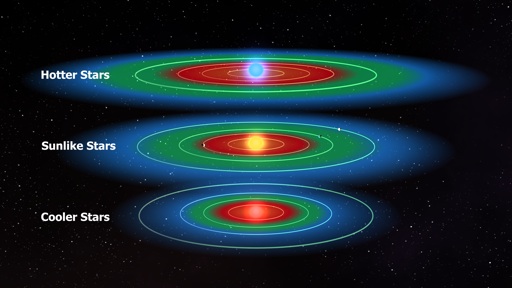
The stars that have been identified as the best targets when looking for Earth-like planets lying in a star’s habitable zone are small, cool M dwarfs. A number of the talks in this session addressed these promising targets:

  • Habitable zones

    The habitable zone lies at a different location for different stars. Cool M-dwarfs have close-in habitable zones, making it easier to detect planets around them. [NASA]

    Phil Muirhead (Boston U) summarized the results of multiple research programs exploring properties like rotation, magnetic fields, and metallicity of M dwarfs. We still have a lot to learn — for instance, there’s still an order of magnitude uncertainty in the amount of high-energy radiation bombarding M-dwarf exoplanets — but we’re making progress!
  • Amber Medina (Harvard) provided further insight into M-dwarf activity. In her work, she measured the flare rates of all 0.1–0.3-solar-mass mid-to-late M dwarfs within 50 light-years observed by TESS. While faster rotators (P < 85 days) showed a high rate of energetic flares, slower-rotating stars (P > 100 days) showed little to no flaring activity — perhaps making these better targets in the search for life.
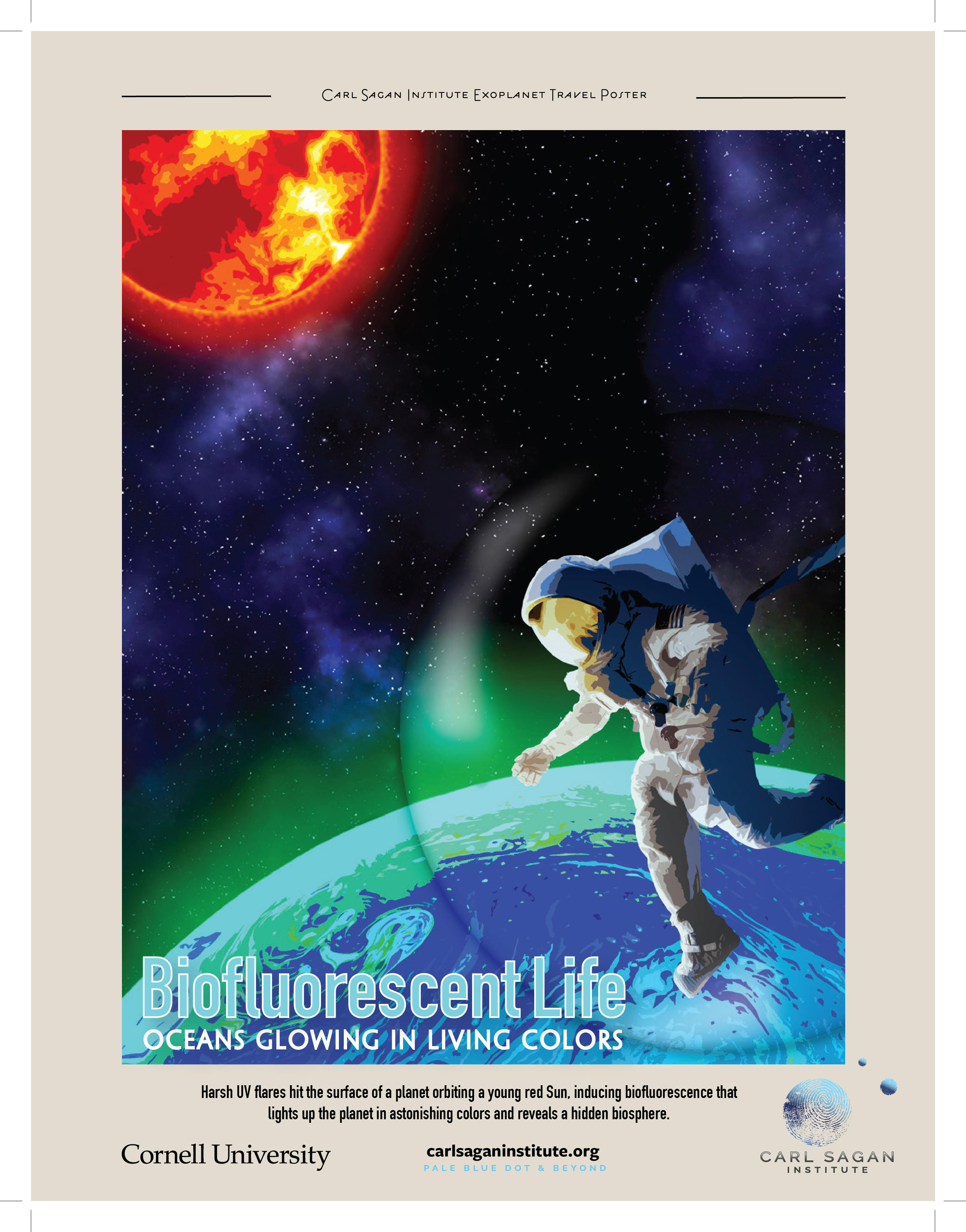
  • Biofluorescent life

    Kaltenegger also described her research into how we might detect life on planets hit by ultraviolet flares. And they made a travel poster about it (click to enlarge)! [Wendy Kenigsberg/Matt Fondeur/Cornell University]

    Howard Chen (Northwestern) used a 3D chemistry-climate model to simulate tidally-locked exoplanets orbiting in the habitable zones of M and K dwarfs. Among his results, he found that only planets around active M dwarfs are susceptible to extreme ocean-loss; planets orbiting quiescent M dwarfs were able to hold on to their water content.
  • Lisa Kaltenegger (Cornell) dove deeper into exoplanet oceans. Her recent work explores how oceans on M-dwarf exoplanets differ from Earth’s: since the stellar light peaks at a different wavelength, it penetrates to a different depth in the oceans — possibly around 100 times less deep! This should lead to enormous differences in water heating, ocean dynamics, winds, photosynthetic processes, and much more.

The earliest life presumably arose under quite harsh conditions on prebiotic planets — but there are some geochemical conditions that are needed to make the emergence of life possible. Dimitar Sasselov (Harvard) outlined a few of these necessities, like lots of hydrogen cyanide (for the C and N atoms) and ultraviolet light in the narrow 200–300 nm window.

Session 18: Future Missions

A perfect note on which to conclude the conference, the final session explored what’s next for exoplanet observational studies. TL;DR: we’ve got some seriously exciting exoplanet missions on the horizon!

Evgenya Shkolnik (Arizona State) opened the session by selling us on why small satellites (SmallSats, to those in the know) are awesome: they’re satellite missions that weigh 180 kg or less, and cost 1–2 orders of magnitude less than major space missions — yet they can do fantastic science! In particular, she described the SPARCS (Star-Planet Activity Research CubeSat) mission, a SmallSat that aims to launch in 2021 and will monitor M dwarfs in ultraviolet to provide valuable context for our search for biosignatures.

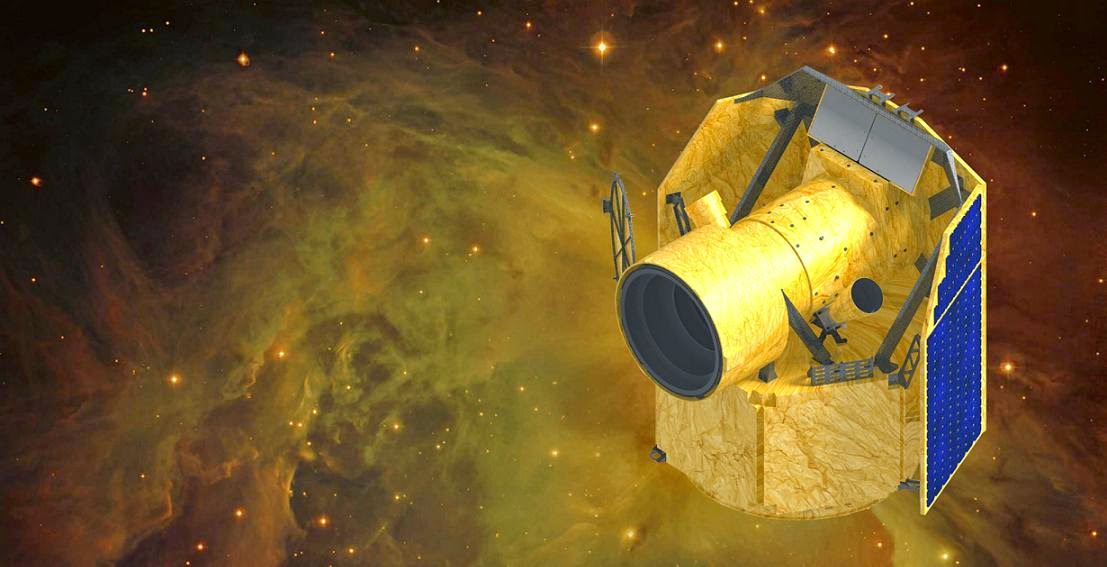
CHEOPS

Artist’s impression of CHEOPS. [ESA]

What’s next on the exoplanet front from Europe? Christopher Broeg (U Bern) reported that CHEOPS (CHaracterising ExOPlanets Satellite) is in-budget and on schedule to launch later this year! CHEOPS will observe the brightest host stars in the sky, watching the transits of super-Earths and Neptune-size planets. This small satellite is intended as a follow-up mission to complement future ground- and space-based surveys; it’ll observe one target at a time with ultrahigh-precision photometry, allowing us to make incredibly precise radius measurements for known planets.

Andy Skemer (UC Santa Cruz) made his second appearance of the day, this time introducing the future of exoplanet imaging with upcoming extremely large telescopes (ELTs). ELTs will allow us to take photos of and characterize hundreds of gas-giant planets, dozens of Neptune-sized planets, and even a handful of rocky planets in reflected light and thermal emission. One example of upcoming capability is the Planetary Systems Imager, planned for use on the Thirty Meter Telescope (TMT).

ARIEL

An artist’s illustration of ARIEL in space.
[ESA / UCL]

Measurements of exoplanet masses and radii are important, but what about chemical composition? Göran Pilbratt (ESA/ESTEC) introduced ESA’s Atmospheric Remote-Sensing Infrared Exoplanet Large-survey (ARIEL) mission, which is designed to do one thing (and do it well): it will perform a detailed chemical census of the atmospheres of a large, well-constructed, diverse sample of transiting exoplanets orbiting F through M stars. ARIEL is scheduled for launch in 2028.

Looking ahead to the James Webb Space Telescope’s (JWST) launch, scheduled for March 2021, Eliza Kempton (U Maryland) described how this long-anticipated infrared telescope will allow us to determine whether or not atmospheres are present on M-dwarf terrestrial planets. Kempton showed that JWST photometric observations of secondary eclipses (when the planet transits behind its host) could potentially distinguish between the presence or absence of an atmosphere in as little as a single eclipse.

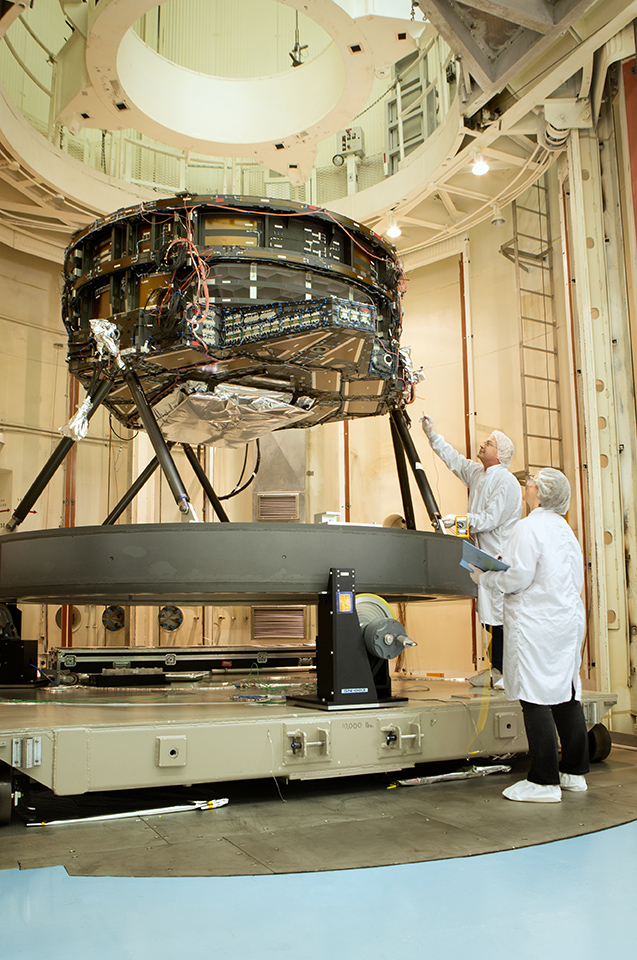
WFIRST

Scientists with FIRST during its primary mirror assembly. [Harris Corporation / TJT Photography]

Where does Wide-Field Infrared Survey Telescope (WFIRST) stand? This space telescope is still on target for a 2025 launch, reports Matthew Penny (Ohio State). If all goes according to plan, WFIRST will explore exoplanets in two ways: 1) it’ll conduct an exoplanet census via a large microlensing survey toward the galactic bulge, hunting for planets on orbits wider than 1 AU (as well as free-floating planets!), and 2) it will directly observe exoplanets with extreme contrast coronagraphic imaging and spectroscopy. The coronagraph instrument will serve as a proof of concept for technology for future missions, like LUVOIR and HabEX.

We’ve talked about the future of transits, direct imaging, and microlensing — but what’s next for radial-velocity surveys? The final presentation of ExSS IV was given by Jennifer Burt (MIT), who gave us a road map for the next decade of extreme-precision radial velocity (EPRV) surveys. Burt outlined the capabilities of current and future EPRV surveys and discussed how they will help us to achieve goals like performing transit follow-up, exploring long-period architectures, and revisiting the closest, brightest, quietest stars to spot planets that we’d previously been unable to detect.


And with that, we’re done with ExSS IV! Congrats to all for a successful conference filled with some truly exciting science.

And for those of you following along at home: If you enjoyed reading about this meeting but feel like you want to hear more about science from our own solar system, check back in three weeks! I’ll be reporting from the EPSC-DPS Joint Meeting 2019 on planetary science in Geneva, Switzerland.

Harpa fireworks

Fireworks over the Harpa Center, where we met for the ExSS IV meeting. The fireworks show was part of Reykjavik Culture Night, which occurred just after the meeting ended. [AAS Nova/Susanna Kohler]

evaporating atmosphere

Editor’s note: This week we’re in Reykjavik, Iceland at the Extreme Solar Systems (ExSS) IV meeting. Follow along to catch some of the latest news from the field of exoplanet research!

Session 10: Atmospheres I

How much do exoplanet scientists care about planet atmospheres? So much that, this morning, we kicked off with the first of three sessions on atmospheres. Welcome to Day 4 of ExSS!

To prepare to interpret images of distant, rocky worlds, we can start by observing nearby worlds — Jupiter’s Galilean moons — as though they were exoplanets. Laura Mayorga (Harvard-Smithsonian CfA) presented lessons learned from analyzing more than 5,000 images of the Galilean moons taken by the Cassini probe, exploring how properties like the angle of the Sun’s illumination affect our interpretation of observations.
atmospheric erosion

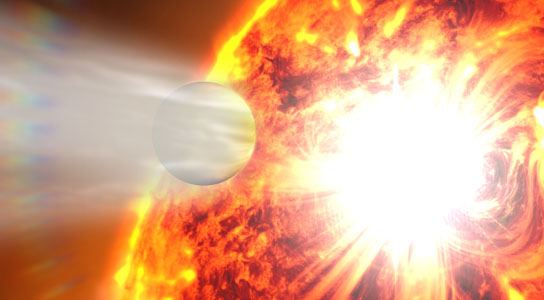
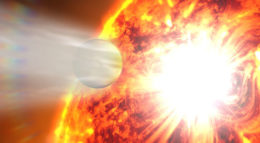
Artist’s impression of a star’s high-energy radiation evaporating the atmosphere of its planet. [NASA’s Goddard SFC]

Ruth Murray-Clay (UC Santa Cruz) demonstrated that we can support theoretical models of photoevaporation — the erosion of a planet’s atmosphere by energetic stellar radiation — with observations, by exploring planet transits in a specific wavelength: Hα (656 nm). If a planet is receiving large ionizing fluxes from its host star, the escaping atmosphere of the planet should show strong Hα absorption signatures.

We’ve discovered a wealth of worlds that fall between Earth and Neptune in size — but these planets can be ice giants, water worlds, or even primarily rocky. Björn Benneke (Montreal) demonstrated that we may be able to use observations of sub-Neptune atmospheres to help characterize the planets: atmospheric metallicity can tell us about how the planet formed and subsequently accreted solids.
Maggie Thompson

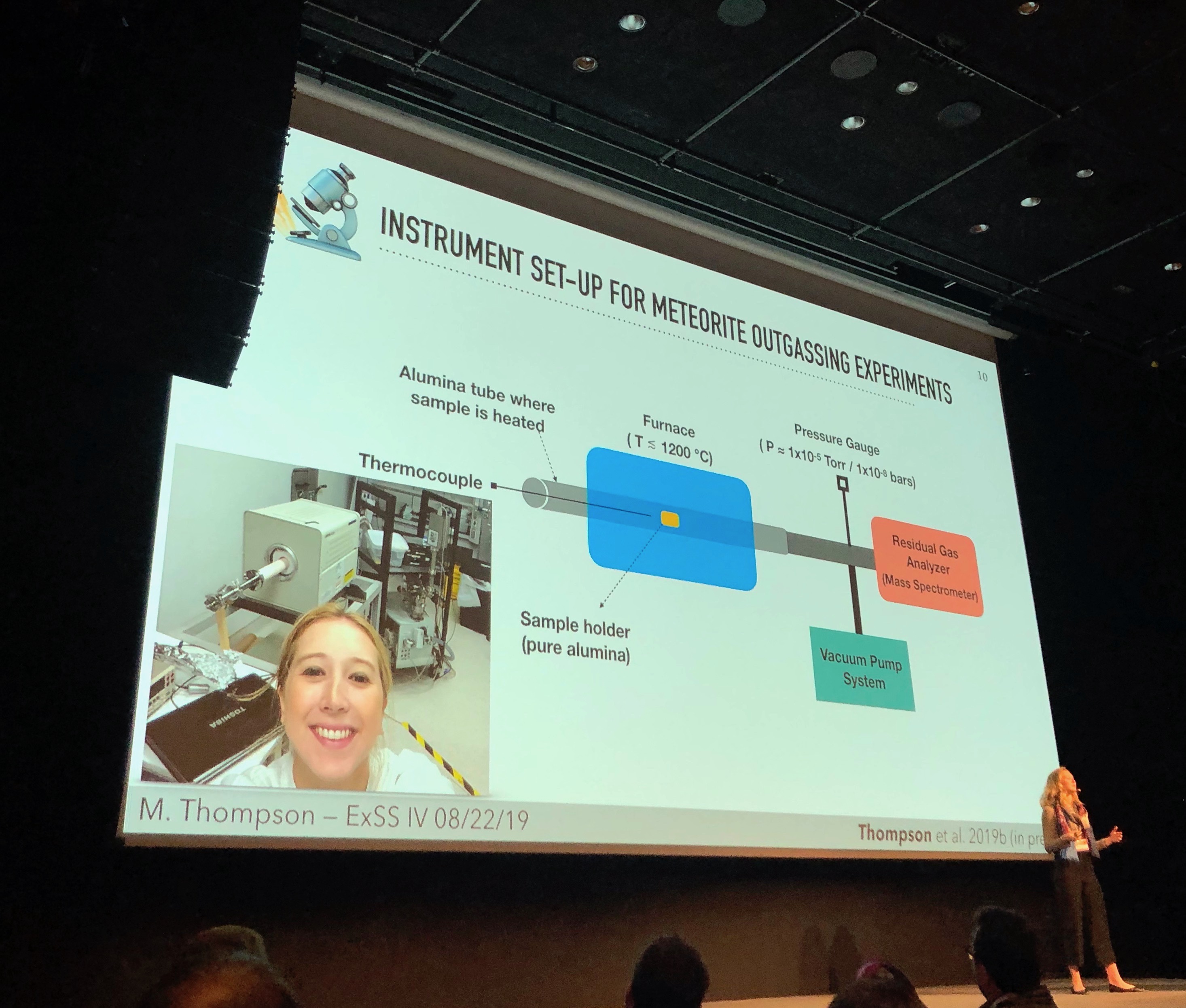
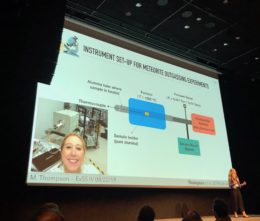
Maggie Thompson’s presentation came with a requisite selfie with her lab experiment setup! [AAS Nova/Maggie Thompson]

What can we learn about super-Earth atmospheres from meteorites? Some super-Earths are thought to form their atmospheres through outgassing during accretion. Since solar-system planets are thought to have formed from material analogous to meteorites, Maggie Thompson (UC Santa Cruz) uses laboratory experiments to heat up meteorites and study their outgassing, thereby exploring the possible compositions of super-Earth atmospheres.

Time for the perennial question: But what about magnetic fields? Though it’s believed that magnetic fields should have a significant impact on planet atmospheres, we’ve struggled to obtain observations to confirm this. Wilson Cauley (UC Boulder) reported on the derivation of the magnetic fields of a small sample of hot Jupiters using observations of the interactions between these giants and their host stars.

The “radius valley” describes a dearth of small, short-period planets discovered with radii between roughly 1.5 and 2 Earth radii — a result that could be explained by photoevaporation of planet atmospheres. Leslie Rogers (U Chicago) presented theoretical calculations that suggests that planets that lie near the upper edge of this valley may become enhanced in helium and heavier elements after several billion years of hydrogen mass loss due to atmospheric escape.

Session 11: Population Statistics and Mass-Radius Relations

As of 21 August 2019, we’ve observed 4,043 confirmed exoplanets — with many more still in the pipeline. What can we learn from the broader statistics of observed exoplanet populations? Today’s late-morning session walks us through a few lessons.
planet distribution

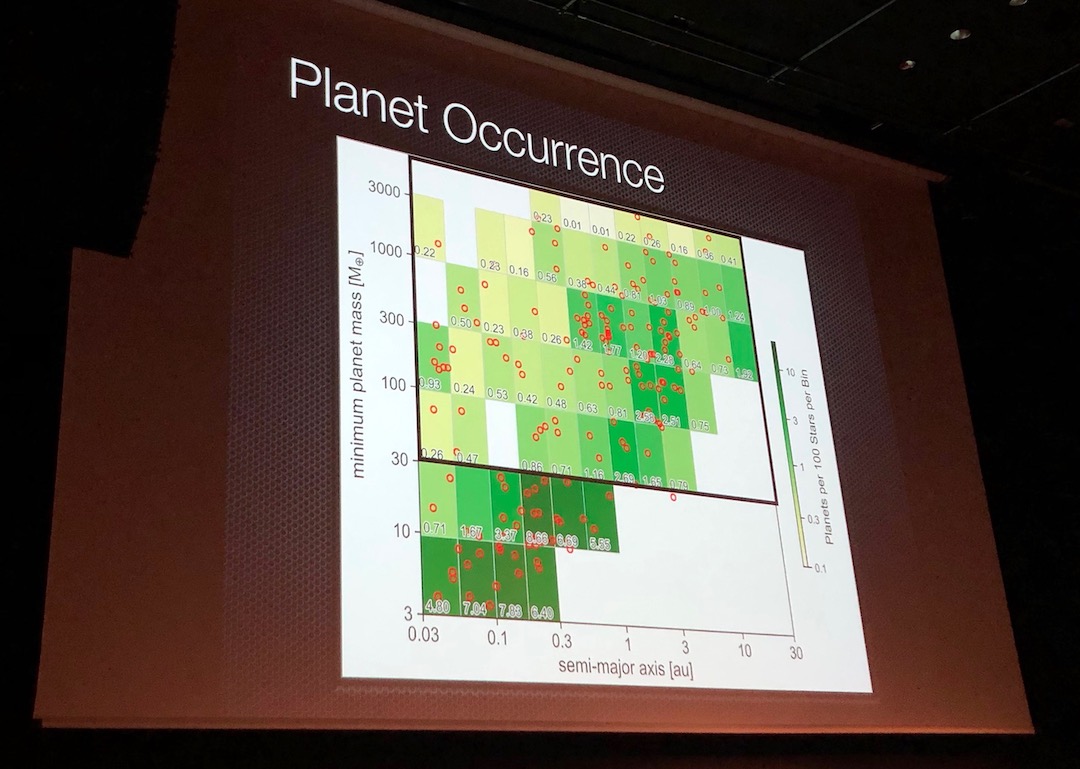
The distribution of masses vs. locations for giant planets on long-period orbits, according to Benjamin Fulton’s work. Click to enlarge. [AAS Nova/Benjamin Fulton]

We’ve heard a lot this week about how wide-orbit companions can influence the architecture of exoplanet systems. But how frequent are long-period giant planets? Benjamin Fulton (Caltech/IPAC) used 35,000 archival radial-velocity measurements to build a picture of where long-period giant planets lie, and how their masses and eccentricities are distributed.

At this point, there are around 60 planets for which we have not only radius measurements, but also well-measured masses. Dave Latham (Harvard-Smithsonian CfA) provided a summary of what we’ve learned exploring the relation between these planets’ masses and radii — including evidence that most planets smaller than about 1.8 Earth radii are similar to our solar system’s terrestrial planets in their bulk densities.

Remember TRAPPIST-1? This system was discovered in 2017 and immediately made headlines for its seven temperate, terrestrial planets, many of which lie in the star’s habitable zone. Since this sole discovery, however, the TRAPPIST telescope hasn’t made any further transiting-planet detections. Was TRAPPIST-1 just dumb luck? Didier Queloz (Cambridge) argued TRAPPIST’s subsequent non-detections allow us to make inferences about the likely occurrence rate of planets like TRAPPIST-1b.
DSHARP results

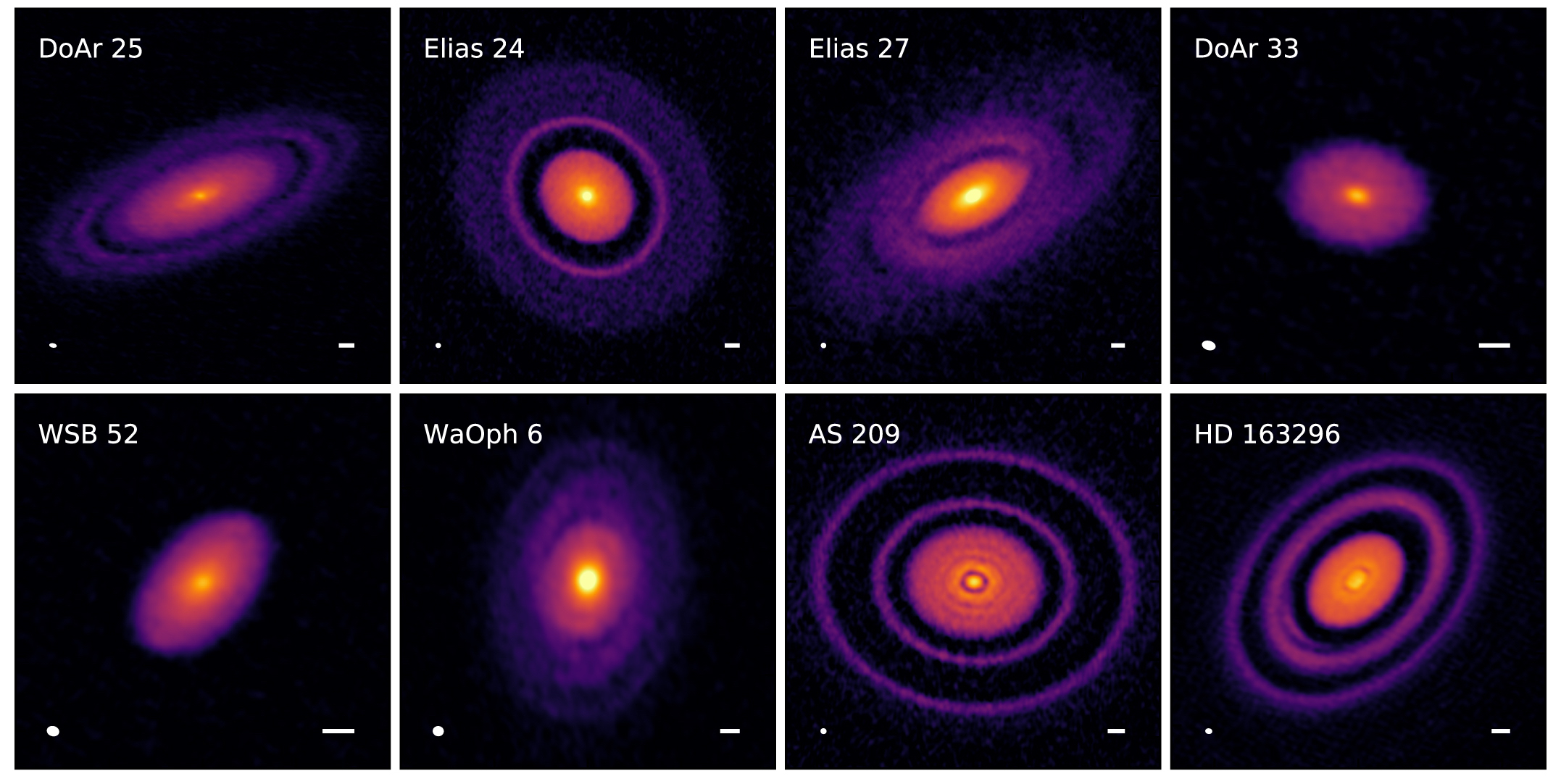
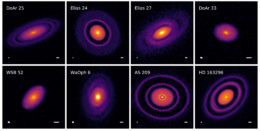
A small subset of the DSHARP protoplanetary disks, showing a variety of gaps and rings possibly generated by planets. [DSHARP]

It’s thought that interstellar asteroids like ‘Oumuamua might be ejected from their systems due to kicks from wide-orbit, massive planets — but the inferred occurrence rates of ‘Oumuamua-like bodies would require an enormous population of hidden long-period giant planets (1011 of them!). Intriguingly, Malena Rice (Yale) demonstrated that such a population is consistent with another observation: the gaps in protoplanetary disks observed in the DSHARP survey.

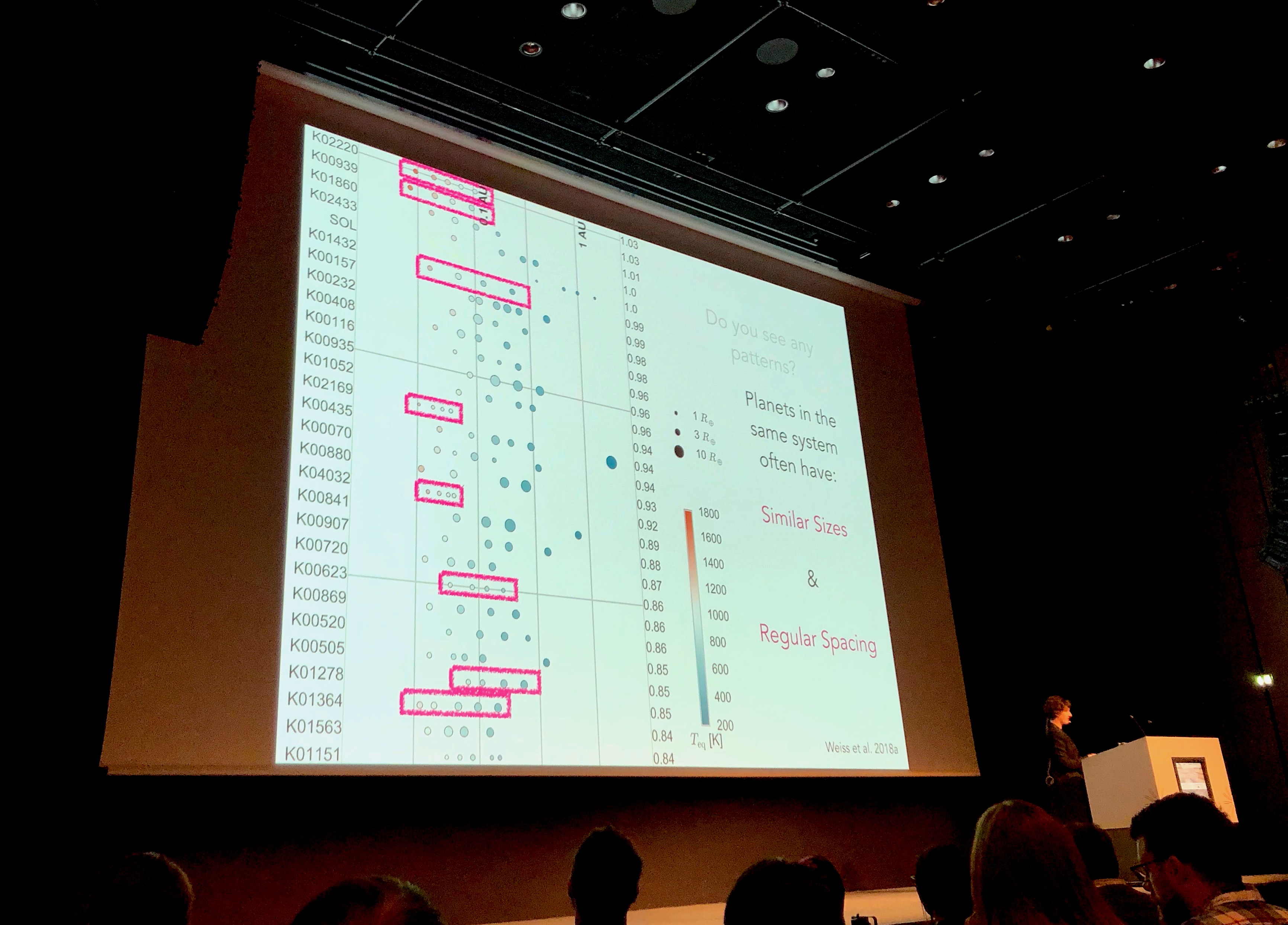
Do we see any interesting patterns in Kepler populations with four or more transiting planets? The final three talks of this session beautifully illustrated the process of scientific debate, as Lauren Weiss (Hawaii), Wei Zhu (CITA), and Yanqin Wu (Toronto) all presented their differing answers to this question.
  • peas in a pod

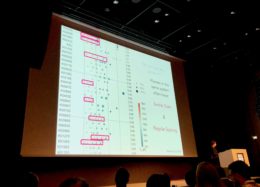
    Do you see any patterns in the Kepler multi-planet data? Weiss highlights “peas in a pod” systems. Click to enlarge. [AAS Nova/Lauren Weiss]

    Weiss put forward a “peas in a pod” picture: her data analysis from the California Kepler Survey suggests that planets in the same multi-planet system often have similar sizes and regular spacing. She argued that this pattern is astrophysical — it’s a remnant of planet formation.
  • Zhu, on the other hand, argued that the “peas in a pod” pattern isn’t real, but is instead the result of observational biases. According to Zhu, Kepler’s signal-to-noise threshold influences which planets are detectable in each system; accounting for these biases would remove the apparent uniformity within Kepler systems.
  • Wu took what perhaps is an even more radical stance: she argued that there’s a universal scaling law relating Kepler’s planet masses to their host-star masses — i.e., more-massive planets are found around more-massive stars. According to Wu’s analysis, the typical ratio of planet mass to stellar mass is ~8x the Earth-to-Sun mass ratio.

So who won the debate? Alas, that’s not how science works! Only further observational and theoretical evidence will settle whether Kepler multi-planetary systems truly show uniformity or not.

Session 12: Planets in and Around Binaries

This afternoon’s first session focused on a popular favorite topic: the existence of Tatooine-like planets orbiting within and around binary star systems.
Circumbinary planets

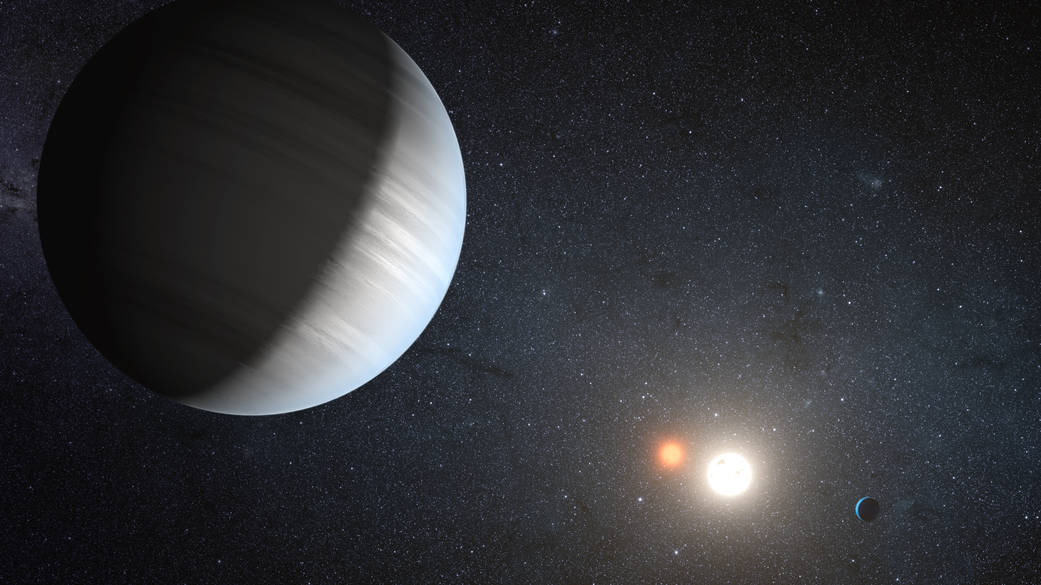
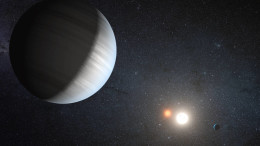
Artist’s illustration of a circumbinary system: multiple planets orbiting two stars. [NASA Ames/JPL-Caltech/T. Pyle]

Does stellar multiplicity — the number of stars in a system — influence the formation of close-in giant planets and brown dwarfs? Clémence Fontanive (Edinburgh) presented analysis suggesting that stars hosting giant planets or brown dwarfs have a binary rate of ~80%, which is twice as high as that for field stars. Her results indicate that wide binaries play an important role in the formation of short-period companions.

To draw useful conclusions from the 11 circumbinary planets Kepler has discovered, we first have to understand the underlying distribution of mutual inclinations — the inclinations between the planet orbit and the binary orbit. Ian Czekala (UC Berkeley) analyzed a sample of circumbinary protoplanetary disks to infer that disks around short-period binaries (P < 40 days) typically have low mutual inclinations, and disks around longer period binaries have a broad range of mutual inclinations.

Eleven Tatooine-like planets may not sound like a large sample, but we have prospects for more! Bill Welsh (San Diego State) presented on three more unconfirmed candidates: two from Kepler (KOI-3152 and KIC 10753734) and one from TESS (TIC 260128333). TESS is predicted to discover around a hundred more of these circumbinary planets over the course of its mission.

Session 13: Planets Around White Dwarfs

Next we switched gears to talk about another type of unusual host for exoplanets: white dwarfs. Since Sun-like stars should end their lives as white dwarfs, and they should retain their planetary systems in the process, we expect to find planets around white dwarfs. Have we?

We have! Christopher Manser (Warwick) kicked off the session by presenting on the first spectroscopically detected planetesimal found orbiting within a disk of debris around a white dwarf. This body blazes around the white dwarf in just over 2 hours, which means it must be remarkably dense to withstand the strong gravitational forces so close to the star. Could it be the iron core of a planet that has partially disintegrated?

In addition to this direct evidence, we also have indirect evidence. Matthias Schreiber (U Valparaiso) described observations of a white dwarf that appears to be accreting a disk of hydrogen, oxygen, and sulfur. The composition is unusual for a disk around a white dwarf — but it perfectly matches the composition we expect for the deeper layers of a giant planet’s atmosphere. Schreiber argues that the gas of this disk has come from the evaporated atmosphere of an undetected giant planet orbiting the dwarf.

It turns out that about 30–50% of white dwarfs show heavy elements in their atmospheres, likely indicating that they have been polluted by accretion of planetary material. Amy Steele (U Maryland) presented her work modeling the chemical abundances of the circumstellar gas around these white dwarfs, which will help us to better understand observations.
GJ 3470b

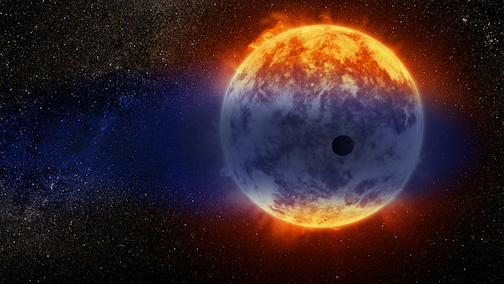
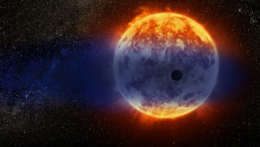
Artist’s illustration shows a giant cloud of hydrogen streaming off a warm, Neptune-sized planet. [NASA, ESA and D. Player (STScI)]

Session 14: Atmospheres II

For the last session of the day, we returned for another look at planetary atmospheres.

Vincent Bourrier (U Geneva) opened the session with a comparison of GJ 3470b — a nearby warm Neptune shown by Hubble to be exhibiting dramatic atmospheric loss as it orbits close to its host star — to other evaporating warm Neptunes. GJ 3470b may already have lost 40% of its mass in its short, two-billion-year lifetime! Bourrier’s observations shed further light on the apparent dearth of Neptunes on short, close-in orbits.
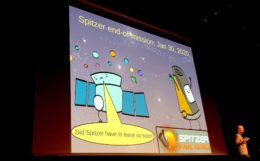
goodbye Spitzer

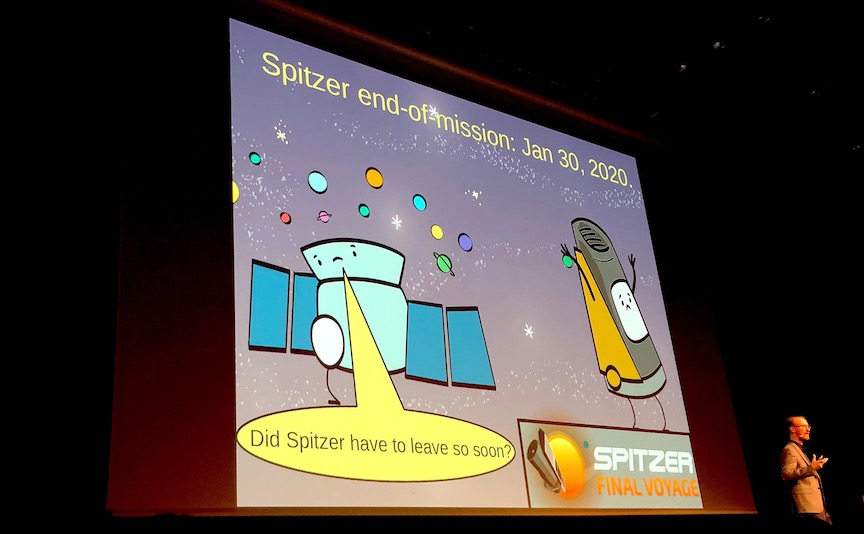
We’ll miss you, Spitzer! [AAS Nova/Ian Crossfield]

Ian Crossfield (MIT) described what we’ve learned from Spitzer photometric follow-up of TESS planets, obtaining infrared transits and eclipses. A main takeaway: two planets can have exactly the same irradiation and gravity, but completely different atmospheres. Crossfield also tugged at our heartstrings by pointing out we’ll soon no longer be able no longer be able to make observations like this — Spitzer will be decommissioned in January 2020.
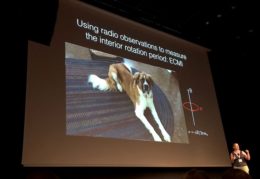
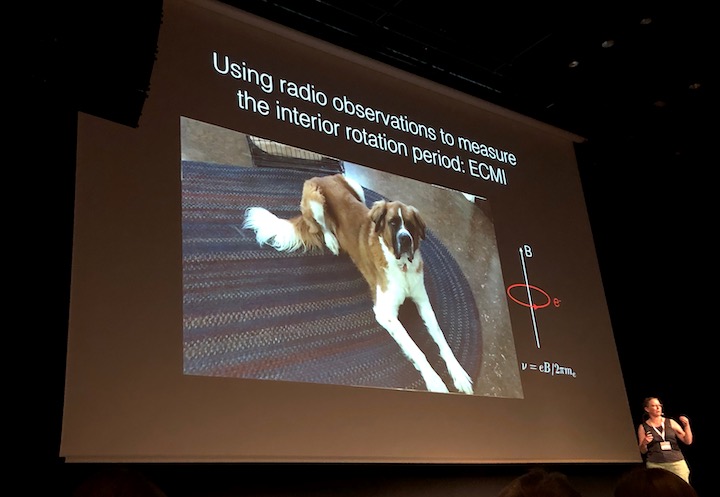
doggo demonstration

Katelyn Allers gets major bonus points for using a video of her dog to illustrate how synchrotron radiation works. [AAS Nova/Katelyn Allers]

How can we measure wind speeds on exoplanets and brown dwarfs? Katelyn Allers (Bucknell U) presented a novel method, using a combination of radio observations and infrared photometric variability to infer the bulk atmospheric flow and constrain the wind speed of a brown dwarf. With lower-frequency observations in the future, her method could be applied to exoplanets as well.

Enric Palle (Canarias) described a He I survey, conducted with the CARMENES spectrograph, that’s exploring ultra-hot Jupiter- to Neptune-sized planet atmospheres via transmission spectroscopy. The goal of the survey is to build a large and diverse sample with high-resolution observations that can be used to understand atmospheric evolution.

Did you know that there’s a secret mode on the Hubble Telescope? Nikole Lewis (Cornell) introduced us to a useful — yet underused, due to some challenges — instrument on Hubble: its WFC3/UVIS G280 grism. With some new data reduction and analysis techniques, this grating prism can be used to obtain highly sensitive near-ultraviolet spectroscopic observations. By using this newly unlocked mode, Lewis and collaborators probed the chemical processes in hot Jupiter HAT-P-41b’s atmosphere.
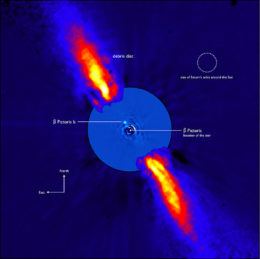
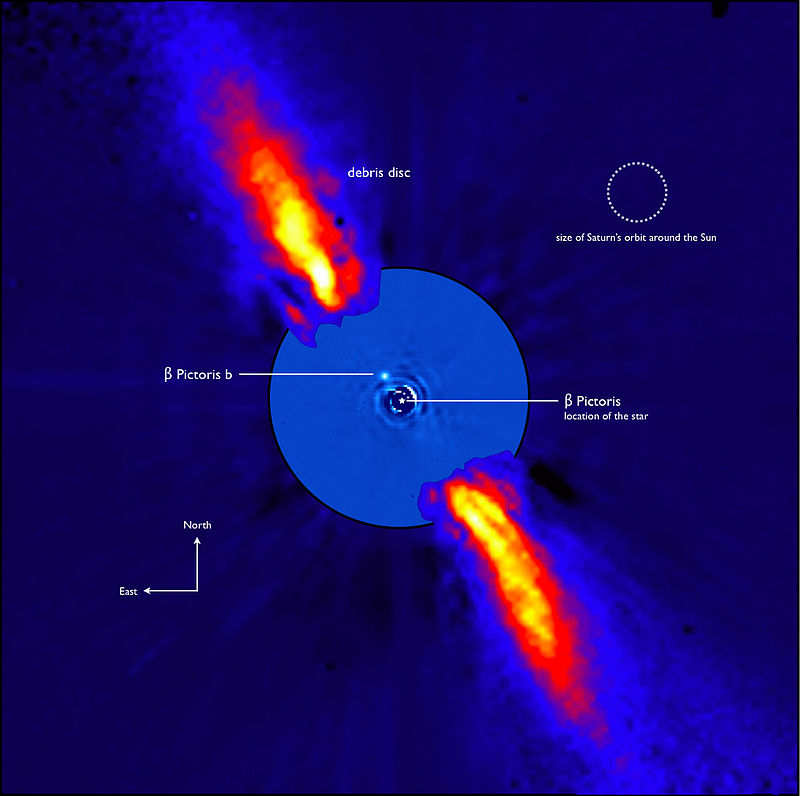
Beta Pic

Infrared observation of the Beta Pic system, revealing the star, its surrounding dust disk, and the giant planet Beta Pic b. [ESO/A.-M. Lagrange et al.]

Exoplanet clouds are anything but boring! They can be composed from a variety of materials, like refractory minerals, silicate dust, salts, and volatile ices. Caroline Morley (UT Austin) and collaborators have worked to develop a set of theoretical models for the cloudy atmospheres of substellar bodies warmer than 1,000 K, which we can use to interpret to future observations.

How did the giant planet beta Pictoris b form? Mathias Nowak (Obs. Paris) presented the first long-baseline interferometric observations of Beta Pic b, which allow us to probe the carbon/oxygen ratio in the planet’s atmosphere. The low C/O ratio found can be used to constrain the possible formation mechanisms for the planet.

gas-giant formation

Editor’s note: This week we’re in Reykjavik, Iceland at the Extreme Solar Systems (ExSS) IV meeting. Follow along to catch some of the latest news from the field of exoplanet research!

Session 9: Planet Formation

Observations of planet populations provide a rich source of information about how planets might form — shaping our theories and models far beyond what was possible when we only had our own solar system as a guide. Today’s only talk session discussed just a few of our latest ideas about how both rocky and gassy planets are first born and evolve.

MU69

The bi-lobed object MU69, as captured by NASA’s New Horizons spacecraft during its flyby. [NASA/Johns Hopkins University Applied Physics Laboratory/Southwest Research Institute]

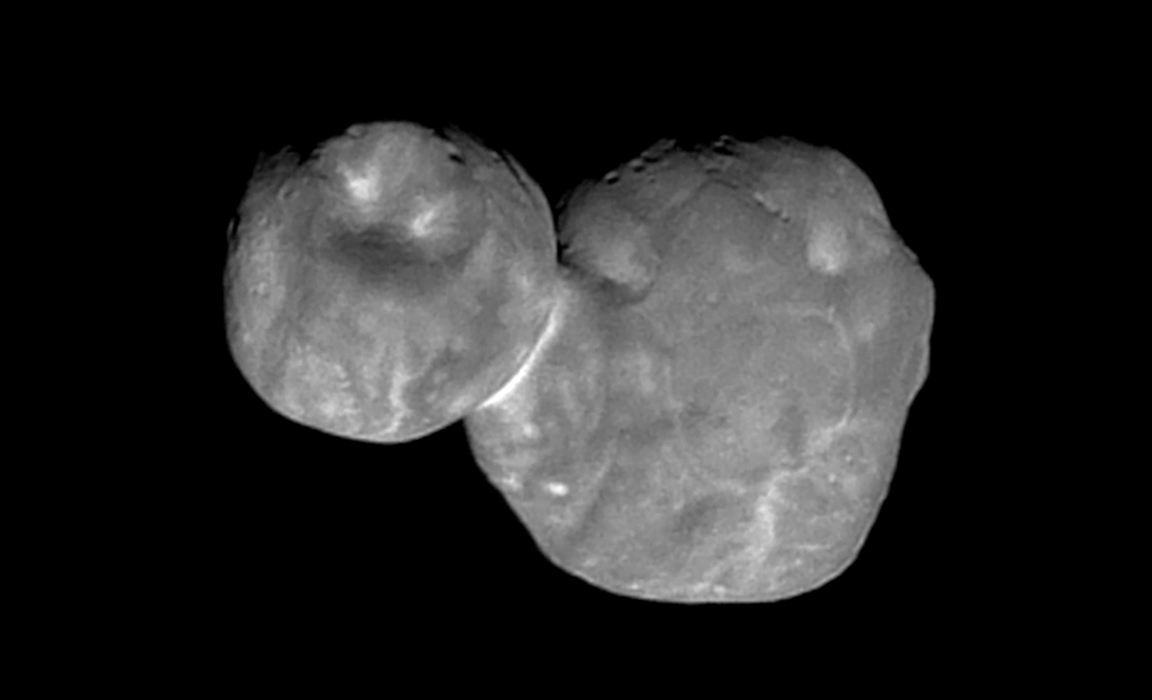
On the first day of 2019, New Horizons flew by outer solar-system body 2014 MU69 (popularly known as Ultima Thule). What lessons have we learned about planet formation from this cold, distant rock? Catherine Olkin (SwRI) pointed out MU69’s distinctive bi-lobed structure; this body clearly formed from two different components, but there’s no evidence for catastrophic impact between the two lobes. Instead, a combination of observations and models suggest that it formed from a gentle merger (just 2–3 m/s impact speed) of two objects born from accretion in the same local environment. Assuming that this body is representative of the broader population of cold, classical Kuiper belt objects, this could have interesting implications for planet formation models describing our solar system.
shape of MU69

New shape models of MU69 suggest its two lobes actually have flattened shapes. [NASA/Johns Hopkins University Applied Physics Laboratory/Southwest Research Institute]

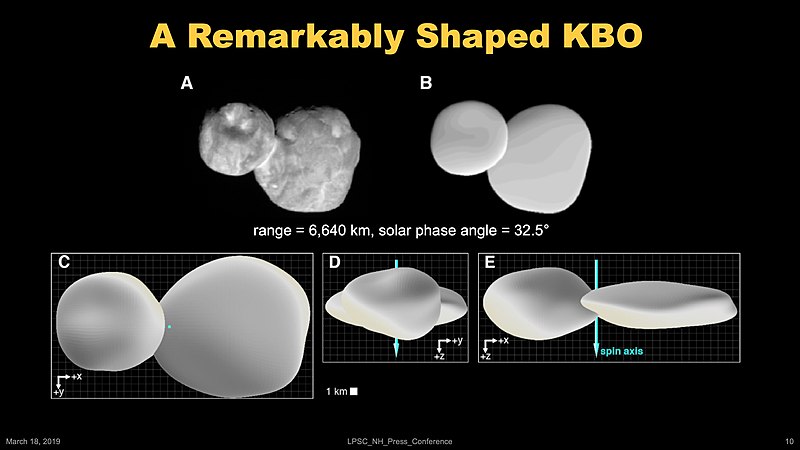
Side note: remember how we originally thought MU69 was snowman-shaped? We’ve got better shape models now, and our revised view is that it’s actually made from two flattened shapes stuck together (larger lobe: roughly 22 x 20 x 7 km; smaller lobe: roughly 14 x 10 x 10 km).

Recent research has shown two curious things: first, that super-Earths in the same system tend to be correlated in size, and second, that the entire population of super-Earths observed can be explained by the same core mass (but with different gas masses for their atmospheres). Mickey Rosenthal (UC Santa Cruz) argues that both of these features could be explained by interesting physics of the pebble-accretion model (in which a core rapidly grows by accreting small particles), which create a natural limit to the mass of an accreting core.

Why do we see so many sub-Saturn planets? These bodies have envelopes with the same mass as their cores, lying just on the verge of the runaway gas accretion that should turn them into gas-rich Jupiters. Since this is an unstable state, we expect to see many more Jupiter-like planets than sub-Saturns — yet sub-Saturns and Jupiters are equally common in the inner regions of disks (i.e., within orbits of 100 days). Eve Lee (McGill U) described her models for gas accretion, which indicate that the properties of an accreting planet depend on where in the disk the planet forms, the initial mass of the core, and when in the disk’s lifetime (during the early, gas-rich stage or during the later, gas-poor stage) the planet forms.

giant impact

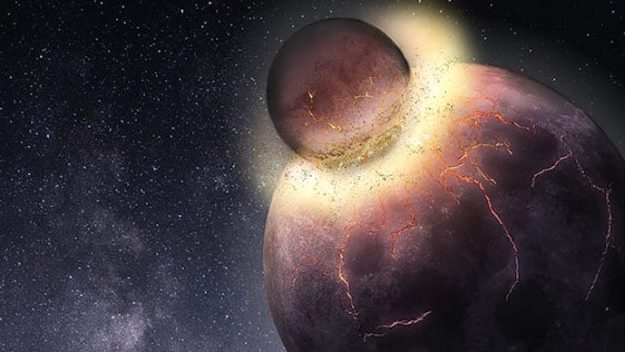
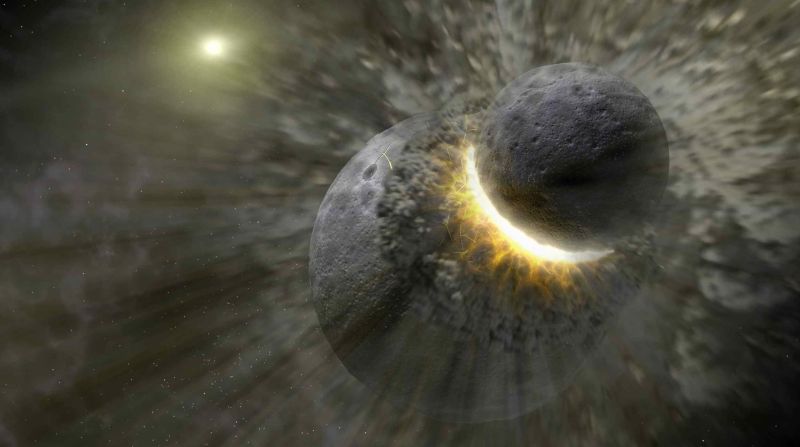
Artist’s illustration of a collision between planets. [Rice University]

Next, we dive deep into planetary interiors, looking at the ratio of core mass to mantle mass in rocky planets. Rocky super-Earths show a wide variety of core-to-mantle mass ratios that can’t all be explained by the ratios we’d expect them to be born with. Jennifer Scora (Toronto) demonstrated that the expected spread can be broadened if many of these bodies underwent dramatic collisions during their lifetimes, stripping material from their mantle. By using realistic N-body models that include collisions, we can therefore use the observed distribution of rocky super-Earth core-to-mantle mass ratios to place constraints on planet formation models.

Continuing the theme of giant impacts, John Biersteker (MIT) explored what happens to the atmospheres of planets when they collide. Some of the diversity of densities and compositions observed for super-Earths and mini-Neptunes can be explained by partial ejections of planet atmospheres from the mechanical shock of impacts. But Biersteker argues that consequences of impacts are even more drastic than this: energy from the impact is also deposited into the planet’s atmosphere, heating the gas and causing the envelope to expand. This leads to significant further mass loss as the planet’s gravitational pull can no longer hold in its outer atmosphere — and can potentially strip the planet’s atmosphere entirely.

super-Earth

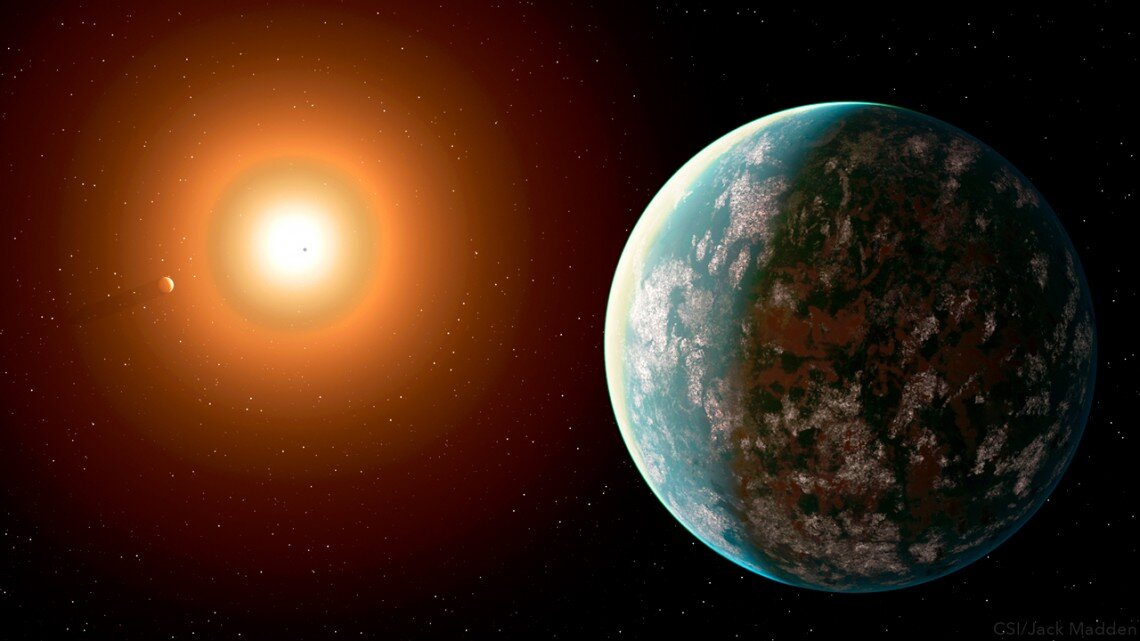
Artist’s impression of a super-Earth exoplanet orbiting its host. [Jack Madden/Cornell University]

The final presentation of the day was given by Oza Apurva on behalf of Caroline Dorn (Zurich). Apurva and Dorn are also collaborating to better understand the diversity of super-Earth compositions and densities we observe. Instead of invoking collisions, however, Apurva — like Eve Lee, earlier — argued that the when and where of planet formation can significantly alter the outcome. The dynamics of a planet’s interior, its outgassing history, and its magnetic field are all affected by its radial location in the protoplanetary disk and when in the disk’s lifetime it was born — perhaps naturally explaining the variety of super-Earth properties we see today.


The rest of the morning was devoted to a special poster session highlighting the nearly 400 excellent scientific posters (which are also available to view all week during coffee breaks), and the afternoon was left free as an opportunity to explore Iceland!

ExSS poster session

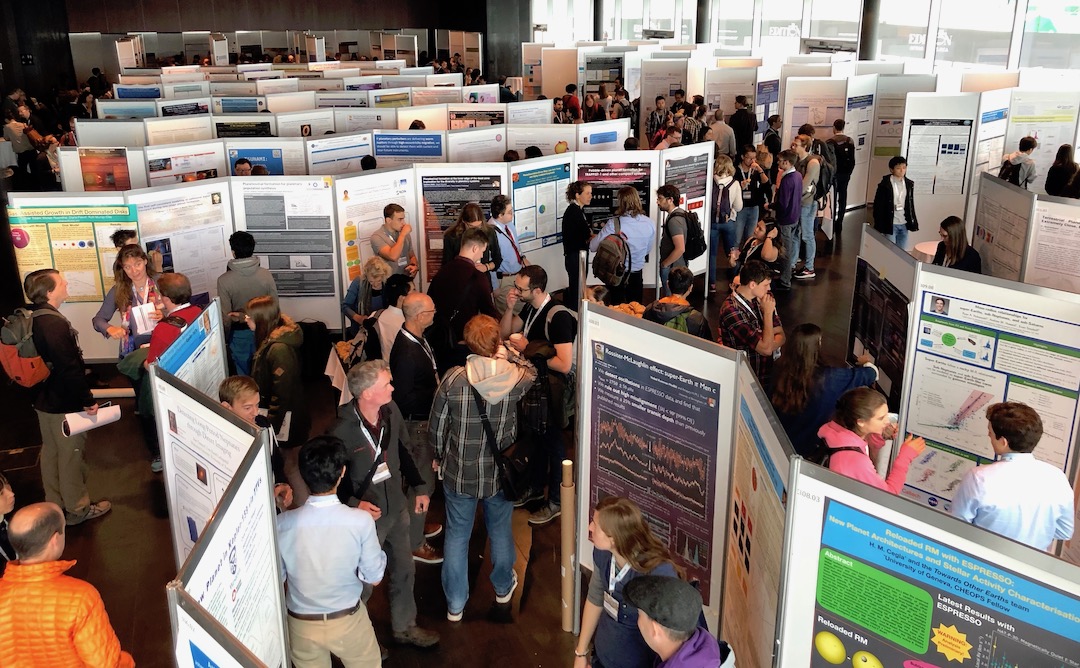
Scene from the ExSS IV poster session. [AAS Nova/Susanna Kohler]

rocky ultra-short-period planet

Editor’s note: This week we’re in Reykjavik, Iceland at the Extreme Solar Systems (ExSS) IV meeting. Follow along to catch some of the latest news from the field of exoplanet research!

Session 5: Dynamical Evolution

After yesterday’s observational talks, Day 2 kicked off with some theory. The morning’s discussions centered on how the dynamics of planetary systems evolve and shape the system over time.

planet mass vs. orbital period

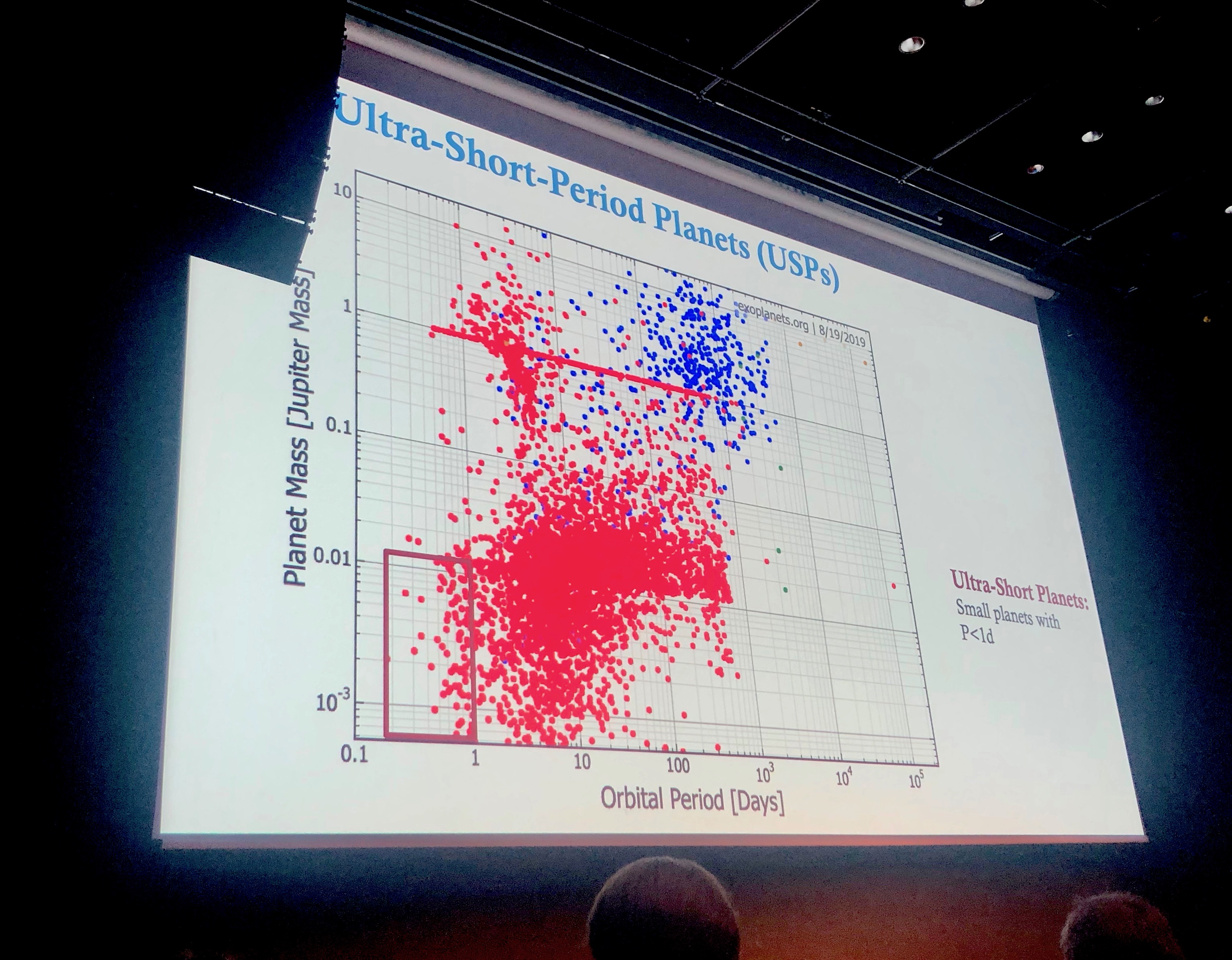
Planet mass vs. orbital period for observed exoplanets. The red box in the lower left identifies the population of ultra-short-period planets. [Dong Lai/exoplanets.org]

Ultra-short-period planets are planets with periods of less than a day. There are about 70 of these planets currently known, and they’re thought to occur around about 0.5% of stars. But how do these planets form? Dong Lai (Cornell) and his group advocate for a low-eccentricity migration scenario: a small planet with a multi-day period undergoes tidal dissipation to shrink its orbit. Nearby companions regularly give it small eccentricity boosts, allowing the planet to continue shrinking its orbit for longer.

Rosemary Mardling (Monash) presented her new formulation that describes two-planet systems that are near resonance, i.e., they exert a regular, periodic gravitational influence on each other that nudges their periods toward an integer multiple of each other.

Where can we find hidden companions in multi-planet systems? Smadar Naoz (UCLA) showed how, if we know the configuration of the inner planets of a multi-planet system (i.e., how far they are from each other, their eccentricities, etc.), then we can estimate the location of an external, wide-orbit companion planet by calculating how the planets are likely to interact.

planet collision

Artist’s depiction of a planet–planet collision. [NASA/JPL-Caltech]

Kassandra Anderson (Cornell) presented work exploring the dynamical histories of warm Jupiters, giant planets with orbital periods of 10–300 days. Her calculations explore different ways of forming these planets, from violent collisions in-situ to migration through a disk.

Many inner giant planets are found on eccentric orbits. How do these planets gain their high eccentricities? And why do the highest-eccentricity planets tend to also be the highest-mass ones? Renata Frelikh (UC Santa Cruz) argued that this can be explained by a system undergoing a giant-impact phase, in which impacts between large planets lead to collisional growth and skewed orbits.

Jacques Laskar (Obs Paris) rounded out the session by discussing a new framework for rapidly understanding the dynamics of a planetary system. His work relies on a description of angular momentum, and it makes it possible to tell, upon discovering a new planetary system, whether the system is stable or unstable.

Session 6: Ultrashort Periods and Planet–Star Interactions

Having an ultra-short period presents an occupational hazard: these planets are likely to be strongly influenced by interactions with their host star. Today’s mid-morning session highlighted a number of interesting research topics related to these extreme planets and their environments.

55 Cancri e

Artist’s impression of the hot super-Earth 55 Cancri e in front of its parent star.

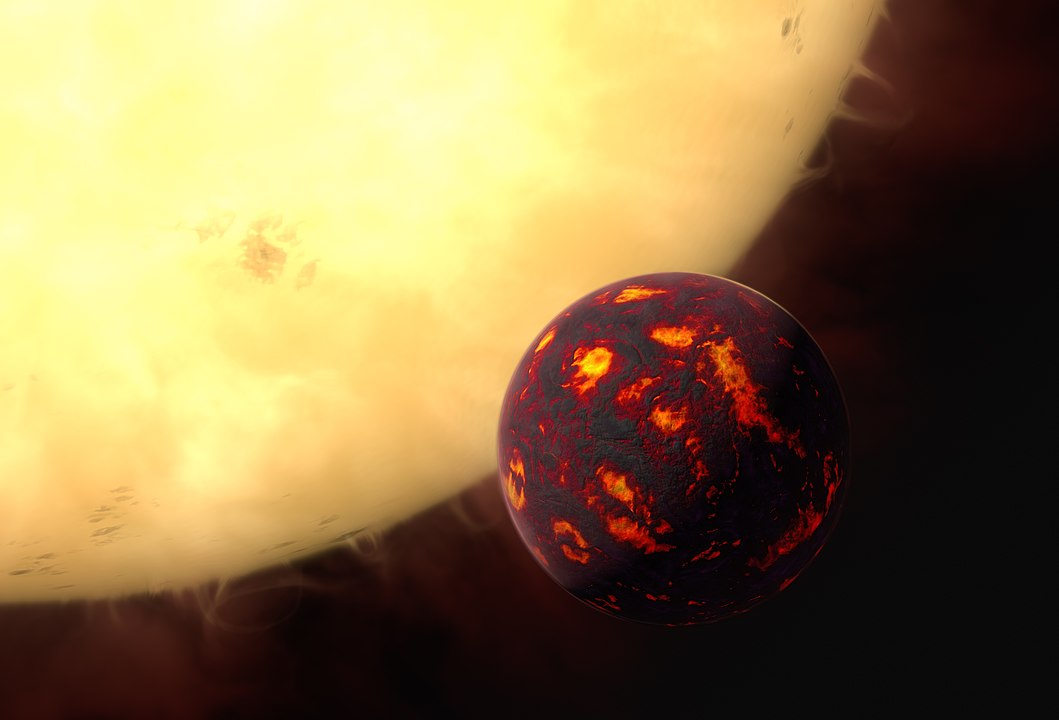
Ray Jayawardhana (Cornell) introduced us to two radical worlds: Kelt-9b, the hottest gas giant known at more than 4,000 K; and 55 Cancri e, a highly irradiated terrestrial planet on an blazing 18-hour orbit that has surprisingly managed to hold on to its atmosphere. Jayawardhana and his research group have used high-resolution spectroscopy to probe the composition of the atmospheres of these extreme worlds.

Radio astronomy is rarely associated with exoplanet research, but magnetized planets are expected to emit strongly at radio wavelengths. Spotting this emission is tough, but Joseph Callingham (ASTRON) presented recent observations from the LOFAR array of low-frequency radio emission associated with an M dwarf. Follow-up observations confirm the presence of a close-in exoplanet in the system. Could this be the launch of exoplanet radio astronomy?

WASP-12b is a well-studied hot Jupiter that provides us with a prime opportunity to explore star-planet interactions. Two presentations focused on aspects of this extreme system:

  • Josh Winn (Princeton) reported on transit timing observations of WASP-12 that show tidal decay — decay of the planet’s orbit due to interactions with its host — occurring in real-time on observable timescales.
  • Taylor Bell (McGill) discussed the hunt to understand WASP-12b’s unusual, double-peaked infrared phase curve — the planet brightens twice per day, rather than the expected one time. He concluded that this can be explained by WASP-12b losing mass in the form of a hot stream of gas flowing from the planet to its host star.

Many recently discovered short-period super-Earths and sub-Neptune planets have large tilts between their spin axes and their orbital axes. Sarah Millholland (Yale) argued that these high-obliquity states can drive higher levels of tidal dissipation, dumping heat into the planet interiors and ultimately inflating their atmospheres to larger radii.

hot Jupiter open questions

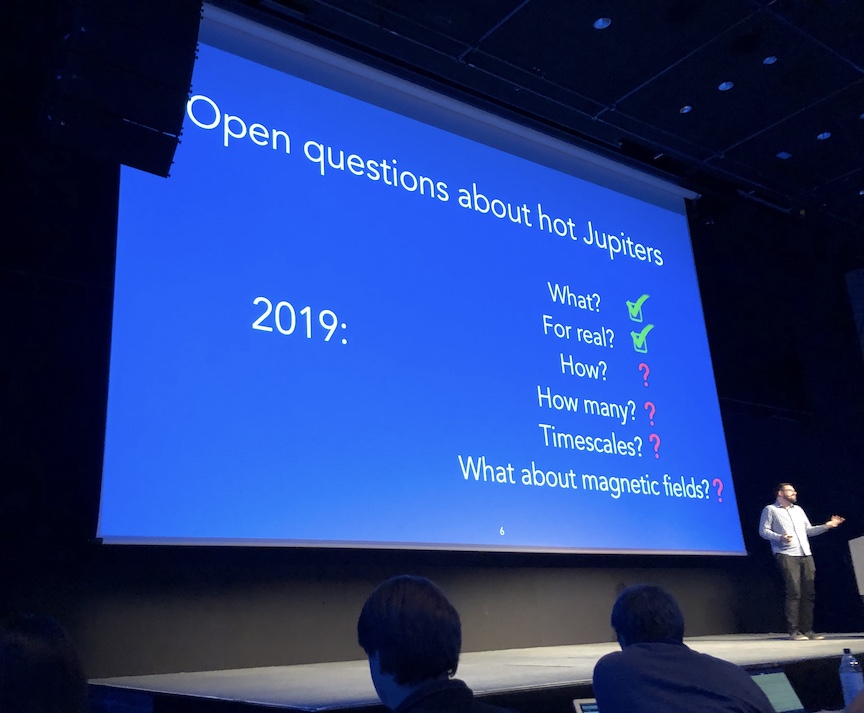
Ben Montet reviews the evolution of open questions about hot Jupiters since 1996. [AAS Nova/Ben Montet]

Ben Montet (U Chicago) reminds us that we’ve come a long way in our understanding of hot Jupiters since 1996. Among the open questions that remain: how long do hot Jupiters live before inspiralling into their host stars? One way of estimating this is by measuring the occurrence rate of hot Jupiters around stars as a function of stellar age — a process that is now possible with the combination of Gaia and Kepler/K2 data.

Roughly 40% of hot-Jupiter hosts show spectroscopic signatures that suggest we’re seeing these stars through a shroud of circumstellar gas that’s been torn from their irradiated, close-in planets. Carole Haswell (Open U) reported on a planet-hunting strategy that targets stars that don’t have known planets but that show similar signatures in their spectra. So far, the Dispersed Matter Planet Project has succeeded in finding three previously unknown planets using this strategy.

Session 7: Stellar Spins and Obliquities

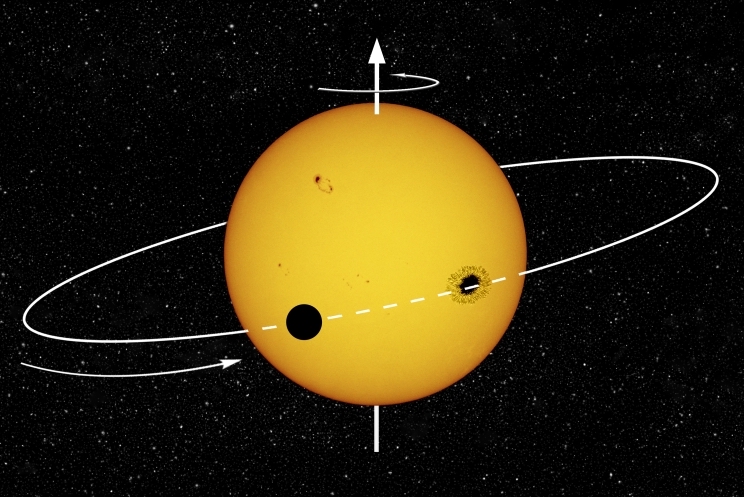
Why should we care about stellar obliquities, the tilts of stars’ rotation axes relative to their orbital angular momentum? This misalignment can tell us about a planetary system’s formation and evolution.

Simon Albrecht (Aarhus U) kicked off the session with a broad overview of some trends observed in stellar obliquities, such as an apparent link between high stellar obliquity and high close-in planet eccentricity, and a typical alignment between multi-planetary system orbital planes and stellar rotation. These trends indicate that tidal alignment is likely an important factor in shaping obliquity distributions.

spin-orbit misalignment

Artist’s impression of a system with a spin–orbit misalignment: the planet orbits in a different plane than the star’s rotation. [Ricardo Cardoso Reis (IA/UPorto)]

What factors might affect spin–orbit misalignment of stars? Marshall Johnson (Ohio State) presented a statistical analysis of star+planet systems and showed how the spin–orbit misalignments correlate with different system properties, like stellar temperatures, metallicities, and ages; planet masses; and the presence of companions.

To understand stars with tilted planetary systems, we may need to look back in time to when these stars were still dispersing their surrounding disks. Cristobal Petrovich (CITA) presented a model in which a short-period planetary system can be excited to high obliquities (often all the way to polar orbits!) by a wide-orbit Jovian companion embedded in a photo-evaporating disk.

The final presentations explored a few example systems and their spin–orbit (mis)alignments:

  • HD3167 c is a sub-Neptune on a nearly polar orbit around its star. Shweta Dalal (IAP) presented measurements of this planet and an additional planet in the system, which is shown to be co-planar. The dynamics of the system indicate the planets are unlikely to have arrived on these orbits without help from an unseen outer companion.
  • K2-25b is a Neptune-sized planet orbiting a young M-dwarf host star. Previously, only one M-dwarf had a highly precise obliquity measurement — and that system, GJ 436, is highly misaligned. Gudmundur Stefansson (Penn State) presented new, precise obliquity measurements for K2-25b, showing that this system is contrastingly well-aligned.
  • angular momentum architecture

    Marta Bryan explains the measurements that fully describe the architecture of this system’s angular momentum. [AAS Nova/Marta Bryan]

    Marta Bryan (UC Berkeley) presented on a complex hunt to understand the system 2M0122, a star and its planetary-mass companion. Bryan looked to fully characterize this system by measuring not just the stellar spin and orbital angular momentum vectors, but also the planet’s spin vector. This uniquely complete view of the 3D angular momentum architecture of the system provides insight into the system’s formation history.

Session 8: Transiting Multi-Planet Systems

One of Kepler’s prime outcomes was the discovery that compact, multi-planet systems are common throughout the galaxy. What have we learned from transits of these systems in recent years?

Trevor David (JPL/Flatiron) opened the session by presenting on V1298 Tau, a young solar analog that’s just 20 or 30 million years old. A family of four transiting planets have been recently discovered orbiting within 0.5 AU of the star, providing us with a unique opportunity to study newly born planets at a time when their young host star is still emitting large amounts of harsh, high-energy radiation. This may tell us more about how compact multi-planet systems form.

We’ve noted that giant planets tend to form preferentially around higher-metallicity stars — but what are the trends for smaller planets? Sophie Anderson (MIT) presented results indicating that compact, multi-planet systems preferentially form around metal-poor M dwarfs. This could be explained if giant planets tend to disrupt interior, compact multiple systems.

planetary system

Artist’s impression of a multi-planet system in which the three currently transiting planets all have different impact parameters. [NASA/Tim Pyle]

What can we learn from transiting multi-planet systems where the planets don’t all transit within the same plane relative to our line of sight? Dan Fabrycky (U Chicago) described how systems that include some high-impact-parameter planets — i.e., planets that transit not across the center of their star from our point of view, but instead cross higher or lower on the disk — provide us with a wealth of information, such as precise planetary masses or constraints on the presence or absence of other, non-transiting planets in the system.

Matthias He (Penn State) showed that modeling of the Kepler population of planetary systems reveals a non-random distribution: instead, there seems to be clustering of planet sizes and periods within each system. This is consistent with previous evidence for two populations of planetary systems: a low-mutual-inclination population with low eccentricities, and one with high mutual inclinations or isolated planets.

How do we effectively categorize observed planets, and what can this categorization tell us about yet-unobserved planets? Emily Sandford (Columbia) took us on a unexpected journey through her collaborative work conducted with an expert in computational linguistics. By treating different kinds of planets as different parts of speech, and treating planetary systems as complete sentences, we can use natural language processing techniques to classify planets and predict the next unobserved planet orbiting a star.

astrobites shoutout

Rodriguez gives a shoutout to astrobites! [AAS Nova]

The final presentation of the session was given by Joseph Rodriguez (Harvard-Smithsonian CfA) — who opened by graciously crediting Astrobites for his talk title. Rodriguez presented on K2-266, a compact six-planet system in which just one of the planets — an ultra-short-period super-Earth — has a significantly misaligned orbit. How do systems like this form? Rodriguez outlines one possible explanation, in which an additional unseen companion could drive the odd misalignment.

LHS 3844b

Editor’s note: This week we’re in Reykjavik, Iceland at the Extreme Solar Systems (ExSS) IV meeting. Follow along to catch some of the latest news from the field of exoplanet research!

Day 1 of ExSS started off at a breakneck pace! This is my first time attending this conference, and I wasn’t expecting the rapid pace of talks (10–15 minutes each, all in back-to-back rather than parallel sessions) and the density of information in them. I expect to be fairly overwhelmed by the end of the week, but so far this has been an awesome way to get a broad sense of the many different recent exoplanet discoveries and what we’re learning about our universe as a result.

Session 1: New Discoveries

What missions are involved in the hunt for exoplanets? What have they found so far, and what can we expect in the future? The first session provided a rapid overview of a few active exoplanet missions and recent discoveries we’ve made.

TESS prime mission

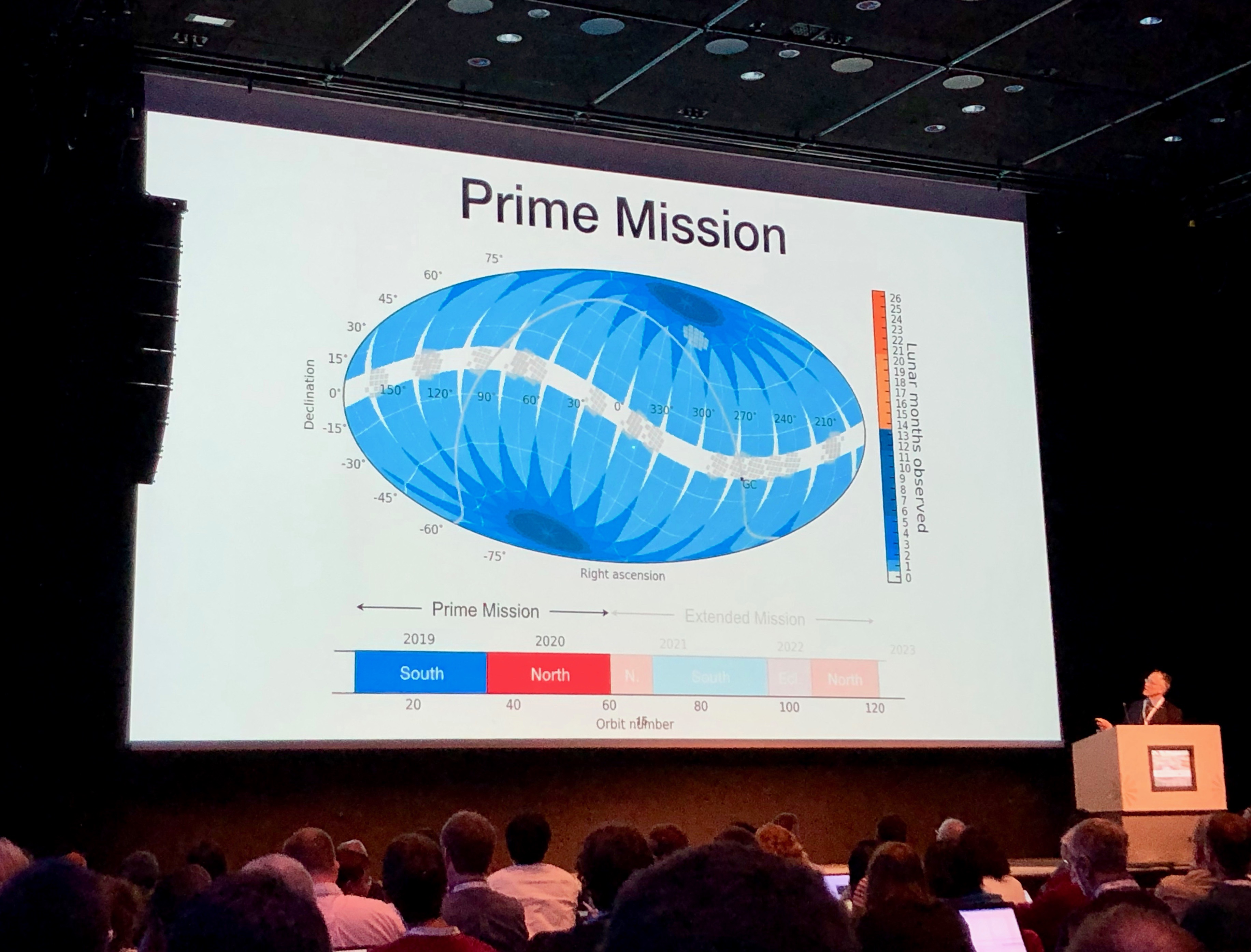
TESS will finish tiling the sky in its prime mission in 2020, at which point it will move on to the extended mission. Click to enlarge. [AAS Nova/George Ricker]

One of the best-known current exoplanet missions is the Transiting Exoplanet Survey Satellite (TESS). George Ricker (MIT) opened the science talks with a review of TESS’s first year and plans for the future. This all-sky survey spent 2019 covering the southern sky, and it’s now started started to tile the northern hemisphere. When that wraps up in July 2020, TESS will move on to its extended mission, revisiting previously covered regions to hunt for longer-period planets. So far we’ve already found 1,000 TESS Objects of Interest (potential planet candidates), with many more expected in the future!

Eric Nielsen (Stanford) next updated us on results from the Gemini Planet Imager Exoplanet Survey (GPIES), which is a ground-based direct-imaging mission hunting for giant planets and brown dwarfs that orbit at distances of 10 to 100 AU from their host stars. So far GPIES has discovered six giant planets and four brown dwarfs — not yet many, but even with these small-number statistics, the GPIES team has been able to start drawing conclusions about the differences between brown-dwarf and giant-planet populations.

What are some particularly interesting recent planet discoveries?

  • David Charbonneau (Harvard) thinks we’ve found the perfect target for studying the atmosphere of a rocky, Earth-like planet: LT1445Ab, an apparent terrestrial planet in a triple-star system. At less than 23 light-years away, this is the closest transiting planet we’ve discovered around an M dwarf, making it an excellent target for spectroscopic follow-up.
  • Anne-Marie Lagrange (Grenoble) described a new discovery in the Beta Pic system. The closest giant planet we’ve directly imaged is in Beta Pic — but now scientists have discovered it has a sibling. This second giant planet was detected spectroscopically, making Beta Pic the first system to host both a planet detected in imaging and one detected with indirect techniques.
  • It’s been suspected — but not confirmed — that terrestrial planets orbiting M dwarfs should have a difficult time retaining their atmospheres due to photoevaporation by their host stars. Laura Kreidberg (Harvard) and collaborators have now measured a thermal phase curve for TESS Earth-like planet LHS 3844b, indirectly confirming that this planet doesn’t have a thick atmosphere.
microlensing diagram

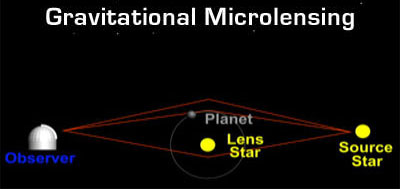
A diagram of how planets are detected via gravitational microlensing. The detectable planet is in orbit around the foreground lens star. [NASA]

Calen Henderson (Caltech/IPAC-NExScI) rounded out the session by summarizing the state of microlensing exoplanet studies. Microlensing typically gets less press than other planet detection techniques, but it’s the primary means by which we can detect colder planets and planets that are far away. One of the interesting topics microlensing can address is the frequency of free-floating planets: current estimates suggest there are more host-less, free-floating Earth-mass planets in our galaxy than there are stars!

Session 2: Direct Imaging

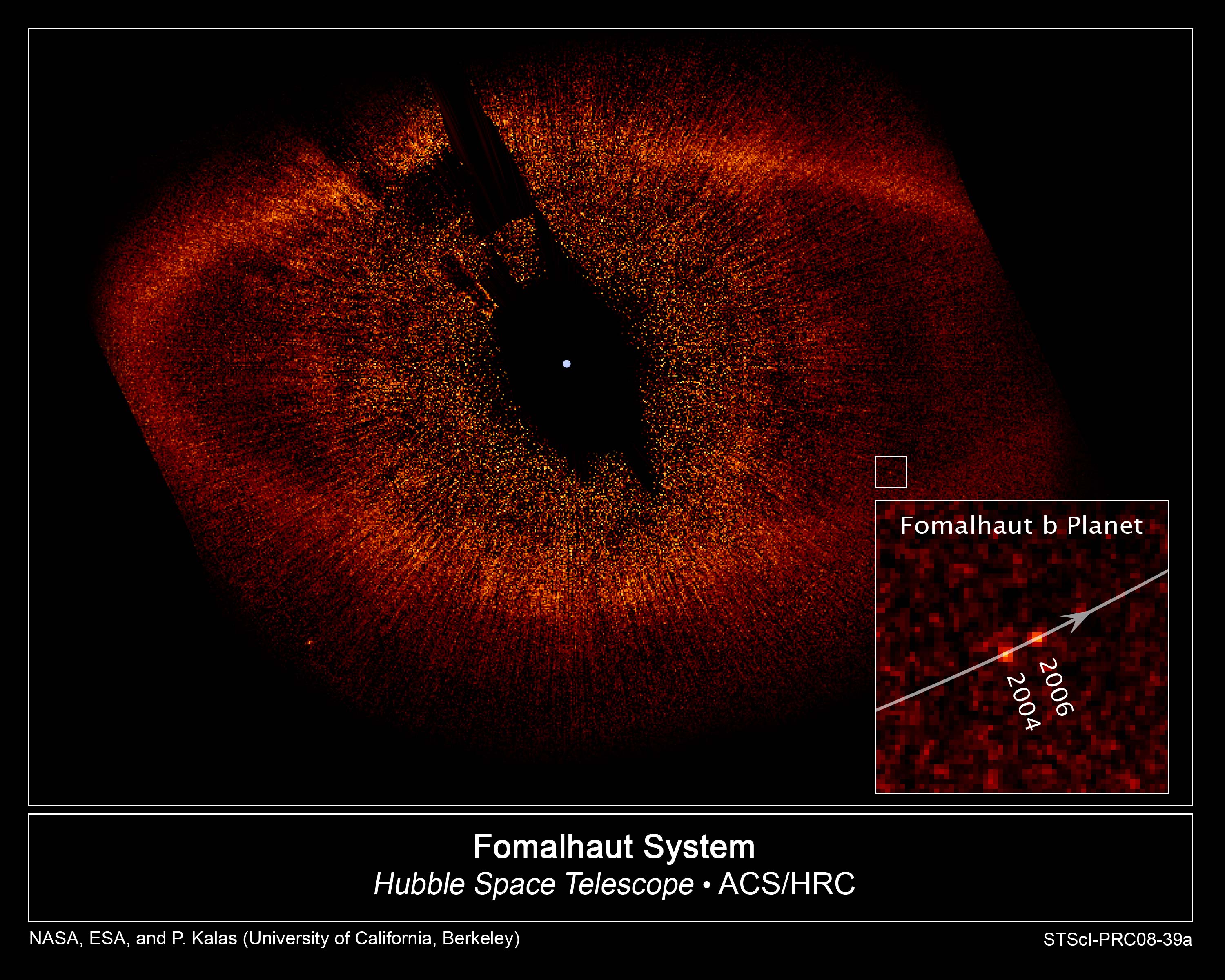
Fomalhaut system

One of the best-known directly imaged planets is Fomalhaut b, visible in the inset in this Eye-of-Sauron-like Hubble photo of the debris disk surrounding the star Fomalhaut. [NASA, ESA, P. Kalas (University of California, Berkeley)]

A select subset of exoplanets — about 15–20 total, so far — have the right properties for us to be able to take actual photos of them. These are giant planets of ~2–15 Jupiter masses, and they can be contrasted to imaged brown-dwarf companions (15–75 Jupiter masses). The next conference session discussed some of the recent results from direct-imaging studies.

Brendan Bowler (UT Austin) discussed one of the results obtained from direct-imaging studies in aggregate: observations suggest that brown-dwarf companions tend to have higher eccentricities, whereas long-period planets preferentially have low eccentricities. This suggests that giant planets are a distinct population from low-mass stars, and they likely formed within a disk.

Updates from a few specific surveys:

  • The SPHERE INfrared Exoplanet (SHINE) survey is studying the population of wide-orbit companions surrounding nearby stars. Michael Meyer (U Michigan) presented a number of the survey’s recent conclusions, one of which is that the frequency of brown-dwarf companions is higher for lower-mass host stars, yet the giant-planet frequency is higher for higher-mass stars.
  • The MagAO Giant Accreting Protoplanet Survey (GAPlanetS) searches for accreting planets lying in the gaps of the brightest transitional disks — disks that lie around young, still-accreting stars. This strategy of searching right where we expect to find planets has led to an impressive detection rate of 20% for the survey so far, according to Kate Follette (Amherst).
  • TESS is known as a transit survey, but it turns out it may prove beneficial as a direct-imaging survey as well — just not for exoplanets. Matt Holman (Harvard-Smithsonian CfA) presented on how TESS and Pan-STARRS, a ground-based sky survey, could be used to search for distant, unseen planets in our own solar system, like the theorized Planet Nine.

Some especially interesting individual detections related to direct imaging:

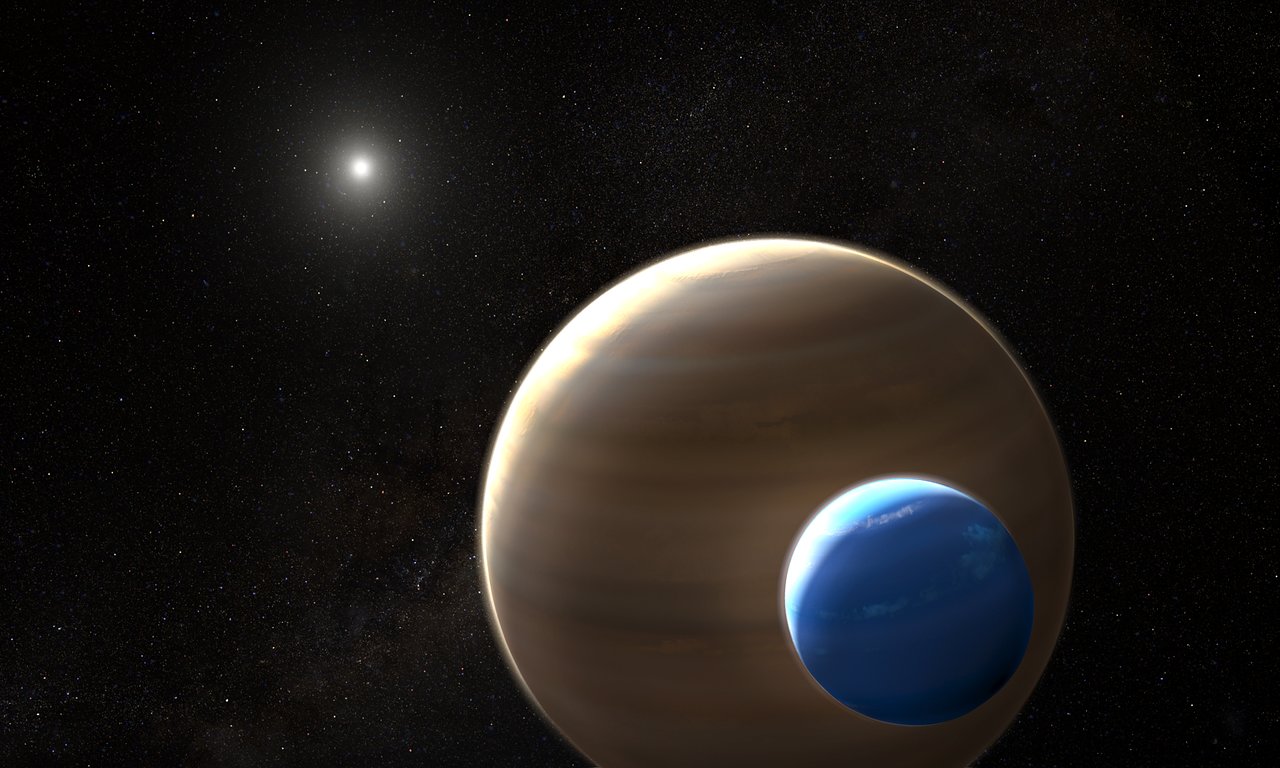
exomoon candidate Kepler-1625b-i

Artist’s impression of a system consisting of a star, planet, and giant exomoon. [NASA/ESA/L. Hustak (STScI)]

  • Cecilia Lazzoni (INAF – Padova) presented an exciting discovery of the SHINE survey: evidence for two giant exomoon candidates orbiting two low-mass brown-dwarf companions. If confirmed, this discovery could constrain planet formation mechanisms.
  • Valentin Christiaens (Monash) discussed spectroscopic evidence for a circumplanetary disk around the first directly imaged protoplanet, PDS 70b. This is the first observational evidence that circumplanetary disks — long theorized — actually exist.
  • HD 20782b is a hot Jupiter with the highest eccentricity known to date (~ 0.96). Sasha Hinkley (Exeter) described how deep VLT-SPHERE observations have ruled out additional bodies in this system that could account for HD 20782b’s extreme orbit, suggesting this planet’s unusual eccentricity may be due to unique internal structure that has prevented its orbit from circularizing through tidal dissipation.

Session 3: Radial Velocities

Another means of detecting exoplanets is radial velocities, in which we examine the spectra of stars, looking for the subtle signature of the gravitational tug of an exoplanet on its host star. The first session of the afternoon focused on some of the results that have recently emerged from radial-velocity studies.

One of the primary benefits of radial-velocity studies is the ability to measure planetary masses — but due to stellar activity muddying the waters, this process is challenging! Xavier Dumusque (Geneva) presented on one approach improving our ability to interpret radial-velocity measurements: HARPS and HARPS-N are observing the Sun as a star! Since we can make independent measurements of solar activity and our planets are well characterized, these observations help us to understand how stellar activity can affect radial-velocity measurements.

René Doyon (Montreal) introduced the SPIRou Legacy Survey, which makes use of the SPIRou spectropolarimeter to achieve precision radial-velocity measurements in the infrared. SPIRou is designed to detect small planets around nearby low-mass stars and explore the impact of magnetic fields on star/planet formation. Though the program was only launched in February, the first science results are already in, with much more to come!

Some specific recent radial-velocity detections:

Teegarden's star

Artist’s impression of two planets orbiting Teegarden’s Star. [Institute for Astrophysics, University of Göttingen]

  • CARMENES, a spectrograph searching for the signals of low-mass planets around low-mass stars, has already doubled the number of known planets with host stars below 0.2 solar mass. Stefan Dreizler (U Goettingen) told us about two of the most Earth-like planets discovered, which orbit a nearby M dwarf known as Teegarden’s star. Fun fact about Teegarden’s star: our relative systems are aligned such that hypothetical Teegardians would be able to detect the Earth as a transiting exoplanet!
  • Remember the discovery of Proxima b, a low-mass exoplanet found around Proxima Centauri, our nearest stellar neighbor? It turns out this planet may have a sibling. Mario Damasso (INAF – Torino) presented analysis of ~17 years of radial-velocity data of Proxima Centauri, which hints at a second planet orbiting at 1.5 AU. If confirmed, this discovery would make Proxima the closest multi-planet system to the Sun, at just 4.2 light-years.
  • Caroline Piaulet (Montreal) told us about follow-up of WASP-107b, a near-Neptune-mass planet that’s the size of Jupiter and challenging planet-formation theories. Radial-velocity observations have revealed a second planet in the system on a wide and eccentric orbit, which may explain some of the strange properties of WASP-107b.
  • “We’ve been monitoring this star for longer than I’ve been alive,” says grad student Sarah Blunt (Caltech) about HR 5183. More than two decades of data allowed Blunt and collaborators to detect an eccentric (e = 0.84) Jovian planet, HR 5183 b, with an orbital period longer than 70 years — the longest-period exoplanet with a well-constrained orbit discovered with radial velocities.

Session 4: Transits

The final session of the day focused on what’s perhaps the most well-known planet detection method: transits, in which we discover planets through the dip in a host star’s light as an orbiting planet passes between us and its star.

Several of the talks highlighted results from TESS:

  • While TESS is directly monitoring 200,000 targeted stars in 26 sectors, it also produces full-frame, 30-minute-cadence images of its sectors. Simulated data predict that we’ll be able to find 3,000 planets in this data — but also 800,000 false positives! Adina Feinstein (U Chicago) discussed the various techniques we can use to eliminate these false positives and recover the real planets.
  • Transiting Exoplanet Survey Satellite (TESS)

    Artist’s conception of the Transiting Exoplanet Survey Satellite (TESS). [NASA’s Goddard Space Flight Center]

    Peter Plavchan (George Mason U) presented on new results still under review at Nature (which means only vague reporting is encouraged) – the TESS and radial-velocity discovery of a two-planet system around a pre-main-sequence M dwarf still surrounded by a debris disk. This system gives us a tantalizing opportunity to study how newly formed planets interact with the disks in which they live.
  • Diana Dragomir (U New Mexico) introduced the HD 21749 system, jointly discovered with TESS and ground-based observations. HD 21749 serves as proof of TESS’s detection capabilities, consisting of an unusually dense, temperate sub-Neptune on a long-period orbit, as well as TESS’s first Earth-sized planet discovery.
  • We’ll be hearing more about ultra-short period planets tomorrow, but James Jenkins (U Chile) gave us a teaser by presenting TESS discovery of LTT9779b, the first Neptune-like ultra short period planet, which orbits its host in just 19 hours. The planet’s equilibrium temperature is a scalding 2,000 K, giving it the distinction of forming a new category: ultra hot Neptunes.
  • What about non-detections? Ji Wang (Ohio State) reported on a search for some of the earliest exoplanets formed. Wang and collaborators looked through TESS data for planets around the most metal-poor stars in our galaxy: a sample of old, Gaia-detected stars in the Milky Way halo. The search didn’t yield any discoveries, but it did place interesting constraints on planet formation in metal-poor environments.

Andrew Vanderburg (UT Austin) discussed the challenges of measuring accurate planet occurrence rates in transit surveys like Kepler, K2, and TESS. Since human judgment isn’t perfect, Vanderburg argues that automatic detection and vetting of planet candidates is the way forward. He and collaborators are working on using deep learning, a machine learning technique, to do this automated detection, and they’ve already demonstrated success in applying this to Kepler data.

Transit observations are good for more than just finding exoplanets; we can also learn about the planets’ properties. Antonija Oklopcic (Harvard) presented a new way to detect magnetic fields in exoplanets, which relies on examining a helium absorption line in a planet’s atmosphere as the planet transits. This line will become polarized in the presence of an external field, and measuring this polarization can provide constraints on the strength of the exoplanet’s magnetic field.

ExSS IV

Greetings from the fourth Extreme Solar Systems (ExSS) meeting, held in Reykjavik, Iceland! This week, I will be writing updates on just a few of the talks at the meeting. The usual posting schedule for AAS Nova will resume next week.

What’s ExSS?

This conference is the fourth in a series that started in 2007 as an opportunity for exoplanet theorists, observers, and instrumentation developers to gather and discuss both our exoplanet discoveries over the past decades and what we can expect in the future.

The conference has reconvened every roughly four years, and the meeting in Iceland is drawing an impressive attendance of astronomers from around the world. Roughly 600 participants will be gathering in Reykjavik, and the full meeting program includes over 100 talks and nearly 400 posters! The program is broken down into broad categories related to exoplanet study, including the following sessions:

  • New Discoveries
  • Planet Formation
  • Direct Imaging
  • Atmospheres
  • Radial Velocities
  • Population Statistics & Mass-Radius Relations
  • Transits
  • Planets in and around Binaries
  • Dynamical Evolution
  • Planets around White Dwarfs
  • Ultrashort Periods and Planet-Star Interactions
  • Disks
  • Stellar Spins and Obliquities
  • Habitability and Biosignatures
  • Transiting Multi-planet Systems
  • Future Missions


I’ll do my best to bring you highlights from as many sessions as I can!

EXSS IV

The many attendees of ExSS IV are ready for the first day of the conference. [AAS Nova]

SOHO

The 234th meeting of the American Astronomical Society took place June 9–13 in St. Louis, MO. The following is the last of the interviews conducted by Astrobites authors with some of the meeting’s keynote speakers to learn more about their research and careers. You can view the rest of the series by searching the AAS meeting tag!

Dr. Philip Scherrer (interviewed by Briley Lewis)

Imagine starting your career with access to a $25,000 computer at your disposal. Except, that computer is limited by its 100-KHz processor, and its memory is stored on tape and can only hold 32 kilobytes. (For reference, a typical iPhone is 4,000 times more powerful, with around 500,000 times the storage capacity.) When Dr. Philip Scherrer began his career in solar astronomy in the late 1960s, this is what he had to work with, and in the past 50 years, he has contributed to the creation of revolutionary telescopes and massive amounts of data, forever changing our understanding of the Sun and its impacts on Earth.

Scherrer

Dr. Philip Scherrer, Stanford University, recipient of this year’s George Ellery Hale prize for his extraordinary contributions to the field of solar astronomy. [Stanford University]

1957 was a great time to be a kid interested in science (like Scherrer was), with both the International Geophysical Year and the world-changing launch of Sputnik-1. Inspired by the events of his childhood, Dr. Scherrer spent his undergrad and part of graduate school at UC Berkeley, before moving across the bay to Stanford, following an opportunity to build a new solar observatory there. This became the Wilcox Solar Observatory, which opened in 1975 and is still operating today. Dr. Scherrer semi-jokingly credits the telescope’s name for its longevity, saying, “If you call it an observatory, people will keep it around. Telescopes will be gone in 10 years.” He then continued on as a postdoc at Stanford, and in 1986 became part of their research faculty, where he remains today.

One of the major projects of his career was the MDI (Michelson Doppler Interferometer) instrument on SOHO — NASA’s Solar and Heliospheric Observatory — in collaboration with the Lockheed solar group. Near the start of the mission, Scherrer recalls the destruction of a Telstar satellite by a (totally unpredicted) coronal mass ejection — something he took quite personally since it disrupted his weekly Star Trek viewing. This further motivated him to understand the Sun’s cycles and activity. The most unexpected change, in his view, is the revolution in how people think of the Sun. We now have the understanding that stars are really dynamic, changing on large and small spatial scales at really fast timescales (minutes to even seconds). Previously, the solar interior was thought of as a black box, but now we can infer structure through helioseismology. “You can look inside a star … and that’s cool! It’s fun to have been a part of it.”

Although he’s certainly learned a great deal about how stars work, Scherrer has also learned a lot about working in astronomy, especially on long-term projects and large mission teams. “It’s hard to judge when you’ve got it right,” he says, with “it” being data from a telescope or mission. You might think the solution is to meticulously triple-check everything to get it perfect before releasing the data, but he disagrees. There’s a benefit to getting data out there, “even with blemishes, since there are few telescopes but lots of blackboards and people with good ideas.” He also conveyed the importance of work-life balance and avoiding burn-out, summed up with a pithy statement: “Don’t forget to live.”

Sun

The Sun, as seen by SOHO. [NASA]

When thinking about future predictions of solar flares and coronal mass ejections, he hopes we’ll finally “do something better than just guess. All the pieces are there.” Given that we just recently started observing the Sun in detail, we still only have a small sample of full solar-cycle data; as Scherrer says, “The fact that it takes 22 years [for a full solar cycle]doesn’t make it easy.” Looking ahead, Scherrer is excited to see what we can do to create a holistic portrait of the Sun, using 20+ years of good helioseismology and magnetic data, solar-cycle monitoring, and computer modeling to tie everything together.

Scherrer had something in store for everyone in his George Ellery Hale prize plenary talk, “Observations about observations of the Sun”, and especially hoped that “it’ll be of value to people just getting started in the field.” He presented his talk on Monday, June 10th at 4:30pm at #AAS234; you can check out Kerry Hensley’s writeup of the talk here!

1 12 13 14 15 16 23