Monthly Roundup: Updates on Three Notable Transients
What’s new with AT 2024wpp, GRB 250702B, and GW231123? Get updates on these three exceptional astrophysical transients in today’s Monthly Roundup.
Researchers search for a connection between short-lived black hole accretion events and neutrinos — elusive, neutral, nearly massless particles.
Astrobites reports on simulations that might help astronomers identify double-detonation supernovae early in their evolution.
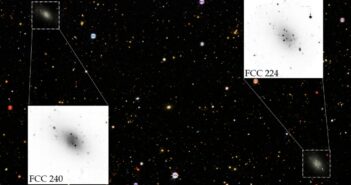
How do giant low-surface-brightness galaxies form? New research investigates two galactic specimens to search for clues.
A satellite-rich dwarf galaxy poses a potential problem for current cosmological models.
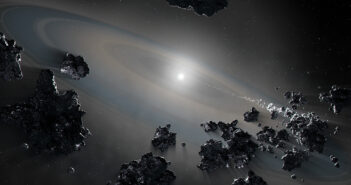
JWST spectra illuminate the composition of the debris disk around GD 362, one of the most polluted white dwarfs known.
Astrobites reports on a cosmic drama in action: three active black holes, tangled jets, and fading light.
Astronomers search for a simple organic molecule in Lynds 1544, a cold, dense clump of gas that will one day become a star.
A chance alignment between galaxies allows astronomers to study a single star system as it was when the universe was just 6 billion years old.
Astrobites reports on the potential habitability of Teegarden’s Star b, a promising Earth-like planet.
How has the Crab Nebula supernova remnant changed since the Hubble Space Telescope observed it in 1999–2000?
A recent study looks to the nearest rubble-ridden systems for the potential origins of interstellar objects that have visited our solar system.