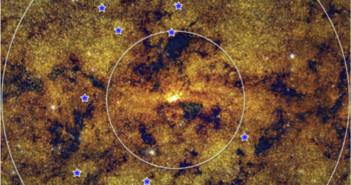
How Did Our Galactic Nucleus Form?
The recent discovery of old, variable stars in the Milky Way’s nucleus may have solved a long-standing question.

The recent discovery of old, variable stars in the Milky Way’s nucleus may have solved a long-standing question.
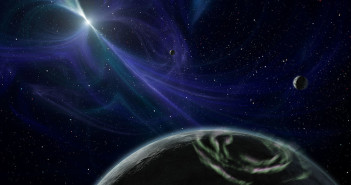
Pulsar planets were the first planets outside the solar system ever discovered, but they now appear to be very rare. Astrobites reports on what makes pulsar planets so uncommon.
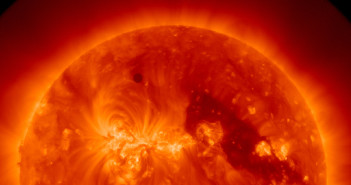
Imaging of Venus during its 2012 transit across the Sun revealed X-ray emission coming from the planet’s dark side. What was the source of this light?
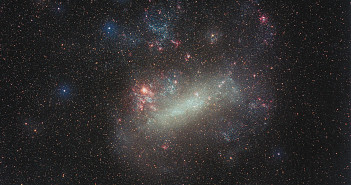
The Large Magellanic Cloud, a satellite of our galaxy, may have a newly discovered satellite of its own — a faint collection of stars being torn apart by the Cloud’s gravitational forces.
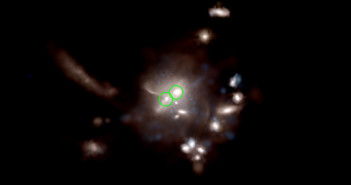
When two galaxies collide and merge, what happens to the supermassive black holes that reside at the galaxies’ centers?
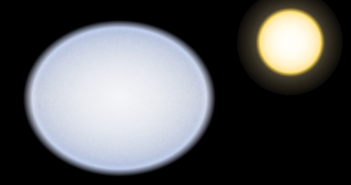
What happens when a planet orbits a rapidly spinning, oblate star? Astrobites reports on how this can potentially double the number of seasons that a planet experiences!
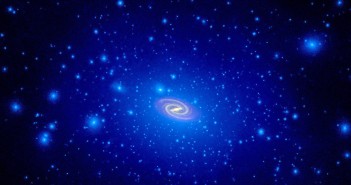
Why aren’t the outputs of cosmological simulations consistent with the satellite galaxies we observe around the Milky Way? A recent study may have found an answer.
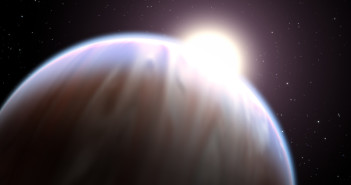
Thus far, most of the exoplanets we’ve discovered orbit around cool stars rather than hot ones. Recently, an unusual technique has been found to discover a planet in the habitable zone of a very hot star.
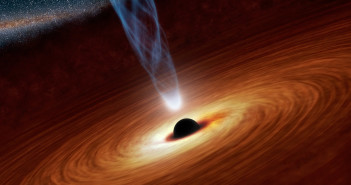
Supermassive black holes — which often weigh in at millions to billions of solar masses — can accrete matter as they lurk at the centers of galaxies. Is there a maximum mass that these monsters can attain?
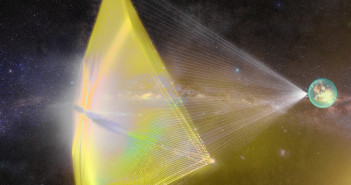
How will the tiny spacecraft of the Breakthrough Starshot initiative fare against dust, as they speed through interstellar space on their way to Proxima Centauri? Astrobites reports on the potentially catastrophic consequences of the interstellar medium for the mission.
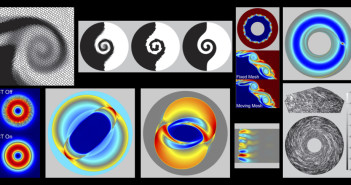
Creating the codes that are used to numerically model astrophysical systems takes a lot of work — and a lot of testing! Here’s a brief look at the some of the entrancing test outputs from the new DISCO code.
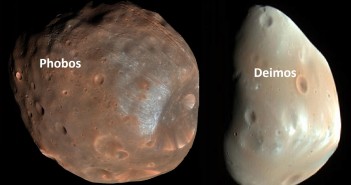
Were Mars’s two moons once main-belt asteroids, now captured into orbit? Or were they created when a large body slammed into Mars?