
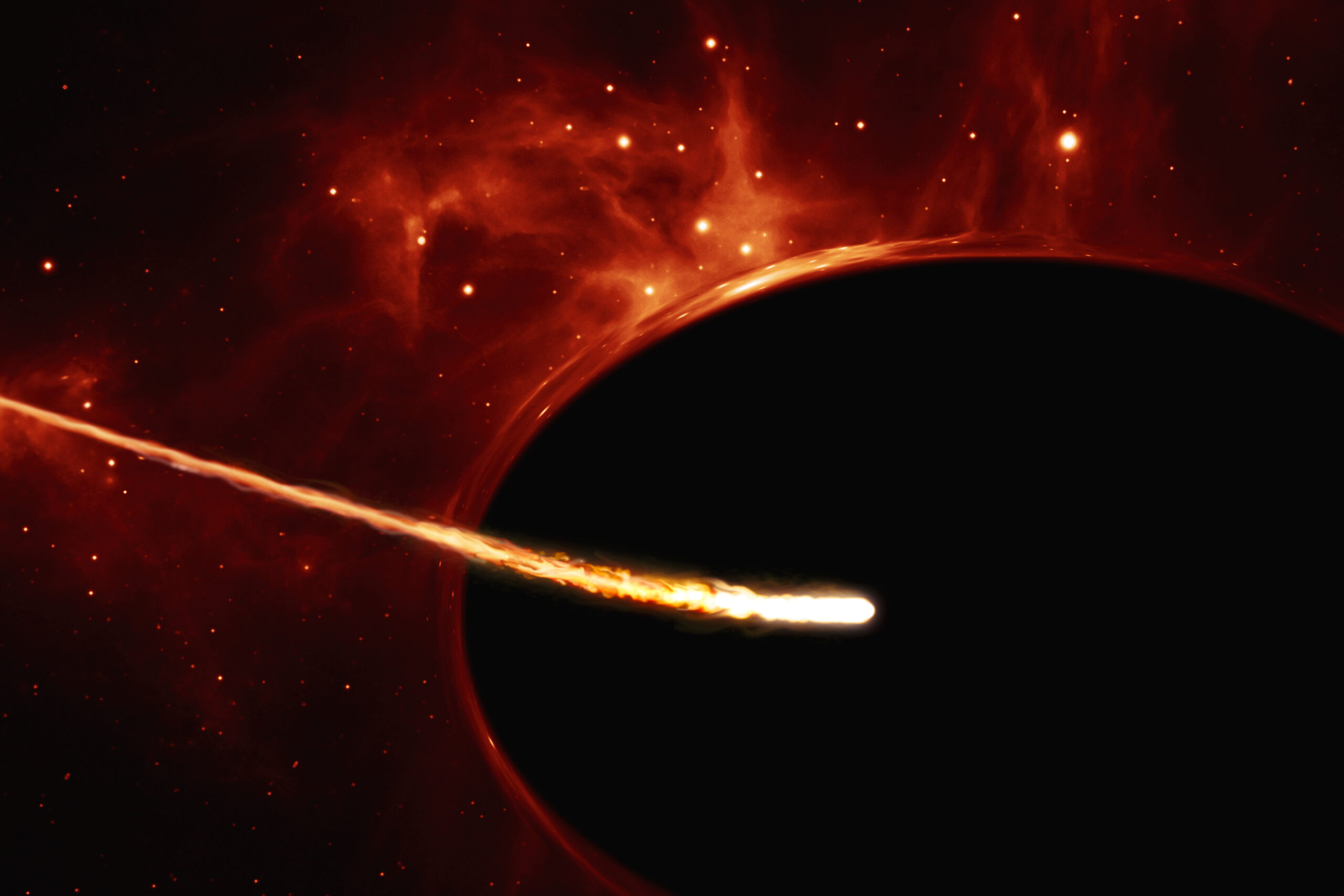
Current gravitational wave detectors are primarily sensitive to powerful sources like black hole–black hole mergers — what types of events may next-generation gravitational wave detectors reveal? A recent study explores stripped subgiant stars around supermassive black holes and how their gravitational waves may be detected in next-generation missions.
Inspiraling Stars and Gravitational Waves
The immense gravity of supermassive black holes at the centers of galaxies drives complicated dynamics that could generate so far undetected gravitational wave signals. One predicted source of gravitational waves is a rare event known as an extreme-mass-ratio inspiral (EMRI) — a prolonged inspiraling of a stellar-mass object around a supermassive black hole, driven inward by gravitational waves. EMRIs are thought to arise when a stellar-mass object is captured into a close-in nearly circular orbit around a supermassive black hole, emitting gravitational waves due to the object’s proximity to the black hole.
To date, most studies have explored EMRIs involving compact objects like black holes, but an EMRI with an inspiraling star is possible, though not yet well explored nor understood. In addition to generating gravitational waves, a stellar EMRI will also emit light as the supermassive black hole rips up siphoned material from the star. These events may explain recent observations of peculiar X-ray transients, but their gravitational wave counterparts remain undetected as EMRIs’ predicted signals fall outside the sensitivity range of current ground-based gravitational wave detectors. However, the Laser Interferometer Space Antenna (LISA), a space-based gravitational wave detector expected to launch in the mid-2030s, will be sensitive to the gravitational waves of EMRIs. In order to properly identify them, we must better understand what to expect.
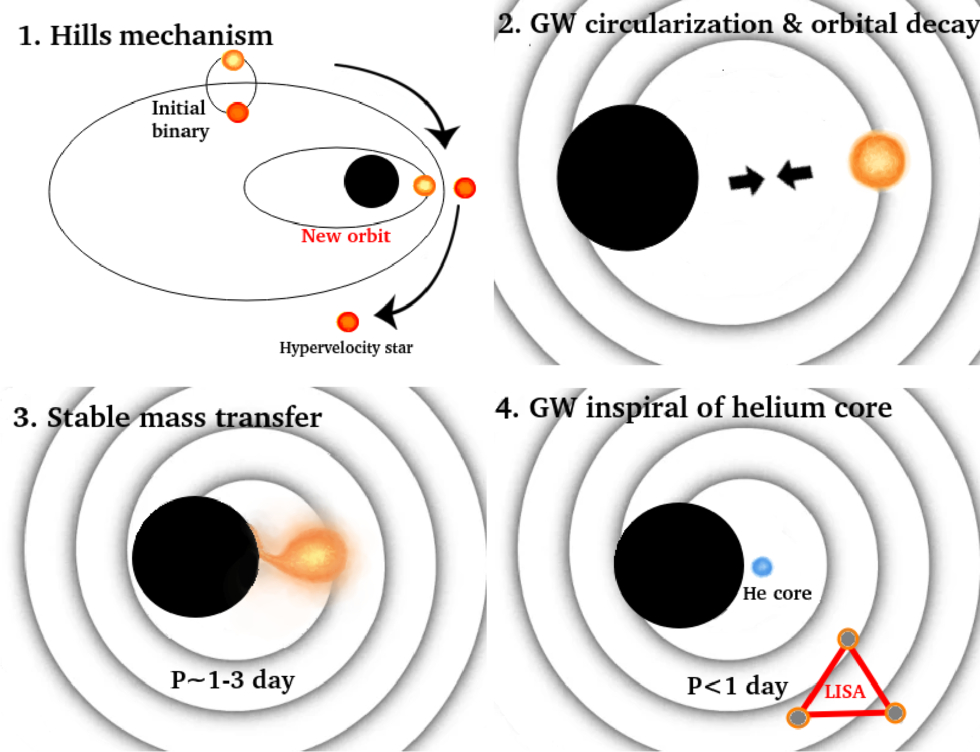
Diagram showing the evolutionary steps of a supermassive black hole capturing a subgiant star that subsequently undergoes mass transfer and gravitational wave-driven inspiral. Click to enlarge. [Olejak et al 2025]
Modeling a Subgiant Inspiral
Seeking to better predict what the gravitational waves of stellar EMRIs may look like and what LISA may detect, Aleksandra Olejak (Max Planck Institute for Astrophysics) and collaborators used stellar evolution code to simulate the evolution of a subgiant star as it transfers mass to a supermassive black hole and gravitational waves draw in its orbit. In their models, the supermassive black hole captures the star through scattering between stars or tidal interactions with a stellar binary in which the black hole catches one star and ejects the other.
Once the star is captured, its orbit becomes circularized around the black hole, pulled in closer over time until mass transfer of the star’s outer envelope begins. During this stage, the gravitational wave signal remains too weak to be detected. However, as the star is stripped down to just a helium core, it contracts and experiences an extended gravitational wave–driven orbital decay.
Possible Detections with LISA
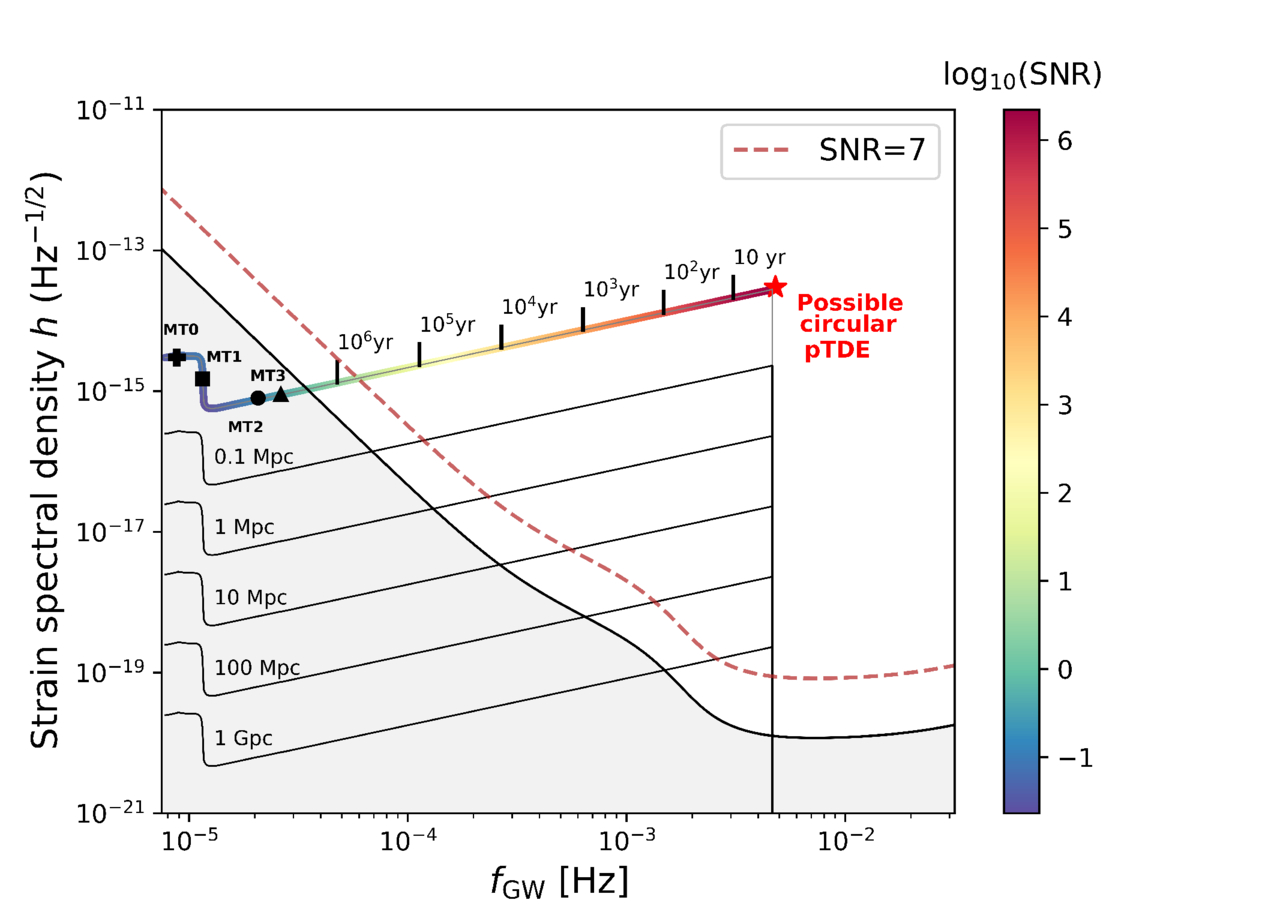
The strain spectral density as a function of the detected frequency of the gravitational wave. The colorful line indicates the signal from a stripped subgiant at the Milky Way’s center, and the gray lines are what would be observed at greater distances. LISA’s sensitivity to gravitational wave signals is shown with the black and red lines with detectable sources falling to the right of or above the line. Click to enlarge. [Olejak et al 2025]
This study provides exciting potential for what is possible with LISA, and future detections of gravitational waves will shine further light onto the complicated dynamics of galactic centers and the evolution of stars around supermassive black holes.
Citation
“Supermassive Black Holes Stripping a Subgiant Star Down to Its Helium Core: A New Type of Multimessenger Source for LISA,” Aleksandra Olejak et al 2025 ApJL 987 L11. doi:10.3847/2041-8213/ade432