
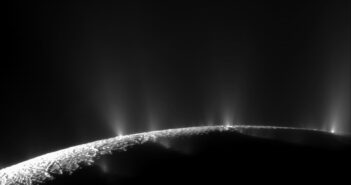
Seeding Life in the Oceans of Moons
Astrobites reports on research that explores the possibility of impacts delivering organics to the ocean worlds in our solar system.
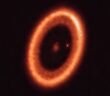
PDS 70c is the first exoplanet known to host a circumplanetary disk, where moons are potentially forming.
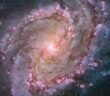
Galaxies of Many Colors
Astrobites reports on whether our methods for weighing galaxies can help save cosmology from JWST’s universe-breaking galaxies.
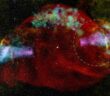
An accreting stellar-mass black hole embedded in a supernova remnant is potentially a powerful cosmic particle accelerator.
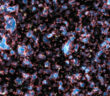
When two galaxies collide, they spark new star formation that can emit tons of powerful radiation. A recent study observes such a system and connects this process to the reionization of the universe.
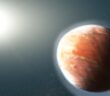
What do the latest JWST data say about the notable ultra-hot Jupiter WASP-121b?
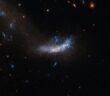
A Seriously Dusty Supernova
A supernova discovered in 2010 appears to have created tens of thousands of Earth masses of dust.
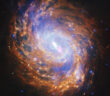
Astrobites reports on whether the correlation between galactic radio, infrared, and gamma-ray emission is truly a sign that cosmic-ray electrons deposit all their energy before they can escape to intergalactic space.
Finishing Off an Asteroid
Astronomers may have spotted the crumbs of a recently eaten asteroid around a white dwarf star.