
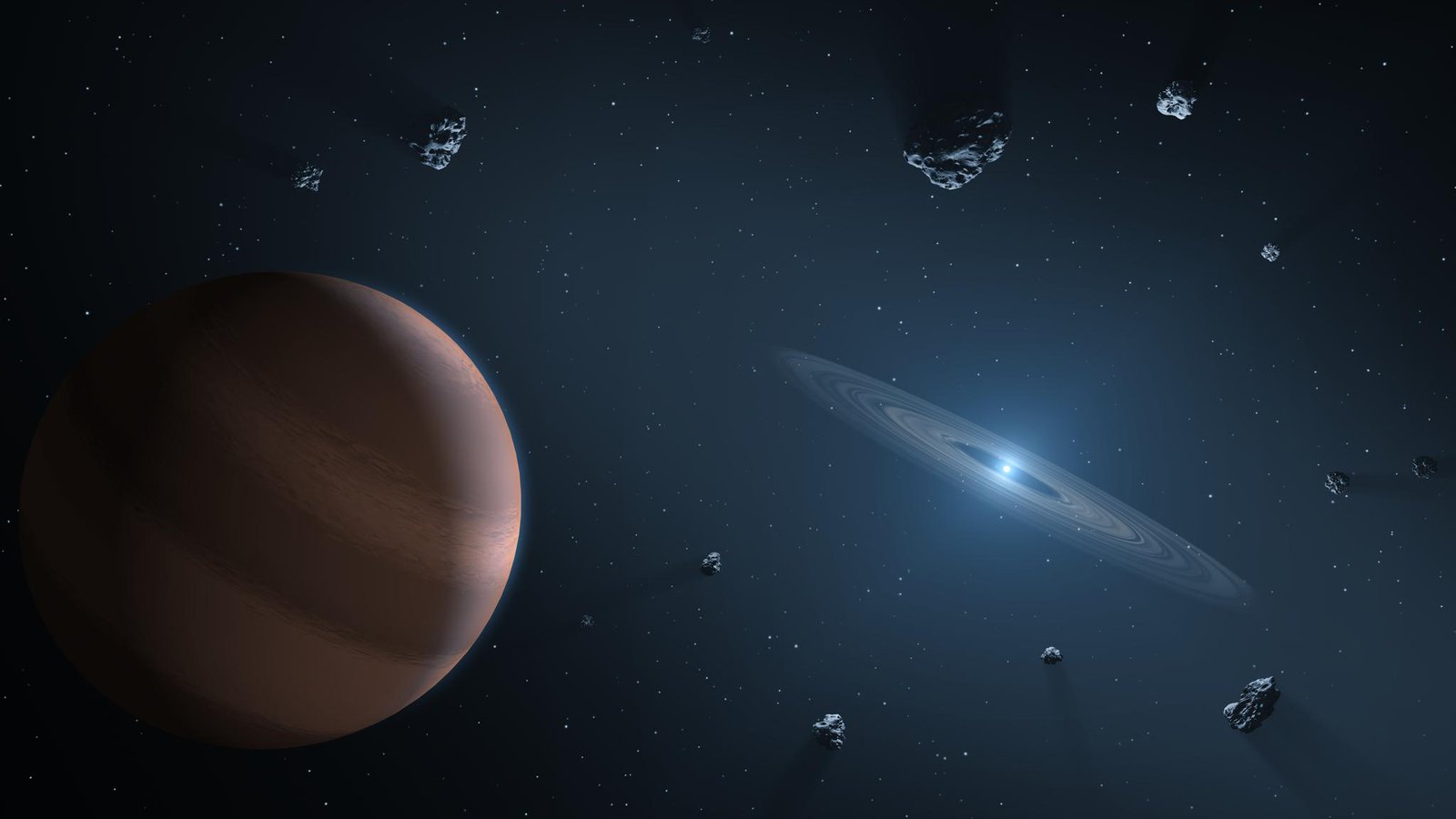
Only one white dwarf star has ever been caught eating an asteroid. Recently, however, astronomers may have found another that just finished its meal.
Eating Asteroids
Although stars like our Sun don’t explode in violent supernovae like their massive counterparts, they don’t slink quietly into a peaceful old age either. When a solar-mass star reaches the end of its main sequence life, it first swells dramatically (the Sun may eventually grow so large that it consumes Earth and the device you’re reading this on), then shrinks down to a tiny but incredibly hot ember known as a white dwarf.
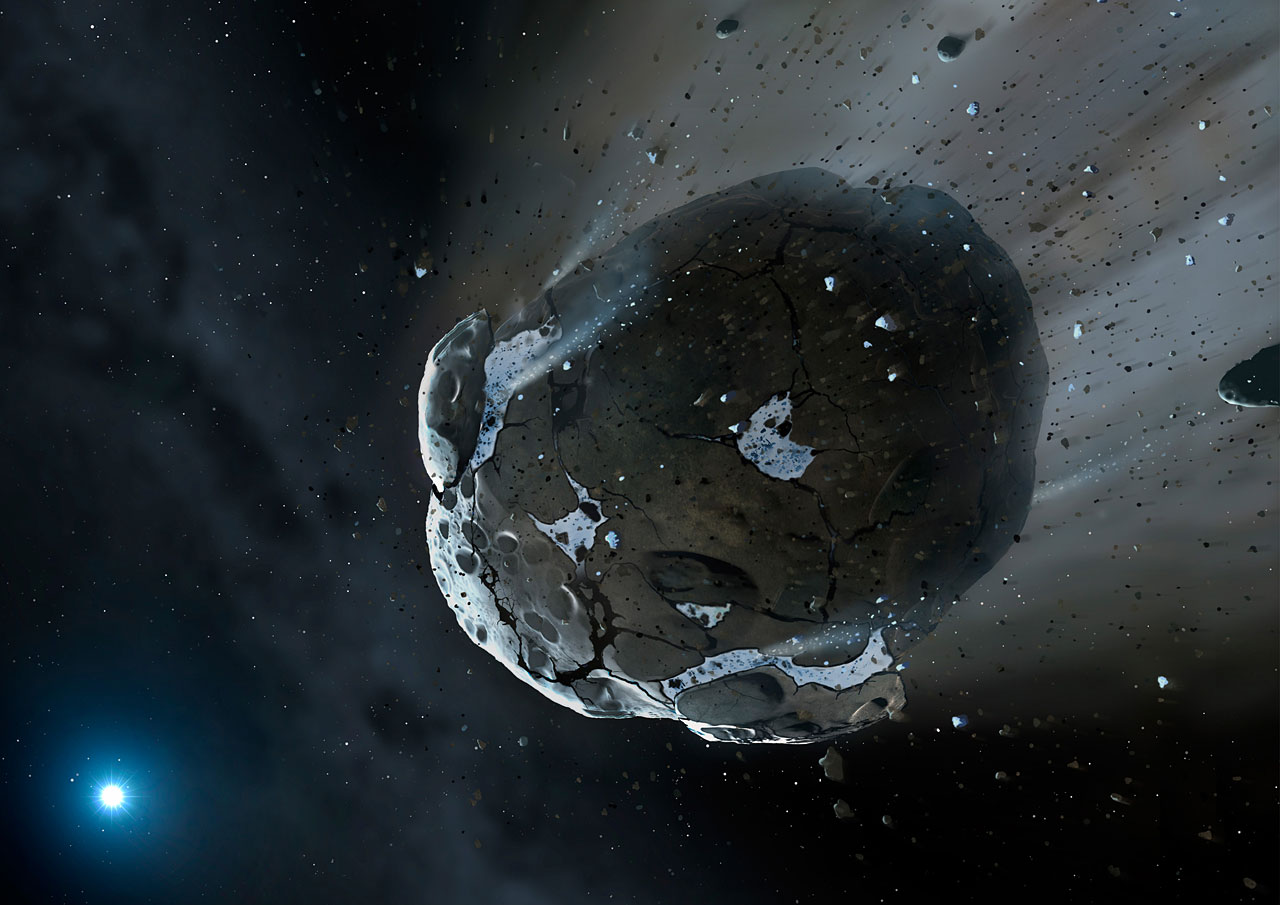
An artist’s impression of an asteroid breaking up near a white dwarf star. [NASA, ESA, M.A. Garlick (space-art.co.uk), University of Warwick, and University of Cambridge]
However, although researchers have found these stains in over a quarter of white dwarfs and consequently have reasoned that asteroid snacking must be common, they’ve only ever caught one star mid-meal. Recently, Ben Zuckerman (University of California, Los Angeles) and a team of collaborators may have found another, though it may have just finished dining.
Leftover Crumbs
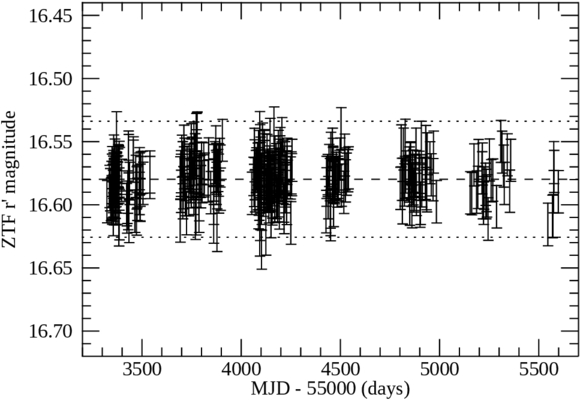
The light curve of WD J0234-0406 measured by the Zwicky Transient Facility. Unlike WD 1145+017, which frequently changes brightness, this white dwarf appears remarkably steady despite the high-velocity gas surrounding it. [B. Zuckerman et al. 2026]
The researchers suggest that this relative quiet is a matter of timing. While asteroids are actively breaking up around WD 1145+017, the parent bodies that supplied the gas and dust around WD J0234-0406 may have shattered long ago and have already been either vaporized or ground down into smaller particles. All that is left over are the crumbs slowly spiraling toward the star.
Although WD J0234-0406’s meal may not be as dramatic as WD 1145+017’s feast, it’s still exciting to expand the sample of known white dwarf-asteroid interactions. And, with the upcoming release of data from the DESI survey poised to reveal the spectra of tens of thousands of white dwarfs, the sample is likely to grow again soon.
Citation
“High-velocity Circumstellar Gas Orbiting a White Dwarf Star,” B. Zuckerman et al 2026 ApJ 1004 254. doi:10.3847/1538-4357/ae23c4