
Editor’s Note: This week, we’ve been posting summaries of selected sessions from the 58th Division for Planetary Sciences (DPS) meeting in Spokane, WA. The usual posting schedule for AAS Nova will resume on 2 November.
Table of Contents:
- Press Conference: Studies of Titan, Rocky Body Surfaces, 10 Years of Juno, and Rubin Studies of TNOs
- Press Conference: Studies of Rocky Body Atmospheres, the OSIRIS-Rex Mission, Connections to Exoplanets, and Characterization of the Outer Solar System
- 2026 DPS Masursky Award: Saving NASA Science (Casey Dreier and Jack Kiraly)
- 2026 DPS Urey Prize Presentation: Characterizing Exoplanet Climates from Close-In Gas Giants to Temperate Rocky Planets (Tad Komacek)
- 2026 DPS Urey Prize Presentation: Unlocking Planetary Histories Through Subsurface Stratigraphies (Ali Bramson)
- 2026 DPS Alexander Prize: Titan: Ingredients for Life (Catherine Neish)
- 2026 DPS Kuiper Prize: New Worlds — Legacy Processes (Mark Marley)
Press Conference: Studies of Titan, Rocky Body Surfaces, 10 Years of Juno, and Rubin Studies of TNOs (Briefing video)
Devin Hoover (University of Arizona) described a study of Lyman-α (121.6 nm) emission from Titan. Titan, Saturn’s largest moon, is the only moon in the solar system with a significant atmosphere. Within Titan’s atmosphere, photochemistry creates a thick layer of haze and splits apart methane molecules, liberating hydrogen atoms that can escape to space. By monitoring the Lyman-α emission from this escaping hydrogen, researchers can study depletion of the methane in Titan’s atmosphere.
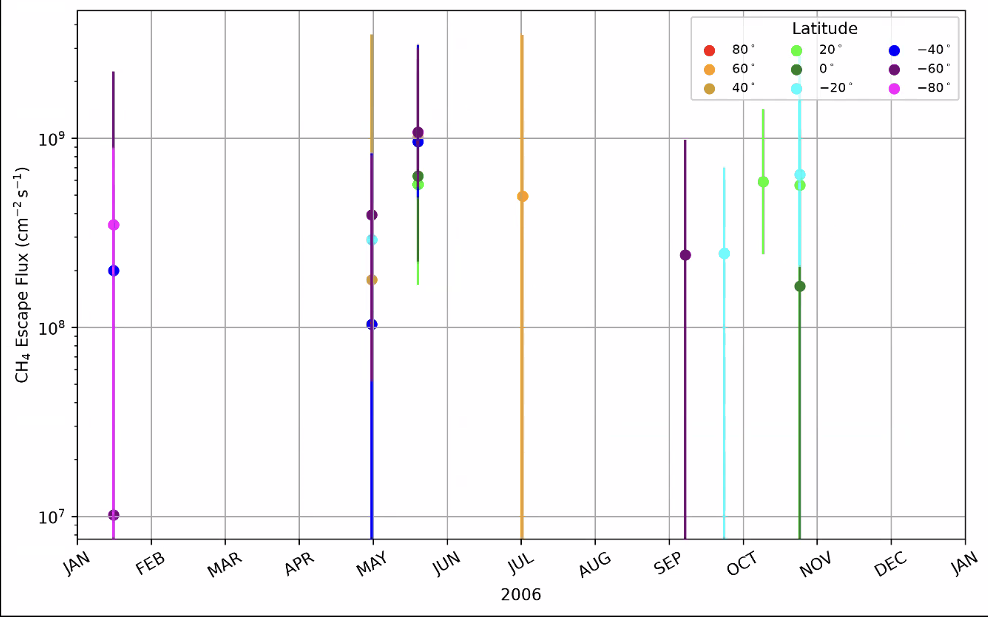
The calculated methane escape rate as a function of time. Click to enlarge. [From slide by Devin Hoover]
C. Adeene Denton (Southwest Research Institute) discussed new work on the creation of our Moon. In the canonical scenario, a Mars-sized protoplanet called Theia crashed into the proto-Earth, forming a debris disk around the proto-Earth, and the Moon coalesced out of the debris disk. Modeling of this scenario typically uses smoothed-particle hydrodynamics simulations, which approximate the colliding bodies as fluids. This means that the bodies will deform like fluids do as they interact, and in the Moon-formation scenario, this leads Theia to be fully destroyed in the impact, creating a melt-dominated debris disk. The Moon is then built back up out of this debris disk in days to years.
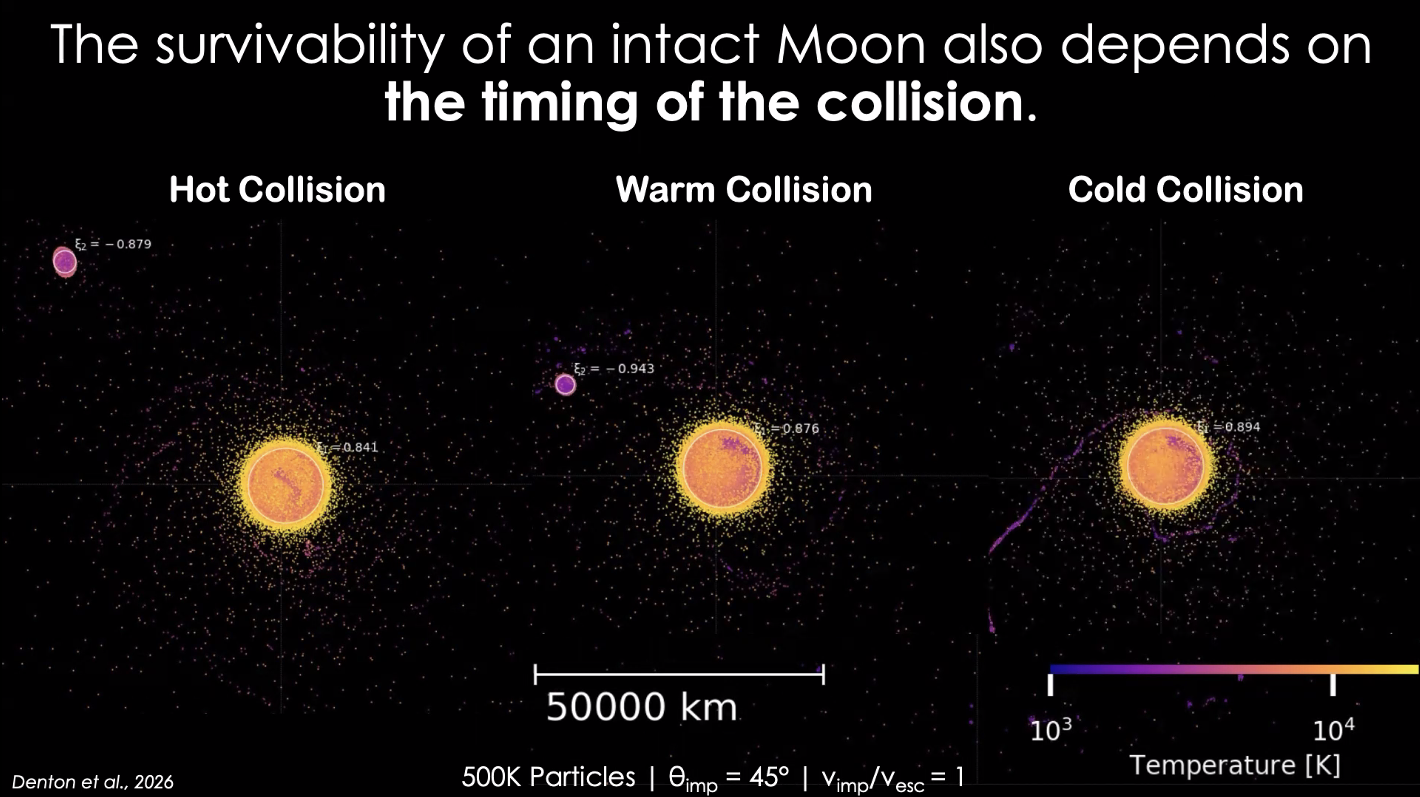
Comparison of Moon-forming impact outcomes under different temperatures. Click to enlarge. [Slide by C. Adeene Denton]
Gokce Inal (Ohio State University) examined the impact of another recent technological advance: AI. Inal’s research was motivated by two questions: 1) Can AI understand the lunar surface the way a planetary scientist does? 2) Can AI make recommendations like a mission planner would? Inal’s team developed LLaVA-Le, an AI agent that can answer questions about orbital images of the Moon’s surface the way a scientist would. Then, a second AI agent called LUMINA can act as a mission planner, developing a ranked list of landing sites based on public NASA maps and landing rules. LUMINA created a list of 30 potential landing sites within a 72,000 km2 region at the Moon’s south pole, and all seven of NASA’s candidate lunar landing regions are in the AI’s top 16 regions.
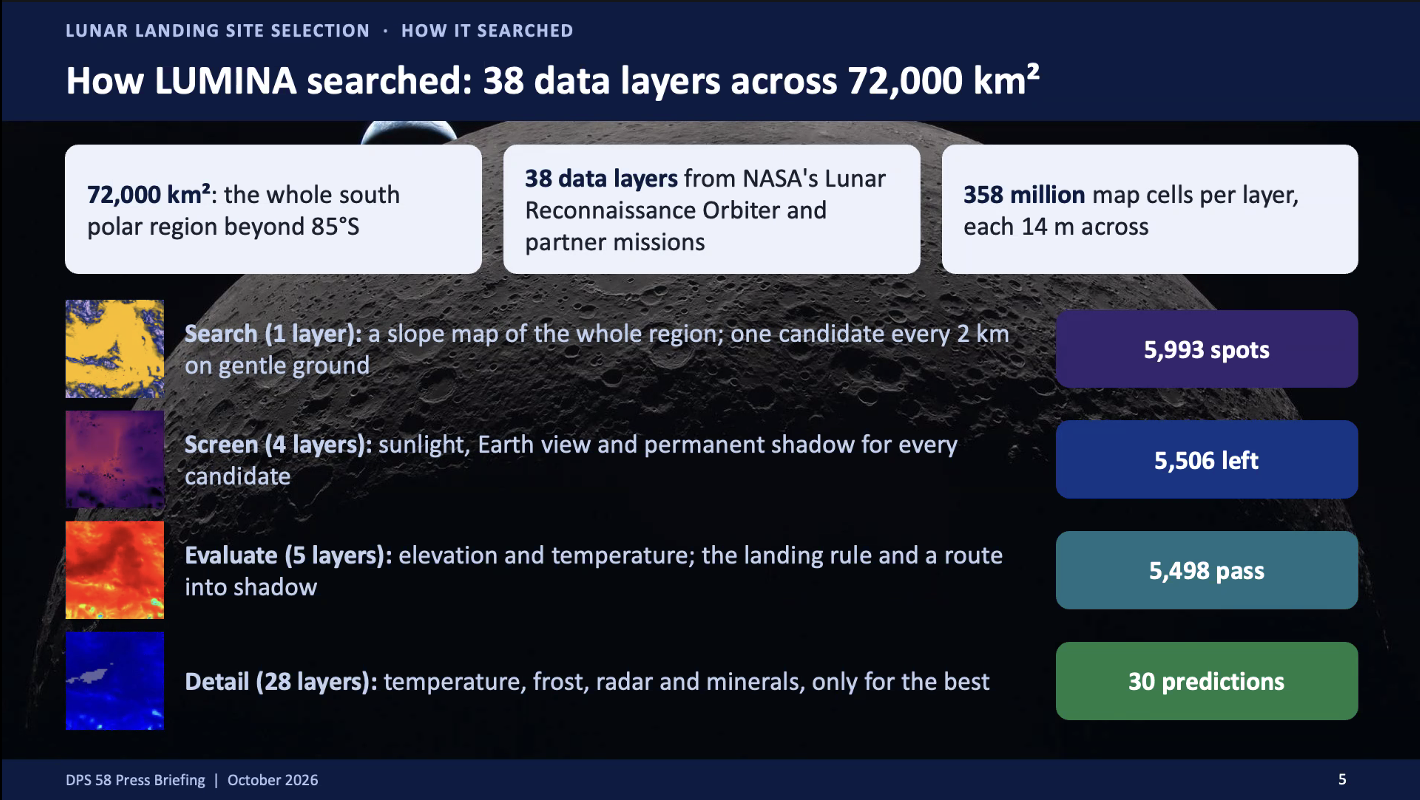
Overview of LUMINA’s decision-making process for lunar landing site selection. Click to enlarge. [Slide by Gokce Inal]
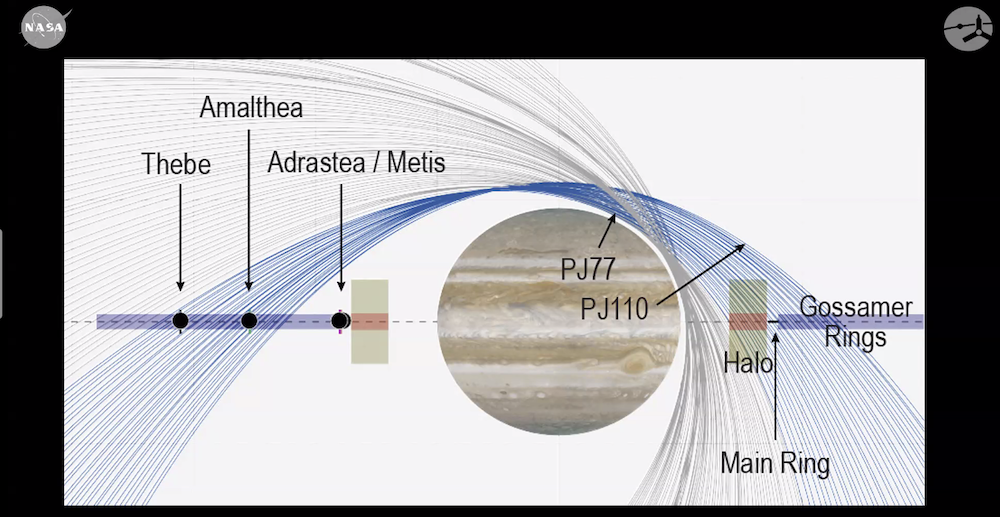
A diagram showing how Juno’s orbit will evolve over time, allowing the spacecraft to explore new regions. At the time of this writing, Juno recently completed its 88th close approach to Jupiter. Click to enlarge. [Slide by Scott Bolton]
Early discoveries from the Juno mission include the finding that the atmosphere is not well mixed, and that the planet’s core, rather than being small and metal rich, is large, diluted, and depleted of heavy elements. Together, these findings suggest that sending a probe into the atmospheres of each of our solar system’s giant planets is unlikely to illuminate solar system history as once hoped. (So far, only Jupiter has been probed in this manner.) Juno also revealed Jupiter’s polar cyclones in vivid detail, showing that they have warm cores just like Earth’s tropical cyclones. Juno’s observations were also critical for constraining the thickness of the ice shells on several moons and demonstrating that while Io does not harbor a massive subsurface magma ocean, it likely has small, separate seas of magma. Now, as the mission continues, Juno will explore new regions and undertake new science.
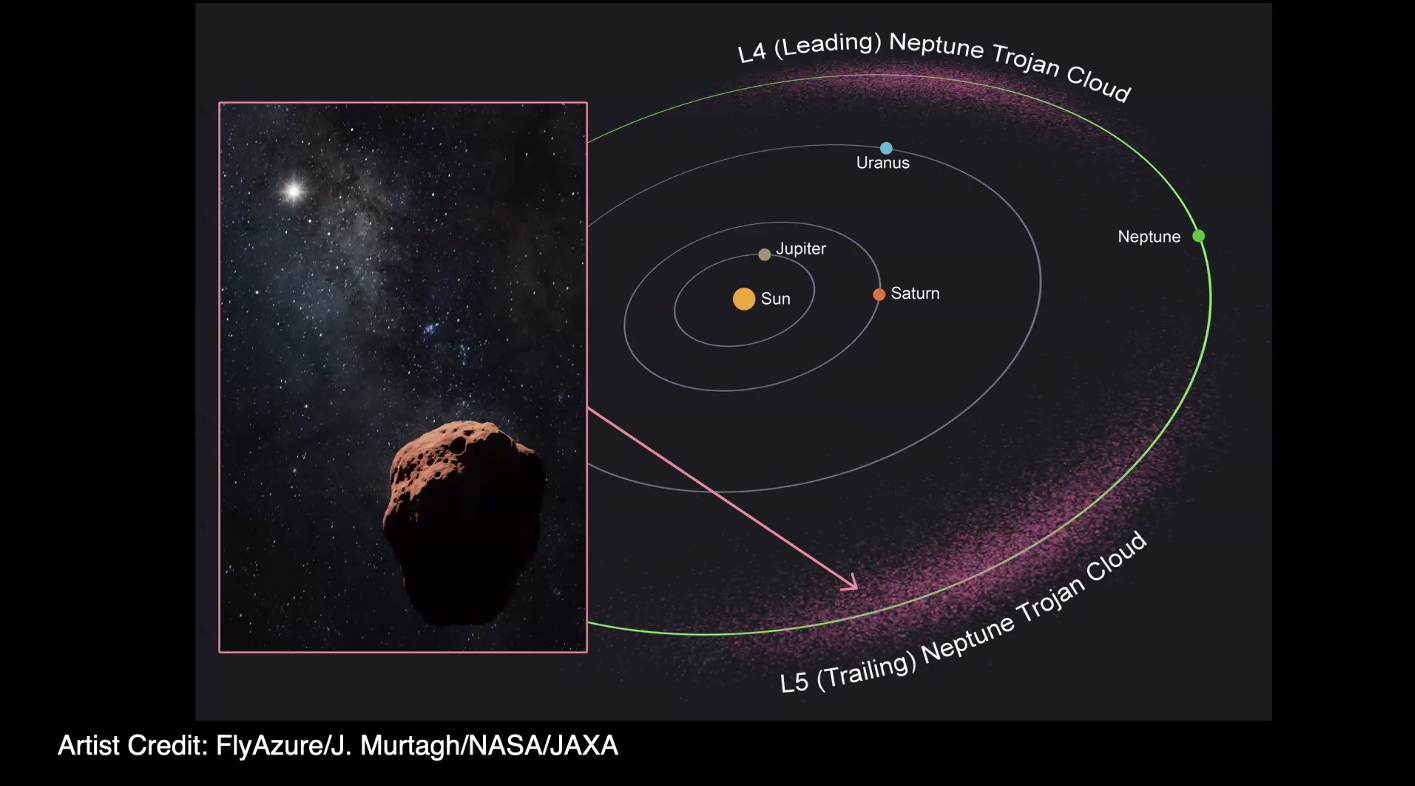
Illustration of the location of the Neptune trojans within Neptune’s orbit. Click to enlarge. [Slide by Megan Schwamb]
Neptune and Jupiter host the majority of the trojans in our solar system. So far, we’ve discovered about 16,000 Jupiter trojans and just 32 Neptune trojans — but researchers suspect that there are actually 4–10 times more Neptune trojans than Jupiter trojans. Nearly all of the known Neptune trojans inhabit the swarm that leads Neptune in its orbit, while just two occupy the trailing swarm. It’s not yet known whether these clouds of objects are actually symmetrical because the trailing cloud has been projected against the crowded plane of the Milky Way for 15 years. Now, Rubin has already discovered three trailing Neptune trojans (two confirmed and one candidate). By monitoring these objects and determining their colors, Rubin has also shown that the leading and trailing clouds of Neptune trojans have similar compositions. This is just the beginning: Rubin’s Legacy Survey of Space and Time will discover tens to hundreds of new Neptune trojans.
Press Conference: Studies of Rocky Body Atmospheres, the OSIRIS-REx Mission, Connections to Exoplanets, and Characterization of the Outer Solar System (Briefing video)
Edward (Beau) Bierhaus (Lockheed Martin) reported on a serendipitous experiment enabled by the OSIRIS-REx mission to the asteroid Bennu. OSIRIS-REx touched down on Bennu, a 500-meter-wide rubble pile near-Earth asteroid, and collected a sample to return to Earth. This process required the lander to fire its thrusters and lift off from the surface of the asteroid, unintentionally carrying out an experiment relevant for planetary defense.
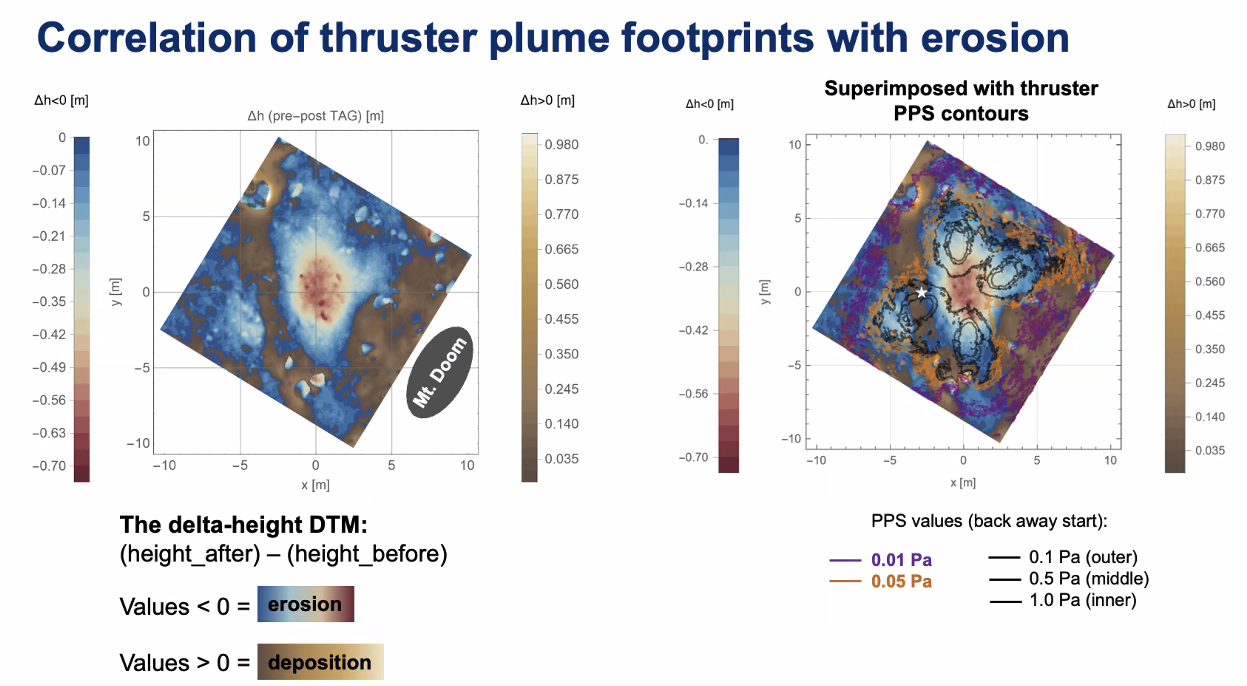
The thruster plume footprints and the erosion of the surface are correlated. Click to enlarge. [Slide by Edward Bierhaus]
Steven Desch (Arizona State University) described a search for the answer to a question posed 17 years ago: why is the Sun more depleted in refractory materials than 82% of solar twins? Early on, it was thought that this mystery could be solved by the presence of our solar system’s giant planets: perhaps our star is depleted in refractory materials (materials that remain solid up to relatively high temperatures) because these materials are locked away inside the giant planets. Further research disproved this theory, and now, Desch’s team has a new hypothesis: astronomers’ favorite scapegoat — magnetic fields — are to blame.
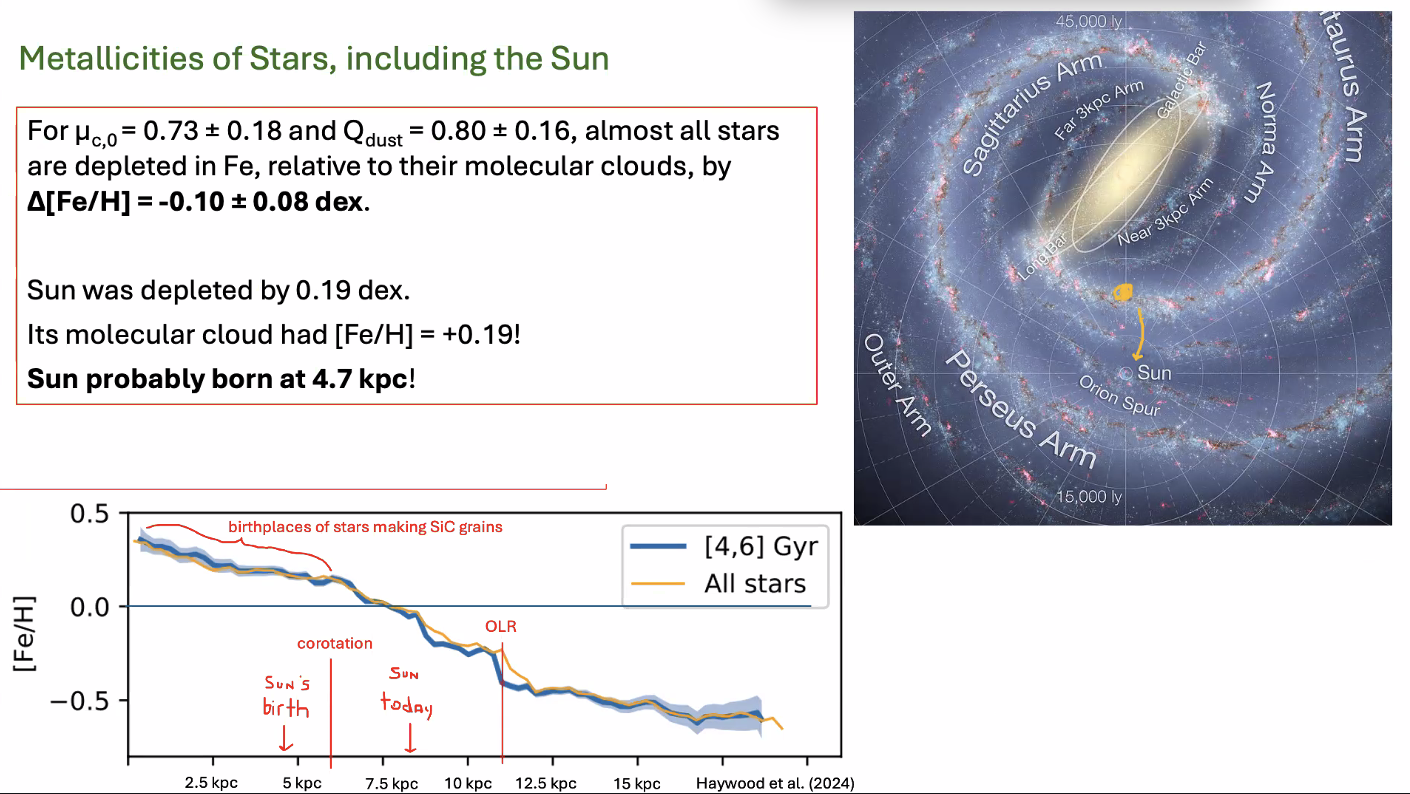
Desch and collaborators found that most stars are depleted in refractory materials relative to the clouds they formed in. This suggests that the Sun was born closer to the galactic center than commonly thought. Click to enlarge. [Slide by Steven Desch]
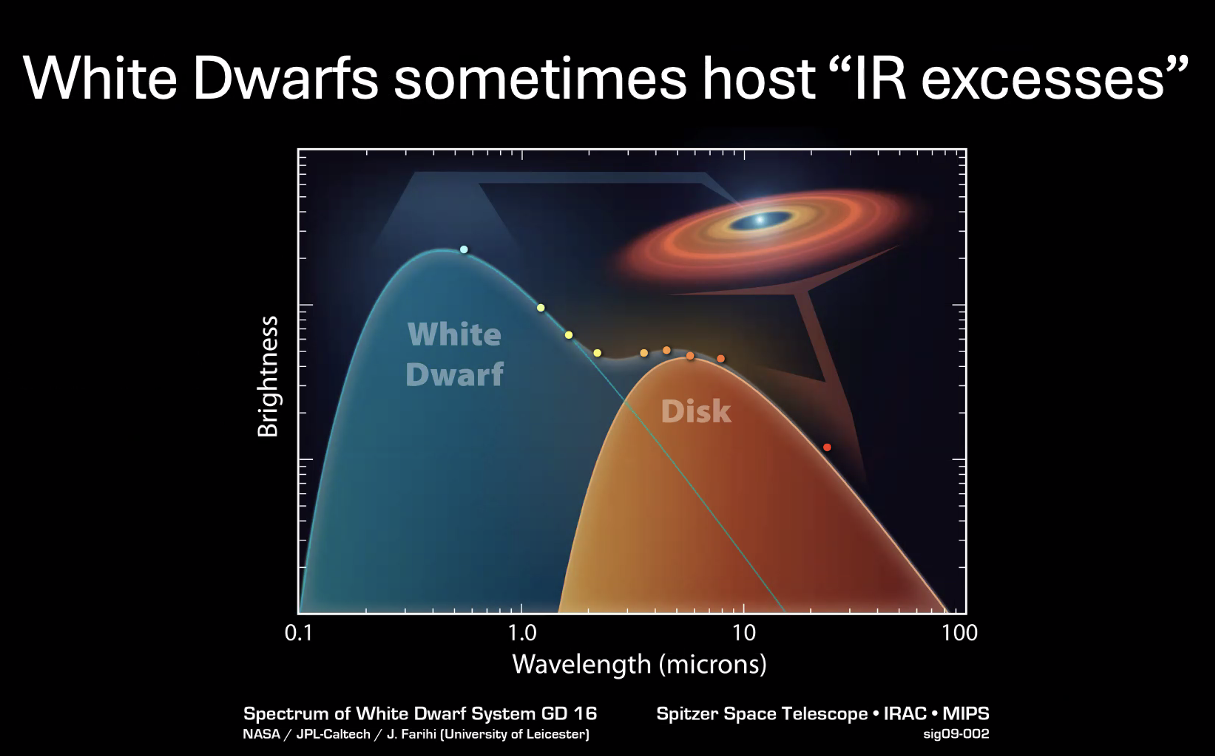
Diagram of the infrared excess caused by a close-in debris disk around a white dwarf. Click to enlarge. [Slide by Jordan Steckloff]
Steckloff considered how the strength of these materials affects the size of the debris that forms during migration, finding that the characteristic size is in the range of 100–1,000 meters — much larger than the pulverized dust thought to inhabit a white dwarf’s debris disk. While the mystery of how a white dwarf’s dusty disk comes to be remains unsolved for now, future work that explores the impact of collisions or rotational disruption may hold clues.
Elizabeth Silber (Sandia National Laboratories) brought the discussion back to the OSIRIS-REx mission, describing what was learned from the journey of its sample return capsule through Earth’s atmosphere. Silber’s team is interested in what happens when objects slam into Earth’s atmosphere. These impacts generate shockwaves and low-frequency sound called infrasound. By monitoring the infrasound from an atmospheric impact, scientists hope to use models to extract the properties of the impacting object. However, it can be extremely difficult to determine how large the impacting object was and how much energy it deposited in our atmosphere, and it’s hard to know anything about the object itself without discovering an associated meteorite.
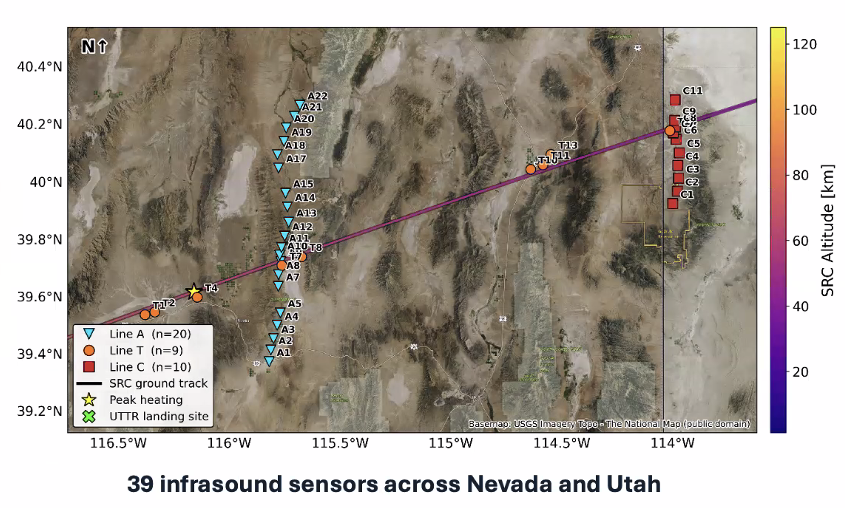
Map of sensors deployed along the reentry path of the OSIRIS-REx sample return capsule. Click to enlarge. [Slide by Elizabeth Silber]
2026 DPS Masursky Award: Saving NASA Science, Casey Dreier and Jack Kiraly (The Planetary Society)
The 2026 Harold Masursky Award for Meritorious Service to Planetary Science was awarded to Casey Dreier and Jack Kiraly of the Planetary Society for “exceptional service to planetary science and space exploration.” Dreier described the Save NASA Science advocacy campaign, which worked to prevent a devastating 47% cut to NASA funding proposed in the fiscal year 2026 President’s Budget Request. This campaign unfolded on multiple levels, from highly successful social media posts (reaching 9 million views on Instagram reels about planetary science policy) to the re-establishment of the Congressional Planetary Science Caucus. Part of the campaign was the largest Day of Action for space science in history, bringing more than 300 advocates to Washington, DC. Dreier highlighted the year-round advocacy efforts of the Planetary Society, including the creation of a dashboard to track the scientific impact of NASA missions. These collective actions were successful, and Congress overwhelmingly rejected the proposed cuts.
Kiraly expanded on the year-round advocacy efforts of the Planetary Society and described upcoming opportunities. In January, there will be 90 or more new members of Congress, which may be a record. This presents an incredible opportunity to define the issue of planetary science funding for more than a fifth of the new Congress. The Planetary Society aims to reach these new members with the next Save NASA Science Day of Action, which will take place 31 January and 1 February 2027 in DC. Kiraly hopes that they can break last year’s record for participation and ward off another existential threat to space science. Check out the Save NASA Science Action Hub to learn more and get involved!
2026 DPS Urey Prize Presentation: Characterizing Exoplanet Climates from Close-In Gas Giants to Temperate Rocky Planets, Tad Komacek (Oxford University)
Tad Komacek was awarded a 2026 Harold C. Urey Prize in Planetary Science for “pioneering research in planetary science, which has fundamentally advanced our understanding of planetary atmospheres within the solar system and beyond.” In this presentation, Komacek discussed his work on characterizing exoplanet atmospheres, specifically of hot Jupiters and temperate rocky planets around M dwarfs.
Hot Jupiters are completely unlike anything we have in our solar system. These planets are close to their stars, tidally locked, strongly irradiated, and extremely hot, with equilibrium temperatures greater than 1000K. The irradiation gradient on these planets creates strong pressure gradients that drive intense winds. These rapid winds should bring things into equilibrium quickly, but observations show that hot Jupiters have day–night temperature differences of hundreds of degrees. Komacek showed that damping of gravity waves is responsible for maintaining this temperature difference.
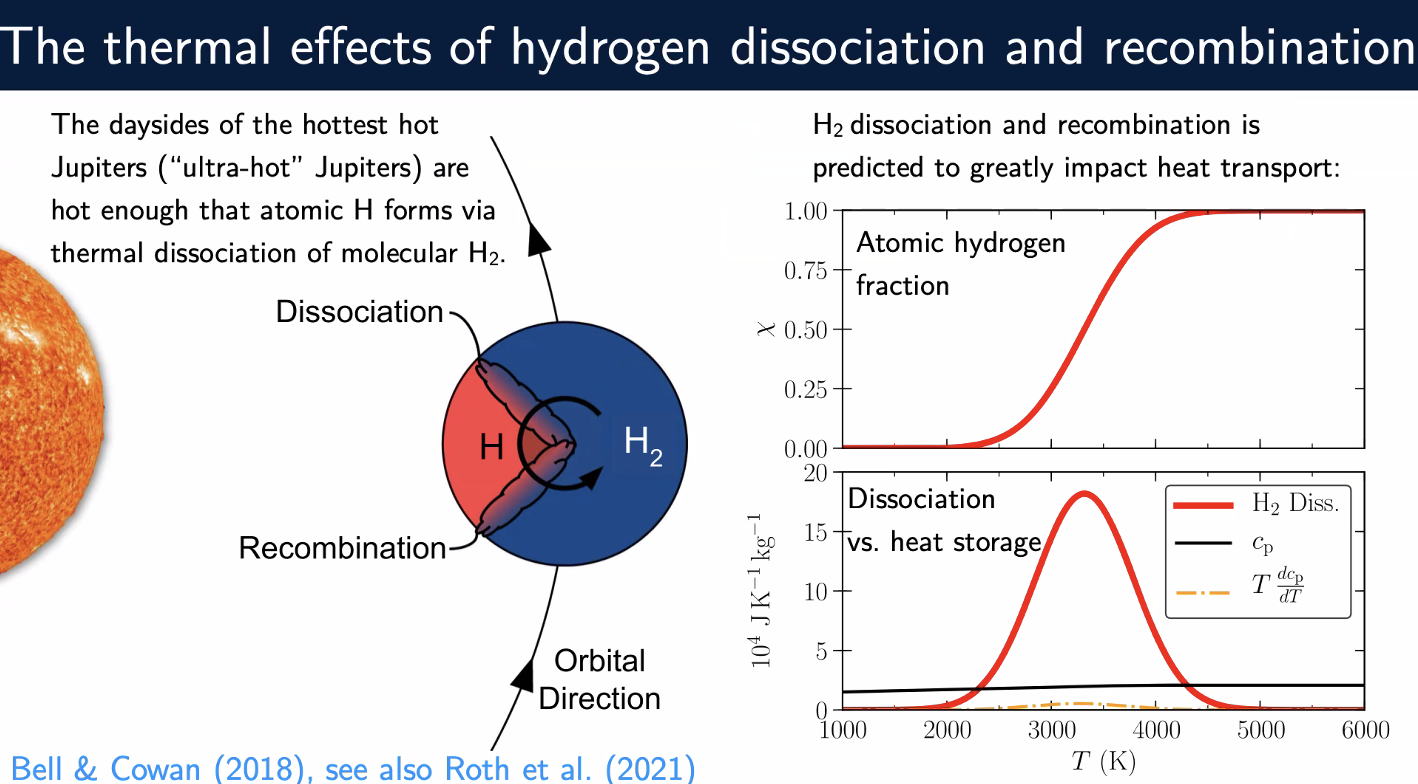
Molecular hydrogen can dissociate in the atmospheres of ultra-hot Jupiters, changing their atmospheric dynamics. Click to enlarge. [Slide by Tad Komacek]
Komacek has also used models to explore mineral clouds on hot Jupiters. Using WASP-43b as an example, he showed that certain planets’ phase curves can’t be matched by cloudless models. Further work on observations of WASP-43b from JWST has suggested that this planet only has clouds on its nightside, prompting a need for models that couple clouds, circulation, and radiation.
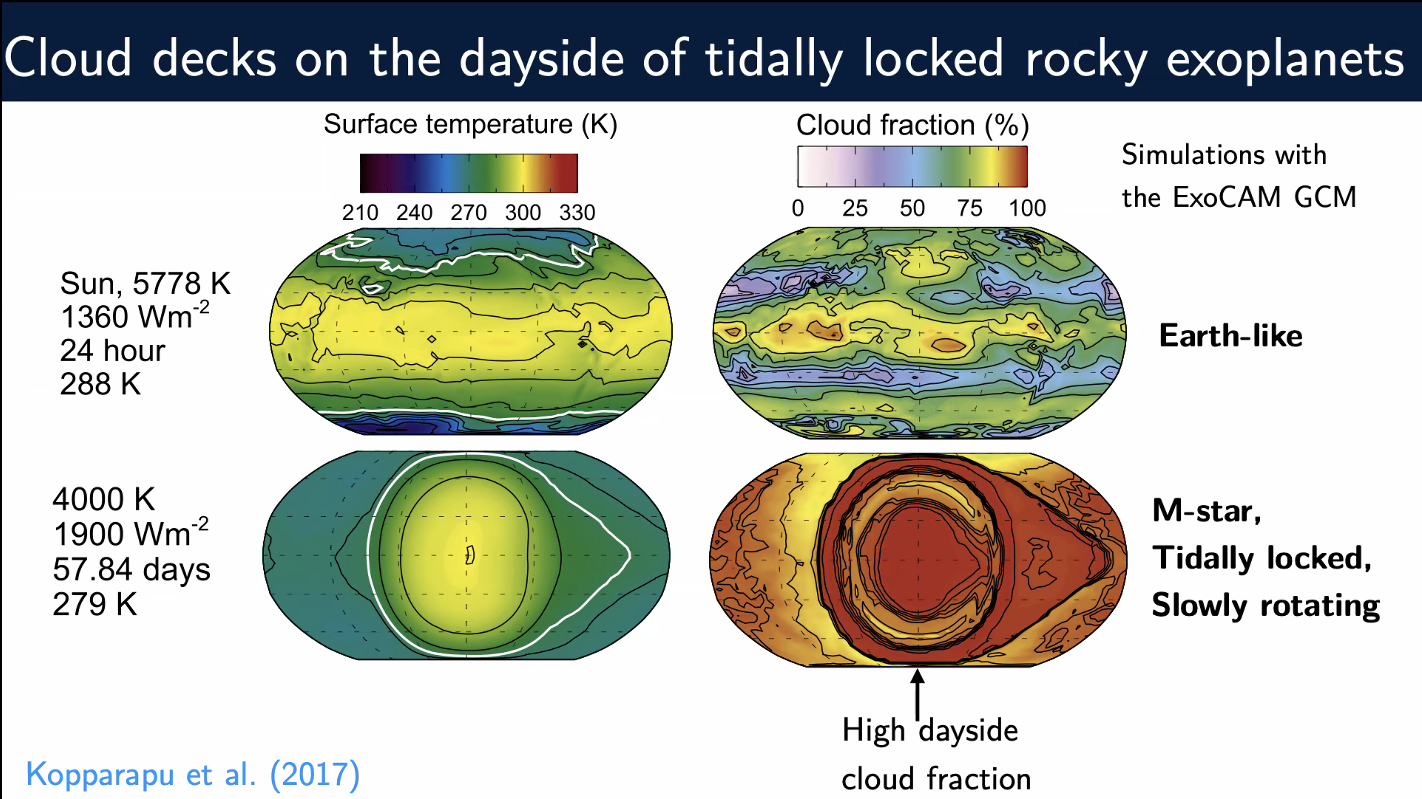
Comparison of temperature and cloud cover on Earth and a temperate planet around an M dwarf. Click to enlarge. [Slide by Tad Komacek]
Komacek also described modeling work from a member of his research group who has estimated the thermal emission from M-dwarf exoplanets that are not transiting. This showed that the thermal emission, including certain spectral features, could be detectable for some planets by upcoming missions like the Habitable Worlds Observatory.
2026 DPS Urey Prize Presentation: Unlocking Planetary Histories Through Subsurface Stratigraphies, Ali Bramson (Purdue University)
Ali Bramson was awarded a 2026 Harold C. Urey Prize in Planetary Science for “her groundbreaking contributions to planetary science.” In a delightful extension of her childhood fascination with columnar basalts and the planetary history they convey, Bramson now explores planetary history through stratigraphy: the study of rock and other layers
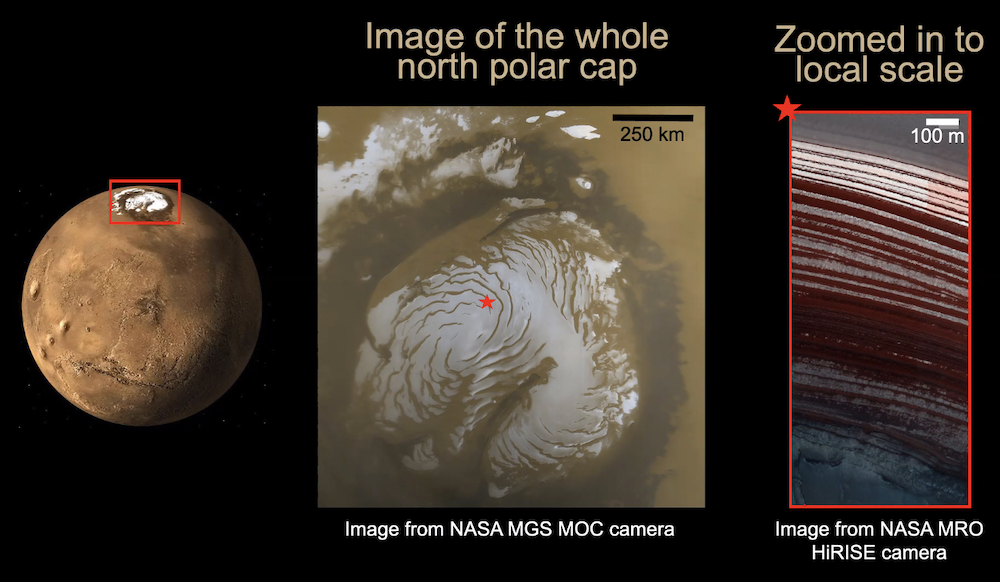
Aerial view of ice layers in Mars’s polar ice cap. Click to enlarge. [Slide by Ali Bramson]
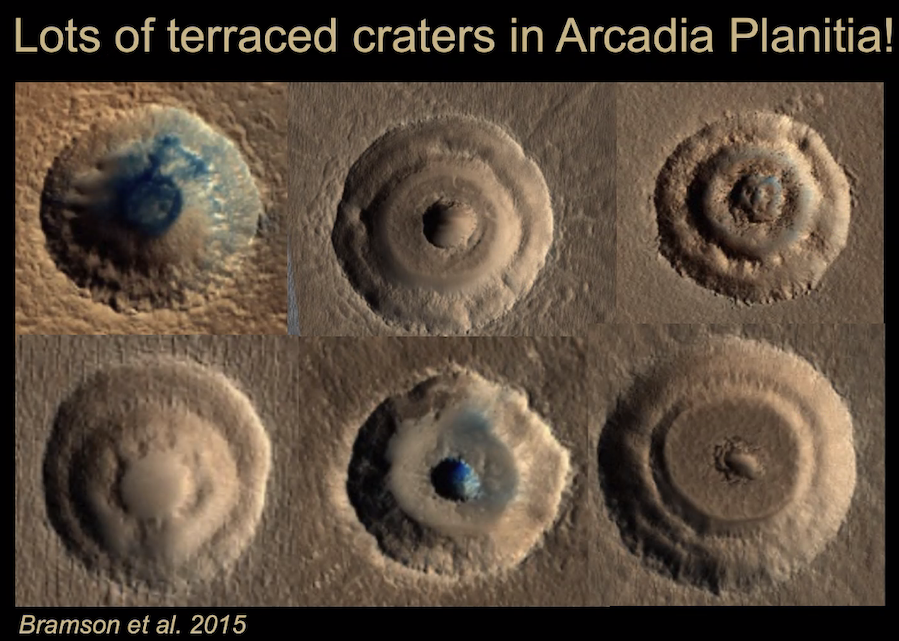
Terraced craters in Arcadia Planitia. [Slide by Ali Bramson]
To close out the Mars portion of the talk, Bramson emphasized that studying ice on Mars is critical for constraining the planet’s climate; understanding its habitability, especially in terms of its water budget; and enabling future human explanation. She concluded with a brief detour to the Moon, where her team works to understand the extent of a different buried material: ancient lava flows that created the dark areas on the Moon’s surface. Using radar, Bramson’s team has shown that the buried lava flows are three times more extensive than thought, which important for our understanding of the Moon’s past volcanism.
2026 DPS Alexander Prize: Titan: Ingredients for Life, Catherine Neish (University of Western Ontario and the Planetary Science Institute)
Catherine Neish was awarded the 2026 Claudia J. Alexander Prize in Planetary Sciences for “her scientific, leadership, and collaborative contributions to planetary science.” Neish’s topic was Titan, the only moon in our solar system with a dense atmosphere, and an intriguingly Earth-like one at that. Titan’s thick atmosphere is rich in nitrogen, and reactions between nitrogen, methane, and incoming photons create a smoggy blend of organic compounds.
Our understanding of Titan’s atmosphere and surface has evolved dramatically since 1944, when Gerard Kuiper discovered the moon’s atmosphere and saw that it contained methane. When Voyager 1 paid a visit in 1980, it found that the atmosphere was rich in nitrogen, expanding our understanding of Titan’s atmospheric chemistry, but the spacecraft carried no instruments capable of peering through the atmosphere to the surface. Finally, starting in 2004, the Cassini–Huygens mission revealed Titan as a strangely Earth-like world, with sand dunes, bright plains, lakes, and a young, weathered surface relatively unmarked by impact craters.
Thanks to Voyager and Cassini, Neish said, we now know that Titan has all the ingredients needed for life: an energy source (mainly the Sun), the necessary elements (carbon, hydrogen, nitrogen, and oxygen), and a solvent. Titan actually has two plausible solvents: liquid methane and water. Liquid methane likely makes a poor solvent for the chemical reactions necessary for life, and any life that relies on methane would be so different from life as we know it that we might not even know what to look for. Water, on the other hand, we know to be a great solvent — but on Titan it’s frozen hard as rock.
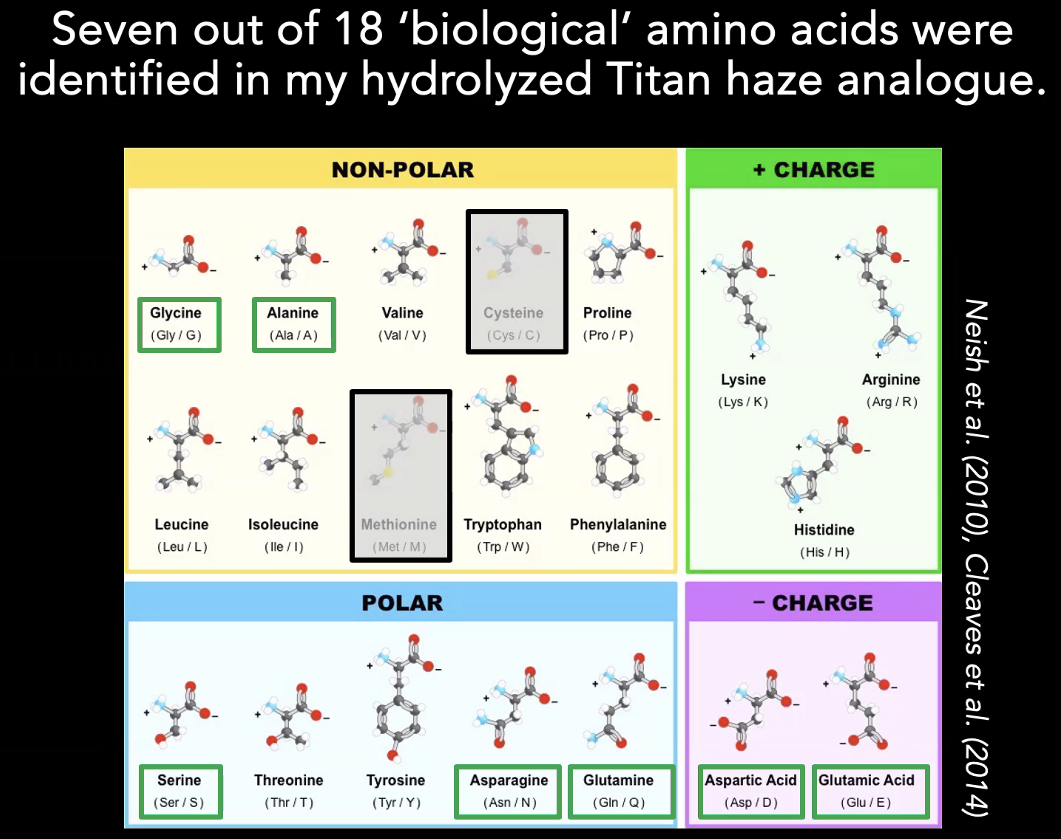
Amino acids produced by mixing lab-grown Titan haze particle analogs with water. The two amino acids that are grayed out contain sulfur, which makes them unlikely to form on Titan. Click to enlarge. [Slide by Catherine Neish]
Energized by this finding, Neish was excited for a mission to Titan that could search for evidence of amino acid formation. But when the results of the decadal survey rolled out in 2011, a Titan mission didn’t make the list. After pivoting to work on impact melt of the Moon, Neish got a call from a colleague inviting her to work on a proposal for a new Titan mission. That mission — Dragonfly — is now scheduled for launch in 2028, with arrival at Titan in the mid-2030s. Dragonfly will touch down between dunes near Selk crater, a young impact crater near Titan’s equator, offering an opportunity to study a region where organic materials and liquid water might have mixed in the past.
2026 DPS Kuiper Prize: New Worlds — Legacy Processes, Mark Marley (University of Arizona)
Mark Marley was awarded the 2026 Gerard P. Kuiper Prize in Planetary Sciences for “outstanding contributions to the field of planetary science.” Marley centered this talk on processes that have been discovered and understood within the solar system, then extended to exoplanets and brown dwarfs, helping to place the planets in our solar system within the broader context of substellar worlds.
Marley focused on three processes: disequilibrium chemistry, clouds, and temperature inversions. Taking Jupiter as an example, Marley recounted the discovery of carbon monoxide in Jupiter’s atmosphere — a molecule that, under equilibrium chemistry, shouldn’t have been there. Researchers discovered that carbon monoxide was present because the mixing timescale on Jupiter was faster than the chemical equilibrium timescale, allowing carbon monoxide to be brought up high in the atmosphere.
Looking at this same process in brown dwarfs, Marley introduced Gliese 229B, the first unequivocal brown dwarf to be discovered. Gliese 229B is warmer than Jupiter but still quite cool, and it too has carbon monoxide in its atmosphere despite equilibrium chemistry saying it shouldn’t be there. Looking at a larger sample of brown dwarfs, researchers have mapped the presence of carbon monoxide as a function of effective temperature, using this relationship to understand how fast the atmospheres of these worlds are mixing as a function of temperature. This revealed changes in the depth of the convective boundary with temperature.
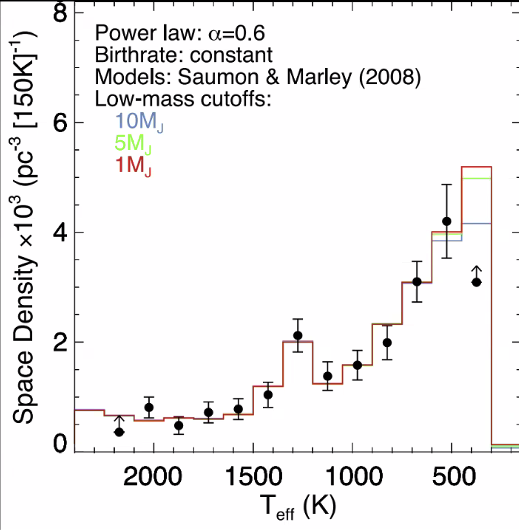
Observed space density of brown dwarfs as a function of effective temperature. There is a visible pileup of brown dwarfs at 1300K. [From slide by Mark Marley]
Marley briefly touched on the final topic by noting that brown dwarfs appear to have temperature inversions (a localized reversal of the trend of decreasing atmospheric temperature with increasing altitude), but without nearby stars to heat their upper atmospheres, it’s not clear why. A student of Marley’s is working to understand the source of brown dwarfs’ temperature inversions.
Marley concluded by reemphasizing that many processes have been discovered and explored in planetary atmospheres before being applied to exoplanet and brown dwarf atmospheres. Because of this connection between planetary science and substellar astrophysics, there are ample opportunities for human connections as well, bringing together planetary scientists and astronomers to advance our understanding of distant worlds.