
Editor’s Note: This week we’re at the 248th AAS meeting in Pasadena, CA. Along with a team of authors from Astrobites, we will be writing updates on selected events at the meeting and posting each day. Follow along here or at astrobites.com for daily summaries, or follow @astrobites.bsky.social on Bluesky for more coverage. The usual posting schedule for AAS Nova will resume on 22 June
Table of Contents:
Plenary Lecture: Ian Roederer, The Ultraviolet Path to the Origin of the Elements (by Susanna Kohler)
When the universe first formed, the only elements present were the three lightest — hydrogen, helium, and lithium. Today, there are 118 confirmed chemical elements that make up the periodic table. So where did the heavier elements come from, when were they first created, and what can they tell us about the first stars that formed in the universe? In the final plenary of AAS 248, Ian Roederer (North Carolina State University) walked us through how ultraviolet observations are the key to understanding the origin of the elements.
We know that hydrogen, helium, and lithium were cycled through the earliest stars in the universe, where fusion and other processes produced the first heavy elements that were spit back out into the cosmos when these stars ended their lives as supernovae. According to Roederer, within just the first two or three generations of stars, every element with stable or long-lived isotopes had already been created. For the heaviest of these elements, the dominant source is likely a process called r-process nucleosynthesis, in which a rapid burst of neutrons bombards atomic nuclei, resulting in the quick capture of the neutrons to form very massive nuclei that subsequently decay to stable isotopes.
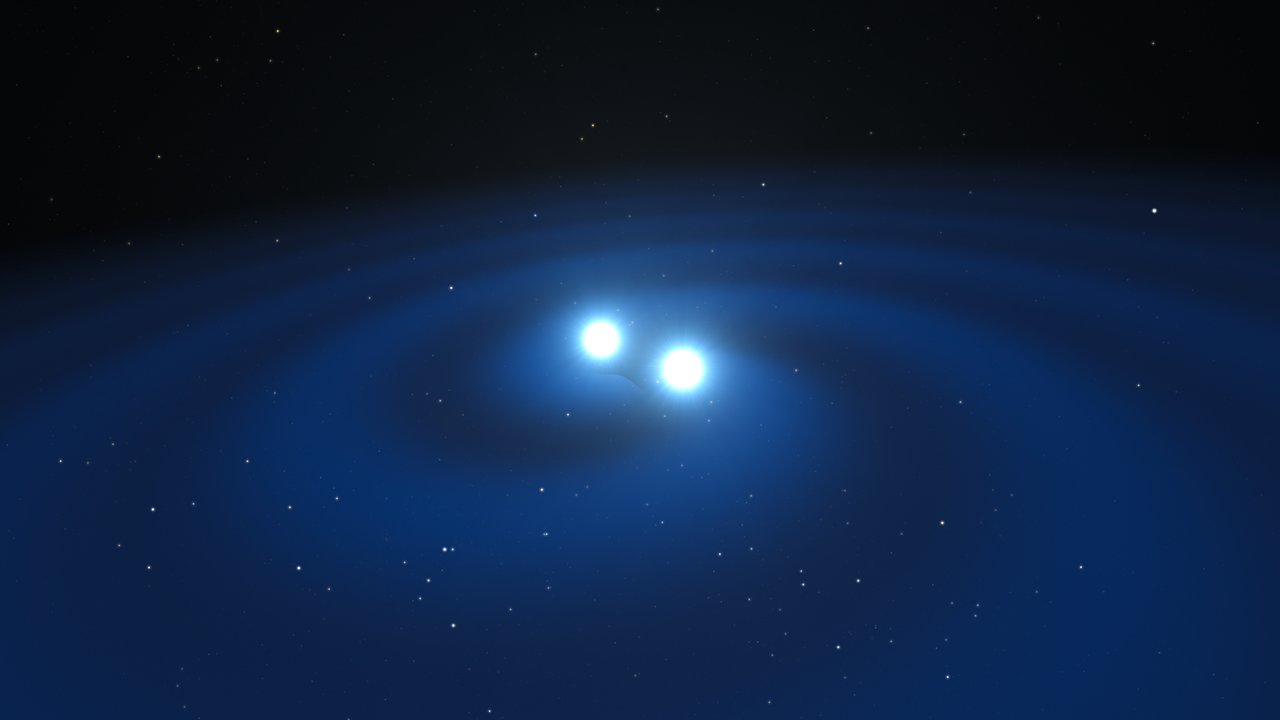
Illustration of two neutron stars approaching a merger, emitting gravitational waves as they draw closer together. [ESO/L. Calçada/M. Kornmesser; CC BY 4.0]
But remember all those news headlines about how binary neutron star mergers produce gold and platinum? Roederer points out that these were all inferred results — we didn’t actually observe direct evidence of gold and platinum in the aftermath of this explosion. That’s because it’s very difficult to detect the spectroscopic emission lines of heavy elements. To do so effectively, Roederer argues, requires high-resolution ultraviolet (UV) spectroscopy. He showed that in a cool star, high-resolution UV spectra provide a 50% increase in the number of elements you can detect. The heaviest of elements are only detectable with spectra in the UV range.
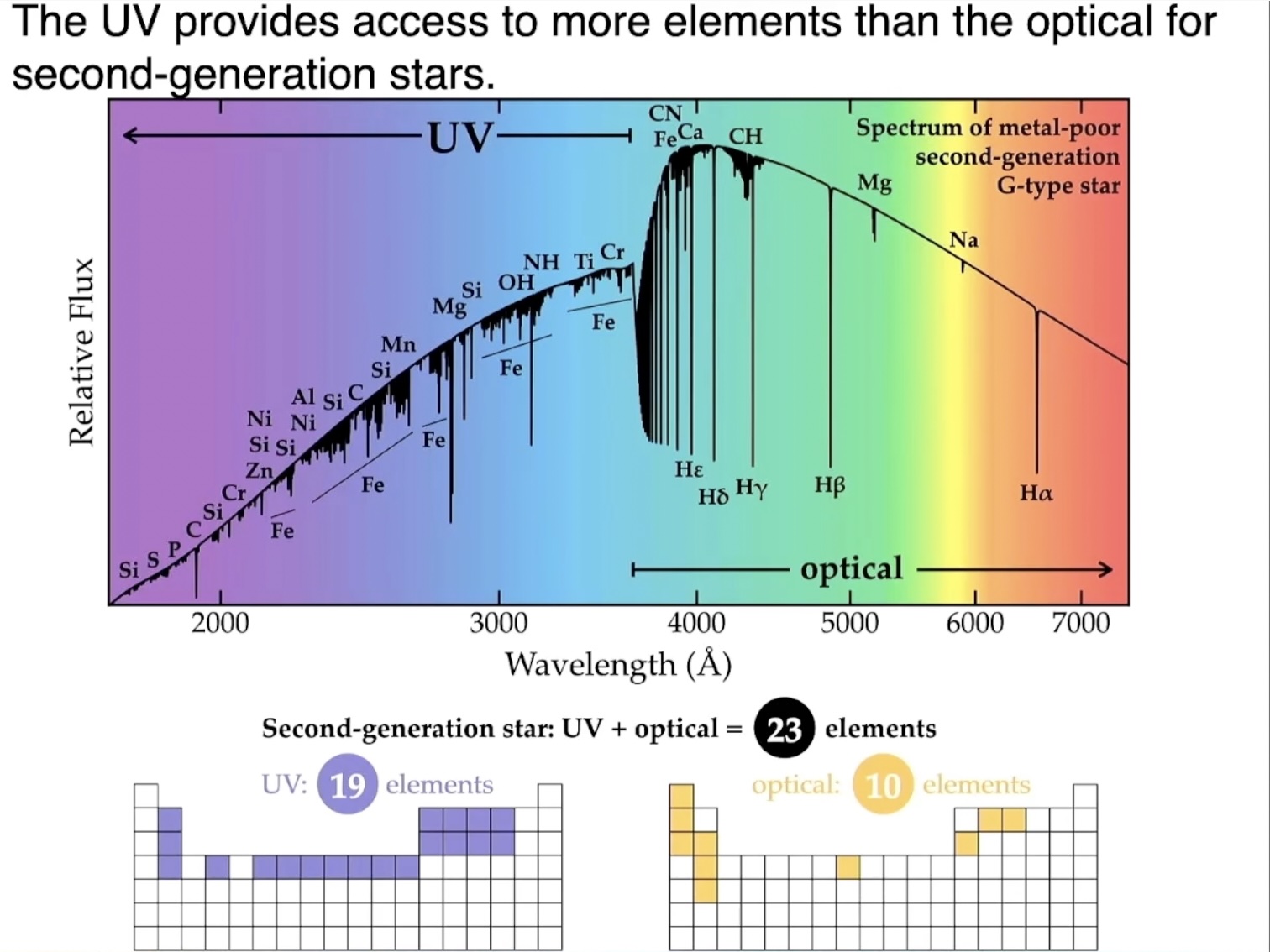
An example spectrum for a second-generation star shows how the UV is critical for identifying a broad range of elements. [Roederer 2026]
Roederer ended his talk with a look ahead at the future of UV spectroscopy and the path to the universe’s first stars. Right now, the only mission we have that produces high-resolution UV spectroscopy is Hubble. NASA’s next big flagship mission with a high-resolution spectrograph, the Habitable Worlds Observatory (HWO), will be transformational in the ability to detect — or verify the absence of — heavy elements in stellar atmospheres. An observatory like HWO will provide our best shot at identifying low-mass, metal-free stars that survive from the first generation of stars in our universe. As Roederer concluded, “The future of studying the origin of the elements is bright in the UV.”