
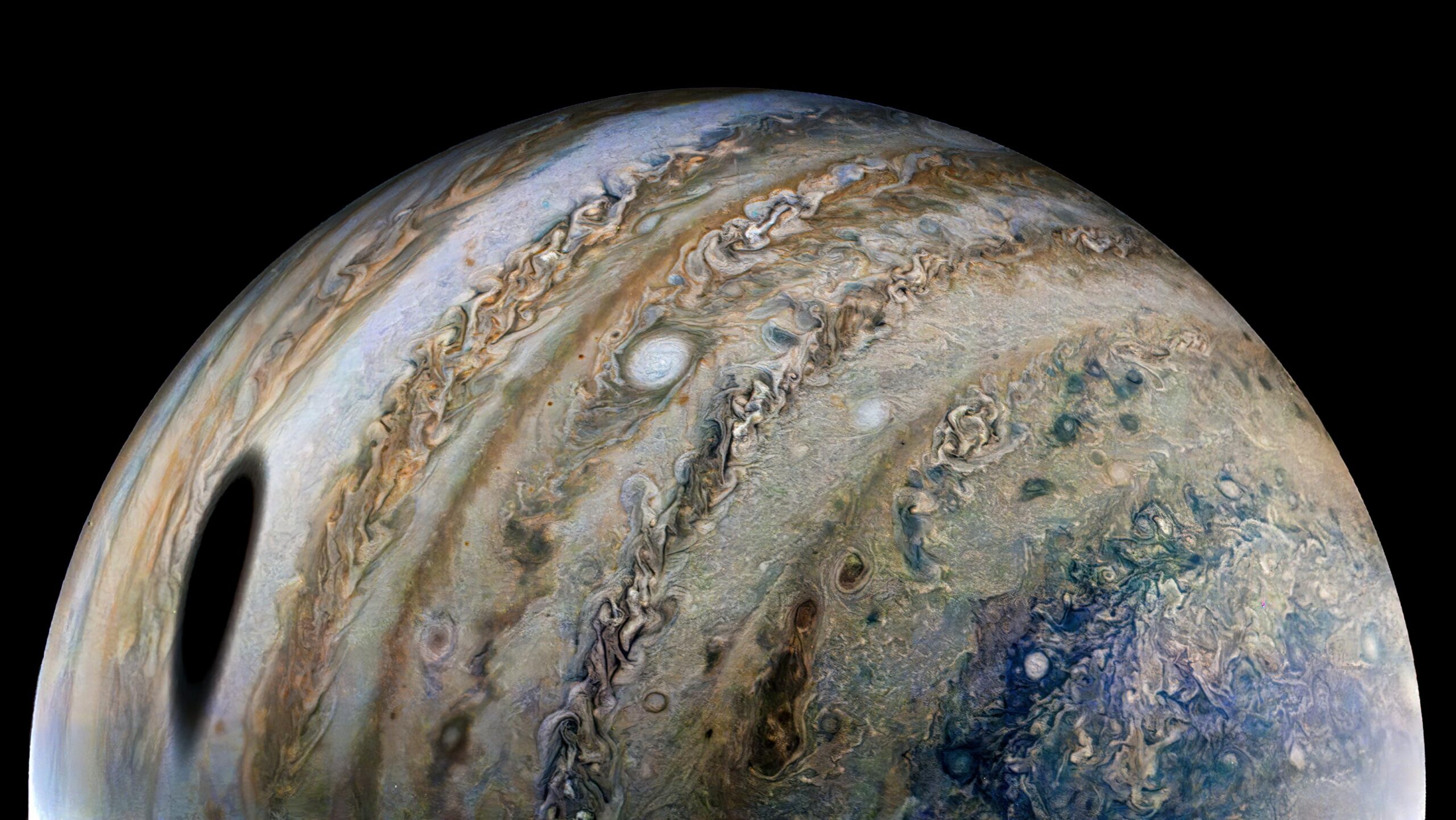
Jupiter’s upper atmosphere is hundreds of degrees hotter than it has any right to be, and for decades astronomers could only study it in brief, seemingly chaotic glimpses. New global maps built from years of observations have finally revealed the big picture — and it is surprisingly calm.
Order from Chaos
Although we’re well acquainted with Jupiter, having sent eight spacecraft on close passages and lived with it dominating the night sky for millennia, some of its simplest characteristics continue to puzzle us. For example, high above Jupiter’s cloud bands, temperatures exceed 800 K — far hotter than we’d expect given the meager sunlight that reaches that distance. Astronomers have long suspected that this excess is deposited by energy from the planet’s brilliant polar auroras, but previous observations provided only localized, sporadic snapshots that collectively painted a confusing picture of an ever-changing landscape.
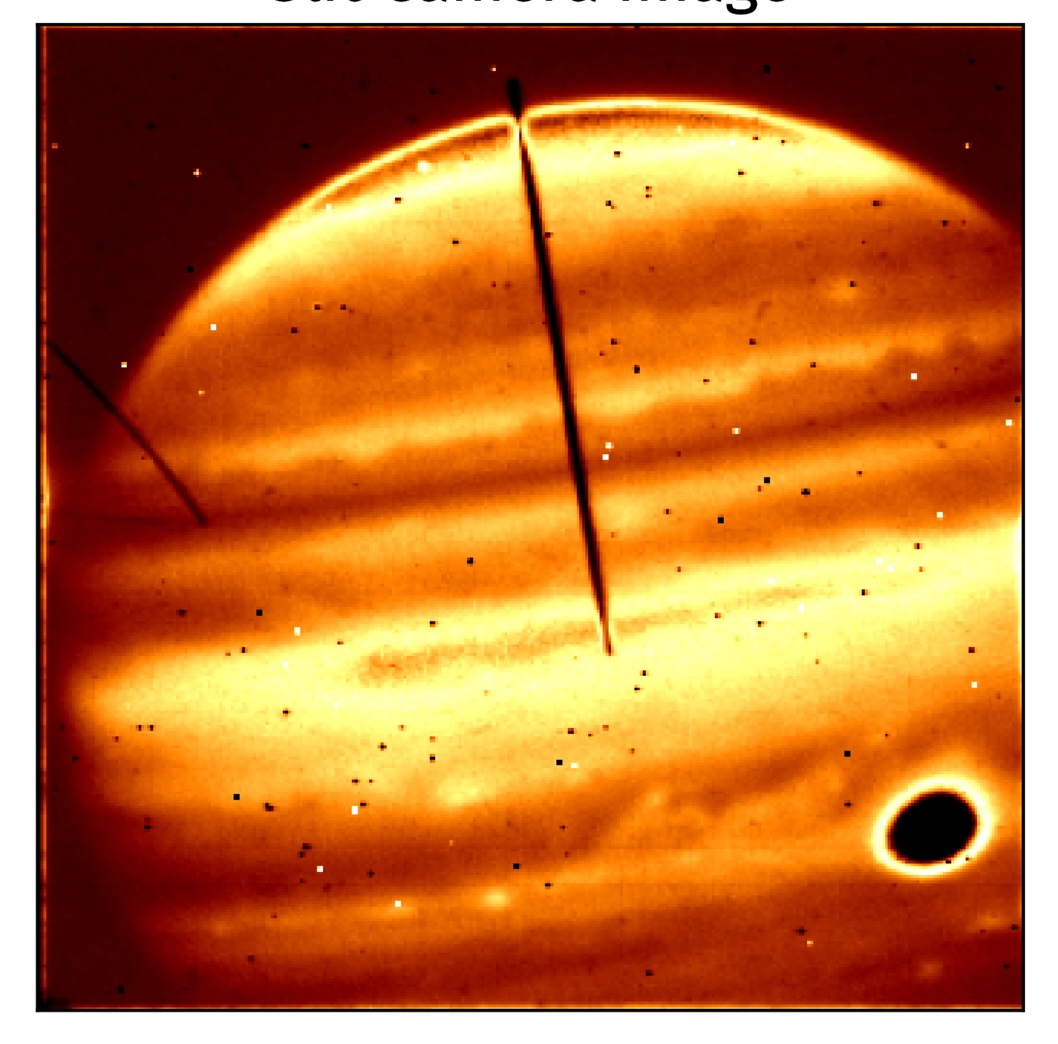
Jupiter as seen by the slit camera on the Keck telescope during one of the team’s observations. The spectrograph slit is the dark vertical band stretching from the equator to the north pole, and the Great Red Spot appears in black at the lower right. [Adapted from Roberts et al. 2026]
Consistency is Key
A look at how the maps evolved over time revealed striking order: the spatial patterns remained nearly constant, and the temperatures barely changed even over years. In general, the team noted that temperature decreases smoothly from the auroral regions near the poles (~1,150 K) to the equator (~750 K) at every longitude, and that although there is some night-to-night temperature variation, things stay remarkably steady over the years-long baseline.
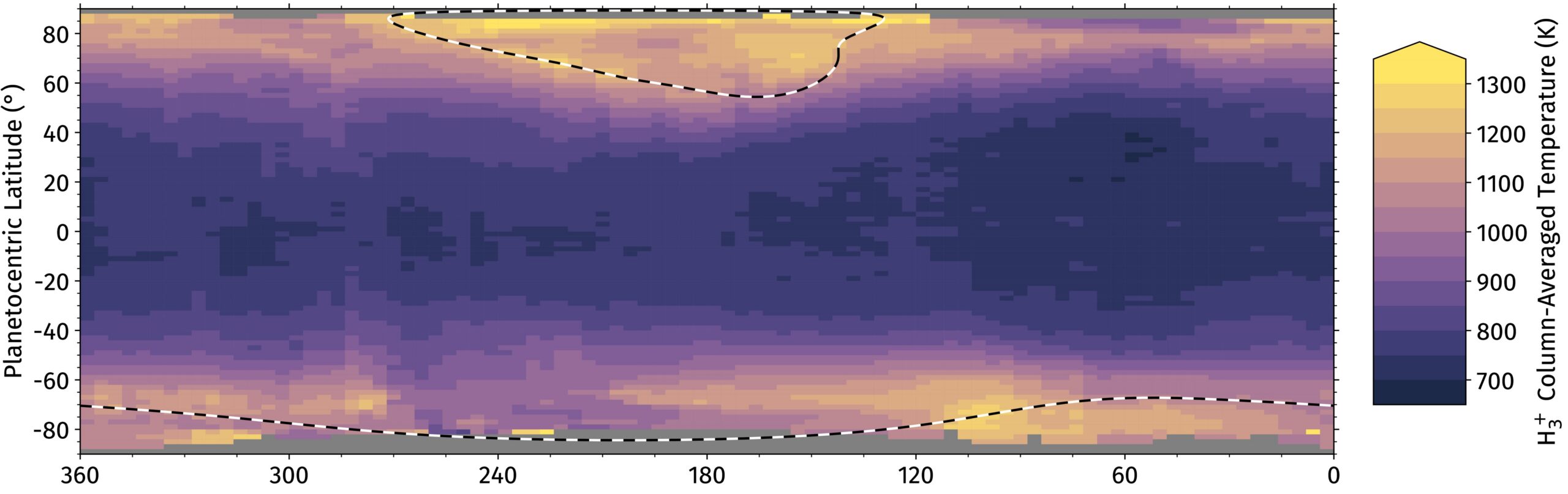
A map of the average temperature of Jupiter’s upper atmosphere, as measured by the new Keck NIRSPEC data. Click to enlarge. [Adapted from Roberts et al. 2026]
The conclusion that the upper atmosphere is complex but steady has implications beyond just Jupiter, as the team notes that JWST has already observed spatial patterns in the temperatures of the upper atmospheres of both Uranus and Neptune. As Roberts and colleagues note, “similar physical mechanisms could give rise to comparably stable structures” on those distant ice giants, meaning this analysis could ground our understanding of the upper atmospheres of giant worlds across the solar system.
Citation
“A Global View of Jupiter’s Upper Atmosphere Through H3+,” Kate Roberts et al 2026 ApJL 998 L13. doi:10.3847/2041-8213/ae3c9b