
Editor’s Note: Astrobites is a graduate-student-run organization that digests astrophysical literature for undergraduate students. As part of the partnership between the AAS and astrobites, we occasionally repost astrobites content here at AAS Nova. We hope you enjoy this post from astrobites; the original can be viewed at astrobites.org.
Title: SIRIUS: Identifying Metal-Poor Stars Enriched by a Single Supernova in a Dwarf Galaxy Cosmological Zoom-In Simulation Resolving Individual Massive Stars
Authors: Yutaka Hirai et al.
First Author’s Institution: Tohoku University
Status: Published in ApJL
All of the elements in stars come from, well, other stars. Each star has its own unique makeup of elements, kind of like our own DNA. Just like genes passing down generation after generation, elements in stars can be passed down to newly forming stars after the previous generation has died. So, if you’re looking at the chemical makeup of a particular star, what you’re really seeing is all the elements that were created after another star in the region exploded (went supernova) and enriched the gas (that the new star formed from) around it with elements like oxygen, nitrogen, iron, and more.
Like genealogy for stars, astronomers can use stellar enrichment to work their way back from a star they observe to its potential predecessors. It’s a bit trickier for stars that have a lot of elements, dubbed “metal-rich” stars, because there’s no way to tell which star contributed what mixture of elements at what point in time. However, scientists have recently been observing “extremely metal-poor” stars, which are stars with only small amounts of elements like oxygen, nitrogen, or carbon. Because there are so few of these elements, it’s safe to assume that these stars formed out of gas that didn’t have many predecessor stars enriching it — in fact, astronomers are hoping to find stars that only ever had one ancestor, calling them “mono-enriched” stars. Finding a mono-enriched star would tell us exactly what elements were produced in the supernova — aka in supernova nucleosynthesis.
However, how many of these metal-poor stars are mono-enriched is unknown. Estimating this fraction could help researchers identify more of them. The authors of this study tackle this problem by examining how many might exist in dwarf galaxies and what kind of chemical signatures they could produce.
Simulating Mono-Enriched Stars
To do this, they simulate a dwarf galaxy with the hydrodynamic code ASURA and model the gas physics in the galaxy with CLOUDY. In this method, stars form once the density of hydrogen gas in a region exceeds a certain threshold at a temperature that is cool enough for the gas to clump together. Pockets of this simulated region are then randomly assigned a stellar mass from the initial mass function, and eventually explode, diffusing elements into the gas particles around it.
Finding Mono-Enriched Stars in the Simulated Stellar Haystack
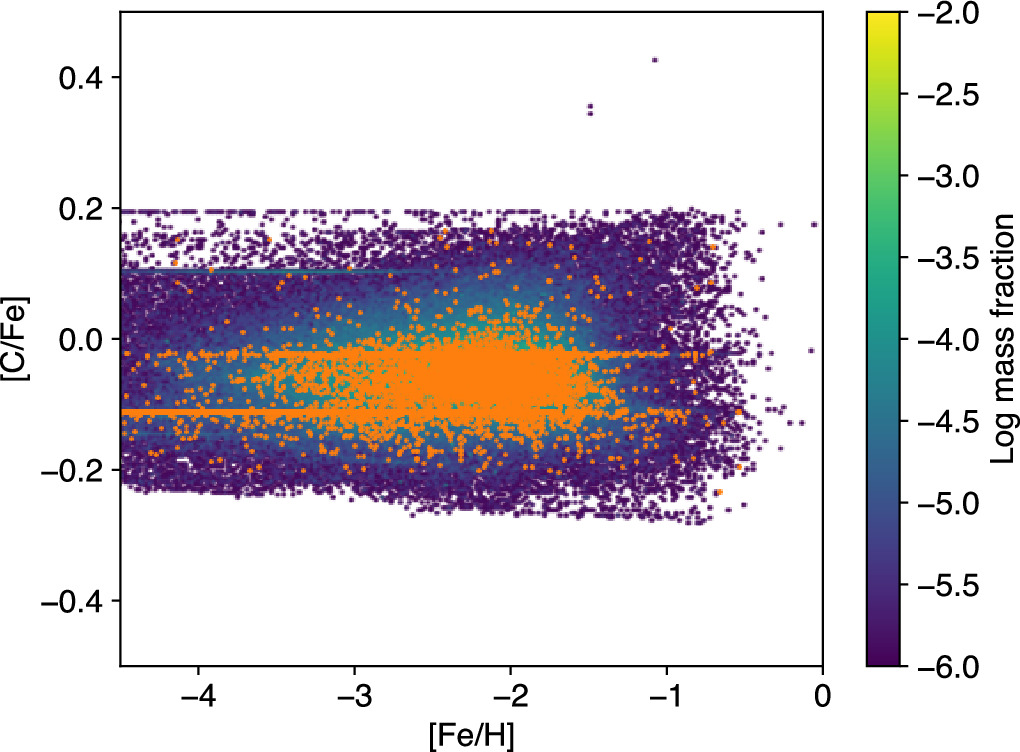
Figure 1: Every simulated star in the dwarf galaxy, shown as a function of their stellar metallicity, [Fe/H], carbon enhancement, [C/Fe], and their mass. Orange points are identified as mono-enriched stars. Click to enlarge. [Hirai et al. 2025]
Once these data points are collected, the authors investigate the fraction of mono-enriched stars at different metallicities. The authors essentially ask, are mono-enriched stars more likely to occur at lower metallicities? They find that, indeed, stars that are lower metallicity (and thus have lower [Fe/H]) are more likely to be mono-enriched (Figure 2). For stars with exceedingly low metallicities, [Fe/H] < −5, about 11% of them in this simulated dwarf galaxy have formed out of gas enriched by only one supernova.

Figure 2: Fraction of mono-enriched stars in the stellar population depending on the stellar metallicity ([Fe/H]) of the population. Stars with much lower metallicities ([Fe/H] < 2.5) are more likely to be mono-enriched. [Hirai et al. 2025]
Finding Mono-Enriched Stars in the Observed Stellar Haystack
These theoretical predictions help observers prepare what to look for when they want to find a mono-enriched star. These predictions seem to suggest that astronomers should keep looking for these extremely metal-poor stars if we want to find these unique stars that tell us about what elements are made in core-collapse supernovae. There is currently a decently large database of extremely metal-poor stars found with photometry, and if observers could follow up with the most ideal candidates spectroscopically we could really test what kind of elements are in these stars. Further, the upcoming Subaru Prime Focus Spectrograph will take many spectroscopic observations of close-by dwarf galaxies, which may contain more extremely metal-poor stars.
The authors note there is more work to be done in simulations, as they are interested in testing how extremely metal-poor stars, specifically ones with enhanced carbon, form. All of this will hopefully lead to a better understanding of how elements are made when stars explode, perhaps leading us to how some of the earliest elements formed in the early universe.
Original astrobite edited by Diana Solano-Oropeza.
About the author, Caroline von Raesfeld:
I’m a third-year PhD student at Northwestern University. My research explores how we can better understand high-redshift galaxy spectra using observations and modeling. In my free time, I love to read, write, and learn about history.