
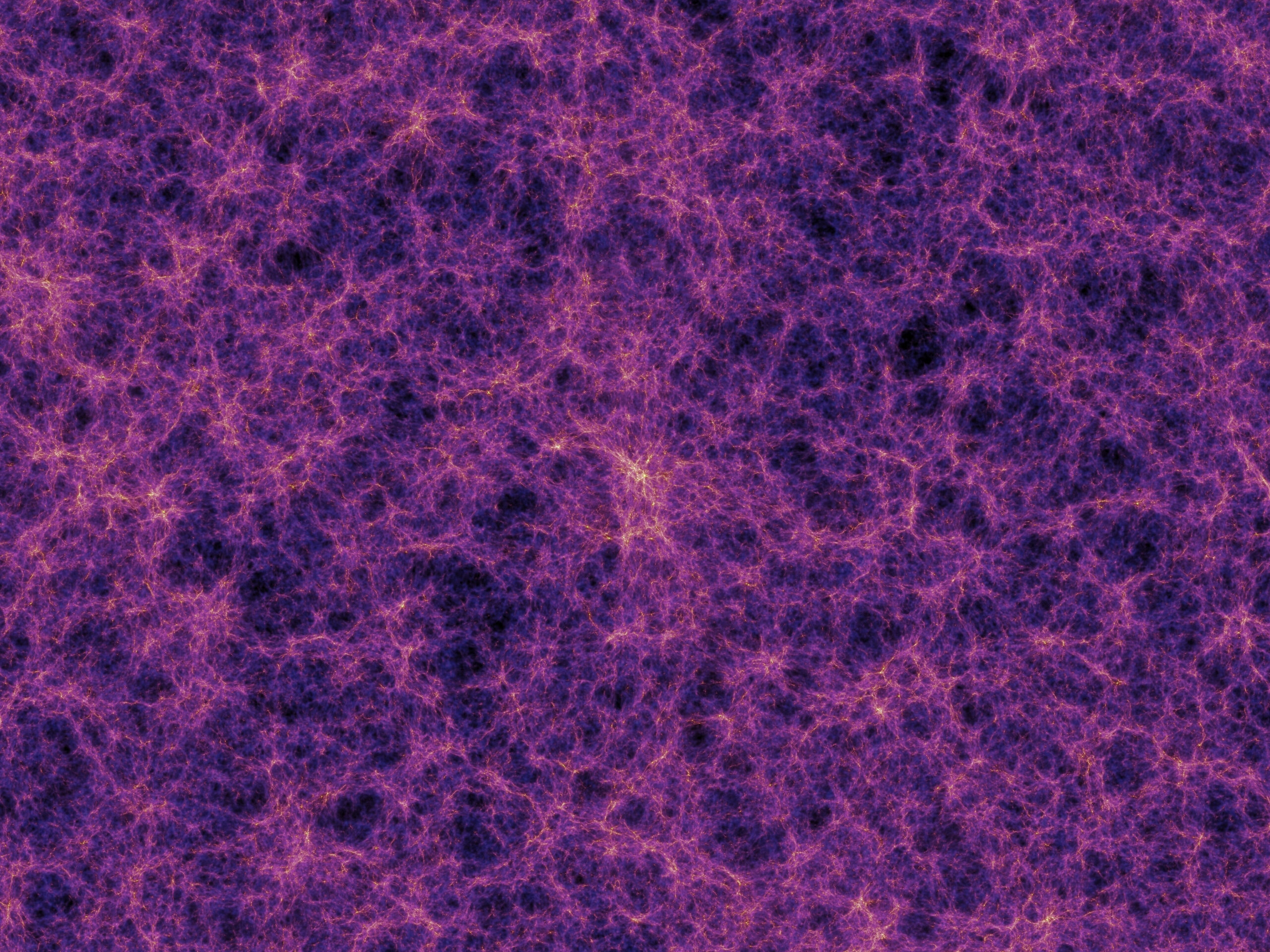
Equipped with newly refined algorithms and a high-resolution simulation of the universe, researchers may have uncovered a universal pattern in the density profiles of cosmic web filaments.
Pulling on Threads of Dark Matter
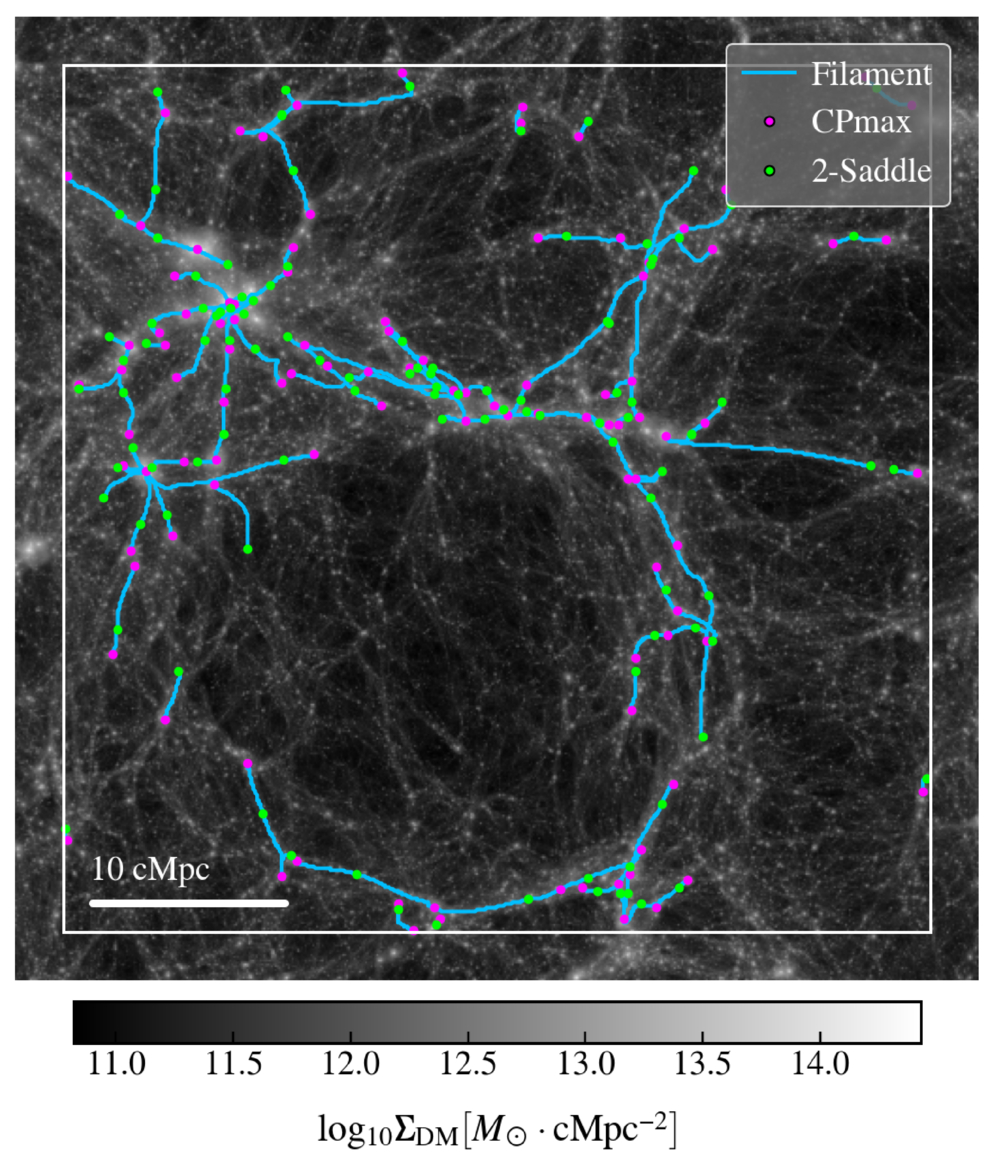
A density map from the TNG50-1 cosmological simulation, overlaid with lines highlighting the structure of filamentary arcs identified by the software package DisPerSE. [Xu et al. 2026]
While this basic picture is well understood, accounts conflict on how dark matter is distributed within cosmic filaments. Part of this confusion comes from the fact that even developing a reliable definition of a filament’s center can be harder than it appears. In DisPerSE, a software package commonly used for identifying structure in cosmological simulations, these centers are pinpointed using the properties of a smoothed dark matter density map generated from the simulations. This smoothing sometimes results in filament centers that are slightly offset from the position of true peaks in dark matter density, leading to incorrect density profiles near filamentary cores.
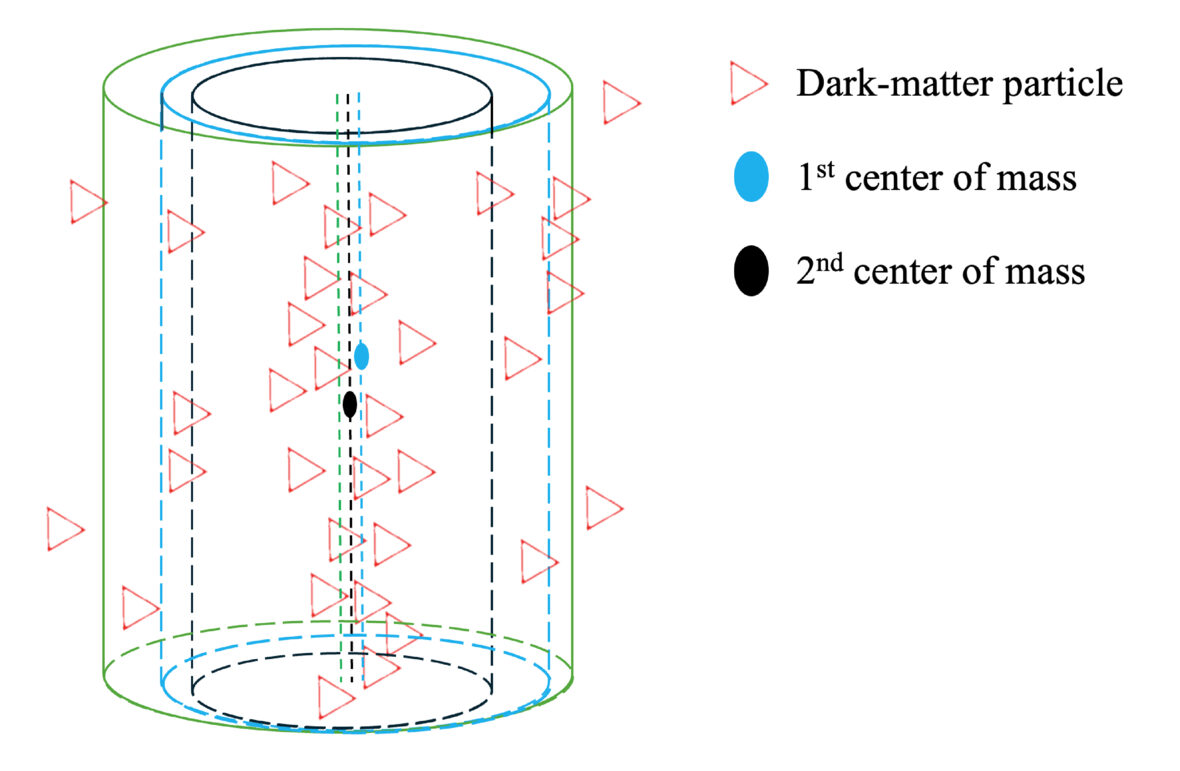
A visual depiction of the “shrinking cylinder” algorithm. By examining the center of mass of dark matter particles contained within increasingly small regions near inferred filament centers, a refined estimate of the center’s true position can be made. [Adapted from Xu et al. 2026]
Cosmological Cross-Stitch Patterns
In a new study led by Peng Xu (Peking University), a team of researchers refined the usual DisPerSE pipeline using what they call a “shrinking cylinder” algorithm. After accepting the usual filament-center estimates from DisPerSE, this algorithm examines the raw, unsmoothed distribution of matter around each filament segment. First, a large cylinder is aligned with a given filament segment, and the center of mass of the dark matter within this region is computed. Then, successively smaller cylindrical regions are drawn around each newly-identified center of mass until the spine of the filament converges on a stable location.
While it may seem like a small tweak, the researchers show it can have significant consequences for our understanding of filament structure. For example, in the team’s analysis of the TNG50 cosmological simulation, they find that dark matter density rises sharply toward cosmic filament centers — a feature that is easily washed out when relying on traditional implementations of the DisPerSE pipeline. This rise is primarily due to the presence of dark matter halos that cluster near the cores of filaments. After removing these halos from their analysis, the team found that the non-halo dark matter density does flatten near the center of filaments, but no longer as the result of poor filament centering.
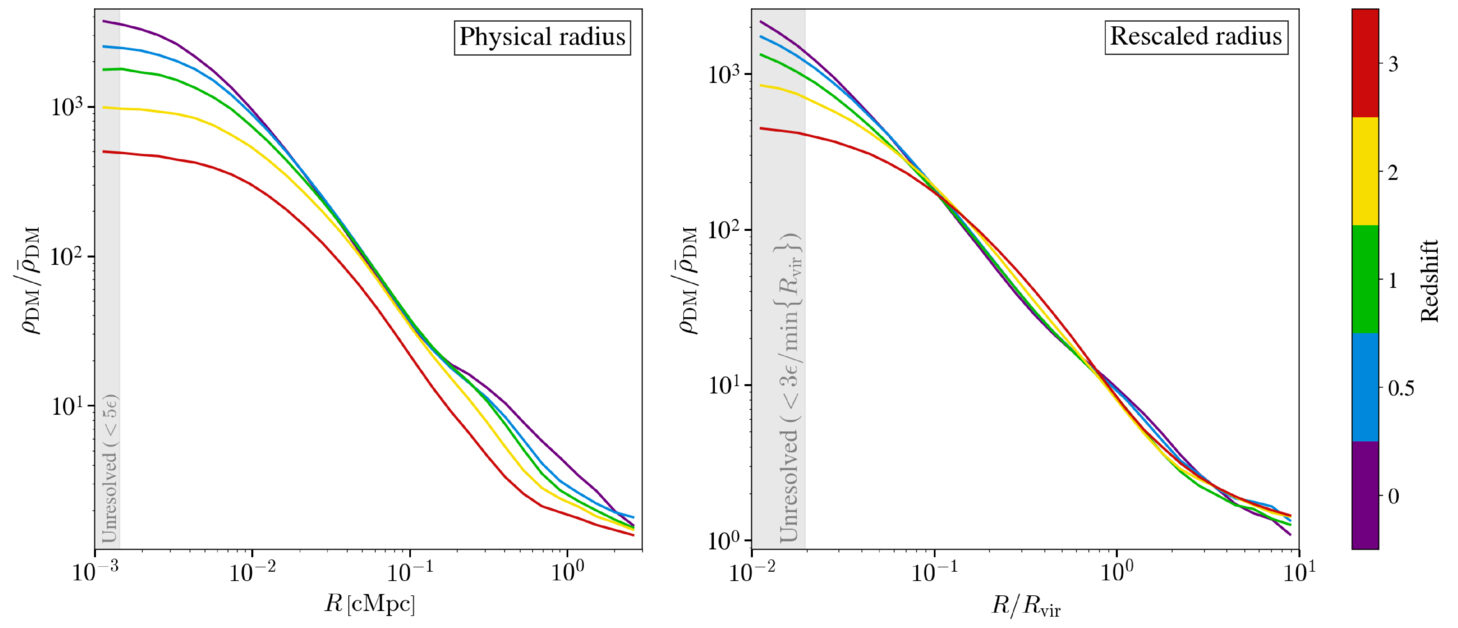
The relationship between dark matter density and distance from simulated filament centers across cosmic redshift. In the right panel, this relationship is scaled by the virial radius of each filament’s terminal node, revealing a near-universal relationship across all examined redshifts. [Adapted from Xu et al. 2026]
Citation
“Universal Dark-matter Density Profiles of Cosmic Filaments” P. Xu 2026 ApJL 1009 L26. https://doi.org/10.3847/2041-8213/aea298