
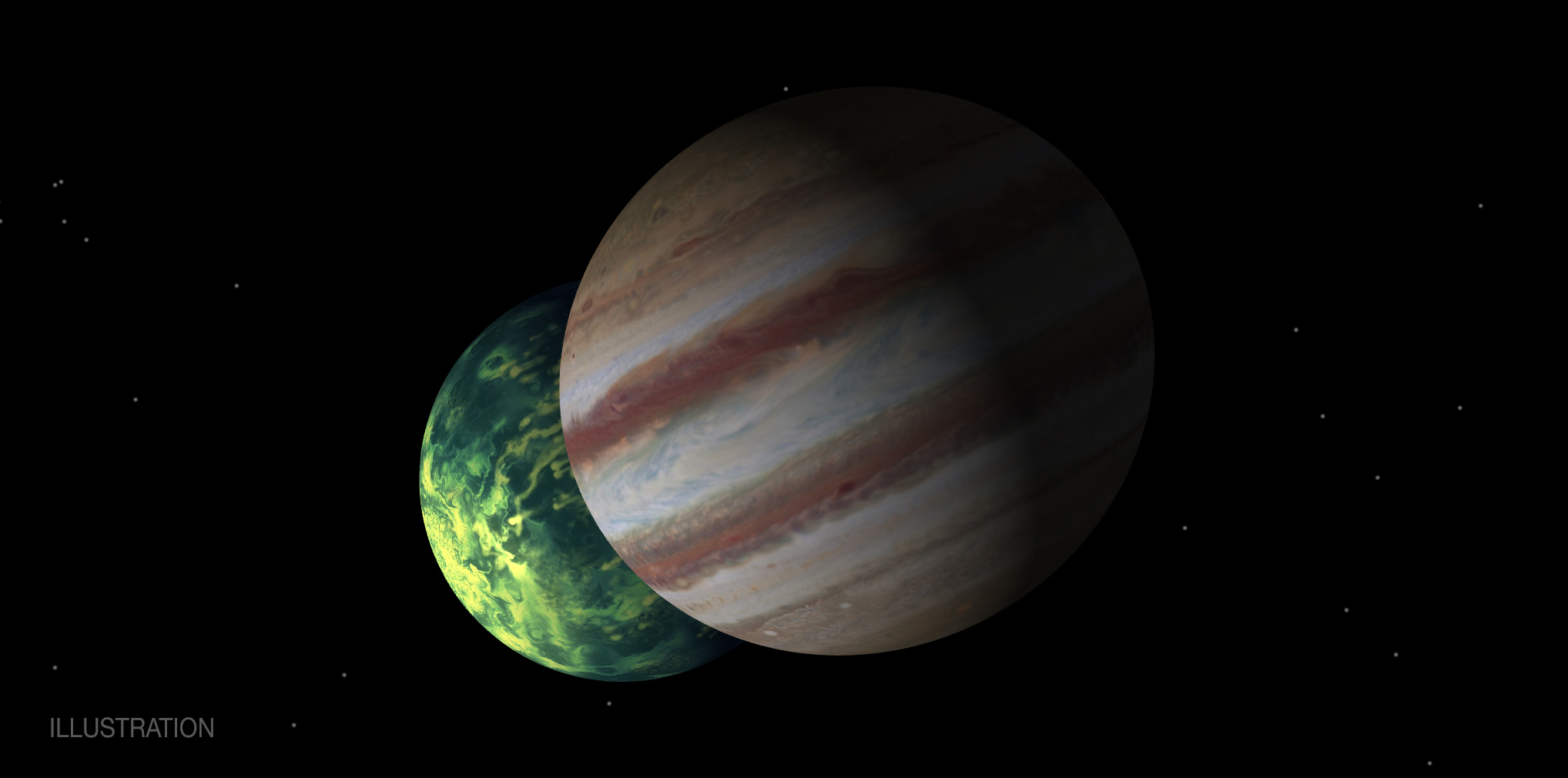
Of the nearly 6,000 currently known exoplanets, few closely resemble any of the planets in our solar system. New research suggests that JWST is capable of directly imaging exoplanets with temperatures and orbital distances similar to Jupiter and Saturn, placing truly familiar exoplanets within our observational grasp.
Increasingly Cold Discoveries
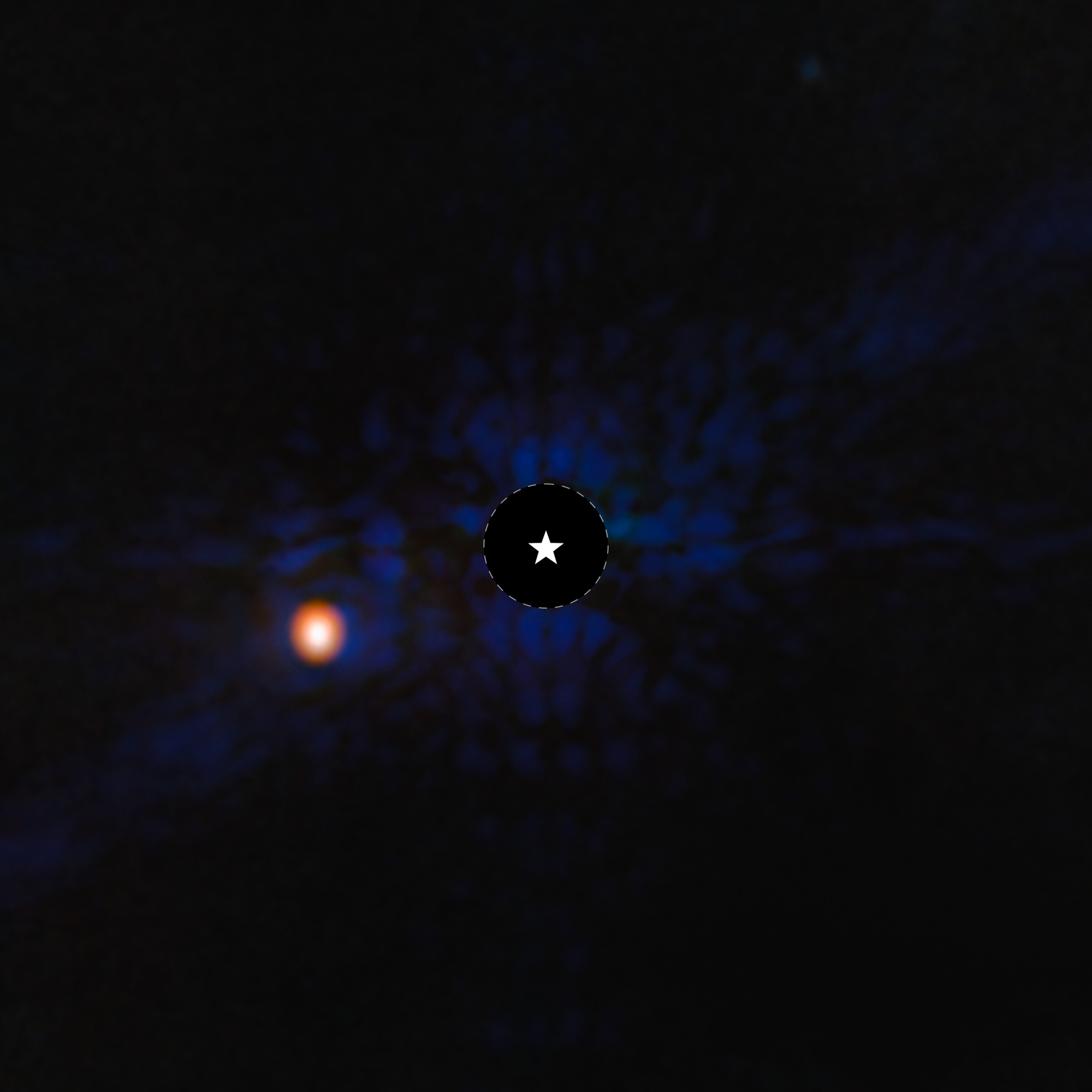
A JWST image of the exoplanet Epsilon Indi Ab, one of the coldest exoplanets to be directly imaged. The planet’s temperature is estimated to be just 275K (35℉/2℃). [NASA, ESA, CSA, STScI, Elisabeth Matthews (MPIA)]
Answering this question requires a deep dive into the abilities of JWST’s instruments. The current go-to method for directly imaging planets with JWST is coronagraphy with its Near-Infrared Camera (NIRCam). In this observing mode, the instrument blocks the light from the star, allowing the fainter thermal glow of the planet to shine through.
But as Rachel Bowens-Rubin (University of Michigan and Eureka Scientific) and collaborators note in a recent research article, this may not be the best way to detect cold giant planets. Models suggest that these planets have cloudy atmospheres, which means that they wouldn’t be bright at NIRCam’s preferred near-infrared wavelengths, and would instead be detected more easily in the mid-infrared, where JWST’s Mid-Infrared Instrument (MIRI) reigns.
Combining Data and Models
To examine the capabilities of both of these instruments, Bowens-Rubin’s team analyzed JWST observations from the Cool Kids on the Block program, which targets cold, low-mass giant planets around nearby low-mass stars with NIRCam coronagraphy and MIRI imaging. The team used observations of nearby M-dwarf stars Wolf 359 and EV Lac to construct constrast curves: the level of planet–star flux contrast that is detectable by each instrument as a function of distance from each star. These curves depend on the flux of the star and the planet as well as the limitations of the instrument — the detector noise and background noise.
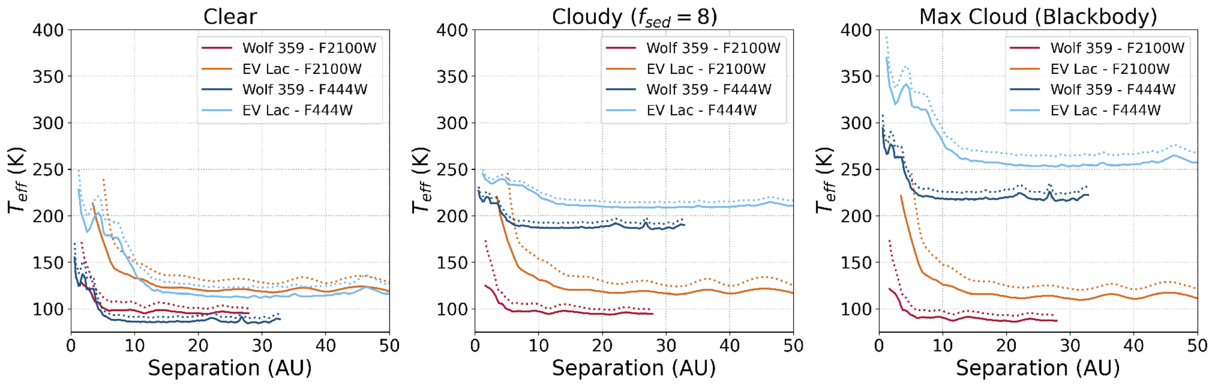
Temperatures of coldest detectable planets as a function of separation from the host star for Wolf 350 and EV Lac. Results are shown for MIRI F2100W imaging and NIRCam F444W coronagraphy. Click to enlarge. [Bowens-Rubin et al. 2025]
NIRCam vs. MIRI
This analysis showed that MIRI is the best choice for directly imaging cold planets around nearby stars (within 65 light-years). MIRI should be able to detect giant planets with temperatures down to 94K around Wolf 359 and 114K around EV Lac — about the temperature of Saturn and slightly colder than Jupiter, respectively. For Wolf 359, sub-100K planets are detectable at orbital distances of at least 4.8 au, meaning these planets could also have similar orbital separations to Jupiter and Saturn.
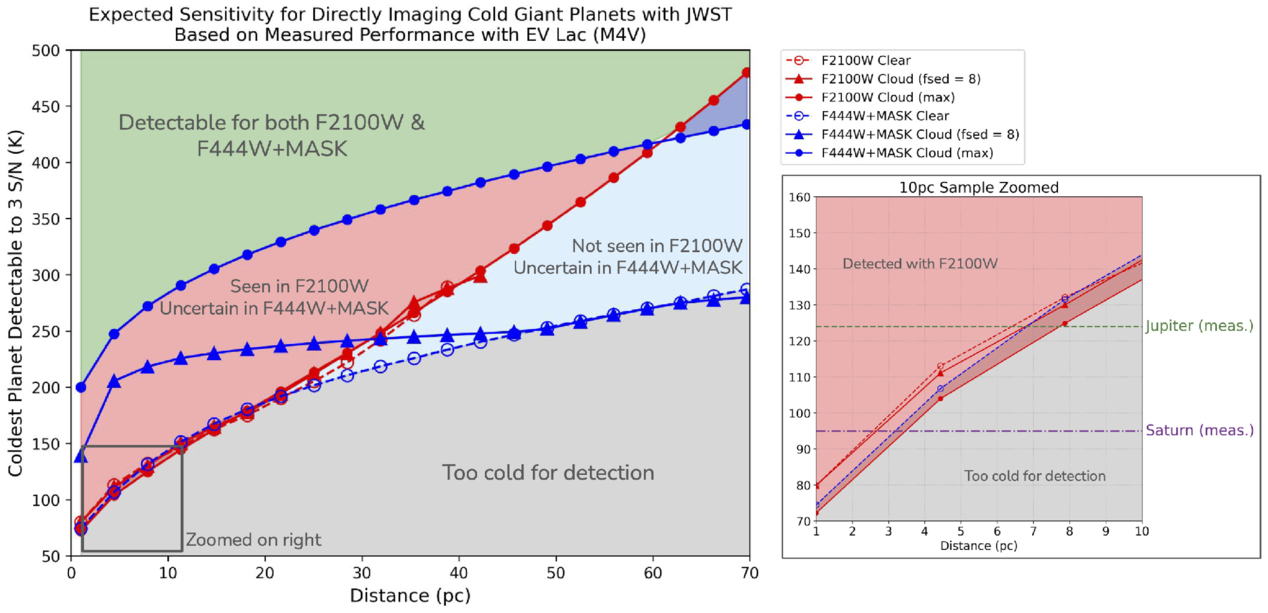
Temperatures of planets detectable to a signal-to-noise ratio of 3 as a function of distance from Earth. Detection limits for MIRI and NIRCam are shown as red and blue lines, respectively. Click to enlarge. [Bowens-Rubin et al. 2025]
As impressive as these results are already, Bowens-Rubin and coauthors noted that future work, such as developing strategies to mitigate MIRI’s “brighter-fatter effect” that limits sensitivity at small angular separations from the host star, could enhance the search for exo-Saturns and exo-Jupiters even further.
Citation
“NIRCam Yells at Cloud: JWST MIRI Imaging Can Directly Detect Exoplanets of the Same Temperature, Mass, Age, and Orbital Separation as Saturn and Jupiter,” Rachel Bowens-Rubin et al 2025 ApJL 986 L26. doi:10.3847/2041-8213/addbde