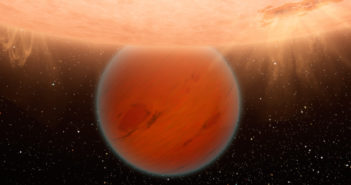
Grab Your Umbrellas, ’Cause It’s Raining Grazing Planets!
Astrobites reports on a method that uses umbrellas to model exoplanets that graze their stellar hosts.

Astrobites reports on a method that uses umbrellas to model exoplanets that graze their stellar hosts.
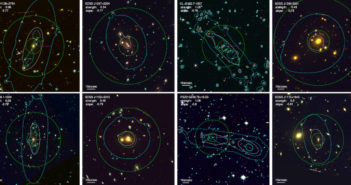
A survey of the largest gravitationally bound structures in the universe seeks to understand why some clusters are better gravitational lenses than others.

The brightness of the Sun’s corona could indicate when nasty space weather events are headed our way.
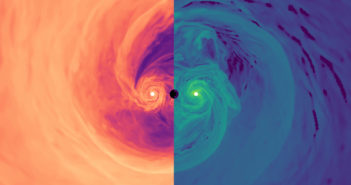
With gravitational waves from supermassive black hole mergers still out of reach, astronomers are exploring other ways to track them down.
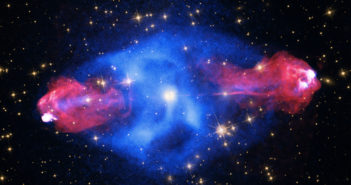
Astrobites reports on how magnetic fields in galaxy clusters evolved throughout cosmic history and what these fields can tell us about magnetism in the early universe.
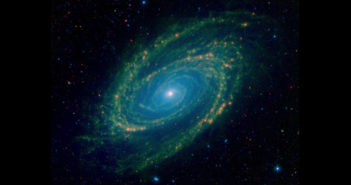
What can visible-light observations tell us about an unusual class of moderately luminous infrared transients?
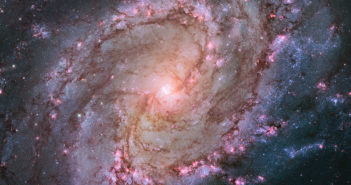
Astronomers study photons from the early universe to search for hard-to-find matter in Milky Way-like spiral galaxies.
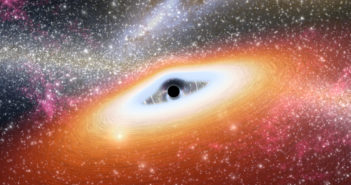
Extremely dense stars composed entirely of elementary particles called strange quarks might exist throughout the universe. Can gravitational waves emitted from an encounter with miniature black holes reveal them?
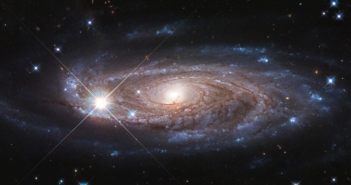
Astrobites reports on a spiral-shaped impostor found where an elliptical galaxy is meant to be: shining brightly in the center of a galaxy cluster.
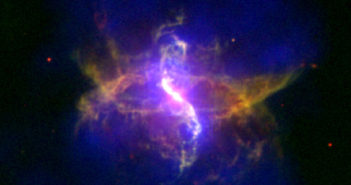
Close binary system R Aquarii dazzles in archival observations, revealing diffuse X-ray emission for the first time.

How do binaries with circular orbits get that way? A new study explores how waves inside stars can nudge an orbit to circularize.
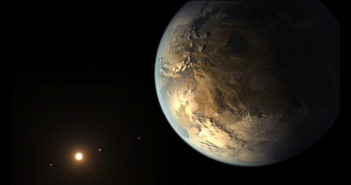
Dip your toes into the science of planetary surfaces with today’s article about oceans on water-rich exoplanets.