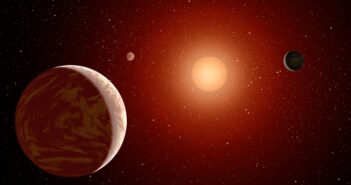
Siblings or Only Children: M-dwarf Planets
Astrobites reports on the differences between planets orbiting M dwarfs in single-planet and multi-planet systems.

Astrobites reports on the differences between planets orbiting M dwarfs in single-planet and multi-planet systems.
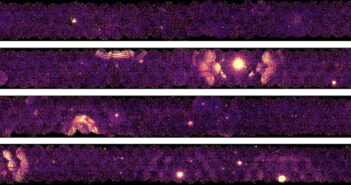
The first phase of a survey designed to discover faint X-ray sources in our galaxy is complete, resulting in the discovery of hundreds of new sources.
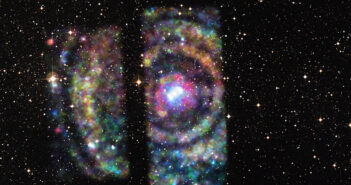
An investigation of a young neutron star in an X-ray binary system has led researchers to propose a new model that explains its complicated X-ray behavior.
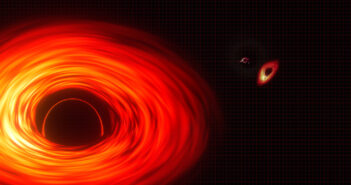
Between stellar-mass and supermassive black holes lie elusive intermediate-mass black holes. New radio data give insight into the nature of the promising intermediate-mass black hole candidate CXO J1338+04.
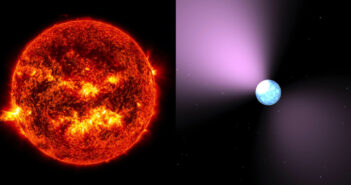
Astrobites reports on the far-out possibility of using continuous gravitational waves from faraway pulsars to learn about the inside of the Sun.
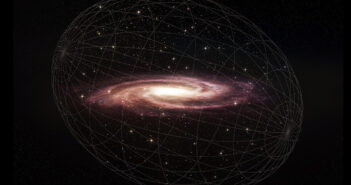
Can impact-tilted dark matter halos explain why so many spiral galaxies have warped disks?
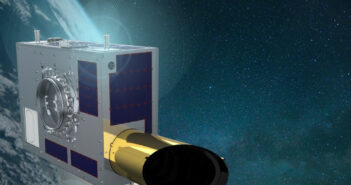
A recently discovered exoplanet required immense patience to uncover, both from an international team of astronomers and from a plucky suitcase-sized satellite.
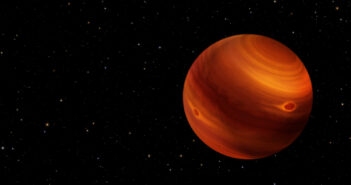
Researchers have taken another look at a peculiar brown dwarf, highlighting the challenges of studying these cool, cloudy objects.

Astrobites reports on the assumptions used in photoionization models that affect our understanding of ionized gas clouds surrounding hot stars.
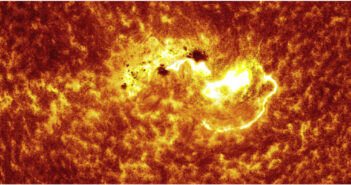
A new catalog of solar flares aims to understand why some flares are accompanied by massive explosions of plasma and others are not.

How precise will our measurements of neutron star sizes be when future gravitational wave observatories come online?
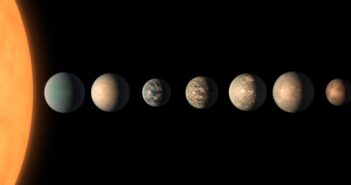
Five articles provide perspectives on the TRAPPIST-1 planetary system, from JWST’s first search for the innermost planets’ atmospheres to the prospect of detecting life, should it exist.