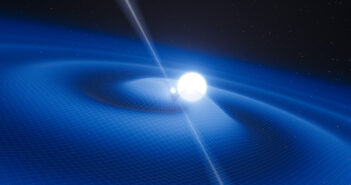
Making Computers Count Pulses
Fitting models to pulsar arrival times is typically a tricky business. A new algorithm might let computers take on some of the decision-making burdens.

Fitting models to pulsar arrival times is typically a tricky business. A new algorithm might let computers take on some of the decision-making burdens.
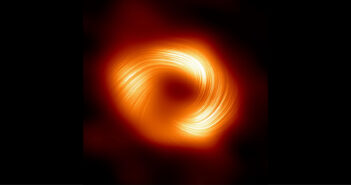
The Event Horizon Telescope Collaboration has analyzed data that show our home galaxy’s central black hole in a new light — polarized light, to be precise.
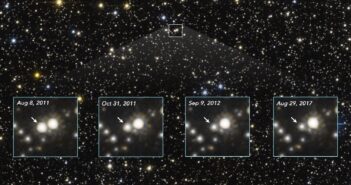
Astrobites reports on how we can find isolated black holes by searching for the twinkling of stars that these black holes pass in front of.
When white dwarfs begin to crystallize, can the change prompt the formation of magnetic fields millions of times stronger than Earth’s?
Are you an astronomy graduate student who’s interested in science communication? Apply for the AAS Media Fellowship by June 21!
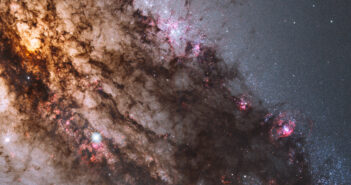
A new modeling technique lets black holes and their surroundings “talk” more easily, allowing researchers to simulate the complicated physics of accretion and feedback.
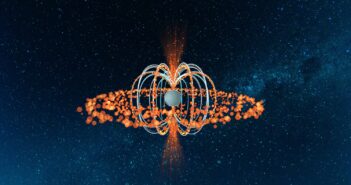
Astrobites reports on two objects whose unusually spaced-out radio pulses have puzzled astronomers. Could these objects be white dwarfs or magnetars?
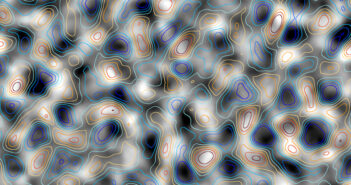
Researchers measure tiny distortions in the oldest light in the universe to determine where matter is concentrated.
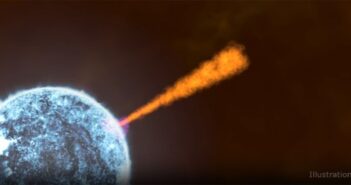
Massive stars are not typically inclined to go gentle into the good night. Some, new work suggests, might dramatically cut themselves in two using a “relativistic blade.”
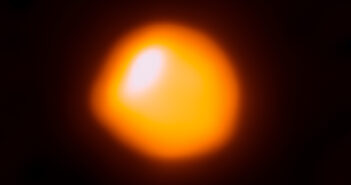
Three recent studies of the famous red supergiant examine the aftermath of the Great Dimming, probe the possibility of a stellar merger, and reconsider some critical evidence that suggests that Betelgeuse was once two stars.
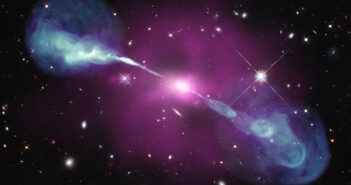
Astrobites reports on the changing-look active galactic nuclei seen in the first year of the fifth Sloan Digital Sky Survey.
A new interpretation of JWST spectra suggests that exoplanet K2-18b is a gas-rich world without a habitable surface rather than an ocean world.