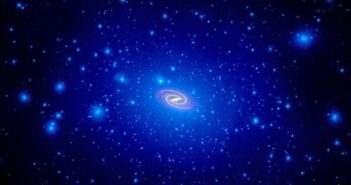
A Dark Matter Origin for Little Red Dots
Researchers examine whether the black holes at the centers of little red dots could have been born in the collapse of dark matter halos.

Researchers examine whether the black holes at the centers of little red dots could have been born in the collapse of dark matter halos.
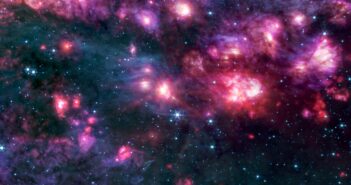
Researchers use an unlikely tool — distant beacons called quasars — to study the constant inflow and outflow of gas to and from our galaxy.
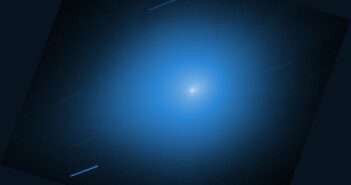
The discovery of interstellar comet 3I/ATLAS was one of the top astronomy stories of 2025. Though the comet is now heading back to interstellar space, research into its properties and origins continues.
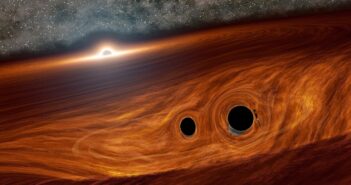
Astrobites reports on how active galactic nucleus disks might connect black holes across the mass spectrum, setting the stage for extreme-mass-ratio and intermediate-mass-ratio inspirals in the same system.

Hubble has revealed new features in Dracula’s Chivito, the largest known protoplanetary disk.
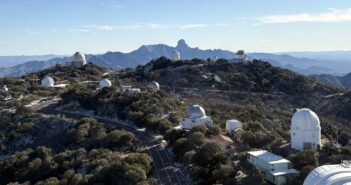
A mountain top in the Arizona desert scattered with telescopes, the Kitt Peak National Observatory is home to cutting-edge research and cultural connections.

Lasting multiple hours and featuring several bursts, GRB 250702B is a rare, powerful, and unusual gamma-ray burst. What do JWST observations tell us about the host galaxy and origins of this event?
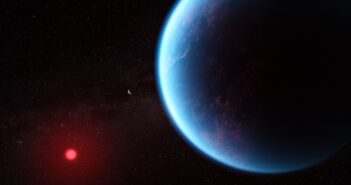
Astrobites reports on whether the low-density planets that keep popping up in our growing collection of exoplanets are really the water worlds that we imagine them to be.
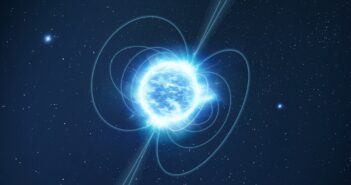
New research suggests that ultra-long-period pulsars might begin their lives as massive stars in close binary systems.
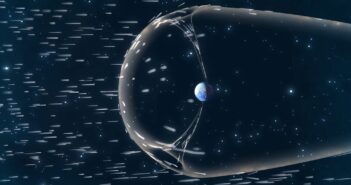
Though less destructive than coronal mass ejections, moderate space weather events like stream interaction regions can still cause geomagnetic storms. Researchers have used machine learning to investigate the drivers behind these events.
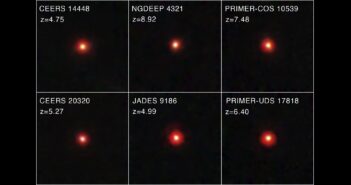
Astrobites reports on how astronomers got a closer view of the distant and mysterious little red dots.
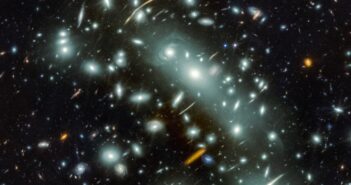
The CANUCS survey brought five galaxy clusters into focus, painting a portrait of galactic life in the early universe.