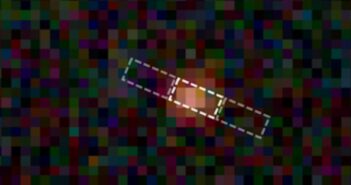
A Potential New Piece of the “Little Red Dot” Puzzle
Astrobites reports on an intriguing new object that may be an early universe supermassive black hole shedding its gas cocoon.

Astrobites reports on an intriguing new object that may be an early universe supermassive black hole shedding its gas cocoon.
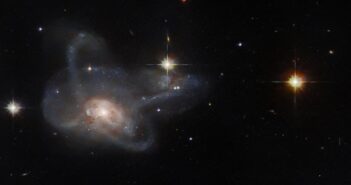
Researchers investigate the possibility that the off-center black hole and double nucleus of NGC 4486B can be traced to a recent supermassive black hole merger.
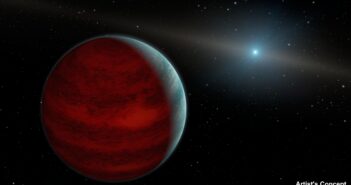
A recent study uses high-resolution JWST observations to perform an atmospheric analysis of a rare exoplanet orbiting a dead star.
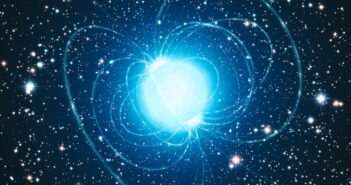
Neutron stars contain some of the most extreme matter in the universe, and researchers are exploring a promising but challenging way to probe their interiors.
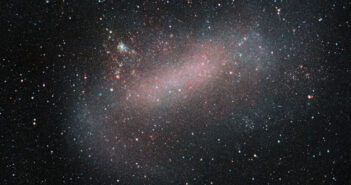
Astrobites reports on the detection of complex molecules around a protostar in the Large Magellanic Cloud.
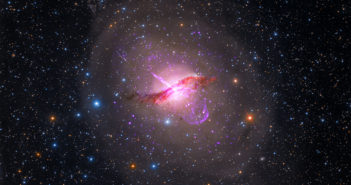
Jets, variability, and neutrinos: dive into three recent investigations of active galactic nuclei.
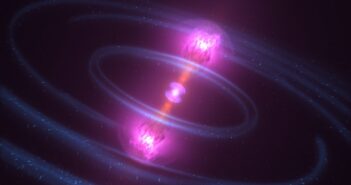
Hoping to find the second kilonova to be detected in both gravitational waves and light, astronomers ended up with a supernova instead.
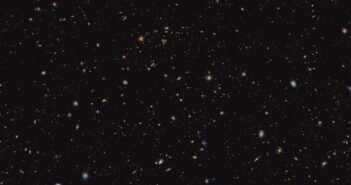
JWST’s mysterious little red dots may be evidence of black hole stars in the early universe.
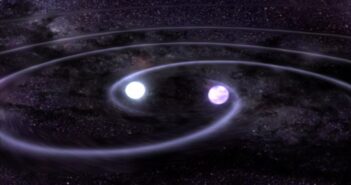
Astrobites reports on whether a distant companion in a triple-star system could push the inner binary toward merging into a remnant object that emits fast radio bursts.
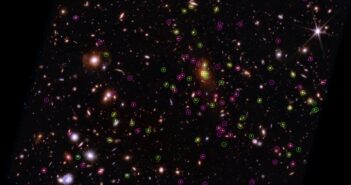
Observations of a galaxy cluster during the universe’s star-formation heyday give clues to the cluster’s history.
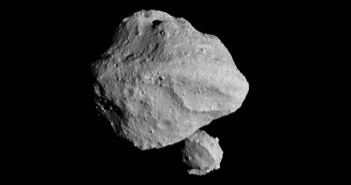
The Lucy mission has provided insights into the craters, boulders, and other surface features of the asteroid Dinkinesh and its small satellite, Selam.
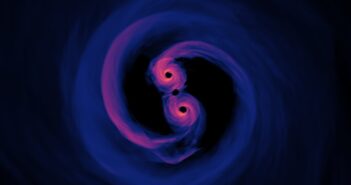
Astronomers search for spacetime ripples from a possible supermassive black hole binary at the heart of the elliptical galaxy 3C 66B.