Discovery of a New Super-Fast Rotator
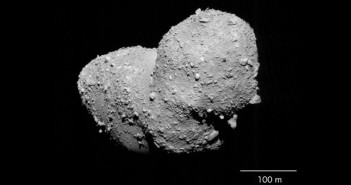
Recent observations of asteroid (335433) 2005 UW163 have added a new member to the mysterious category of “super-fast rotators” — asteroids that rotate faster than should be possible, given current theories of asteroid composition.
Asteroids come in sizes of a few meters to a few hundred kilometers, and can spin at rates from 0.1 to nearly 1000 revolutions per day. Current theories suggest that asteroids smaller than 150m are mostly monolithic (made up of a single rock), whereas asteroids larger than 150m are usually what’s known as a “rubble pile” — a collection of rock fragments from past collisions, bound together into a clump by gravity. “Rubble pile” asteroids have an important structural limitation: they can’t spin faster than once every 2.2 hours without flying apart as the centripetal force overcomes the force of gravity.
Asteroid 2005 UW163 violates this rule: its diameter is 690m, but it rotates once every 1.29 hours. This discovery was made by a team of scientists using telescopes at the Palomar Observatory in California to conduct a large survey of the rotation rates of nearby asteroids. The group, led by Chan-Kao Chang of Taiwan’s National Central University, discovered 11 super-fast rotator candidates — of which asteroid 2005 UW163 is the first to have its rotation rate confirmed by additional observations.
The category of super-fast rotators poses an interesting problem: how are they able to spin so quickly without flying apart? Either the density of these asteroids is unexpectedly high (roughly four times the density of typical “rubble pile” asteroids), or else there must be additional forces besides gravity at work to help hold the asteroid together, such as bonds between the rocks. Future observations of super-fast rotators will help us better understand the peculiar structure of these rocky neighbors.
Citation:
Chan-Kao Chang et al. 2014 ApJ 791 L35 doi:10.1088/2041-8205/791/2/L35