
Editor’s Note: Astrobites is a graduate-student-run organization that digests astrophysical literature for undergraduate students. As part of the partnership between the AAS and astrobites, we occasionally repost astrobites content here at AAS Nova. We hope you enjoy this post from astrobites; the original can be viewed at astrobites.org.
Title: High-Energy Neutrino Predictions for T Coronae Borealis: Probing Particle Acceleration in Novae
Authors: Prantik Sarmah, Sovan Chakraborty, and Xilu Wang
First Author’s Institution: Chinese Academy of Sciences
Status: Published in ApJL
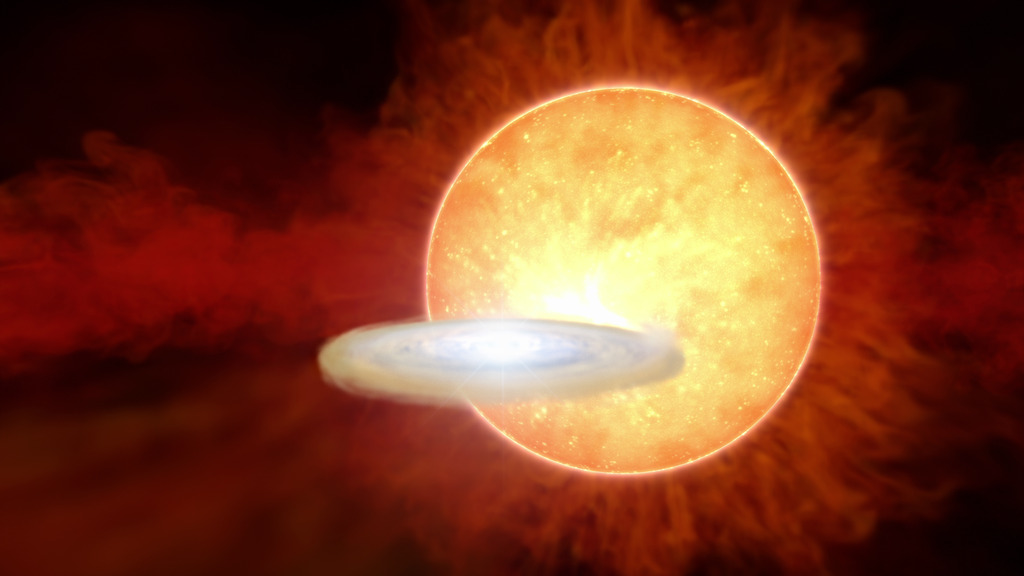
Since late 2024, the eyes of the world (or at least, a bunch of excited astronomers) have been on a particular binary star system: T Coronae Borealis, also known as the Blaze Star. Located 3,000 light-years from Earth, the system is thought to consist of an elderly red giant star locked in orbit around a compact white dwarf — a perfectly standard binary system in a Milky Way of millions, or so it seems. In fact, T Coronae Borealis (T CrB) is simply lying dormant, biding its time. Hidden in its depths is a steadily ticking alarm clock, and it’s just about time for its wake-up call…
Don’t Miss the Once-in-a-Lifetime Fireworks Show
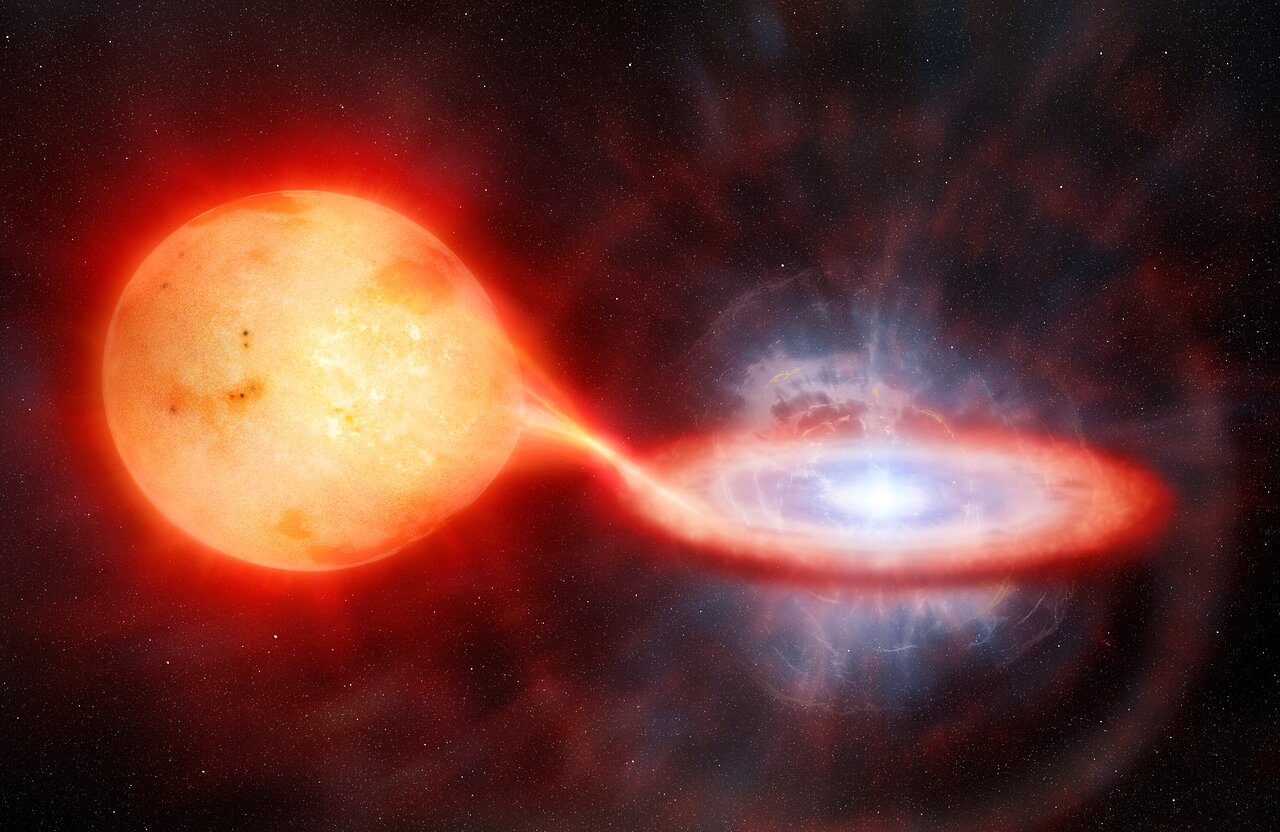
Figure 1: A visualisation of a recurrent nova. The red giant star (left) is accreting material onto the white dwarf (right), powering the brightening event. [International Gemini Observatory/NOIRLab/NSF/AURA/M. Garlick, M. Zamani; CC BY 4.0]
At the same time, this material will also collide with ambient particles in the surrounding space environment, leading to a rush of secondary high-energy particles from the event. This is particularly exciting as T CrB is practically in our local neighbourhood on galactic distance scales, giving us a reasonable chance of detecting these particles and gaining a rare view into the dramatically explosive processes that produce them.
A Watched Pot Never Boils
So that sounds great! Now we just have to wait for T CrB to wake up… and wait a bit more. In fact, the first predictions for T CrB’s big day were in early 2024, with subsequent dates set in 2025 and mid-2026. So far, T CrB has happily ignored all of these predictions, hitting snooze on each alarm and staying stubbornly asleep in its orbit. Aside from twiddling our thumbs and hitting refresh on the GCN alerts, is there anything we can do in the meantime?
Today’s authors have taken the opportunity to investigate some of the high-energy photons and particles that T CrB is expected to produce in the course of its explosion, focusing particularly on the very energetic gamma rays and neutrinos. In the process, they’ve found an exciting new tell that might just give us some warning when the system finally decides to get out of bed.
Past Performance Is an Indicator of Future Results
In order to probe T CrB’s emission, the authors simulated two possible mechanisms at play in the system: the external shock model, and the magnetic reconnection model. In the former, the fast-moving ejecta from the white dwarf collide with protons in the red giant wind, producing charged and neutral pions that decay into the gamma rays and neutrinos that make their way to Earth. In the latter, the strong magnetic fields that surround the white dwarf interact with each other, transferring energy into the protons near the white dwarf’s surface and flinging particles out into space.
Both models are thought to possibly be involved in particle emission from recurrent novae. To test this, the authors use Rs Ophiuchi (or Rs Oph) as a case study. Rs Oph is another recurrent nova that exploded back in 2021, leading to the detection of a bunch of high-energy gamma rays, but no neutrinos. The authors use the explosion from this system to build the credibility of their models, making sure they can reproduce the gamma-ray emission that was detected from the event.
They then proceed to apply both models to T CrB, taking into account propagation effects of the particles as they make their way to Earth, as well as the uncertainties in our knowledge of the system and the free parameters in the model that could influence the results. So what do they find?
External Shocks: Plenty of Gamma Rays, Not So Many Neutrinos
In Figure 2, the results of the external shock model are shown for both gamma rays (left) and neutrinos (right). The detection prospects for gamma rays are encouraging, with the expected events (solid red line) reaching well above the various detector sensitivities (solid/dashed black lines). However, the predictions for neutrinos are not so optimistic; comparing the neutrino detector sensitivities to the most likely emission (solid blue line), it’s clear that any neutrino detection would be very difficult. In the external shock scenario, then, it seems that we could expect to see a good portion of high-energy gamma rays, but no corresponding neutrinos from the T CrB outburst.
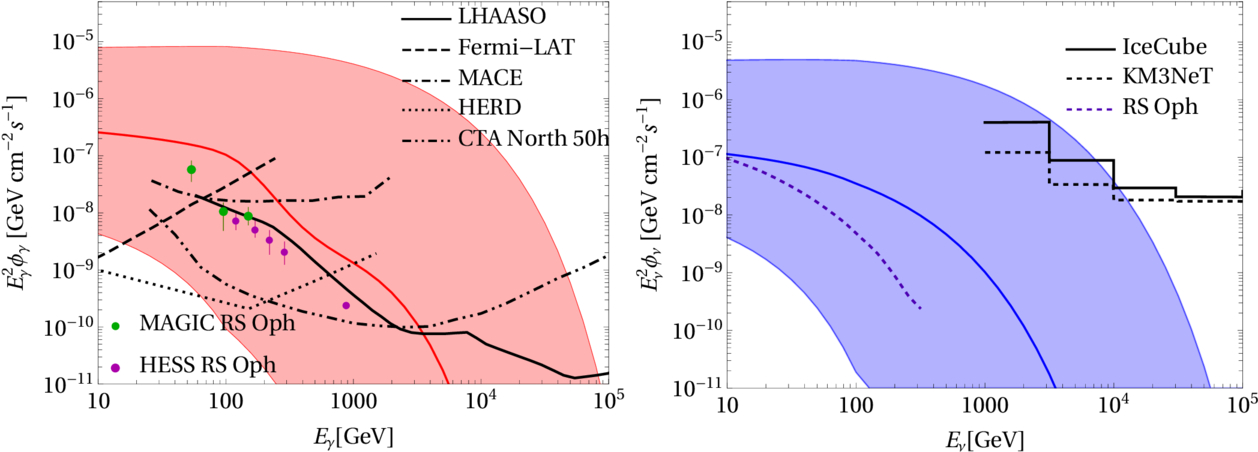
Figure 2: The simulated gamma-ray (left) and neutrino (right) emission expected from T CrB in the external shock model. The flux is shown on the y-axis for different energies shown on the x-axis. The solid red and blue lines indicate the expected flux, with coloured bands indicating the range of uncertainties on those fluxes. Both plots also show the sensitivities of different detectors, given in the top right; detections can be expected to occur when the flux is found above the detector sensitivity. Finally, the flux from Rs Oph is also shown: with green/purple points indicating gamma-ray detections on the left, and in a dashed purple line on the right, showing the neutrino flux as predicted by the simulated model for Rs Oph. [Sarmah et al. 2026]
Magnetic Reconnection: Trapped Gamma Rays and a Healthy Smattering of Neutrinos
In Figure 3, the same results are shown for the magnetic reconnection model, albeit for neutrinos only. While magnetic reconnection does produce gamma rays, the location of the mechanism — deep within the white dwarf winds — ensures that they will not be able to escape the dense ambient photon matter, and no gamma rays will make their way to Earth. Neutrinos, on the other hand, are not keen on interacting with other types of matter, which means that they will be able to slip past and escape the system. And, as shown in Figure 3, this leads to a much more favourable scenario for neutrino detection on Earth, where the expected emission (solid green line) almost reaches the neutrino detector sensitivities (solid/dashed black lines). It seems that there is a much higher chance, if magnetic reconnection does occur, that neutrinos will be detected from the T CrB event.
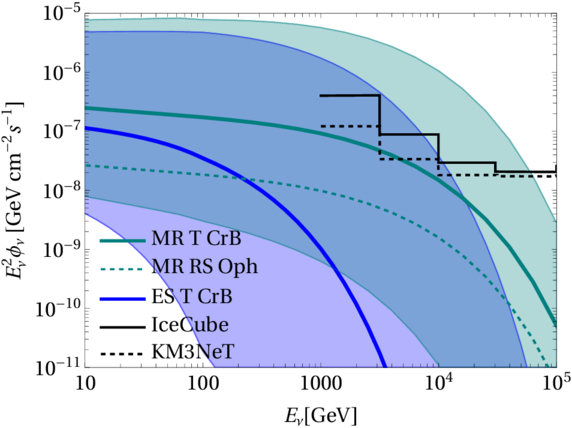
Figure 3: The expected number of neutrinos (solid green line) predicted to come from T CrB in the magnetic reconnection model. This is compared to the number from magnetic reconnection in the RS Oph scenario (dashed green line) and the number from the external shock model in the T CrB event (solid blue line, also shown in the right of Figure 2), with coloured bands indicating the simulation uncertainties. The sensitivity of two neutrino detectors (IceCube and KM3NeT) is also shown with black solid and dashed lines, and it can be seen that the magnetic reconnection model flux rises just above the KM3NeT experimental sensitivity. [Sarmah et al. 2026]
Turning Up Early for the Show
While these results already offer a lot of insight into the T CrB emission, there is another particularly exciting point here: namely, that the two emission mechanisms have separate, distinct signals. This means that the detections (or non-detections) of neutrinos and gamma rays should give clear evidence as to which, if either, of these two mechanisms is playing a role in the outburst.
But what happens if both occur? In this scenario, it is possible that gamma rays (from an external shock) and neutrinos (primarily from magnetic reconnection, and from an external shock) could be detected. But as discussed, the two mechanisms occur at notably different locations within the T CrB system, meaning that there would likely be a significant time delay between the neutrino and gamma-ray signals. In fact, the authors estimate that the neutrinos may arrive some 9 to 10 hours earlier — and this could serve as a very useful early warning that T CrB is about to wake up, giving us time to point as many telescopes as possible at the system, get out the popcorn, and wait for the fireworks to start.
Waiting and Wondering
As usual, there are a few caveats. For magnetic reconnection to occur, the T CrB white dwarf has to have a very strong magnetic field, but current evidence of magnetic fields of this strength among white dwarfs in recurrent nova systems is lacking. There are also a lot of uncertainties in the model — as shown in both figures — which could, for example, ensure that the neutrinos are in reality suppressed. However, the possibility of such a distinct temporal signature goes a long way to demonstrate the physics potential of the T CrB nova, where even a non-detection will help untangle these mechanisms and broaden our understanding of these sleeping giant systems. So for now, astronomers can continue to theorise, model, and build anticipation for the day that T CrB finally decides to get out of bed and send us some particles — before heading back down for another 80-year nap.
Original astrobite edited by Sandy Chiu.
About the author, Isha Loudon:
Second-year PhD student at the ULB in Brussels, Belgium. Working in the experimental detection of ultrahigh energy cosmic neutrinos, and following interests in neutrino astronomy, cosmic rays and all things astroparticle physics. Can otherwise be found running, attempting to paint, or looking after an ever-growing collection of houseplants.