
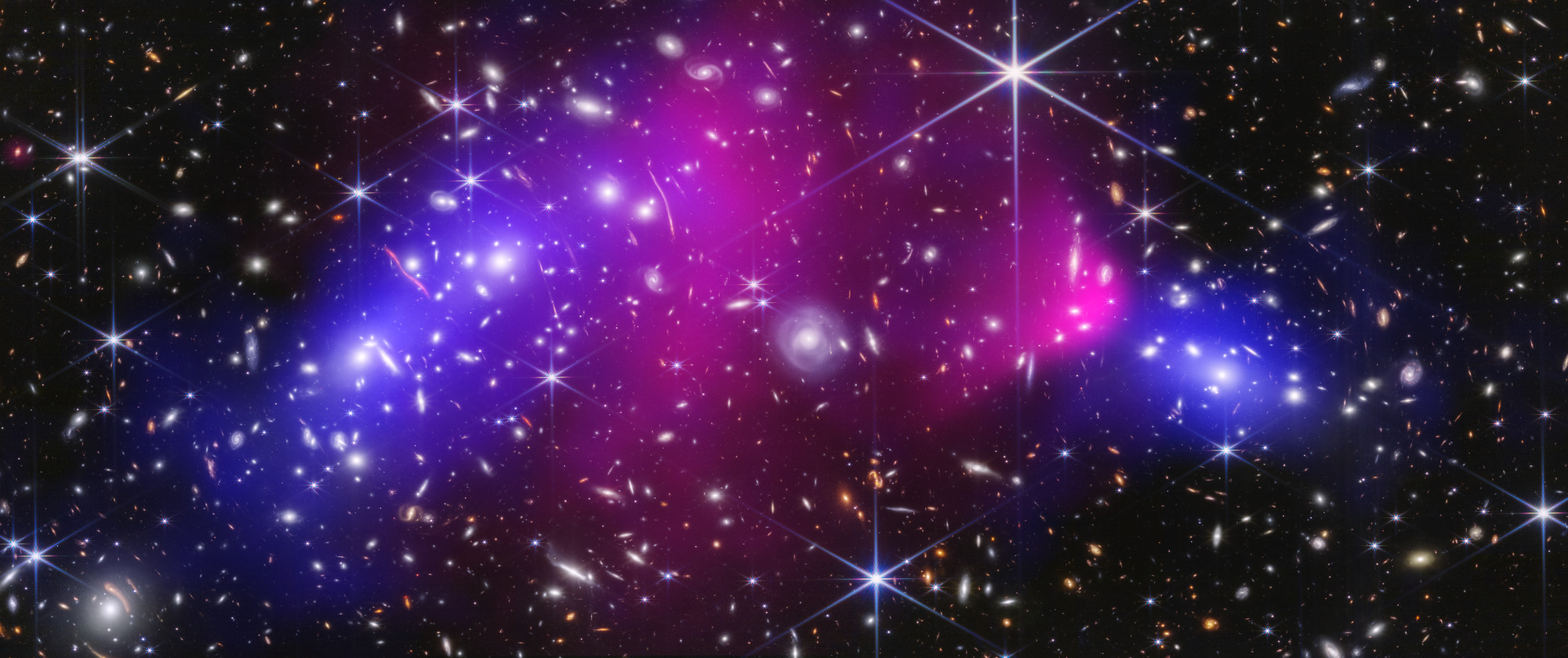
The Bullet Cluster is an important testing ground for a variety of astrophysical theories; its unique geometry pushes the limits of cosmological models and is seen as a major roadblock for theories that attempt to modify gravity. But is this system really a galactic silver bullet, or might modified gravity deserve a second look?
Gravity Blues
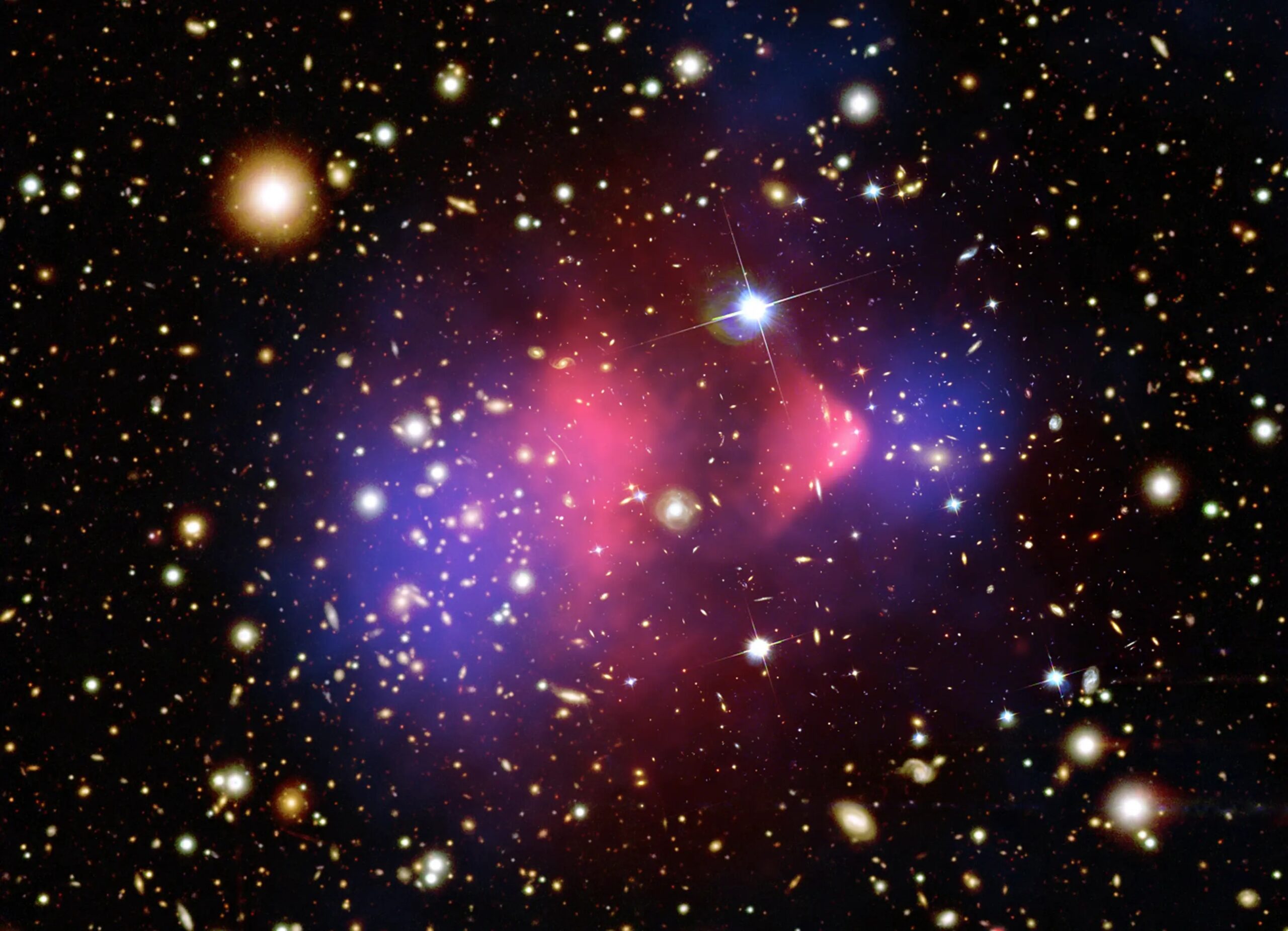
The Bullet Cluster shown in visible light, X-rays (pink), and via its gravitational lensing signature (blue). The separation of these various features, which trace galaxies, hot gas, and total mass, respectively, provides strong evidence for dark matter. [X-ray: NASA/CXC/CfA/M.Markevitch, Optical and lensing map: NASA/STScI, Magellan/U.Arizona/D.Clowe, Lensing map: ESO WFI]
about systems at different scales. For example, in the traditional formulation of modified Newtonian dynamics (MOND), Newton’s second law is modified to boost the effect of gravitational forces once an object’s acceleration drops below a certain value. With the right choice of cutoff, MOND can reproduce galactic rotation curves fairly well — but this same cutoff, when applied to galaxy clusters or cosmology, leads to faulty predictions.
One system that has been framed as particularly tricky for MOND is the Bullet Cluster. This structure consists of two subclusters that once passed through each other at high speeds, leaving an extended blob of hot gas strewn across the space between the subclusters. While this central gas is estimated to contain the majority of the system’s baryonic mass (e.g., stars, gas, and dust), gravitational lensing signatures remain strongest around the subclusters and suggest the presence of extra non-baryonic mass. If this excessive lensing were the result of a modification to Newton’s laws, it should be seen everywhere throughout the structure, not just around the subclusters. While dark matter halos provide a natural explanation for the separation, traditional MOND struggles to account for these observations.
Modified Expectations
The trick for proponents of MOND is that there’s more than one way to modify gravity. In quasi-linear modified Newtonian dynamics (QUMOND), rather than applying a simple boost at low accelerations, the effects of gravitational forces are rescaled in a way that depends on the geometry of the overall mass distribution. As a result, computing the lensing profile of the Bullet Cluster under QUMOND is a far more complicated task than in its predecessor theory. Recently, Xavier Hernandez (National Autonomous University of Mexico) performed the first detailed modeling of the Bullet Cluster within the QUMOND framework, ultimately putting pressure on the idea that the system can’t be reconciled with modified gravity.
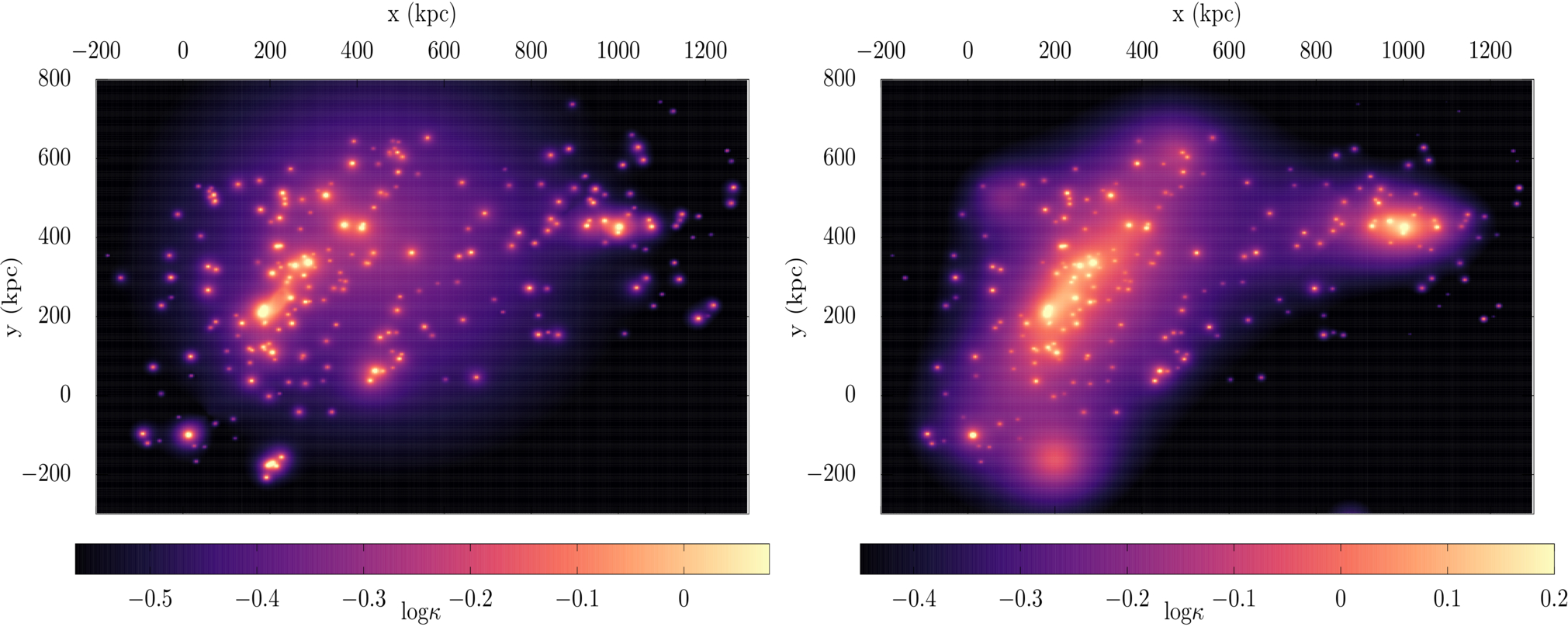
Figure 2: Reconstruction of the inferred mass surface density of the Bullet Cluster in a QUMOND scenario with no dark matter (left) as compared to a recent observational reconstruction by G. Rihtaršič et al. 2026 (right). [Hernandez 2026]
By modeling these phantom potentials, Hernandez was able to produce a map of where an observer would naively infer the cluster’s extra mass to be. Intriguingly, some broad qualitative features of the Bullet Cluster were reproduced by this map: QUMOND’s effects were strongest around the subclusters, while the gaseous region between the two clusters was less affected. On the other hand, the maps still exhibit deficiencies when it comes to reproducing small-scale features and underestimate the system’s total mass — a common problem for modified gravity in galaxy clusters. So while this modeling helps to push back on the idea that the Bullet Cluster is the end-all and be-all for ending modified gravity, there’s still more work to be done.
Citation
“A Detailed MOND Modelling of the Bullet Cluster,” X. Hernandez 2026 ApJL 1008 L46. doi:10.3847/2041-8213/ae9d4c