
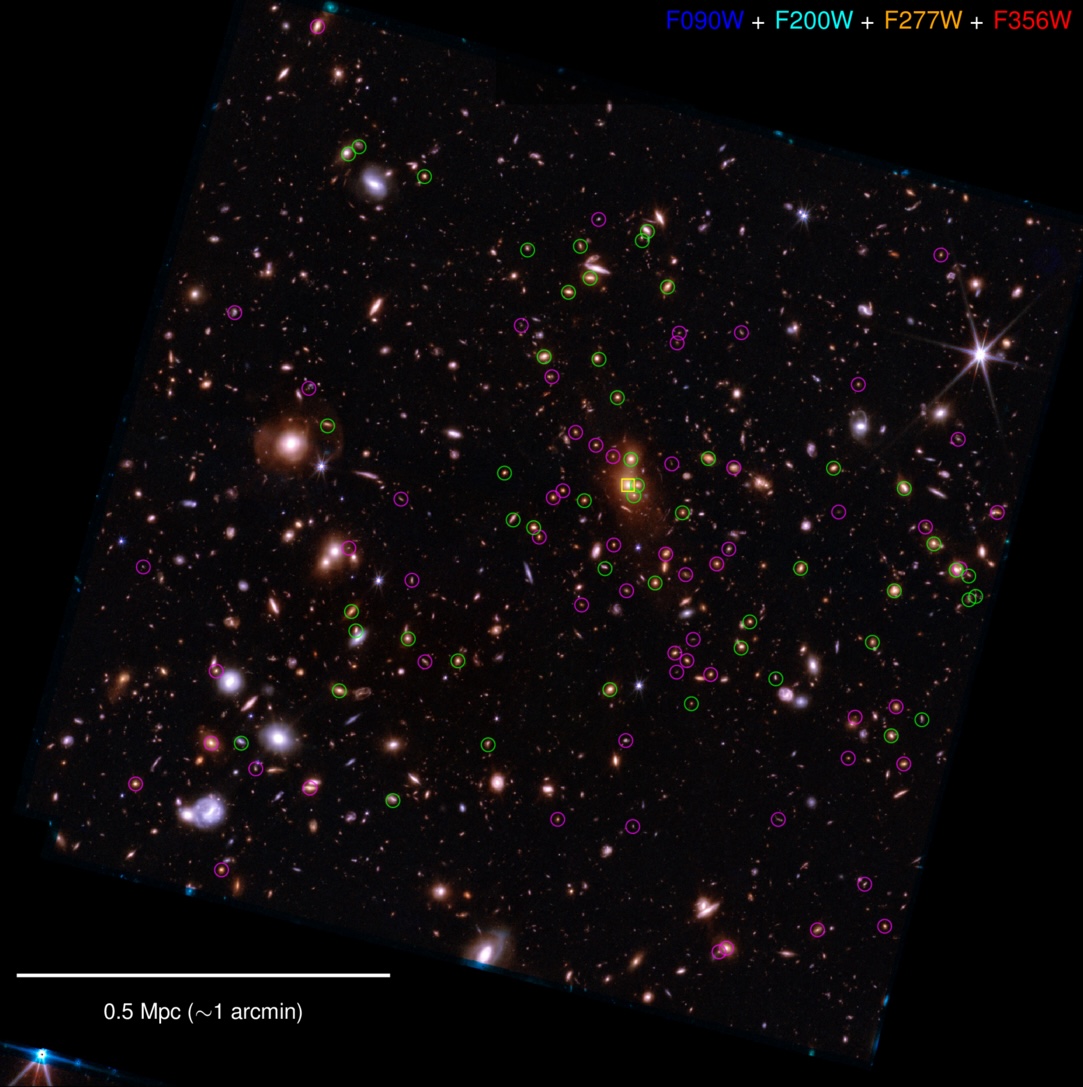
This image from JWST shows the galaxy cluster XLSSU J021744.1-034536. The cluster is at a redshift of z = 1.98, placing it at cosmic noon, when the universe’s star formation was at its peak. To study the formation and evolution of this cluster, Zachary Scofield (Yonsei University) and collaborators collected wide-ranging clues, including signs of weak gravitational lensing, the glow of gas in between the galaxies of the cluster, and an analysis of the cluster members. The image above (click for the full view) indicates the galaxies that are members of the cluster. The brightest galaxy in the cluster is marked with a yellow square, and the remaining cluster members are circled, with the color indicating whether the galaxy’s cluster membership was assigned photometrically (magenta) or spectroscopically (green). Combining all available lines of evidence, Scofield’s team found that XLSSU J021744.1-034536 is undergoing a merger, giving a rare glimpse into this stage of cluster formation. To learn more about this work and what it tells us about galaxy clusters at cosmic noon, be sure to check out the full article linked below.
Citation
“An Active Galaxy Cluster Merger at Cosmic Noon Revealed by JWST Weak Lensing and Multiwavelength Probes,” Zachary P. Scofield et al 2026 ApJL 999 L1. doi:10.3847/2041-8213/ae447a