
Editor’s Note: Astrobites is a graduate-student-run organization that digests astrophysical literature for undergraduate students. As part of the partnership between the AAS and astrobites, we occasionally repost astrobites content here at AAS Nova. We hope you enjoy this post from astrobites; the original can be viewed at astrobites.org.
Title: Beyond the Monsters: A More Complete Census of Black Hole Activity at Cosmic Dawn
Authors: Madisyn Brooks et al.
First Author’s Institution: University of Connecticut
Status: Published in ApJ
Meet the Monsters
Astronomers think nearly every massive galaxy in the universe has a supermassive black hole at its center. Supermassive black holes in the local universe range from a few million to more than 10 billion times as massive as the Sun. While they’re super massive to us, these black holes are tiny on cosmic scales — usually about 1,000 times less massive than their host galaxies! The original black holes that grew into today’s supermassive black holes — often called “black hole seeds” — are still a mystery. We know that smaller, stellar-mass black holes form after a massive star dies in a supernova, leaving behind a black hole with a mass of a few to roughly 100 times the mass of the Sun. That means that to form supermassive black holes, there are two options: either stellar-mass black holes in the early universe grew into the supermassive monsters we see today, or some other mechanism — for example, the direct collapse of a large gas cloud into a massive black hole — formed heavier “seed” black holes.
The growth of stellar-mass black holes via black holes merging, gobbling up stars, and accreting gas from the host galaxy is enough to explain the existence of supermassive black holes in the local universe. After all, they’ve had more than 13 billion years to grow to their current size. But recent observations with JWST have found supermassive black holes in distant galaxies when the universe was less than a billion years old. These monster black holes are much more massive than we would expect for their host galaxies, with some reaching one-tenth the mass of their hosts. If all supermassive black holes in the early universe were this massive, it would be impossible to form them from stellar-mass black hole seeds. Instead, some other physics would be required to create such massive black holes so early.
But are all supermassive black holes in the early universe this massive? Today’s authors set out to answer this question to better understand how the first black holes formed and grew alongside their host galaxies.
Monster Hunting
Supermassive black holes can only be seen when they accrete material, whether that’s stars or gas. They pull gas into a disk that feeds the black hole. This accretion disk is very hot, so it emits light at basically every wavelength, forming what’s known as an active galactic nucleus, or AGN. The brightness of the AGN is related to how quickly the black hole eats. More massive black holes eat more quickly, meaning the most massive black holes have the brightest signature in observations of the host galaxy.
Light from the disk and the gas surrounding the black hole can be seen in the galaxy’s spectrum (Figure 1). The disk is bright enough to light up other gas orbiting the black hole, causing it to emit light in the form of emission lines. The gas is orbiting the black hole very quickly due to the black hole’s high mass. This causes the emission lines to broaden, since gas orbiting the black hole can move toward and away from the viewer, blueshifting and redshifting the light due to the Doppler effect. Broad emission lines in a galaxy spectrum are a telltale sign of an accreting supermassive black hole.
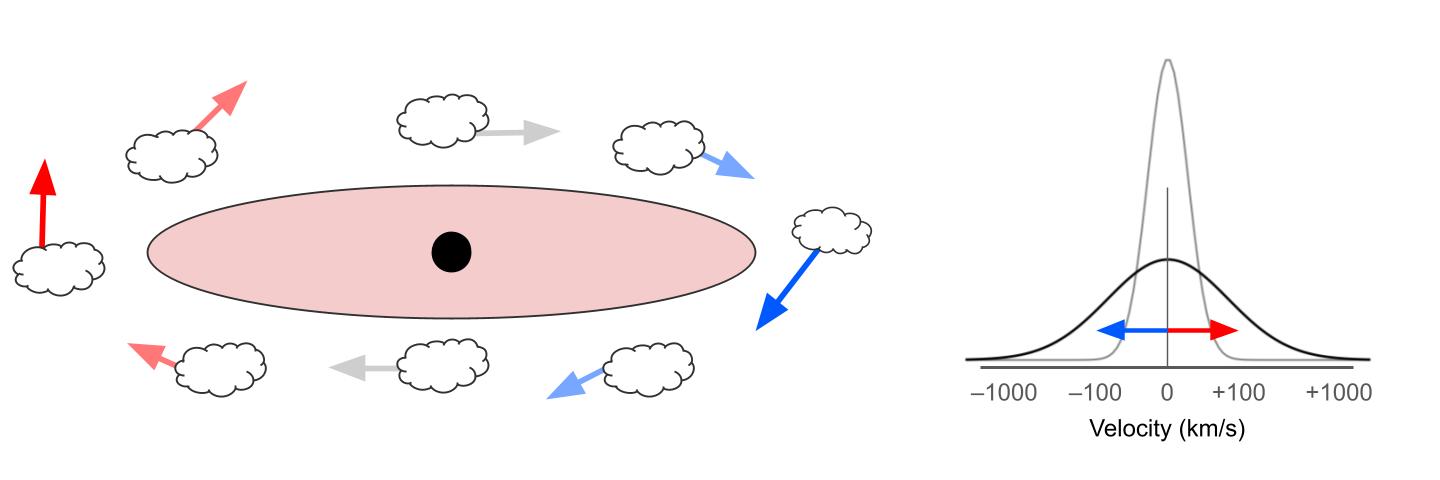
Figure 1: Left: Clouds orbit the central supermassive black hole and its accretion disk at high speed. Light from the accretion disk illuminates the clouds, causing them to emit lines in the spectrum. Lines are redshifted as clouds move away from the viewer and blueshifted as they move toward the viewer. Right: The addition of red- and blue-shifted components from the moving clouds causes a broad line appearance. Broader lines indicate faster clouds, indicative of a strong gravitational field from a supermassive black hole. [Margaret Verrico]
To get around this, the authors use a method called “stacking” to find signatures of fainter accretion disks in spectra of distant galaxies. Stacking is basically taking the average of a lot of data; as you add more data together, random noise tends to cancel out, while real features remain. This increases the signal-to-noise ratio of the data, making it easier to find faint signals. The authors collect galaxy spectra from previous surveys that had no evidence of broad emission lines. They stack these spectra in groups of similar redshift and galaxy luminosity to see whether there are any faint broad lines present to try to find the missing monsters.
Are All Supermassive Black Holes Too Massive?
The authors find evidence of broad emission lines in five of the 16 averaged spectra they produce. They find more broad lines in spectra with a higher average redshift, suggesting many high-redshift galaxies have hidden AGNs that can’t be seen in an individual spectrum. At lower redshift, this problem goes away, meaning we are able to definitively say whether any particular galaxy has an AGN.
The authors then estimate the average masses of the hidden supermassive black holes using the average properties of the broad emission lines, similar to previous studies that found overly massive black holes. They estimate the masses of the host galaxies using spectral energy distribution fitting, or modeling the light of the galaxies. They find that these hidden monsters are on average less massive than supermassive black holes found in other studies at the same redshift (Figure 2).
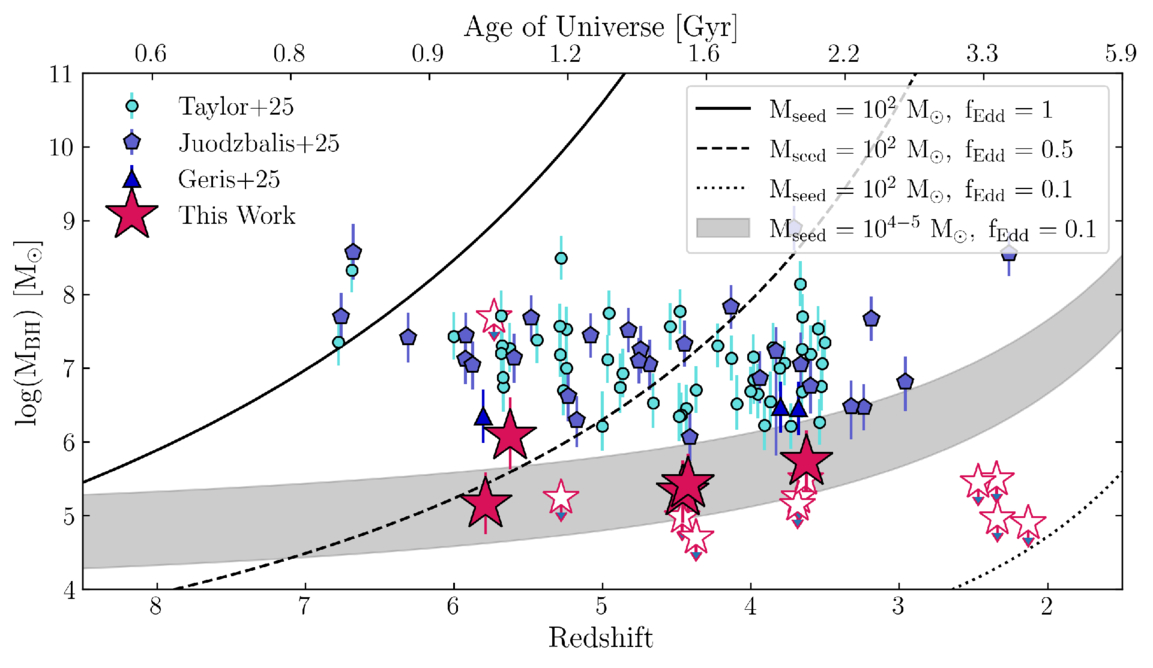
Figure 2: Black hole masses at each redshift from today’s article (red stars) and comparison samples (blue markers). Individual galaxies with broad lines are shown with filled-in markers; the stacked, or averaged, results are shown with white stars. The authors find that stacking reveals a lower-mass population of black holes that are consistent with moderately growing stellar-mass black holes (dashed and dotted lines) or heavier seeds with less growth (gray area). These show that not all supermassive black holes in the early universe had to come from heavy seeds. [Brooks et al. 2026]
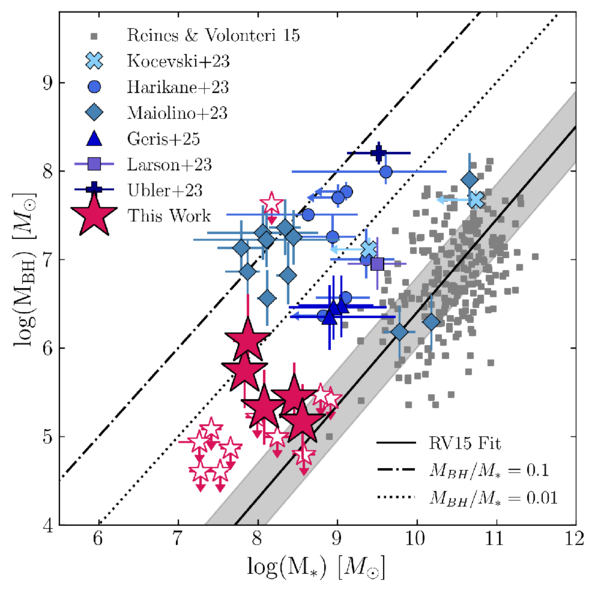
Figure 3: Galaxy mass versus black hole mass for the sample from today’s article (red stars) versus comparison objects at high redshift (blue markers) and AGNs at low redshift (gray squares). The stacked results of today’s article reveal a population of black holes that fall on or near the local black hole–host galaxy mass relation (gray filled area); the authors suggest high-redshift black holes may have a wider range of black hole masses for a given host galaxy mass instead of being consistently over-massive. [Brooks et al. 2026]
Making a Monster
So what do these results mean for black hole seeding? As shown in Figure 2, these results are consistent with either a “light seed” (stellar-mass black hole) feeding at high but realistic rates, or with a heavier black hole seed accreting more slowly. The strongest constraints on possible seeds come from the highest-redshift averaged spectra. This means more data on even higher-redshift black holes is needed to find out where supermassive black holes come from.
Original astrobite edited by Chris Layden.
About the author, Margaret Verrico:
I am a fifth-year graduate student at the University of Illinois Urbana-Champaign. I study the connection between supermassive black hole transients and their host galaxies. I am also an avid knitter and reader, and I am passionate about opening up STEM opportunities for people of all backgrounds.