
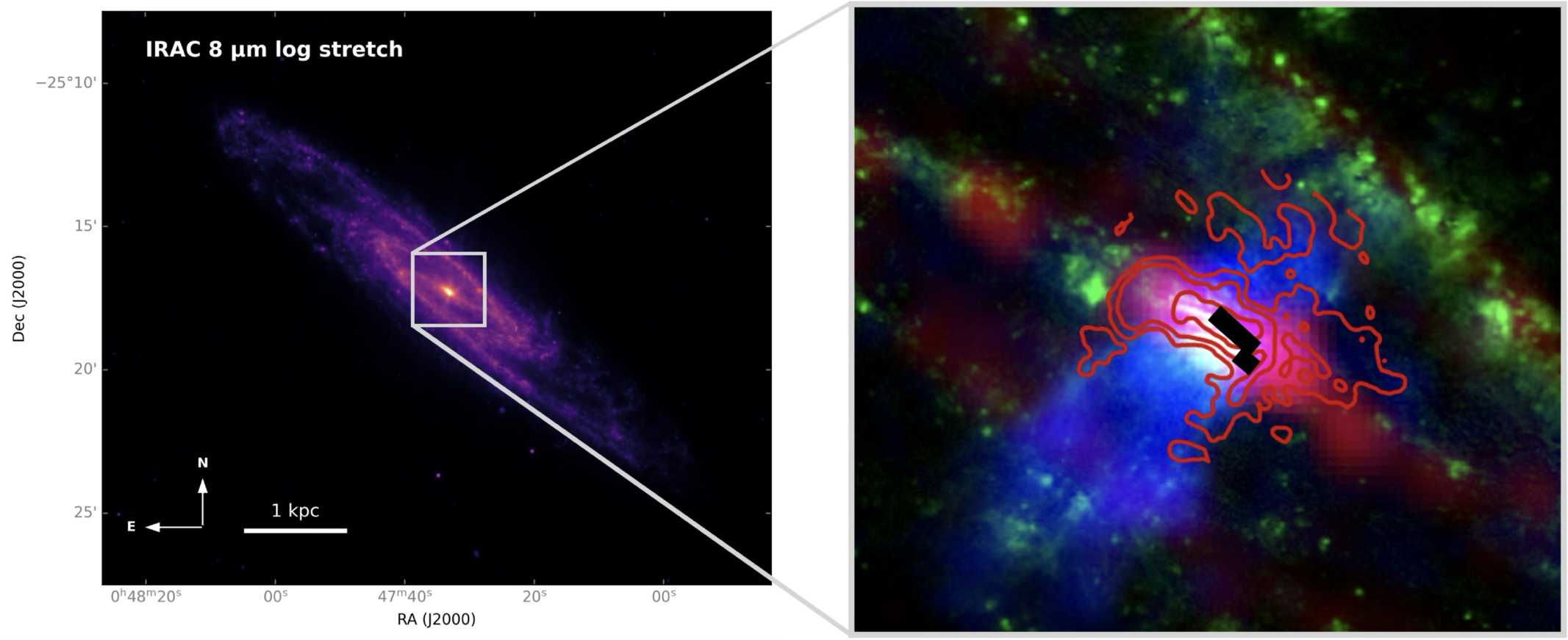
The nearby starburst galaxy NGC 253 has been experiencing enhanced star formation for the past few tens of millions of years, mostly in massive young star clusters embedded near the center of the galaxy. NGC 253 also features a broad outflow of hot gas called a superwind. The feedback from the galaxy’s massive young stars and its superwind are potentially connected, but it’s not yet clear how they become coupled. The image above shows NGC 253 in infrared light captured by the Spitzer Space Telescope on the left and X-ray (blue), Hα (green), and millimeter (red) emission on the right, with the contour lines showing the galaxy’s molecular outflow. Kaitlyn Sheriff (University of Kansas) and collaborators used JWST to peer into the inner regions of the starburst, investigating the areas blocked out in black above. The team identified a 75-light-year-wide bubble-like feature at the same location as a massive young star cluster, which they estimated to contain roughly 5,400 stars with masses of at least 15 solar masses. The team’s analysis suggests that powerful stellar winds inflated this bubble, though supernovae could have played a role as well. The bubble may be beginning to “pop,” allowing the energy and momentum from the star cluster’s feedback to connect to the galaxy’s superwind.
Citation
“JWST Observations of Starbursts: A Young Bubble in NGC 253’s Central Starburst,” Kaitlyn E. Sheriff et al 2026 AJ 172 261. doi:10.3847/1538-3881/aea6ac