
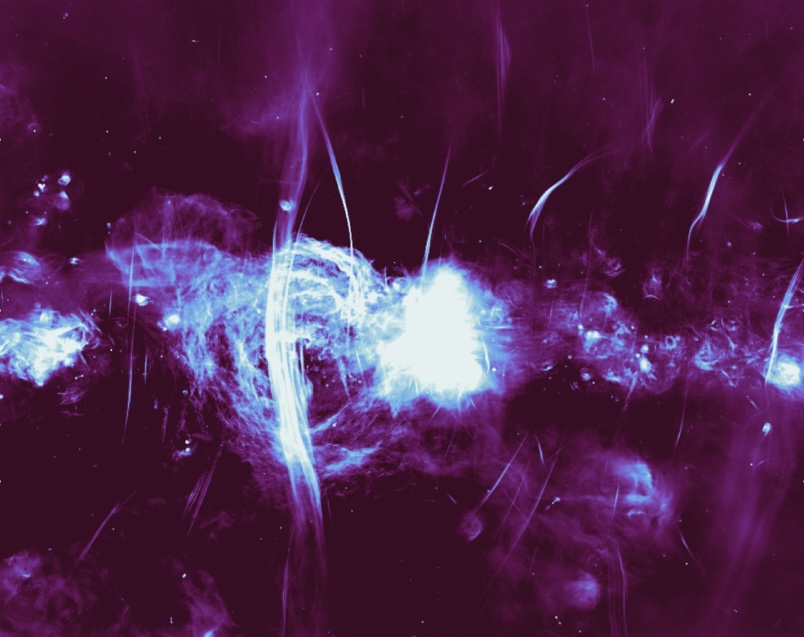
This image of the galactic center from the MeerKAT radio array shows wispy vertical lines known as galactic non-thermal filaments. These structures, which are tens of parsecs long and less than a tenth of a parsec wide, are found throughout a complex region called the central molecular zone. The filaments’ radio emission appears to come from charged particles spiraling around magnetic field lines, but it’s not yet known where the speeding particles that power this emission come from. Recently, Mohan Richter-Addo (University of Wisconsin–Madison) and collaborators used magnetohydrodynamics simulations to explore two potential sources: 1) the electron–positron winds of a pulsar or 2) a proton-rich mix of particles accelerated by interstellar shocks. The team found few discernible differences between simulated filaments illuminated by these two sources, but this work provided new avenues for future exploration. One facet that emerged from the team’s investigation is that filaments should grow longer as they age, with the maximum length set by the underlying magnetic field. This suggests that magnetohydrodynamic turbulence might play a role in shaping the filaments. To learn more about this exploration of galactic non-thermal filaments, be sure to check out the article linked below.
Citation
“The Effects of Cosmic-Ray Protons on Galactic Nonthermal Filaments,” Mohan Richter-Addo et al 2026 ApJ 1009 164. doi:10.3847/1538-4357/aea0c7