
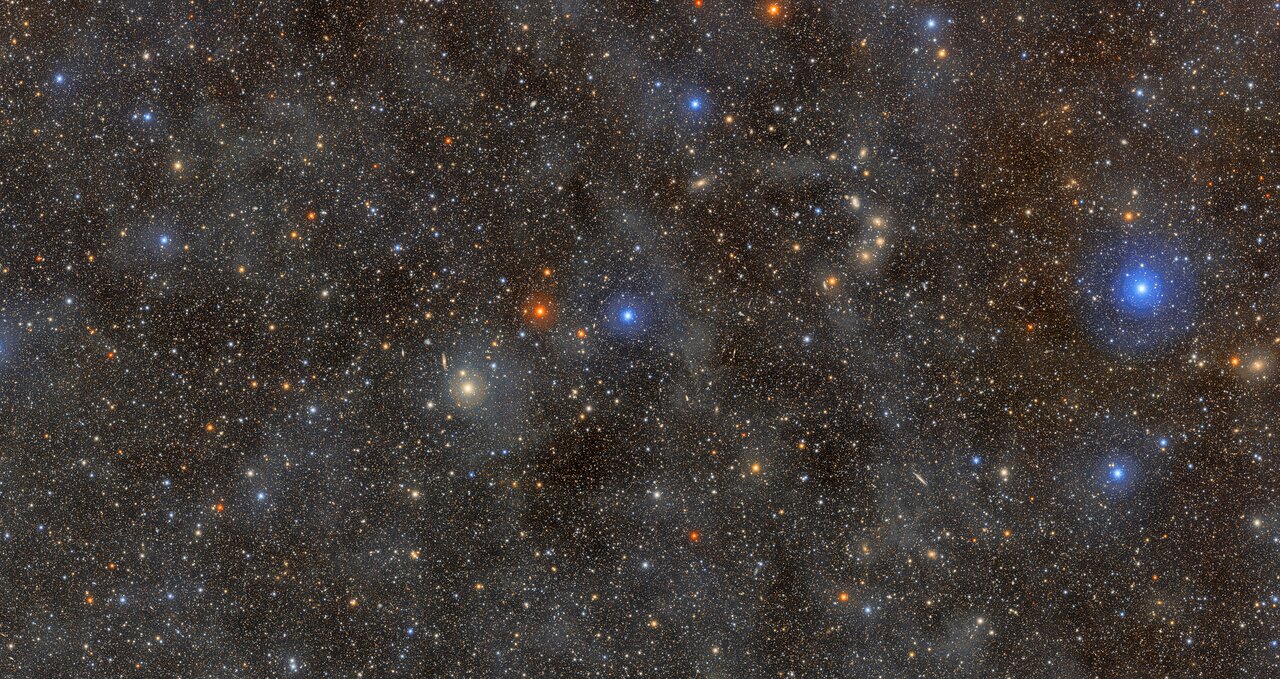
Editor’s Note: Astrobites is a graduate-student-run organization that digests astrophysical literature for undergraduate students. As part of the partnership between the AAS and astrobites, we occasionally repost astrobites content here at AAS Nova. We hope you enjoy this post from astrobites; the original can be viewed at astrobites.org.
Title: Discovery of the Distant, Ultra-Faint Milky Way Satellite Aquarius IV with the Vera C. Rubin Observatory Early Data Preview 2
Authors: William Cerny et al.
First Author’s Institution: Yale University
Status: Published in RNAAS
Warming Up the World’s Largest Camera
Today’s bite covers one of the NSF–DOE Vera C. Rubin Observatory‘s first major discoveries, which was found in testing data before the observatory began its decade of observations. Perched atop a mountain in Chile, the brand-new Rubin Observatory is just beginning a 10-year survey called the Legacy Survey of Space and Time (LSST). LSST will be the deepest and widest sky survey ever conducted, taking images of the entire southern night sky every three nights. This ultra-wide, ultra-high-definition time-lapse of the universe will help answer fundamental questions about dark matter and dark energy, study objects in our solar system, find distant supernova explosions, and more.
LSST is a photometric survey, meaning its main data product is images in several filters. These images are taken with the largest digital camera ever constructed, about the size of a Mini Cooper. The LSST camera has a resolution of 3.2 gigapixels. To put that number into perspective, you would need about 13 copies of the Las Vegas Sphere to display just a single LSST image… and hundreds of these images will be taken every night!
The authors of today’s article use the first dataset from the LSST camera, called Early Data Preview 2 (EDP2). EDP2 was taken from April 2025 to January 2026, covered about 3,000 square degrees (about 7% of the entire night sky), and primarily served as a test before beginning the 10-year LSST (which began in June 2026).
Small Galaxies, Big Questions
Since LSST will survey a large area at unprecedented depths, one field of interest is to study extremely dim and small galaxies called ultra-faint dwarf galaxies (UFDs). These galaxies are so faint that we can only find them close to home, orbiting the Milky Way and other nearby galaxies as satellites. UFDs don’t have much luminous matter, meaning they are likely dominated by their dark matter halos. This makes them useful test beds for our theories of dark matter and galaxy formation, if we can spot them.
Many UFDs don’t look like normal galaxies that resemble blobs of diffuse light with stars; instead, they’re more like a handful of individual stars in an image that also contains foreground stars and background galaxies. So how do you identify them? The trick is that stars born together at the same time from the same gas follow a predictable track in color and brightness called an isochrone. The authors slide a model isochrone for an ancient, metal-poor population through the data at a range of assumed distances and ask: at any spot in EDP2, are there more stars sitting on that track than random chance would predict? Cerny and coauthors found a new spot, which they call Aquarius IV, a new UFD candidate (Figure 1).
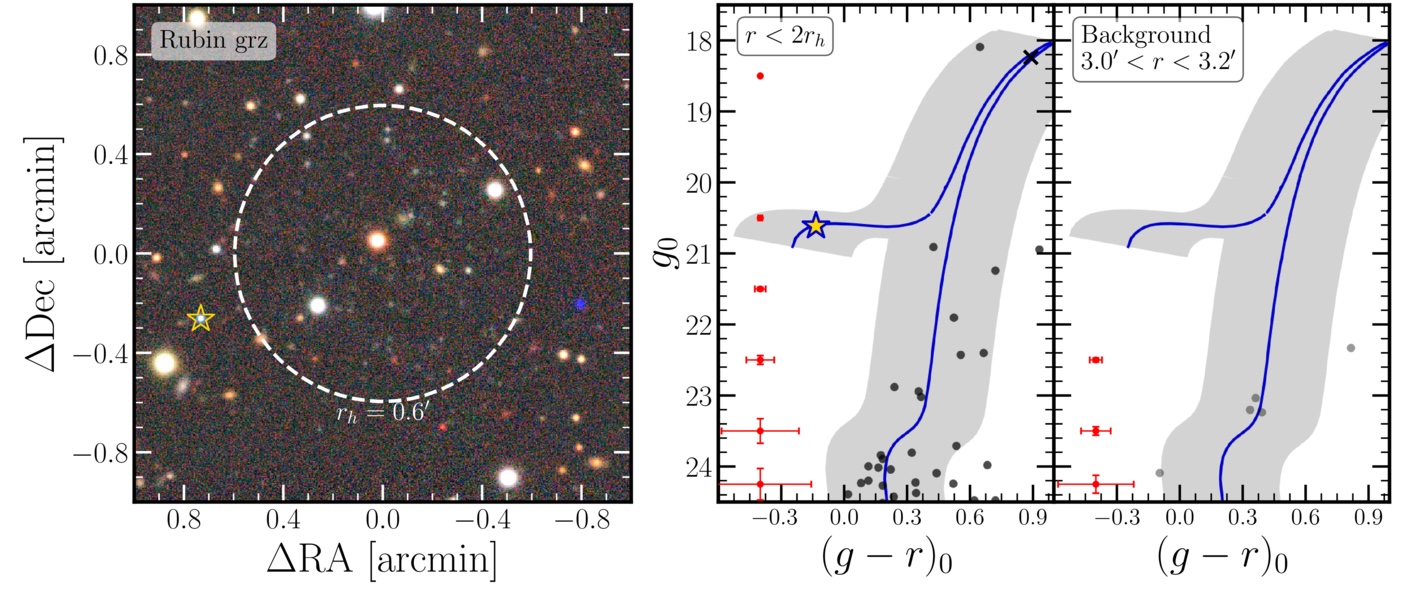
Figure 1: Left: A Rubin image centered on Aquarius IV, combining images in the g, r, and z filters. The dashed circle marks the half-light radius, the region enclosing half the galaxy’s light. Aquarius IV is only a scattering of individual faint stars. The yellow star marks a likely blue horizontal-branch member. Right: A plot of brightness against color for the stars inside twice the half-light radius (first panel) and inside a ring of sky just outside the galaxy (second panel). Stars born at the same time from the same gas fall along the isochrone (blue line; any stars in the grey regions are deemed to follow the isochrone). All the stars follow the isochrone in the first panel but not the second, indicating that the stars are associated. [Adapted from Cerny et al. 2026]
The authors also infer several properties of Aquarius IV, including its centroid coordinates, half-light radius, ellipticity, distance, and absolute magnitude. They find that its radius is larger than almost all Milky Way globular clusters (tight gravitationally bound systems of old stars that don’t reside in their own dark matter halos), suggesting that Aquarius IV is a true dwarf galaxy.
Currently, there are about 40 known UFDs around the Milky Way, and LSST is expected to roughly double this number (see this Astrobite), allowing us to study these tiny galaxies at a population level. This article proves that LSST has the potential to revolutionize many areas of astrophysics! If you are a researcher in the US or Chile and want to play with the EDP2 data yourself, you can access it via the Rubin Science Platform. For researchers from other countries, see more info here.
Original astrobite edited by Katya Gozman.
About the author, Ben Sherwin:
I am a physics PhD student and NSF Graduate Research Fellow at Stanford University. I am interested in theoretical and observational cosmology, specifically in cross-correlations between the cosmic microwave background and tracers of large-scale structure. Outside of work, I enjoy seeing the latest movies in theaters and exploring the San Francisco Bay Area.