
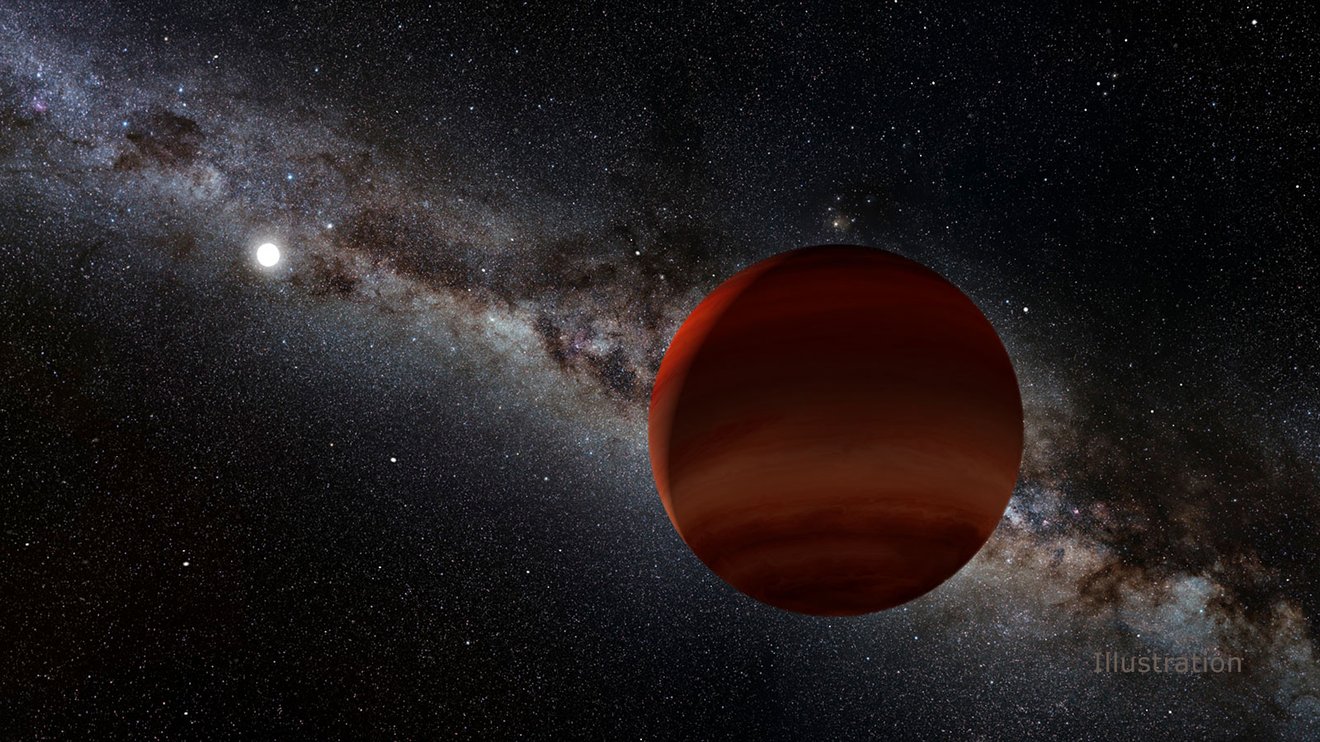
Researchers have followed up on the discovery of a rare binary system containing a white dwarf and a brown dwarf. This unusual pairing offers valuable insights into the physics of atmospheres subjected to strong radiation.
Odd Couple
In 2025, researchers searching through observations from the Transiting Exoplanet Survey Satellite (TESS) spotted an eclipsing binary system in which a brown dwarf orbits the white dwarf J0404+1112 every 2.93 hours. Only about a dozen white dwarf–brown dwarf binaries have been confirmed so far, and each newfound system offers clues to how substellar or planetary companions survive a star’s transition from main-sequence star to swollen red giant to blazing white dwarf.
Because the two objects orbit one another so closely, this remarkable system also offers researchers an opportunity to study the dynamics and chemistry of an atmosphere blasted with high-energy radiation, with important implications for close-in brown dwarfs and giant planets.
Insights from New Observations
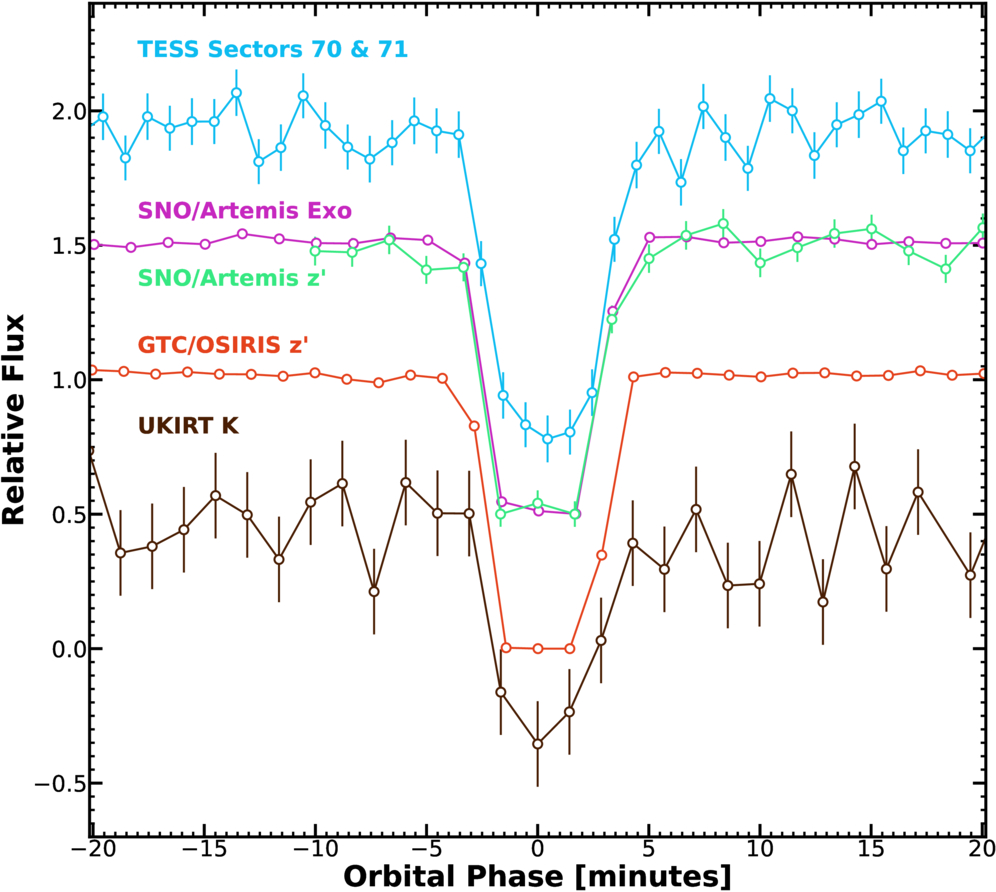
Eclipse photometry of J0404+1112 from TESS, SPECULOOS, the Gran Telescopio Canarias, and the United Kingdom Infra-Red Telescope. [de Wit et al. 2026]
Now, the team has obtained new photometry from the Gran Telescopio Canarias and the United Kingdom Infra-Red Telescope, plus spectroscopy from the Gran Telescopio Canarias, to get a better sense of the system. These observations allowed them to break the degeneracies in the white dwarf’s properties, showing it to be an 0.60-solar-mass white dwarf that has been cooling for more than 10 million years to a present-day temperature of 28,000K. The brown dwarf also appears to be more massive than initially thought, weighing in at roughly 40 Jupiter masses.
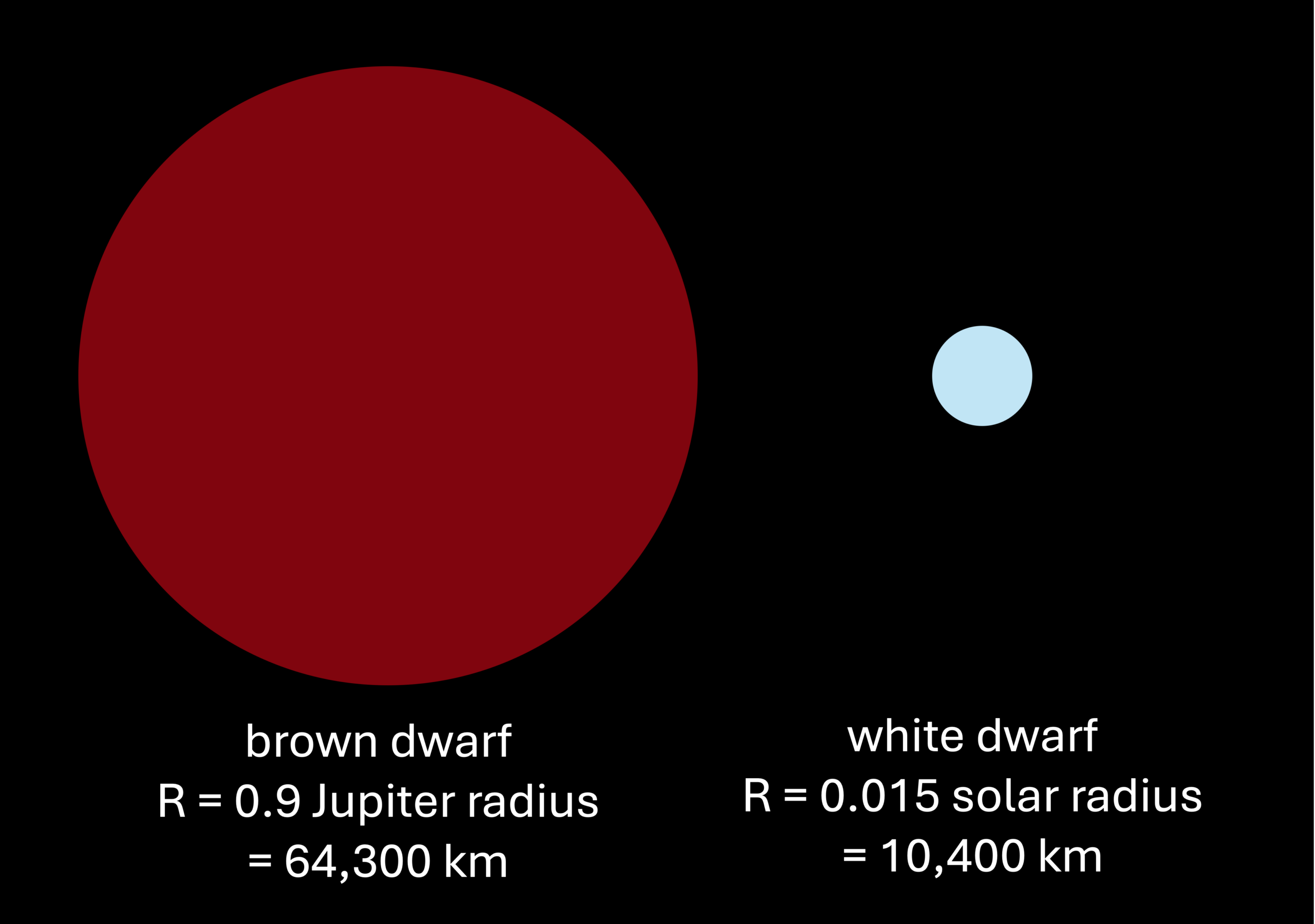
This diagram shows the relative sizes of the brown dwarf and the white dwarf. [AAS Nova/Kerry Hensley]
Like Night and Day
Because the system’s orbit is almost exactly edge on from our point of view, the white dwarf is completely eclipsed as the much larger brown dwarf passes in front of it. This allows the contributions from the two components to be separated, and for the emission from the brown dwarf’s nightside to be measured. The authors constrained the brown dwarf’s nightside temperature to roughly 1750K. Its dayside temperatures are likely to be significantly higher — potentially around 3750K at the point where the white dwarf is directly overhead — but more data are needed to constrain the dayside temperature of this world.
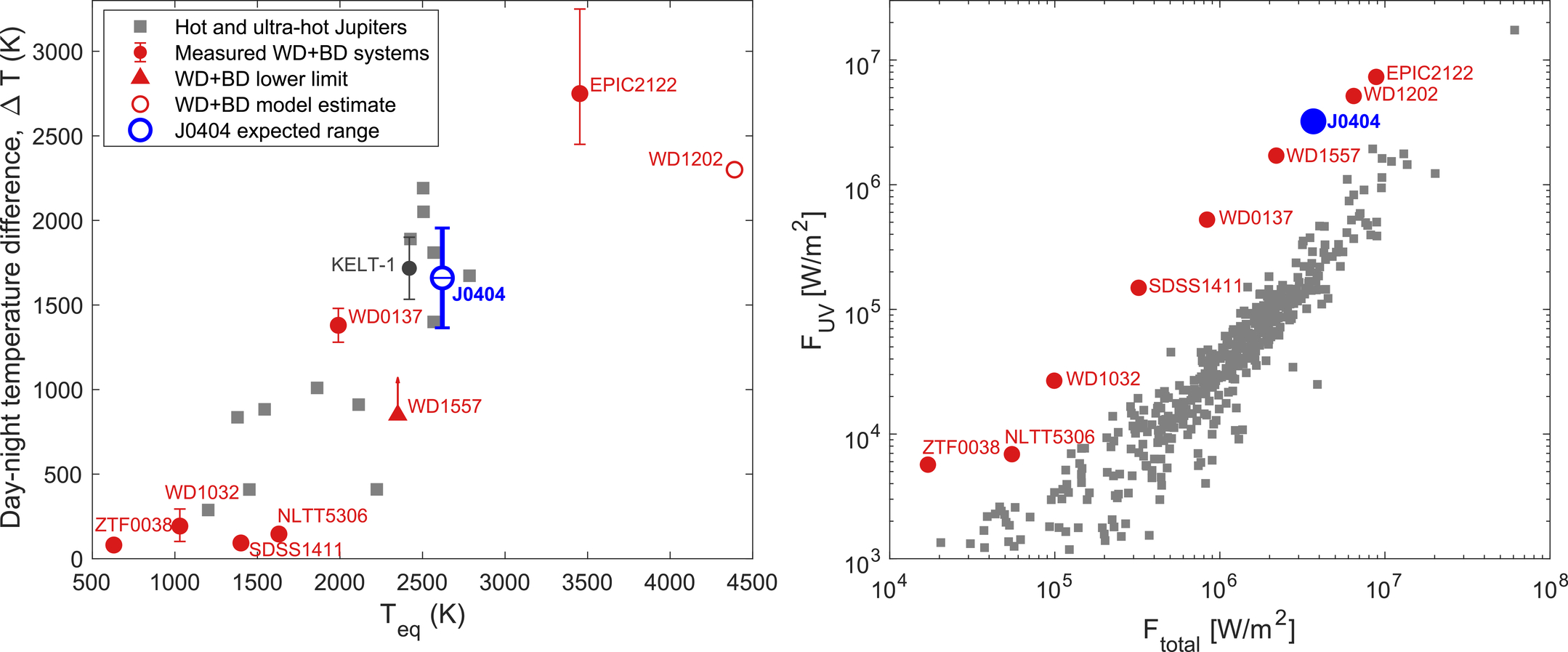
Day–night temperature difference (left) and irradiation flux (right) of the brown dwarf in this system compared to other white dwarf–brown dwarf systems and hot and ultra-hot Jupiters. Click to enlarge. [de Wit et al. 2026]
Citation
“J0404+1112: A 3 hr Eclipsing White Dwarf–Brown Dwarf Probing Multiple Atmospheric Regimes,” J. de Wit et al 2026 ApJL 1009 L40. doi:10.3847/2041-8213/ae9a97