
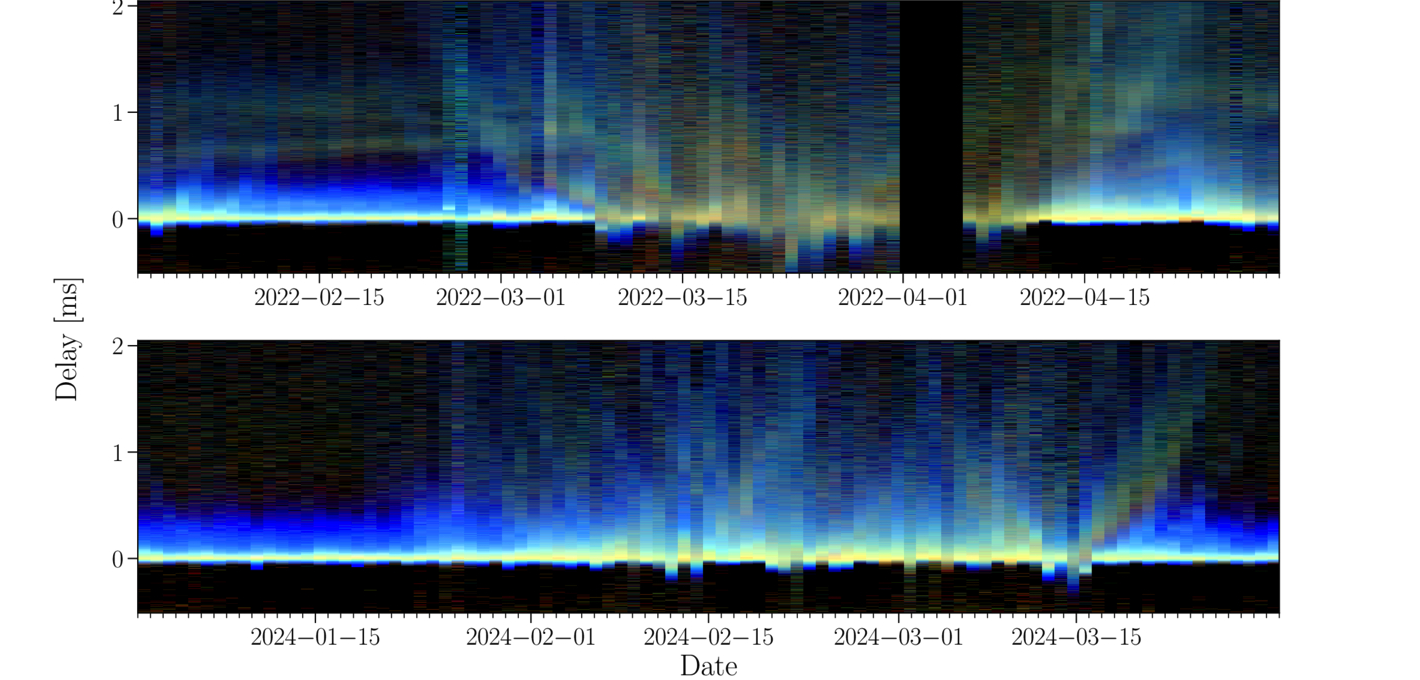
What at first might appear to be abstract pixel art or a fuzzy photograph of skyglow from a distant city is actually a representation of radio emission from the pulsar at the center of the Crab Nebula. When a pulsar’s radio emission passes through a region of ionized gas — like the complex filaments of the Crab Nebula — the plasma deflects the radio signal from its intended course. This detour can create “echoes”: copies of the pulsar signal that arrive later than the original pulse. Thierry Serafin Nadeau (University of Toronto) and collaborators studied these echoes from the Crab pulsar by compiling an archive of giant pulses detected over 2.5 years by the Canadian Hydrogen Intensity Mapping Experiment (CHIME). Giant pulses, which are brighter and narrower than typical pulses, offer a powerful way to probe plasma echoes. The image above shows sweeping parabola-shaped echoes during two particularly active periods. The color shows the frequencies at which power was received: mainly at low (blue), high (red), or all (yellow-white) frequencies. This dataset revealed for the first time a feature predicted to exist but never seen: echoes from plasma structures that never pass directly in front of the pulsar from our point of view. To learn more about the echoes of the Crab pulsar, be sure to check out the research article linked below.
Citation
“Echoes in Different Tempo: Long-Term Monitoring of Crab Echoes with CHIME,” Thierry Serafin Nadeau et al 2026 ApJ 1006 82. doi:10.3847/1538-4357/ae7336