
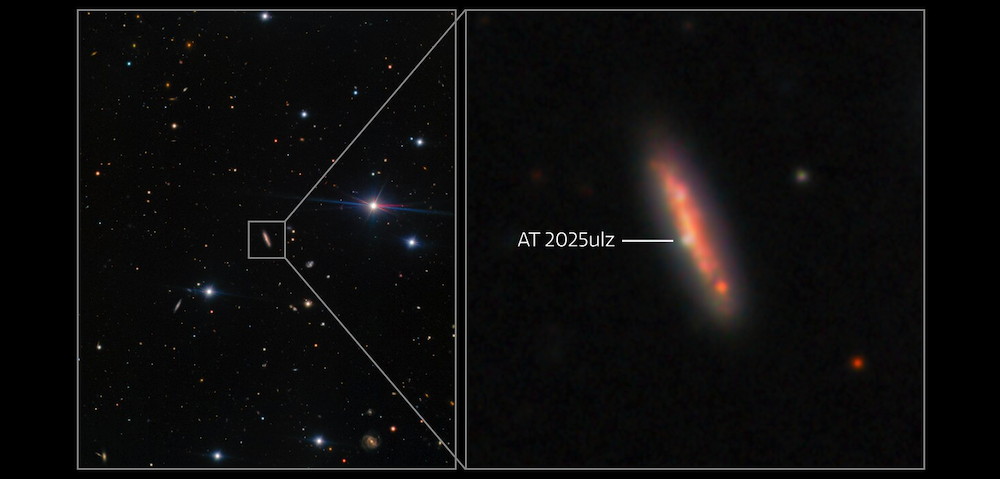
A tentative gravitational wave signal sent astronomers searching for a possible electromagnetic counterpart. New radio observations weigh in on whether the candidate counterpart is a standard supernova or a sign of something rarer.
A Potential Neutron Star Merger
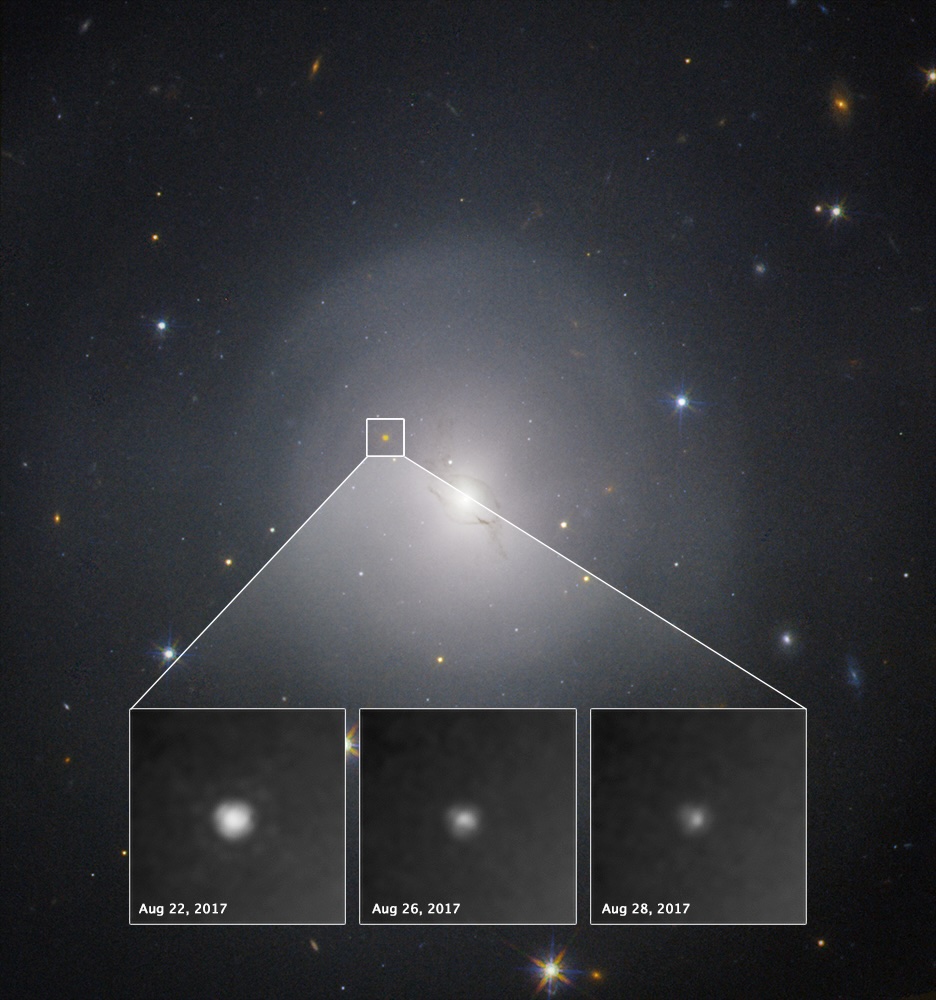
These images from the Hubble Space Telescope show the fading light of the kilonova associated with the gravitational wave event GW170817. [NASA and ESA Acknowledgment: A. Levan (U. Warwick), N. Tanvir (U. Leicester), and A. Fruchter and O. Fox (STScI)]
S250818k offered a rare opportunity to associate the light from a kilonova with a gravitational wave detection, a feat achieved only once so far, in 2017. The intrigue surrounding S250818k was heightened even further by the possibility that the collision involved at least one sub-solar-mass neutron star. Such a lightweight neutron star would fall below the lower mass limit set by stellar evolution models, requiring a different formation pathway.
S250818k’s kilonova potential rose and fell once researchers spotted an electromagnetic transient in its source region. Early optical observations revealed a kilonova-like color and rapid fading, while later observations showed brightening similar to a supernova interacting with circumstellar gas. This led the event to be classified as supernova SN 2025ulz — and therefore unlikely to be the source of the gravitational wave signal.
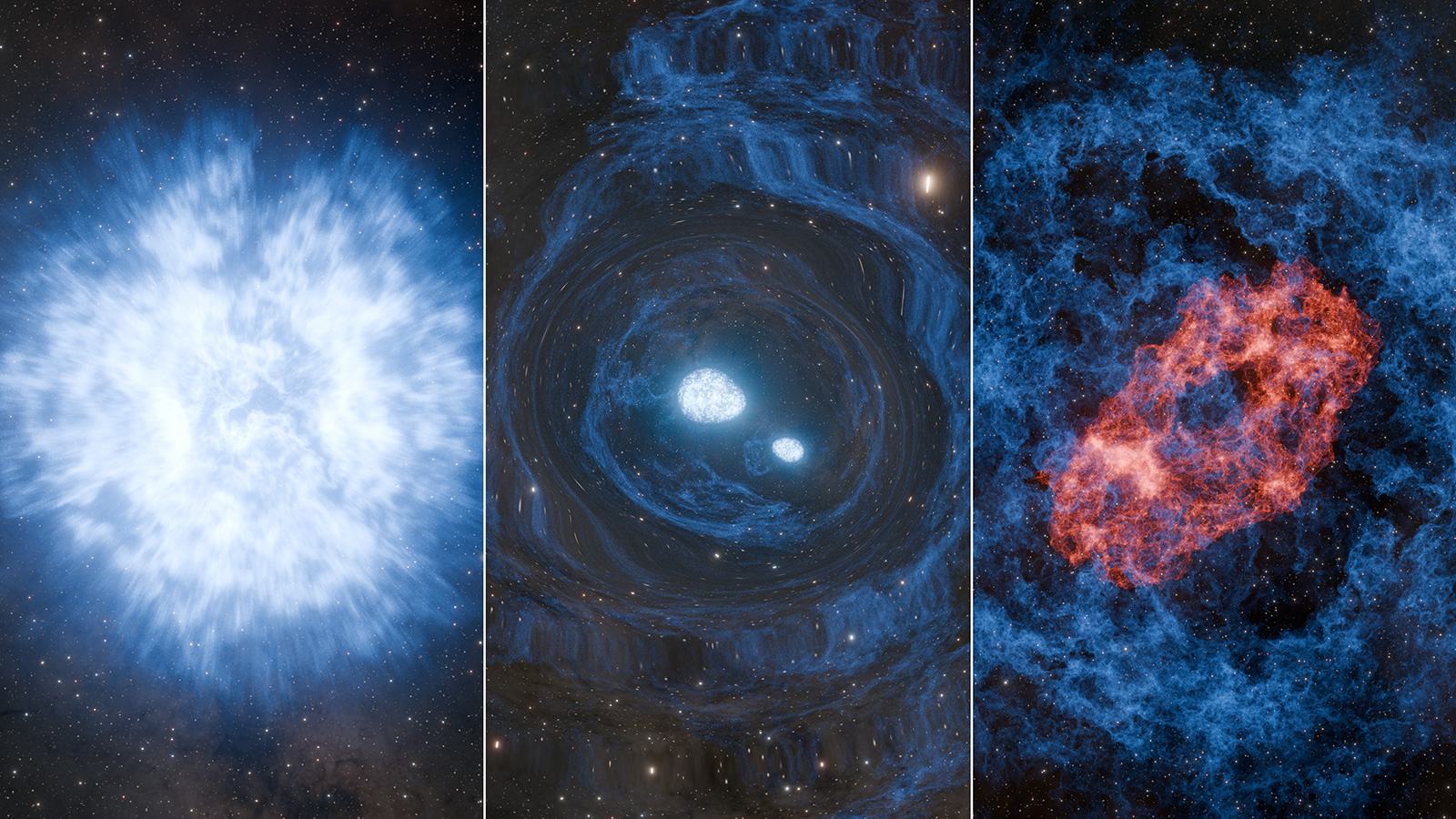
Illustration of a kilonova that occurs in the wake of a supernova. First, a massive star collapses. Then, neutron stars form in the aftermath. Finally, the neutron stars collide, producing a kilonova whose signal might be hidden by the supernova. [Caltech/K. Miller and R. Hurt (IPAC)]
A Kilonova in a Supernova?
Unlikely, but not impossible. Tanner O’Dwyer (Johns Hopkins University) and collaborators investigated the supernova for signs that it wasn’t a typical collapsing star. The team was motivated by theories suggesting that the collapse of a rapidly rotating massive star could produce both a kilonova and a supernova — potentially uniting gravitational wave signal S250818k and supernova SN 2025ulz.
In theory, the demise of a fast-spinning massive progenitor could produce one or more sub-solar-mass neutron stars. This could happen if 1) the collapsing stellar core splits into two neutron stars, or 2) in a twist on the star-formation process, neutron stars coalesce out of neutron-rich material in the disk surrounding the dying star. In either scenario, the neutron stars could merge shortly after the star’s collapse, generating kilonova emission that might be obscured by the expanding supernova.
Looking Deeply in the Radio
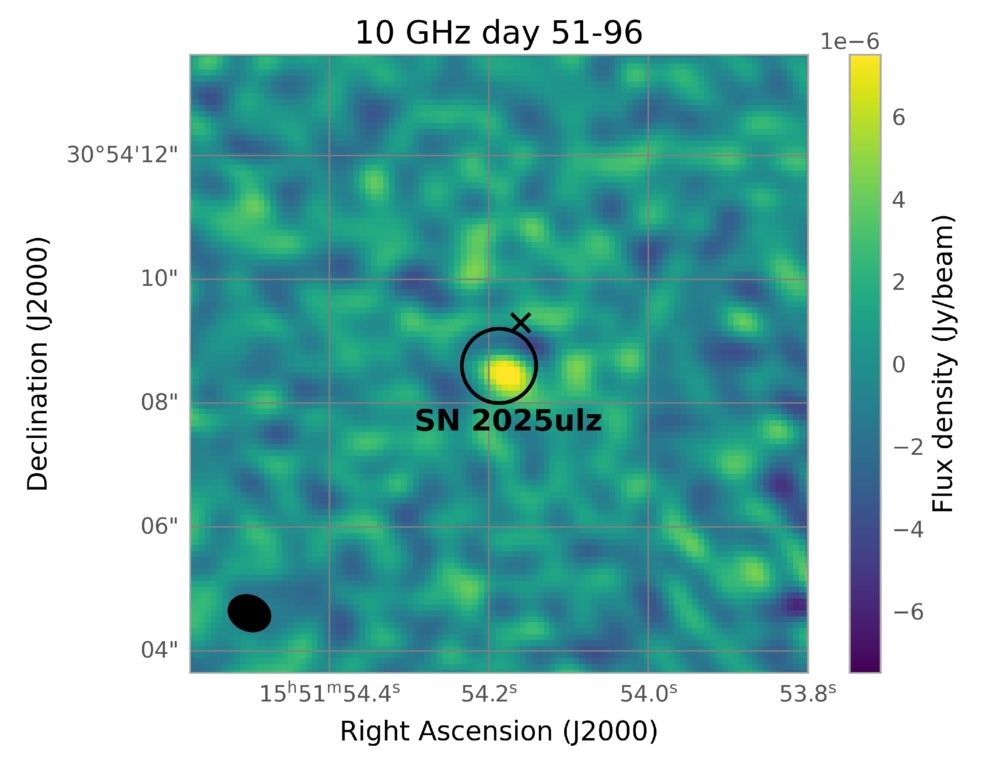
Very Large Array detection of a radio counterpart to SN 20215ulz. The circle shows the optical position of the supernova, and the “x” shows the optical position of the host galaxy. [Adapted from O’Dwyer et al. 2026]
The team found that standard supernova ejecta and relativistic jet models can both plausibly fit the data. In the supernova scenario, the estimated expansion speed and progenitor mass-loss rate place the event well within the bounds of known stripped-envelope supernovae. Though the data were also compatible with an off-axis relativistic jet, the authors were unable to resolve degeneracies in the event’s properties, including the jet energy and the interstellar medium density.
Ultimately, the authors suggested that a supernova fits the data more naturally. While this radio investigation didn’t unambiguously link S250818k and SN 2025ulz via an exotic kilonova-plus-supernova mechanism, it’s clear that radio observations have an important role to play in examining future gravitational wave signals.
Citation
“Identification of a Radio Counterpart to SN 2025ulz in the S250818k Localization Area,” Tanner O’Dwyer et al 2026 ApJL 1009 L44. doi:10.3847/2041-8213/aea4a5