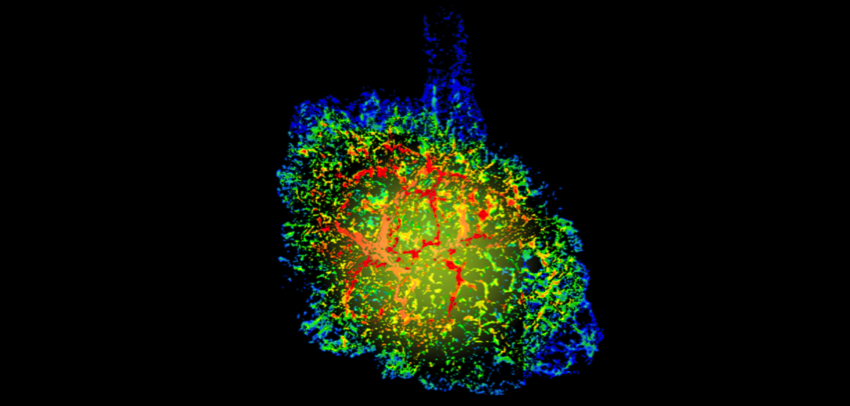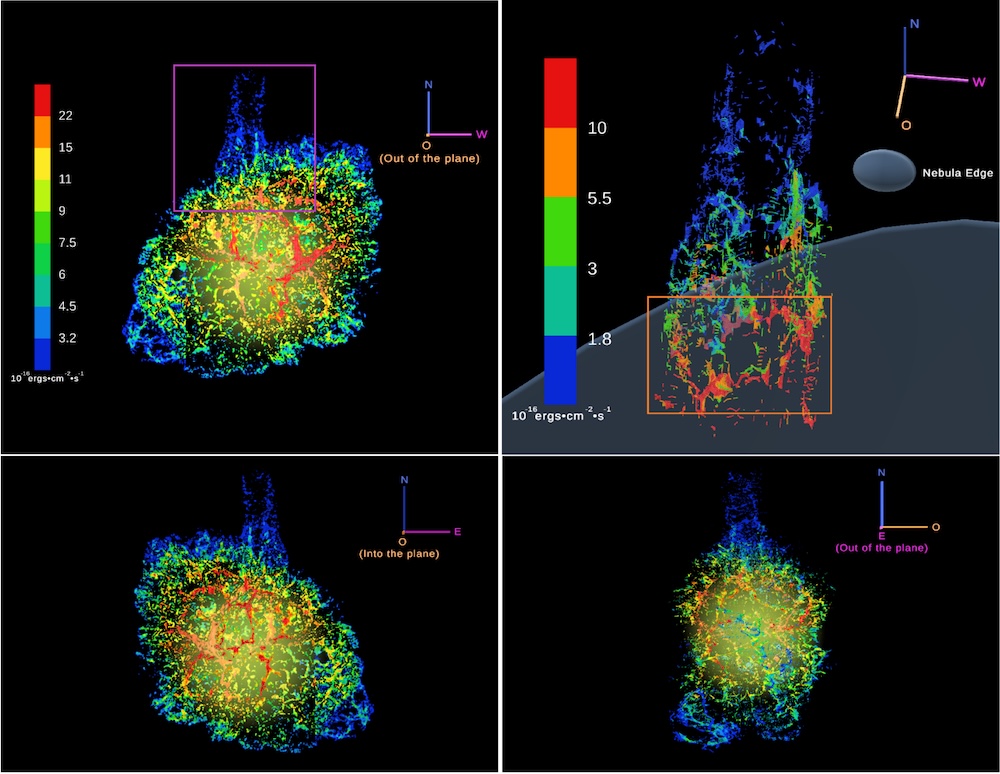
Three-dimensional reconstructions of the Crab Nebula using oxygen emission lines. An animation of this figure is also available. [Ding et al. 2026]
A recent research article by Ziwei Ding (Purdue University) and collaborators introduces a new 3D kinematic reconstruction of the Crab Nebula, the remnant of a supernova seen from Earth in the year 1054. The team observed the nebula’s oxygen emission in 2020 and 2022 with the Canada-France-Hawaii telescope, then compared these observations against others made in 2016 to study the nebula’s structure and motion. The images above and to the right show the nebula from multiple vantage points. These images show a prominent jet-like feature emerging vertically from the nebula. Ding and collaborators demonstrated that the jet appears to be linked to a light-year-wide cavity at its base. The source of the jet is not yet known; past mass loss, a circumstellar disk, and a locally under-dense region might all play a role. Future hydrodynamic simulations can probe each of these possibilities to understand how the winds of the young pulsar at the core of the nebula produced the features seen today. To learn more about these observations of the Crab Nebula, be sure to check out the full research article linked below.
Citation
“3D Kinematic Reconstruction of the Crab Nebula That Includes the Northern Ejecta ‘Jet,'” Z. Ding et al 2026 ApJ 1007 130. doi:10.3847/1538-4357/ae84c0