
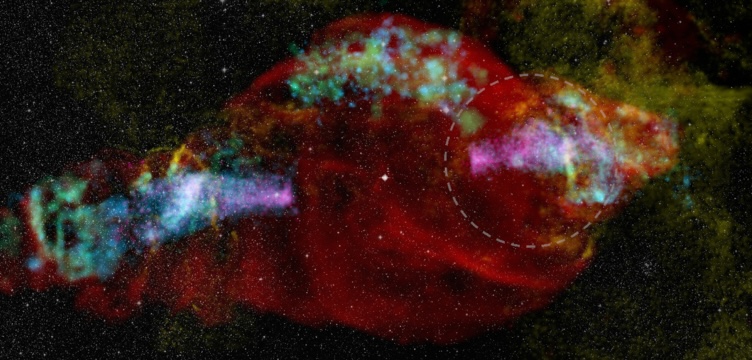
The supernova remnant W50 — nicknamed “the Manatee” because its blobby radio emission resembles an aquatic mammal floating through starry waters — harbors an extreme system at its heart. Near the center of the remnant, the microquasar SS 433 exhibits an immense pair of relativistic jets, likely powered by a stellar-mass black hole accreting material from a companion star. In the image of W50/SS 433 above, radio emission is in red, optical light is in yellow, and soft, medium, and hard X-ray emission are in green, cyan, and magenta, respectively. Brydyn Mac Intyre (University of Manitoba) and collaborators focused on the region circled above, using NuSTAR and XMM-Newton to understand the source of the X-ray emission in that region and the potential for SS 433 to accelerate particles to relativistic velocities. These observations suggest that W50/SS 433 accelerates electrons up to energies of more than 100 teraelectronvolts, and it may launch other particles into the highly sought-after petaelectronvolt range. To learn more about the particle-acceleration possibilities in this remarkable region, be sure to check out the full research article linked below.
Citation
“The Western Jet of SS 433/W50: Hard X-Ray Emission, Spectral Evolution, and Comparison to the Eastern Jet,” Brydyn Mac Intyre et al 2026 ApJ 1006 69. doi:10.3847/1538-4357/ae7a47