
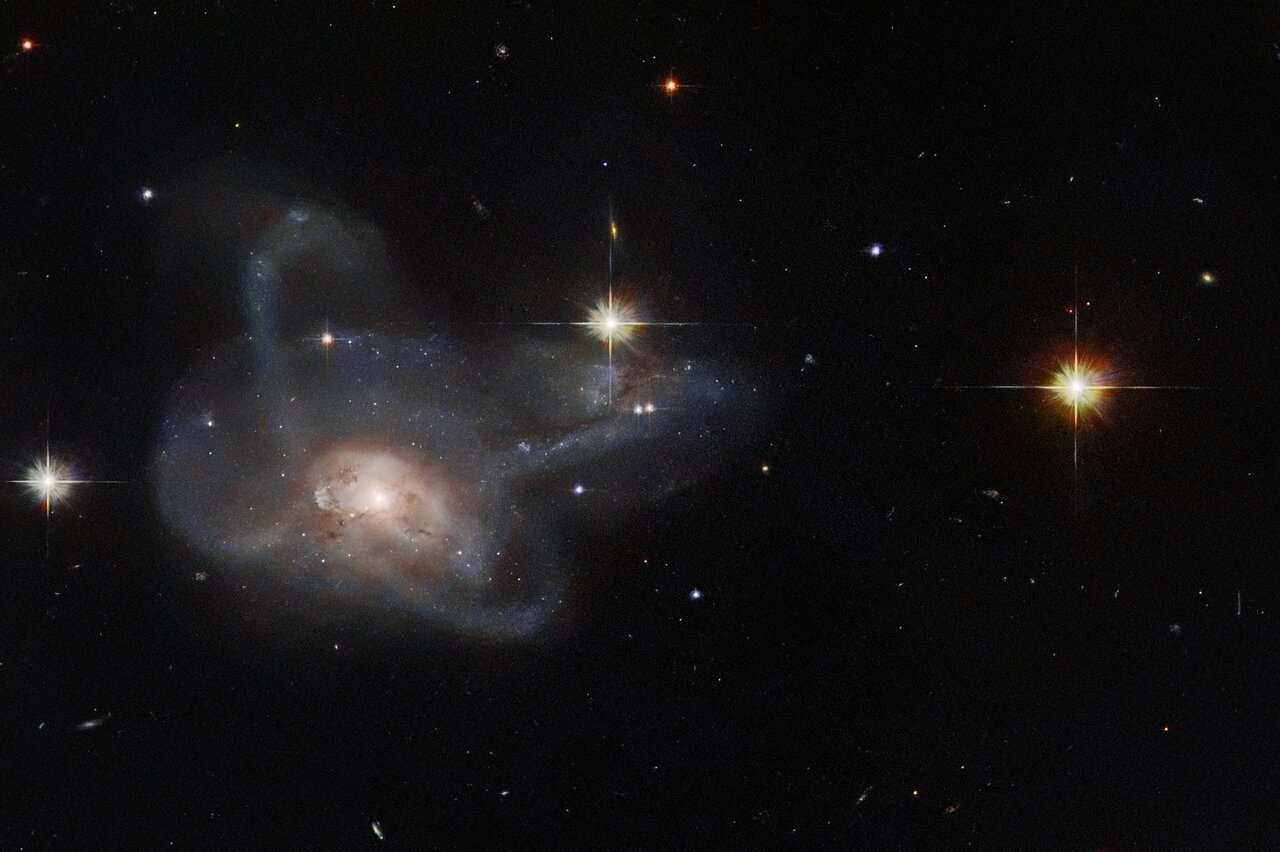
The galaxy NGC 4486B appears calm and collected, but its center may have been roiled by a recent merger of supermassive black holes. New modeling explores the stellar dynamics that support this hypothesis.
Strange Center
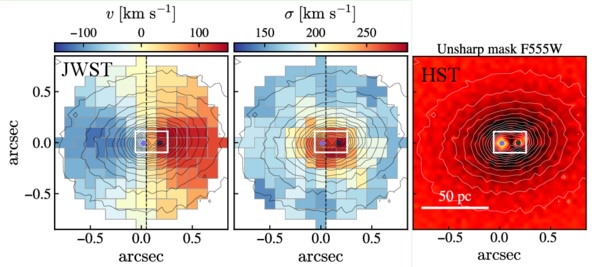
Kinematic maps of NGC 4486B showing the locations of the two peaks of its double nucleus. Click to enlarge. [Adapted from Tahmasebzadeh et al. 2026]
Now, a team led by Behzad Tahmasebzadeh (University of Michigan; Villanova University) has investigated the possibility that NGC 4486B’s double nucleus and off-center black hole can be traced to the aftermath of a supermassive black hole merger.
Simulating Kinematics
In this scenario, the black hole is displaced from the galaxy’s center because of a “kick” it received when it underwent a merger. The double nucleus is a sign of an eccentric nuclear disk: a central disk of stars on aligned elliptical orbits created when merging supermassive black holes disturb an initially orderly disk of stars.
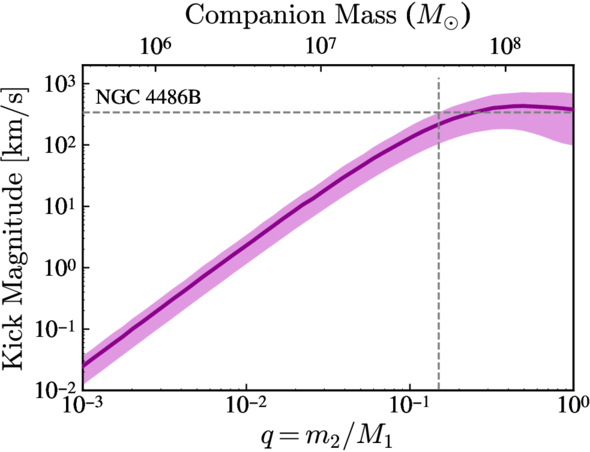
Estimated black hole kick magnitude as a function of the initial mass ratio of the black hole binary. Click to enlarge. [Tahmasebzadeh et al. 2026]
To explore this scenario further, the team carried out N-body simulations of the post-merger black hole’s behavior. These simulations showed that after being booted from the galactic center by the post-merger kick, the black hole returns to the center quickly — within 10–80 million years, depending on the kick strength. Because NGC 4486B’s supermassive black hole is notably off center, this suggests that the merger occurred recently.
Galaxy Merger Versus Black Hole Merger
Tahmasebzadeh’s team tested two other theories that could explain the appearance of NGC 4486B’s nucleus: dynamical buoyancy and a pre-merger supermassive black hole binary. Neither of these scenarios could reproduce the offsets seen in the center of the galaxy.
The team noted that NGC 4486B appears to be in equilibrium, with no sign of a recent merger that could have plunked a second supermassive black hole into the galaxy. How can this fact be reconciled with the evidence for a recent black hole merger? Turning again to simulations, the team found that if the black hole binary’s orbit was aligned with the galaxy’s rotation, the binary could have become trapped in a resonance that greatly delayed the merger of the black holes. This makes it possible that NGC 4486B underwent a galaxy merger in the distant past, but its central black hole merged only recently, leaving signs of a long-ago merger that has otherwise faded from view.
Citation
“JWST Observations of the Double Nucleus in NGC 4486B: Possible Evidence for a Recent Binary SMBH Merger and Recoil,” Behzad Tahmasebzadeh et al 2026 ApJL 1001 L14. doi:10.3847/2041-8213/ae52ef