

Many galaxies, including our own, have a central supermassive black hole. In certain galaxies, gas becomes ensnared in the black hole’s gravitational pull and collects in a disk that feeds the black hole, forming an active galactic nucleus (AGN). An AGN can feast on this disk of gas and dust for millions to billions of years — glowing across the electromagnetic spectrum, brandishing relativistic jets, and creating a brilliant, variable light show visible from billions of light-years away.
Today’s Monthly Roundup investigates the connection between AGNs and neutrinos, considers the question of AGN variability, and explores modeling techniques for relativistic environments.
A Search for Neutrinos from X-Ray-Bright AGNs
Where do neutrinos — neutral, nearly massless elementary particles — come from? AGNs have emerged as one likely source; in 2022, the IceCube collaboration reported evidence for neutrinos from the nearby galaxy Messier 77, which hosts an X-ray-bright AGN, and earlier observations potentially linked a neutrino to the blazar TXS 0506+056.
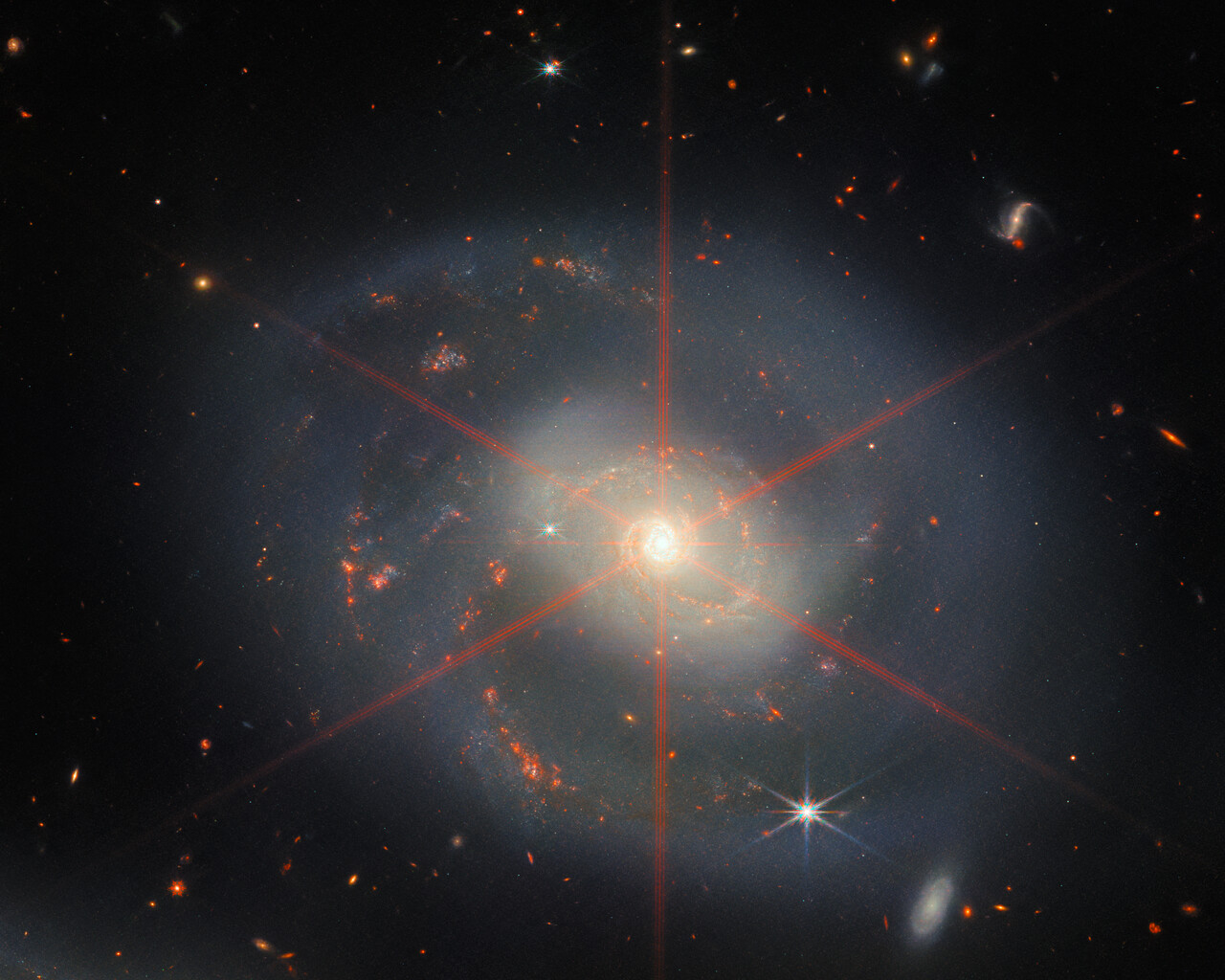
The spiral galaxy NGC 7469, shown here in this JWST image, contains an AGN that may be a source of neutrinos. [ESA/Webb, NASA & CSA, L. Armus, A. S. Evans; CC BY 4.0]
This result suggests that X-ray-bright AGNs are indeed a plausible source of neutrinos. As for the specific physical origin of these AGN-generated neutrinos, the data provide a few clues. The X-ray emission of an AGN is thought to arise from a billion-degree cloud of plasma called the corona. The interaction of coronal X-rays with high-energy protons is thought to produce neutrinos in the energy range of 1–10 teraelectronvolts — roughly the energies of the neutrinos associated with Messier 77 in this study. However, NGC 7469 was associated with neutrinos more energetic than this range, suggesting that not all AGN-produced neutrinos have a coronal origin. Thus, though the body of evidence suggesting that X-ray-bright AGN are a source of neutrinos, the precise mechanism through which these neutrinos are produced remains unknown.
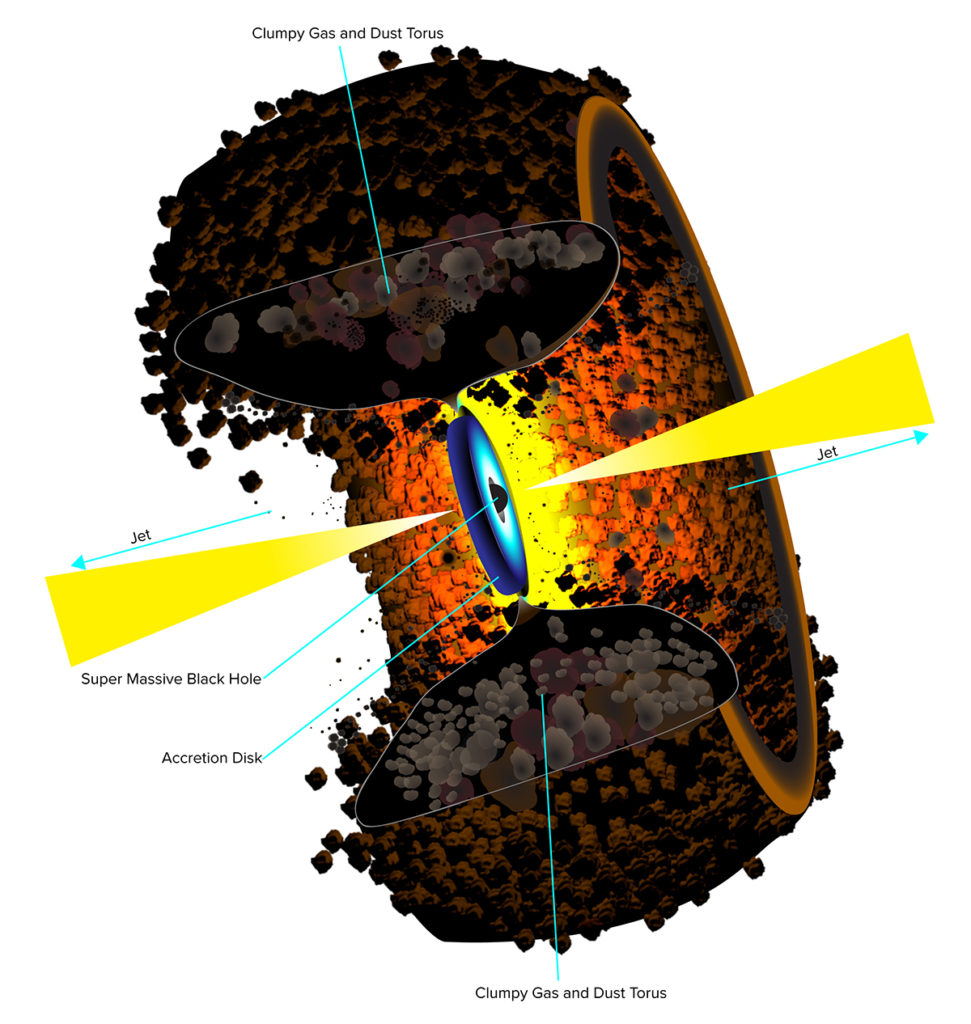
A diagram of the unified model of active galactic nuclei, showing an accretion disk, dusty torus, and jets. Click to enlarge. [B. Saxton NRAO/AUI/NSF; CC BY 4.0]
Disk or Jet: Which Varies More?
If there’s one constant when it comes to AGNs, it’s change; observations show that the emission from active galaxies varies on timescales from minutes to decades. Though both the accretion disk and the jet contribute to the overall multiwavelength behavior of an AGN, it’s not yet clear which of these structures is a greater contributor to an AGN’s variability.
Vineet Ojha (Peking University) and coauthors considered AGN variability at optical and mid-infrared wavelengths. Ojha’s team collected a sample of AGN that lie at similar redshifts and fall into one of three categories: narrow-line Seyfert 1 galaxies detected in gamma rays, narrow-line Seyfert 1 galaxies not detected in gamma rays, and broad-line Seyfert 1 galaxies detected in gamma rays. These three classes are distinguished by the presence or absence of relativistic jets as well as their accretion rate; gamma-ray-detected Seyfert 1s likely host jets, and narrow-line Seyfert 1s likely have higher accretion rates than broad-line Seyfert 1s.
Using optical data from the Zwicky Transient Facility and mid-infrared data from the Wide-field Infrared Survey Explorer, the team separated statistical wiggles from true variability and determined which sample of AGNs was most variable. They found that broad-line AGNs detected in gamma rays are the most variable, suggesting that jets are major contributors to AGN variability. Narrow-line AGNs detected in gamma rays are next in line, likely because these AGNs have jets but also have a strong thermal emission component from their accretion disks due to their high rate of accretion. Narrow-line AGNs not detected in gamma rays are the least variable, lacking a jet and dominated by thermal emission. Taken together, these results suggest that AGN variability is mostly jet driven, with some contribution from accretion disk instabilities.
More on AGN Jets: The Slow-Light Effect
The galaxy Messier 87 (M87) hosts one of the most studied AGN jets. M87’s jet is visibly structured, and it exhibits superluminal motion, in which the relativistic plasma appears to move faster than the speed of light. Because the plasma accelerated by an AGN moves so quickly, researchers attempting to model this plasma may opt to use the slow-light approach, in which the evolution of the ambient plasma is modeled simultaneously with the propagation of light through the medium. Though more computationally intensive than the fast-light approach, in which photons zip through a static medium, slow-light techniques are needed in regions of relativistic flows or strong acceleration.
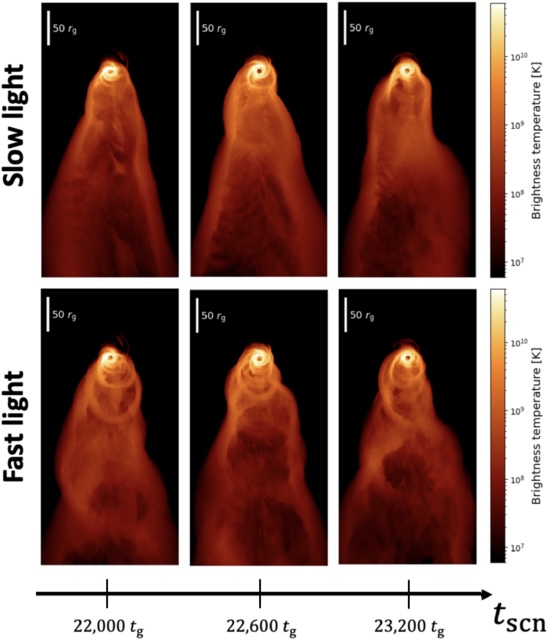
Comparison of the jet morphology from the slow-light (top row) and fast-light (bottom row) methods. [Adapted from Tsunetoe et al. 2026]
The team found that slow-light images tended to be smoother, lacking the looping, helical structures within the jet seen in fast-light images. Slow-light images show more evidence for the superluminal motion that is observed in relativistic jets like M87’s, as well as greater limb brightening and less wobbling motion. The team also investigated the effects of changing the black hole spin, finding greater wobbling in the jet for slow black hole spins and a straighter, wider jet for rapid black hole spins. Overall, Tsunetoe and coauthors found that the slow-light approach generated images that are more consistent with the properties of M87’s jet, demonstrating that the slow-light approach is necessary to capture the behavior of relativistic jets.
Citation
“Evidence for Neutrino Emission from X-Ray-Bright Active Galactic Nuclei with IceCube,” R. Abbasi et al 2026 ApJL 1000 L26. doi:10.3847/2041-8213/ae4aad
“The Relative Contributions of Accretion Disk Versus Jet to the Optical and Mid-Infrared Variability of Seyfert Galaxies,” Vineet Ojha et al 2025 ApJ 994 84. doi:10.3847/1538-4357/ae0a38
“Slow-Light Effect in the Jet-Launching Region of M87,” Yuh Tsunetoe et al 2026 ApJ 1000 29. doi:10.3847/1538-4357/ae43e7