
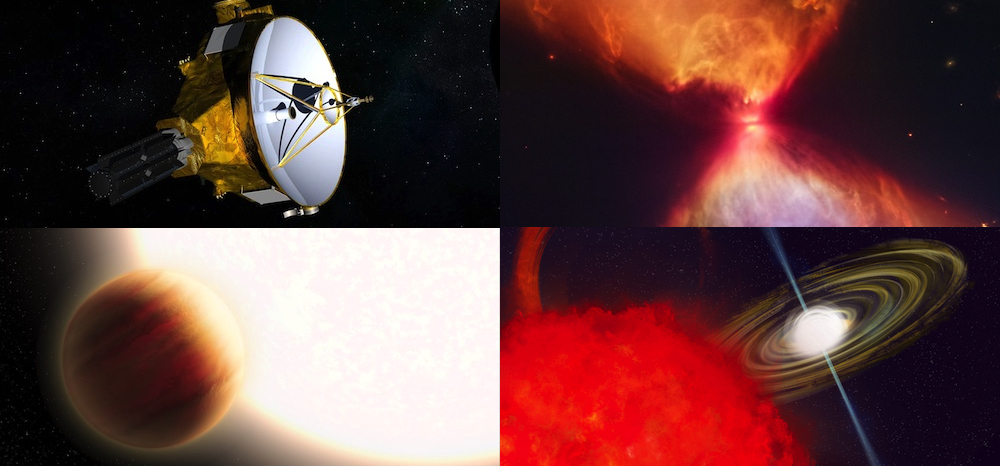
There’s been a lot of astronomy in the news lately! Many recent news stories have featured research published in the AAS journals, so today we’re taking a look at four research articles that have recently gotten attention from the media.
New Horizons Navigates by the Stars
Starting closest to home, the first article describes a technological demonstration that took place on the edge of our solar system. In the nearly 20 years since its launch, the New Horizons spacecraft has ventured from Cape Canaveral to its current berth in the Kuiper Belt, roughly 61 au (5.7 billion miles or 9.1 billion kilometers) from Earth. In that time, New Horizons became the first spacecraft to venture close to Pluto and its moons as well as a second Kuiper Belt object called Arrokoth.
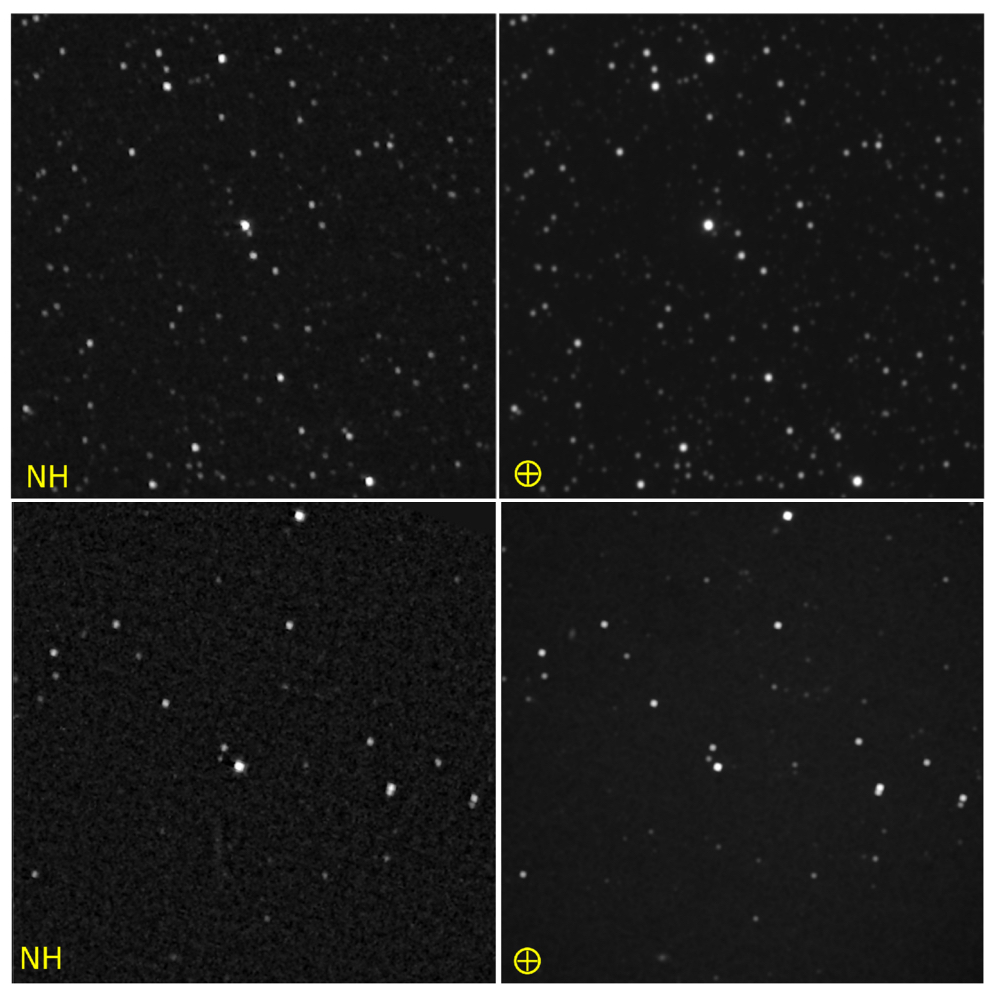
The difference in the position of Proxima Centauri (top row) and Wolf 359 (bottom row) as seen from New Horizons (left column) and Earth (right column) is evident by eye. [Adapted from Lauer et al. 2025]
From the apparent shift in position of the two stars, the team determined the location of the spacecraft in space as well as the error in their measurement. They were able to ascertain the position of the spacecraft to within 0.44 au of its true position.
Though this measurement is far less accurate than localization with the Deep Space Network, it’s still an important step toward understanding the future prospects for autonomous spacecraft navigation via the stars. Looking ahead to future interstellar navigation systems, the team showed that measurements of a few nearby stars (Proxima Centauri and Barnard’s Star are the best bets for journeys within tens of thousands of astronomical units of the Sun) are more useful than measurements of a larger number of more distant stars. Basing measurements on a larger number of images to cut down on random scatter in the position of the star would also improve the results, as would simply using newer instruments. Ultimately, other types of navigation systems, such as those based on measurements of pulsars, are more likely to reach the precision necessary for autonomous spacecraft navigation. However, this method remains interesting, given that the straightforward nature of the imaging and analysis is already well within the capabilities of modern spacecraft systems.
First Detection of Semiheavy Water Ice Around a Low-Mass Protostar
Next up is a discovery from 457 light-years away in the Taurus molecular cloud. With a mass of 0.3–0.5 solar mass, a disk spanning 75–125 au, and a surrounding envelope of 0.9 solar mass, the isolated low-mass protostar L1527 is likely to grow into a star of similar mass to the Sun. That makes it an excellent target for investigating how planetary systems like our own acquire critical molecules like water.
Katerina Slavicinska (Leiden Observatory) and coauthors used JWST to search L1527 for semiheavy water (HDO) — a water molecule in which one of the hydrogen atoms is replaced with a deuterium atom. HDO has been detected in many locations throughout our solar system, including in Earth’s oceans, and water in our solar system tends to contain a high abundance of HDO molecules. A high deuterium abundance can be linked to formation in a cold environment, suggesting that our solar system’s water may have formed in the icy clouds out of which the Sun and the planets were born.
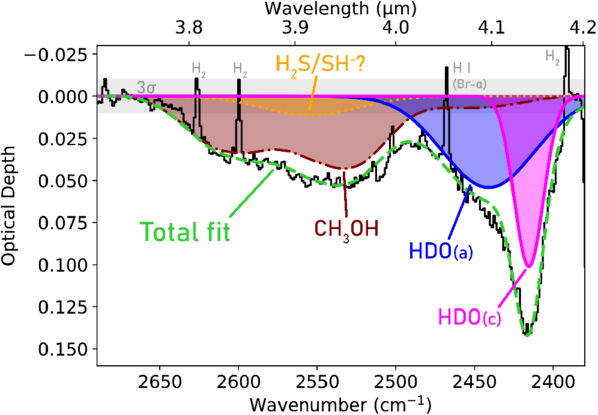
JWST spectrum of L1527. [Slavicinska et al. 2025]
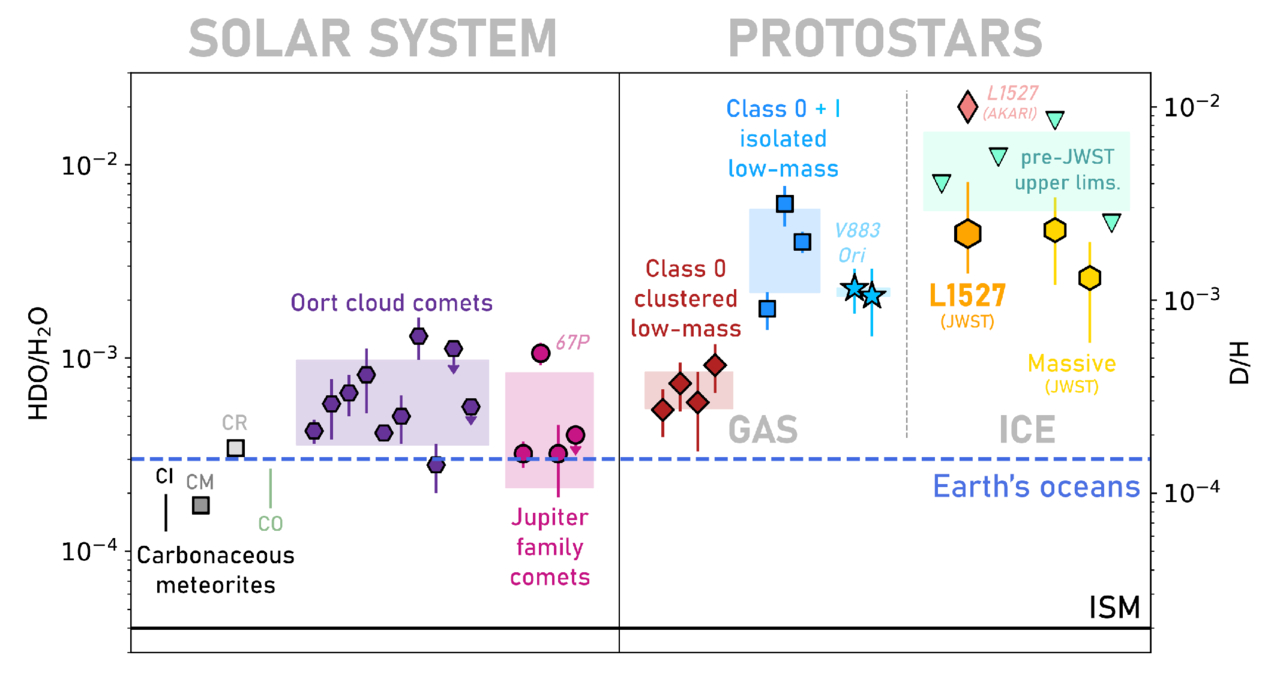
HDO/H2O ratios for various solar system objects and protostars. Click to enlarge. [Slavicinska et al. 2025]
This study demonstrates JWST’s ability to investigate the chemistry of young stars and probe the chemical evolution of protostars and planetary systems. Slavicinska and coauthors identified two important next steps to advance our understanding of the chemistry of star- and planet-forming environments: 1) measuring gas-phase and ice-phase HDO/H2O ratios in the same object to understand how gas-phase chemistry alters water around protostars and 2) measuring the HDO/H2O ratios of larger samples of isolated and clustered protostars in order to understand the impact of environmental factors.
A Massive Planet Approaches Its Doom
TOI-2109b is an ultra-hot Jupiter exoplanet that orbits its host star every 16 hours, giving it the shortest period of any known hot Jupiter. Orbiting its host star so closely, TOI-2109b is susceptible to powerful tidal forces that can lead to an exchange of angular momentum between the planet and its home star, potentially causing the planet to spiral inward and be engulfed by its star.
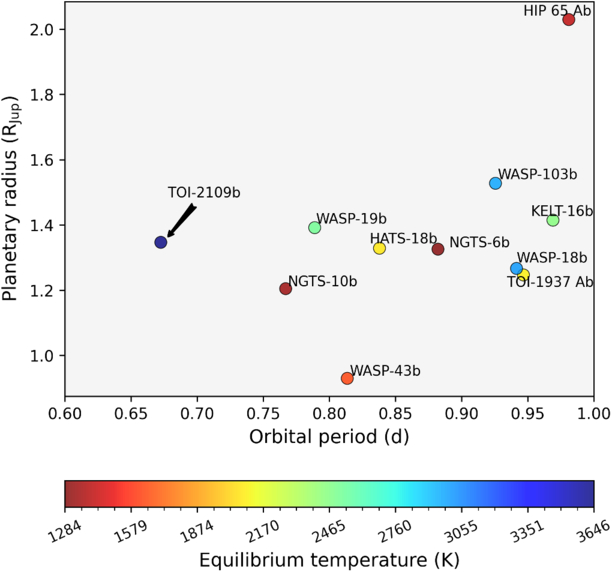
Comparison of the orbital period, temperature, and radius of TOI-2109b to other ultra-short-period Jupiters. [Alvarado-Montes et al. 2025]
Alvarado-Montes and coauthors used data from the Transiting Exoplanet Survey Satellite (TESS), the CHaracterising ExOPlanet Satellite (CHEOPS), and multiple ground-based telescopes to constrain the rate of change of TOI-2109b’s orbital period. Taking into account changes in transit timing due to an outer planet candidate in the system, deviations from spherical symmetry, and other factors, the authors find a likely orbital decay rate of just 2.6 milliseconds per year. This is consistent with the rate predicted for a “young” host star, and it’s expected to shift TOI-2109b’s mid-transit time by a few seconds over a three-year period. This change is potentially detectable with high-cadence observations, helping to understand not just the fate of TOI-2109b, but of ultra-short-period planets as a whole.
Discovery of a Mysterious Long-Period Transient
Finally, Fengqiu Adam Dong (National Radio Astronomy Observatory; Green Bank Observatory) and coauthors recently described their discovery of an unusual long-period transient radio signal. Long-period radio transients exhibit signals that repeat with periods ranging from 10 seconds to multiple hours. While the exact origin of these signals remains unknown, researchers suspect that magnetic white dwarfs and neutron stars are the cause, with the two sources perhaps representing different classes under the long-period radio transient umbrella.
The signal was detected by the Canadian Hydrogen Intensity Mapping Experiment (CHIME) radio telescope, which was searching for bursts of radio emission from pulsars within our galaxy. The newly discovered radio signal, which comes from a source named CHIME J1634+44, has a primary period of 841 seconds and a secondary period of 4,206 seconds, making it decidedly un-pulsar-like. Dong’s team performed follow-up observations of CHIME J1634+44 with the Very Large Array, the Neil Gehrels Swift Observatory, and the Green Bank Telescope. The Very Large Array and the Green Bank Telescope each detected two bursts from the source, bringing the total number of bursts reported in this study to 89.
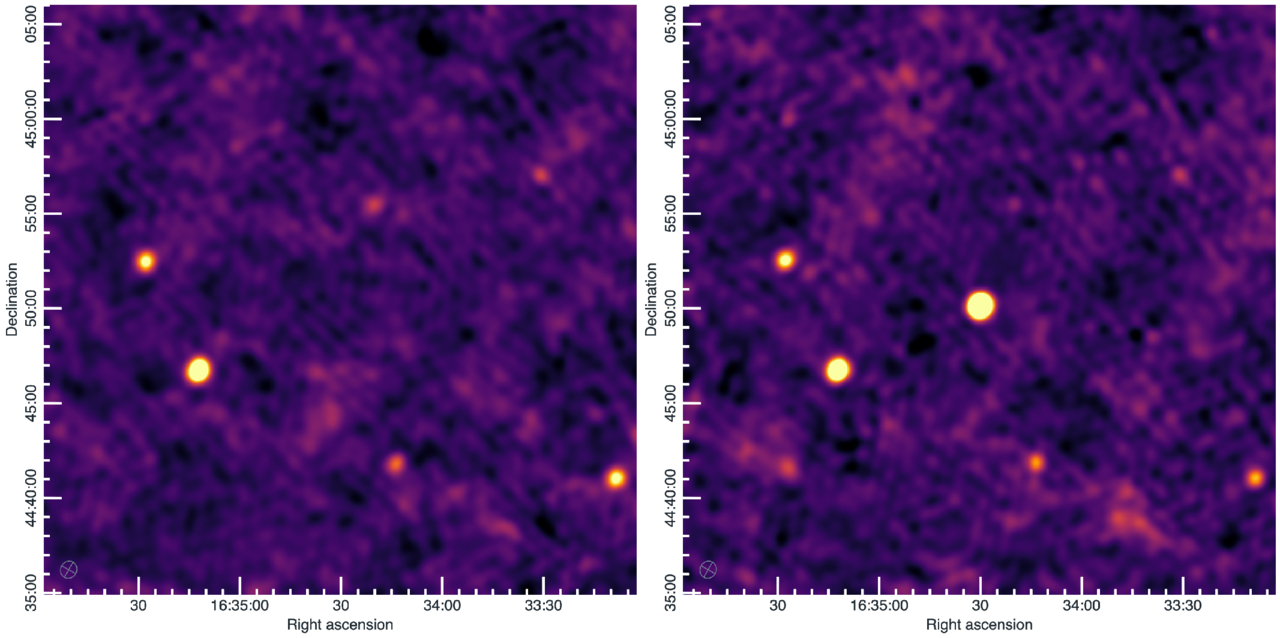
Continuum images of CHIME J1634+44 from the Very Large Array. The two panels show the autocorrelation function of the left-hand (left) and right-hand (right) circularly polarized components of the signal. CHIME J1634+44 is only detected in one of these two images, which suggests a 100% circularly polarized signal. [Dong et al. 2025]
What kind of object could produce this signal? Dong and coauthors considered binary systems containing either a white dwarf or a neutron star. Neither scenario perfectly fits the available evidence, but the team concluded that a binary system containing a neutron star is the likeliest source of the long-period, highly polarized, steadily accelerating pulses of CHIME J1634+44. The strongest evidence in favor of this scenario is that neutron stars are known to exhibit strongly polarized pulses of similar luminosity to those from CHIME J1634+44. Dong’s team expects that CHIME J1634+44 will remain an important test of theories of long-period radio transients — and as new information emerges about its identity, CHIME J1634+44 might just find its way into the news again!
Citation
“A Demonstration of Interstellar Navigation Using New Horizons,” Tod R. Lauer et al 2025 AJ 170 22. doi:10.3847/1538-3881/addabe
“HDO Ice Detected Toward an Isolated Low-Mass Protostar with JWST,” Katerina Slavicinska et al 2025 ApJL 986 L19. doi:10.3847/2041-8213/addb45
“Orbital Decay of the Ultra-Hot Jupiter TOI-2109b: Tidal Constraints and Transit-Timing Analysis,” Jaime A. Alvarado-Montes et al 2025 ApJ 988 66. doi:10.3847/1538-4357/ade057
“CHIME/Fast Radio Burst Discovery of an Unusual Circularly Polarized Long-Period Radio Transient with an Accelerating Spin Period,” Fengqiu Adam Dong et al 2025 ApJL 988 L29. doi:10.3847/2041-8213/adeaab