
Editor’s Note: This article was co-written by Lucas Brown and Alexia Kubas, our 2026–2027 AAS Media Fellows. We’re excited to welcome Lucas and Alexia to the team and look forward to featuring their writing on AAS Nova regularly!
Planetary nebulae mark a key evolutionary phase for low- and intermediate-mass stars, but properties of the parent star are difficult to sleuth out. Researchers have discovered an extragalactic planetary nebula in the center of a star cluster, offering an unprecedented opportunity to trace planetary nebula properties to parent star stats.
The Puzzle of Planetary Nebula Progenitors
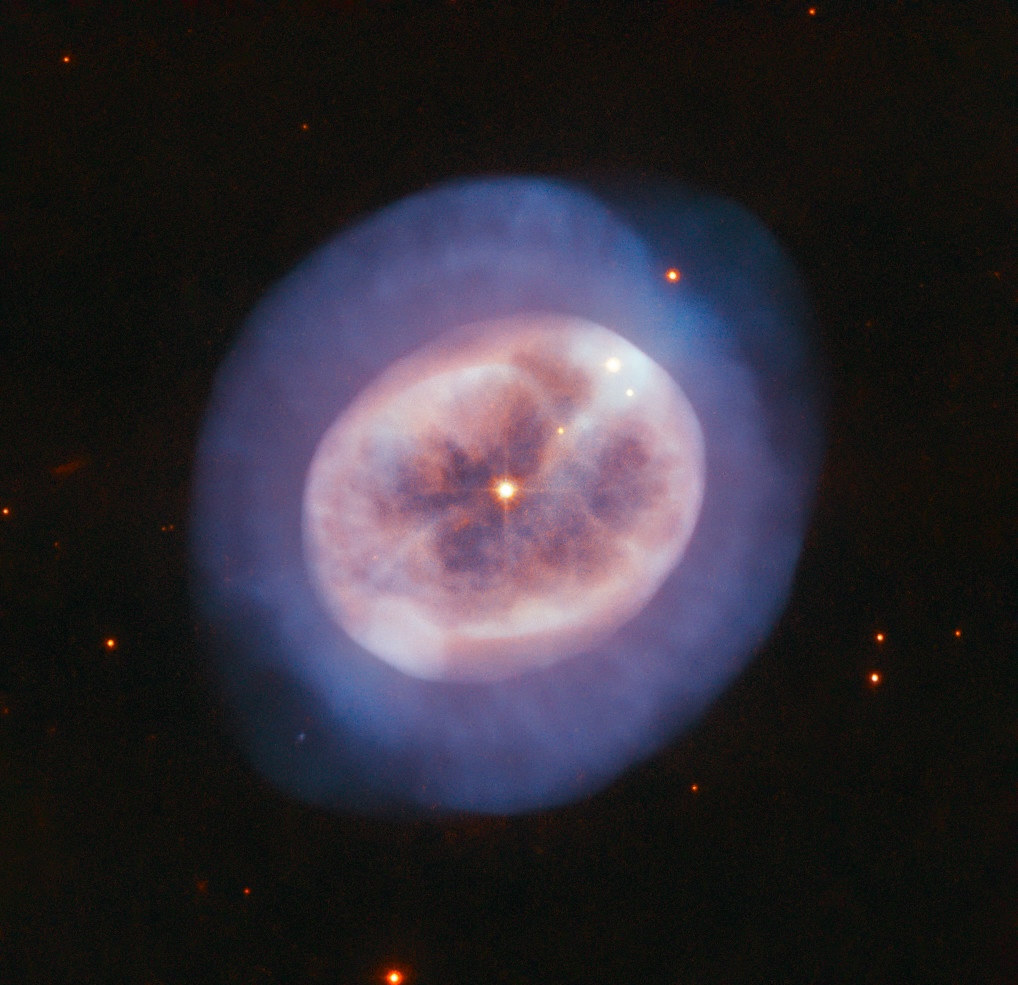
A planetary nebula, so named because the first ones discovered resemble the planet Uranus in a small telescope, forms when a Sun-like star runs out of fuel and sheds its outer layers, leaving a hot remnant core enveloped in a gaseous nebula. At higher masses, a different process kicks in: stellar cores can collapse to produce a chaotic burst of stellar material called a supernova. Where exactly the boundary should be placed between planetary nebula progenitors and supernova-forming stars remains an outstanding question in the field of stellar evolution.
Answering this question is challenging because once a planetary nebula becomes visible, the progenitor star’s transition into a hot, compact white dwarf is already underway, making it difficult to determine the star’s initial mass. For this task, researchers seek out planetary nebulae within open clusters — groups of stars that were born from the same molecular cloud and are roughly the same age — so that cluster characteristics can help piece together the progenitor puzzle. Since open clusters tend to be relatively young, they are also a great tool to probe planetary nebulae from more massive progenitors and explore the boundary between stars that produce planetary nebulae and those that go supernova.
Striking Gold
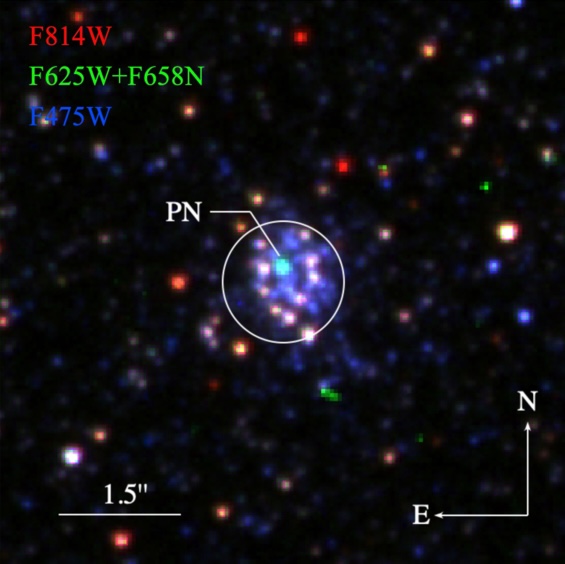
Open cluster AP 210 and planetary nebula M279 in the Andromeda Galaxy, as seen in archival Hubble observations. Click to enlarge. [Chen et al. 2026]
To make this identification, Chen’s team used archival Hubble Space Telescope and MMT data to examine the location of the planetary nebula candidate M279 within the Andromeda Galaxy. The researchers’ critical observation was that the nebula not only overlaps with the position of an open star cluster called AP 210, but it also has an estimated velocity that matches the velocity of other stars in the cluster. These associations, when combined, provide strong evidence that M279 originated within the cluster.
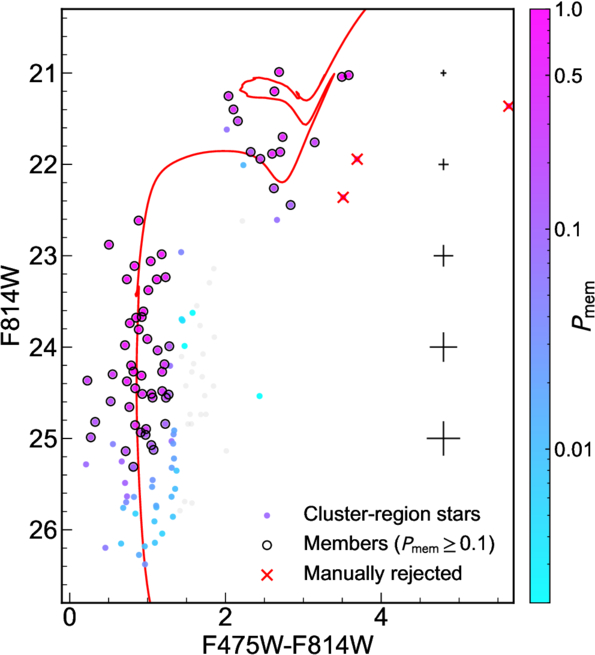
Color–magnitude diagram of stars in the open cluster AP 210. Colored dots represent stars, and the red line is the best-fitting isochrone, which was used to determine the cluster’s age. Click to enlarge. [Chen et al. 2026]
What’s My (Cluster) Age Again?
M279’s cluster origin has significant consequences for pinning down the properties of the progenitor star. First, stars in open clusters all form at roughly the same time — 90 million years ago in the case of AP 210 — allowing the authors to set a tight constraint on the progenitor’s age. Then, because the rate at which a star burns through its nuclear fuel and generates a planetary nebula is related to its initial mass, the researchers are able to connect this age to a specific progenitor mass of around 5.7 solar masses.
The team also subtracted the central star’s contribution from the observed spectrum to isolate the nebula’s composition, illuminating specific nuclear processes relevant to higher-mass stars. Planetary nebulae are cosmic cocktails whose chemical abundances trace the composition of the interstellar medium when the progenitor formed as well as elements formed via nucleosynthesis inside the star during its lifetime. Chen and collaborators found the nebula to be significantly nitrogen-enhanced, which is consistent with a massive asymptotic giant branch progenitor undergoing hot bottom burning that converts carbon to nitrogen. This newly minted metal would then be mixed back into the star’s outer layers, flooding the resultant nebula with its particular spectral signature.
While this work represents only a single observation of a high-progenitor-mass planetary nebula — and only the third compelling extragalactic planetary nebula–open cluster pair — it opens up the possibility that there may be many more waiting to be found, unlocking new insight into the lives of massive stars.
Citation
“A Planetary Nebula from a 5.7 M⊙ Progenitor in a 90 Myr M31 Star Cluster,” Pinjian Chen et al 2026 ApJL 1005 L2. doi:10.3847/2041-8213/ae77e4